
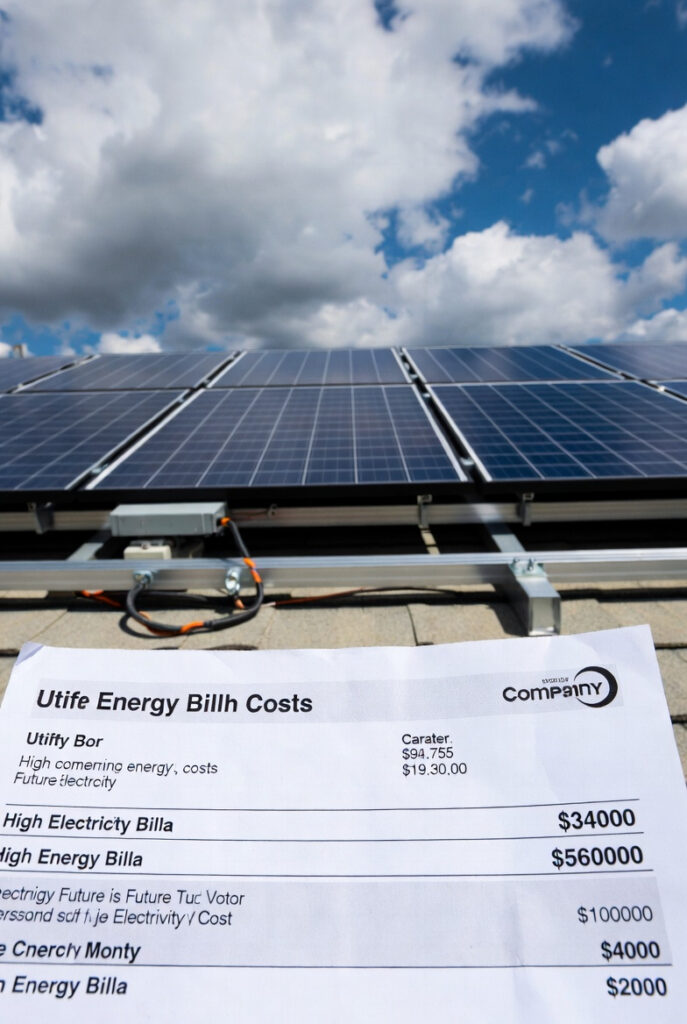
Is off-grid solar worth it? If you are looking for a get-rich-quick scheme no. If you are looking for energy freedom in a world of rising utility costs and increasing grid failures absolutely. Here is the math.
Think of it like pre-paying your fuel for the next 20 years. If someone offered to lock in gas at $0.80 per litre for the next two decades would you take it? That is essentially what a quality solar system does for your electricity costs one upfront payment followed by 20+ years of free power.
Is Off-Grid Solar Worth It? The Two Returns
There are two types of return on a solar investment. Hard ROI the measurable financial return. Soft ROI the value that does not show up on a spreadsheet but matters enormously when the grid fails for four days in January. Both are real. Both factor into the decision.
The Hard ROI: The Math That Matters
The Ontario electricity cost baseline: Ontario hydro rates range from $0.12–$0.22/kWh depending on time of use. The average Ontario household consumes approximately 750–1,000kWh per month. At $0.15/kWh average that is $112–$150/month $1,344–$1,800 per year. Over 20 years at flat rates that is $26,880–$36,000 in electricity costs. But rates are not flat.
The rate increase reality: Ontario electricity rates have increased consistently over the past two decades. Even a conservative 2% annual increase compounds significantly. $1,500/year in electricity costs growing at 2% annually becomes approximately $2,230/year by year 20 total 20-year spend of approximately $36,500. At 4% annual increase that 20-year total reaches approximately $45,000.
The solar investment comparison: A quality mid-size off-grid or hybrid system 2–3kW of panels, 10kWh of LiFePO4 battery storage, quality MPPT controller and inverter costs approximately $8,000–$15,000 installed. That system produces free power for 25+ years.
The breakeven calculation: At $1,500/year in electricity savings a $10,000 system breaks even in approximately 6–7 years. After breakeven every year of production is pure savings. A system installed today that breaks even in 2032 produces free power until 2050 or beyond.
For a detailed payback period breakdown see our How Long Does It Take Solar Panels to Pay for Themselves? guide.
| Scenario | 10-Year Cost | 20-Year Cost |
|---|---|---|
| Grid electricity (2% annual increase) | $16,400 | $36,500 |
| Grid electricity (4% annual increase) | $18,000 | $45,000 |
| Solar system ($10,000 upfront) | $10,000 | $10,000 |
| Solar system with Canada Greener Homes Grant | $5,000–$7,500 | $5,000–$7,500 |
The numbers are clear. The question is not whether solar saves money over time. The question is whether the upfront investment fits your situation today.
Calculating Your Energy Independence Dividend
The financial return on solar is not just about electricity offset. Three additional value streams that most calculations miss:
The delivery charge reality: Ontario hydro bills include fixed delivery charges network maintenance, regulatory fees, debt retirement charges that you pay regardless of how much electricity you consume. Even if you cut consumption by 80% your delivery charges remain. A fully off-grid system eliminates the utility connection entirely no bill at all. That delivery charge savings adds $30–$60/month to your effective ROI $360–$720/year that most solar ROI calculators never include.
Opportunity cost of utility payments: Every dollar you pay Hydro One is gone permanently. Every dollar invested in solar infrastructure generates returns reduced bills, increased property value, avoided rate increases for decades. The opportunity cost of continuing to pay utility bills versus investing in your own power infrastructure compounds over time.
Property value increase: ESA-compliant solar installations increase residential property value by approximately 3–4%. On a $600,000 Ontario home that is $18,000–$24,000 in added resale value potentially exceeding the entire system cost. The requirement is ESA compliance unpermitted installations do not receive this benefit and may actually create liability.
The Soft ROI: What the Spreadsheet Cannot Capture
Four days without power in January in Ontario. Your pipes at risk. Your family cold. Your fridge contents ruined. Your generator running out of fuel.
This scenario is not hypothetical. It happens every winter somewhere in Ontario. The value of sitting in a warm lit house while the neighborhood is dark is not calculable on a spreadsheet but it is real and it is increasing in value every year.
The Ontario grid reality: Ontario’s grid is aging. EV adoption is increasing electrical demand. Climate events are increasing the frequency and duration of outages. The value of grid independence the Soft ROI is higher in 2026 than it has ever been and it will continue to increase.
For homeowners in rural Ontario, cottage country, or areas with aging distribution infrastructure the Soft ROI alone often justifies the investment before the financial math is even run.
For a full breakdown of your system options see our Grid-Tied vs Off-Grid vs Hybrid Solar guide.
The Quality Caveat
Cheap solar is never worth the investment. An inverter that fails in year 3 resets your ROI calculation to zero and adds replacement costs on top. A generic charge controller that damages your battery bank in year 2 costs you the battery investment plus the replacement battery investment.
The math only works with quality components that actually last 20–25 years:
- Tier 1 solar panels from established manufacturers
- Quality MPPT charge controllers Victron, Renogy, or equivalent
- LiFePO4 battery chemistry not AGM, not generic lithium
- Pure sine wave inverters from reputable manufacturers
The Renogy 200W Monocrystalline Panel is a quality entry point established manufacturer, published spec sheets, real warranty support.
The Should You Buy? Checklist
Solar makes financial sense if:
- You plan to stay in your home for 5+ years
- Your current electricity bill exceeds $100/month
- You have roof space or ground area with good solar access
- You are in Ontario where rates are high and rising
- You qualify for Canada Greener Homes incentives
- Grid reliability in your area is declining
Solar may not make sense if:
- You plan to move within 3 years
- Your property has significant shading with no remedy
- You are renting and cannot make permanent modifications
- Your electricity costs are unusually low
For renters and short-term situations: portable solar still delivers Soft ROI blackout protection, reduced grid dependency, and the chance to learn the system before a permanent installation.
Pro Tip: Check your eligibility for the Canada Greener Homes Grant before purchasing any solar equipment. Eligible retrofits have received up to $5,000 in federal rebates effectively a 33–50% discount on a starter system. The grant requires using approved contractors and equipment for permanent installations. Apply before purchasing not after.
The Verdict
Is off-grid solar worth it? For most Ontario homeowners who plan to stay in their homes for 5+ years yes. The financial math works. The Soft ROI of grid independence is real and increasing. Property values benefit from ESA-compliant installations. And the cost of waiting compounds every year as electricity rates rise.
The caveat: quality matters. The ROI calculation only holds for systems built with components that last 25 years. Cheap solar is not solar it is an expensive lesson.
Pre-pay your electricity now. Let the sun cover the bill for the next two decades.
Disclosure: This article contains affiliate links. If you buy through them, GridFree Guide earns a small commission at no extra cost to you.