
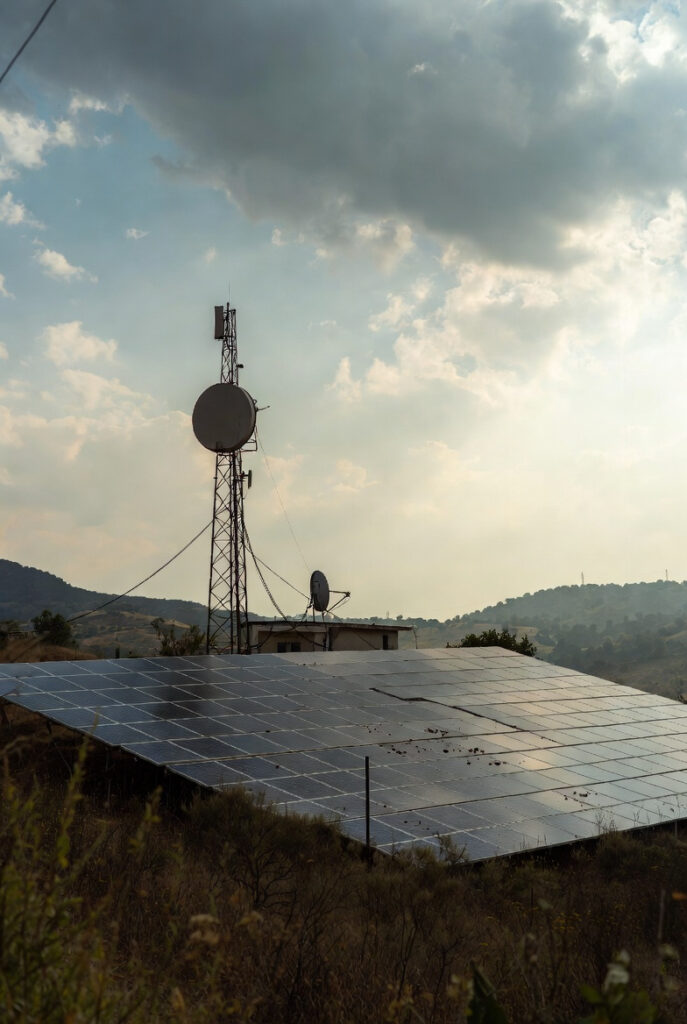
Solar repeater station failures in Ontario happen in December and they are invisible until the internet drops at 4 PM. I commissioned a point-to-point relay station on a ridge north of Guelph in October for a valley property that had no line-of-sight to any tower. The station was a Ubiquiti airFiber 5XHD drawing 13W continuously, a charge controller, and a battery monitor, 18W total continuous load including controller overhead. I sized the panel at 100W, which seemed adequate in October when the system was producing 4 to 5 peak sun hours per day. By December 15th the owner called. Internet was dropping every afternoon around 3:30 PM. I pulled the Victron monitoring data. The battery had been hitting 20% SoC daily by mid-afternoon for six consecutive days. December solar production on the ridge had averaged 1.3 peak sun hours per day. A 100W panel at 1.3 hours produces 130Wh. The 18W continuous load over 24 hours draws 432Wh. The system had a daily energy deficit of 302Wh. The battery was being depleted by early afternoon every single day. The fix was a second 100W panel and a 50Ah LFP battery upgrade. Total additional cost: $240. The internet has not dropped since. The correct sizing from the outset, which the 10:1 rule would have produced, was 200W of panels and 180Wh of storage minimum, not 100W and 100Wh. For the cold climate solar production calculation that the 10:1 rule is calibrated against for Ontario winter, Article 160 covers the December derate factors.
Why a Solar Repeater Station Fails in December: The 10:1 Sizing Rule
The 10:1 sizing rule provides the panel and battery capacity to survive a 5-day solar blackout period, which is the design standard for Great Lakes region winter reliability. For every 1W of continuous load, size 10W of panels and 100Wh of battery storage. A 13W radio requires 130W of panels and 1,300Wh of battery to survive 5 days of zero solar production. The math: 13W multiplied by 24 hours equals 312Wh per day. Five days equals 1,560Wh. With 20% battery reserve the required bank is 1,950Wh. Rounding to the nearest practical size: 200Ah at 12V equals 2,400Wh. The 130W panel at 1.3 December peak sun hours produces 169Wh per day. The deficit is 143Wh per day in the worst December week. The 2,400Wh bank covers the deficit for 16.8 days before reaching 20% reserve, well beyond the 5-day design standard. The 10:1 rule is conservative by design. It prevents the 4 PM December internet blackout. The Victron SmartShunt provides the SoC data that reveals the deficit pattern before the internet drops. For the full system sizing hub that covers the load calculation foundation, the hub covers the numbers.
| Panel Size | December Production | Days of Reserve at 18W Load |
|---|---|---|
| 100W | 130Wh | 0.4 days |
| 200W | 260Wh | 1.6 days |
| 300W | 390Wh | 2.7 days |
The PoE DC Power Path: Eliminating the Inverter from the Radio Circuit
A 12V to 48V DC-DC PoE injector eliminates the inverter from the radio power path entirely, recovering 15 to 20% of the battery bank’s daily output. A standard installation uses a 12V battery bank, a 12V inverter outputting 120V AC, and a 48V PoE adapter converting AC to 48V DC for the radio. Each conversion loses 8 to 10%. Total efficiency: approximately 80 to 84%. A DC-DC boost converter stepping 12V directly to 48V at 95% efficiency eliminates both AC conversion steps. The radio draws 13W from the battery at 95% efficiency instead of 13W at 82% efficiency. The effective battery draw drops from 15.9W to 13.7W. Over 24 hours that is 52Wh saved, the equivalent of 40 minutes of additional solar production on a December overcast day. For the DC-native Starlink POE bypass standard that uses the same DC-to-DC efficiency principle for satellite internet, Article 175 covers the full configuration.
Managing Thermal Load: NEMA 3R Enclosure on a South-Facing Ridge
I inspected a PTP relay station on a south-facing ridge near Elora in August that had been producing erratic latency spikes between noon and 4 PM every day for two weeks. The station was housed in a standard electrical enclosure with no ventilation, a metal box painted dark grey on a south-facing ridge in direct sun. I measured the enclosure interior temperature at 2 PM with a probe thermometer: 61°C. The Ubiquiti radio’s operating specification is 0 to 55°C. At 61°C the radio was in sustained thermal throttle, reducing its throughput by approximately 40% to protect the hardware. The owner had been blaming the ISP for two weeks. The fix was a NEMA 3R vented enclosure with two 40mm DC fans drawing 3W total from the battery bank, and a piece of white reflective aluminium flashing over the enclosure top. Enclosure temperature at 2 PM the following August: 38°C. Latency spikes: zero.
The NEMA 3R standard provides rain and sleet resistance with ventilation capability. The DC fan circuit: two 40mm fans drawing 1.5W each powered from the battery bank load port, thermostat set to activate above 35°C. At 3W for 6 hours of July peak heat the fans draw 18Wh per day, well within the summer surplus from a properly sized solar array. White enclosure colour or reflective flashing reduces solar heat gain by 40 to 60% compared to dark grey.
Remote Monitoring: Victron GlobalLink 520 for an Unmanned Hilltop Installation
The Victron GlobalLink 520 is an LTE-M cellular gateway transmitting battery SoC, voltage, and solar yield to the VRM portal every 15 minutes at 0.5W draw. The 5-year data plan is included in the purchase price. The monitoring value on a solar repeater station: the owner knows the battery SoC before the internet drops rather than discovering the failure when video calls freeze. Configure a VRM alert at 40% SoC, double the normal 20% threshold, because a solar repeater station serving multiple users has a higher consequence of failure than a residential system. At 40% SoC there are still 2 to 3 days of reserve before hitting the low-voltage cutoff, providing time to visit the site or diagnose remotely. The Victron Smart Battery Sense wireless temperature sensor complements the GlobalLink by providing cell temperature data to the MPPT controller, enabling automatic charge suspension if the hilltop enclosure drops below 0°C in January. For the solar remote monitoring standard that covers the full VRM alert integration including the GlobalLink 520, Article 187 covers the complete monitoring architecture.
Wind Ballast: Mounting a Panel on an Ontario Ridge
The wind load calculation for a hilltop panel mount in Ontario’s Region C wind zone requires the mount to withstand a reference wind pressure of 0.48kPa, which translates to approximately 480 Newtons per square metre of panel area. A standard 100W rigid panel at 1.0 by 0.67 metres presents 0.67 square metres of surface area. At 0.48kPa the panel experiences 322 Newtons of force in a design wind event. An unballasted lightweight tripod has a tip-over resistance of approximately 50 to 80 Newtons on a flat surface. The panel becomes airborne at approximately one-sixth of the design wind force. Proper ballast: a minimum of 90kg (200 lbs) of concrete blocks connected to the tripod feet with stainless steel threaded rod and lock nuts. Thread-locking compound on all fasteners. A properly ballasted mount survives the Ontario design wind event. An unballasted tripod does not survive the first November storm. For the battery bank winterization standard that applies to the exposed hilltop battery enclosure in northern Ontario January conditions, Article 190 covers the XPS foam and heating pad protocol.
The Solar Repeater Station System: Minimum Viable vs Full Signal Standard
The decision follows the criticality of the internet service and the severity of the installation environment.
The minimum viable solar repeater station is the correct choice for a single-radio PTP link serving one rural property in southern Ontario with a sheltered ridge location. It includes a 200W panel at 65-degree winter tilt, 100Ah LFP battery, MPPT charge controller, DC-DC PoE injector, NEMA 3R vented enclosure, and proper ballast at 90kg minimum. Capital cost runs $600 to $900. It provides 99%+ uptime for a single 13W radio load through Ontario winter without generator backup.
The full signal standard is the correct choice for a multi-radio relay station serving multiple properties or a northern Ontario ridge with exposed wind conditions and sub-minus 20°C January temperatures. It includes a 300W panel array at 65-degree tilt, 200Ah LFP bank with heated XPS enclosure, Victron GlobalLink 520 with SmartShunt for remote SoC monitoring, DC-DC PoE injector for all radio loads, NEMA 3R vented enclosure with thermostat-controlled DC fans and reflective flashing, and 150kg concrete ballast on stainless threaded rod with thread-locking compound. Capital cost runs $1,200 to $1,800. It provides commercial-grade uptime for multi-radio relay stations in exposed northern Ontario ridge locations.
NEC and CEC: What the Codes Say About Solar Repeater Stations
NEC 690 governs the PV source circuits of any solar installation including a solar repeater station regardless of the size of the array or the remoteness of the location. NEC 690.12 requires rapid shutdown capability for any array where firefighter access may be required. For a remote hilltop installation with no structure, the rapid shutdown requirement applies to the DC conductors from the array to the charge controller. NEC 725 covers the low-voltage communications wiring between the PoE injector and the radio equipment. The PoE circuit is a Class 2 circuit not subject to the full NEC 690 overcurrent requirements. The battery bank and charge controller are subject to NEC 480 for stationary battery systems and NEC 690 for the PV source circuit overcurrent protection.
In Ontario, a remote solar installation at a communications relay site is subject to CEC Section 64 for the PV source circuits regardless of whether the site has a building permit. If the relay station is on Crown land or a road allowance, a land use permit from the Ministry of Natural Resources or the local municipality may be required before installation. An ESA electrical permit is required for the solar installation if it includes fixed wiring connected to the radio equipment. A stand-alone portable solar system powering a radio through a DC-DC injector without fixed wiring does not require an ESA permit in most jurisdictions. Contact the local ESA district office for permit requirements for remote communications installation in Wellington County and Grey County.
Pro Tip: Before commissioning a hilltop solar repeater station, run the complete system on the bench for one full week with the radio connected and the battery at 50% SoC. Measure the SoC at the same time each morning for seven days. If the SoC trends downward over the week, the system is undersized for its location’s winter sun hours. Fix the sizing before you mount it on the ridge, not after a December service call.
The Verdict
A solar repeater station built to the signal standard delivers the same uptime as a commercial tower installation from a hilltop with no grid connection.
- Apply the 10:1 rule without compromise. A 13W radio needs 130W of panels and at minimum 100Ah of LFP storage. The 100W panel that worked in October fails in December. Size for the worst week of the year, not the median week.
- Use a DC-DC PoE injector instead of an inverter. The 48Wh daily saving is the difference between the system making it through a dark December week and the internet dropping at 3:30 PM.
- Set the VRM SoC alert at 40% on an unmanned installation. A residential system can tolerate a 20% warning. A relay station serving multiple users cannot. Double the alert threshold and give yourself the time to act before the signal goes dark.
In the shop, we torque the lugs before the car leaves the lift. On the ridge, we ballast the mount before the first November storm.
Questions? Drop them below.
This post contains affiliate links. If you purchase through our links, we may earn a small commission at no extra cost to you.