
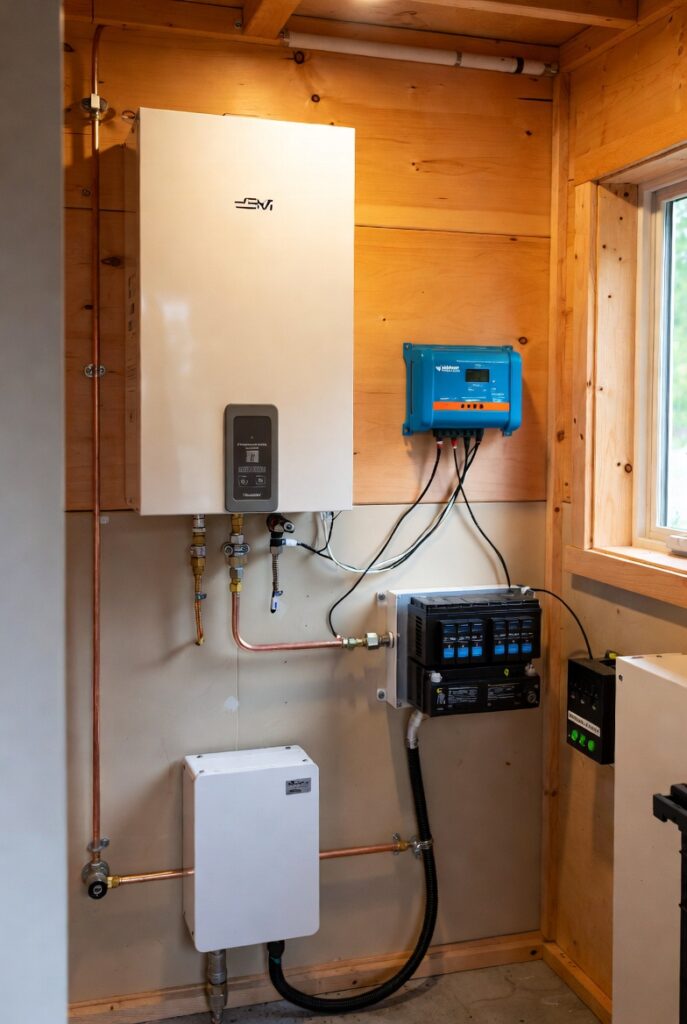
Solar propane hybrid failures are not system failures. They are a year-round off-grid home in Dufferin County where the battery bank drops from 85% SoC at sunrise to 18% SoC by 11 AM every December morning because the electric water heater, the electric range, and the electric dryer are consuming 16,250Wh of battery energy on laundry days against a December solar production of 1,600Wh. I was asked to review the energy balance at a year-round off-grid home on the 8th Sideroad of Mono Township in Dufferin County, Ontario where a couple had built a fully electric off-grid system with a 1,600W solar array, an 800Ah 48V LFP battery bank, a Victron MultiPlus-II 48/5000, a 240V 4,500W electric hot water tank, a 240V electric range with an 8,000W peak draw, and an electric clothes dryer at 5,500W. The system had commissioned in September and operated marginally through fall with 4 to 5 peak sun hours per day. By December with 2 peak sun hours the system was entering the day at 85% SoC and losing 40% SoC during the morning routine before the solar array had produced a single watt-hour.
The electric hot water tank was consuming 6,750Wh per morning heating cycle. The electric range was consuming 4,000Wh on days with oven use. The electric dryer was consuming 5,500Wh per load. The daily thermal load was 16,250Wh on laundry days against 1,600Wh of December production. The 800Ah 48V bank’s usable capacity at 50% DoD is 19,200Wh. The daily net deficit was 14,650Wh, which is 76% of the bank’s usable capacity consumed in a single winter day. The bank had reached the low-voltage disconnect every third day since mid-November and the owner had been running a 3,500W generator for 4 to 5 hours daily to prevent system shutdown. Generator fuel cost was averaging $380 per month in January.
I redesigned the thermal load allocation moving the hot water to a propane tankless water heater, the cooking to a propane range, and the clothes drying to a propane dryer vented to the outside of the utility room. The propane thermal loads consumed 20-pound propane cylinders at a rate of one cylinder per 8 to 11 days. Propane cost at the Orangeville supplier averaged $28 per 20-pound cylinder, producing a monthly propane operating cost of $76 to $105 versus the $380 per month in generator fuel. The battery bank daily draw dropped from 16,250Wh to 3,200Wh from the remaining inverter loads, refrigerator, lighting, electronics, and communications. The December solar production of 1,600Wh covered 50% of the 3,200Wh daily inverter load and the bank no longer reached the low-voltage disconnect during any winter period. Total monthly energy cost dropped from $380 in generator fuel to $105 in propane plus $18 in generator fuel, a savings of $257 per month in January alone. For the off-grid kitchen inverter sizing and simultaneous load standard that covers the same electric kitchen load management principle for off-grid residences, Article 247 covers the full specification. For the full system sizing hub that covers the load calculation foundation, the hub covers the numbers.
Why a Solar Propane Hybrid System Beats All-Electric Off-Grid
A 4,500W electric water heater element heats domestic hot water at 100% electrical-to-thermal conversion efficiency but the electrical energy itself came from solar panels at 20% conversion efficiency, a 95% battery round-trip, and a 93% inverter efficiency. The actual source-to-heat efficiency of the solar resistance heating chain is 0.20 × 0.95 × 0.93 = 17.7%. A propane tankless water heater converts propane combustion to domestic hot water at 82 to 92% efficiency. As a result for every 100 units of source energy the solar resistance heater delivers 17.7 units of heat and the propane heater delivers 87 units, a 4.9-to-1 efficiency advantage for propane in any thermal heating application.
The Victron MultiPlus-II relay output configured at 30% SoC provides the automated propane generator start signal that closes the backup handshake without owner intervention during any grey-sky period. For the solar system monitoring VRM grey-sky production deficit and automated generator alert standard that covers the same MultiPlus relay output and SoC threshold principle, Article 249 covers the full specification.
| Load Type | Correct Fuel | Source-to-Output Efficiency |
|---|---|---|
| Water heater, range, dryer — thermal output | Propane | 82 to 92% combustion efficiency |
| Refrigerator — cooling output | Solar battery | COP 1.5 to 2.5 — 150 to 250 units cooling per 100 units electrical input |
| Lighting, electronics, communications | Solar battery | Direct conversion — no combustion alternative |
The 12V DC Compressor Fridge vs Propane Absorption Refrigerator
A solar propane hybrid refrigerator decision is the one place where propane is the wrong fuel choice, and the installer who specifies a propane absorption refrigerator because it avoids DC power draw is making a fire safety and efficiency error simultaneously. I reviewed an absorption refrigerator failure at a seasonal cottage on the 6th Concession of Algonquin Highlands Township in Haliburton County, Ontario where a propane absorption refrigerator had been installed as the primary cold storage for a couple who used the cottage from May through October. The absorption refrigerator had operated normally through the first two seasons.
In the third season the cottage was closed for winter with the absorption refrigerator in the off position and the propane valve open. A spider built a nest in the burner orifice assembly during the winter, partially blocking the combustion air intake. When the owners opened the cottage in May and lit the absorption refrigerator the restricted combustion produced incomplete combustion and carbon monoxide accumulation at 380 parts per million measured by the CO detector the owners had installed the previous season. The absorption refrigerator also consumed 0.58 litres of propane per day during normal operation, producing an operating cost of $14.80 per month for refrigeration alone.
I replaced the absorption refrigerator with a 12V DC compressor refrigerator connected directly to the 12V battery bus through its own 15-amp fuse. The compressor refrigerator maintains temperature to within 1°C of setpoint regardless of whether the cottage is level, which the absorption refrigerator required for proper operation. It contains no combustion components, no burner orifice, and no carbon monoxide risk. It draws 45W average power from the 12V bus, well within the battery bank’s daily solar surplus from May through October. In 3 subsequent seasons the refrigerator maintained temperature through every summer including one with a 14-day heat wave reaching 36°C, consumed zero propane, and produced zero CO detector events. The switch saved $14.80 per month in propane and eliminated the CO risk entirely. For the solar air conditioning thermal mass and compressor COP efficiency standard that covers the same compressor refrigeration COP advantage over combustion-based cooling, Article 250 covers the full specification.
The Thermal Load Segregation Framework
The dual-fuel load segregation decision follows a single principle: if the load produces heat as its primary output, propane is almost always the correct fuel. If the load produces light, data, motion, or refrigeration as its primary output, the solar battery is the correct fuel. A 4,500W electric water heater, an 8,000W electric range, and a 5,500W electric dryer all produce heat as their primary output. Together they represent 18,000W of potential simultaneous draw that requires a MultiPlus-II 48/5000 at minimum and an 800Ah battery bank to survive a winter day.
Moving all three loads to propane reduces the simultaneous electrical draw to zero for thermal purposes and eliminates the need for the 48/5000 inverter sizing, the 800Ah bank, and the 1,600W solar array that was required to marginally sustain the all-electric system. The Victron SmartShunt logging the daily inverter load draw before and after the propane thermal load shift confirms the reduction numerically, showing the 16,250Wh daily load dropping to 3,200Wh and the battery SoC trend changing from daily depletion to daily surplus. For the generator ground bond MultiPlus relay output and AC input current limit standard that covers the same MultiPlus configuration for generator-assisted battery charging on the solar propane hybrid system, Article 245 covers the full specification.
The Energy Density Calculation: Propane vs LFP Battery Storage
A 20-pound propane tank contains 20 × 21,591 BTU per pound = 431,820 BTU of combustion energy. At 87% water heater efficiency this delivers 375,683 BTU of usable heat to domestic hot water, equivalent to 110kWh of thermal energy per tank at $28 per tank. To store 110kWh of resistance heating energy in LFP batteries at 17.7% source-to-heat efficiency requires 110 ÷ 0.177 = 621kWh of battery storage capacity. At $140 per 100Ah 12V module a Battle Born 100Ah LFP bank of 621kWh usable capacity would require 518 modules at approximately $72,500 in battery cost to store the thermal equivalent of one $28 propane tank.
As a result the cost argument for propane thermal loads in an off-grid system is not philosophical. It is a 2,589-to-1 cost ratio per unit of delivered thermal energy in favour of propane over LFP battery resistance heating. The loads that belong on the battery bank are the ones where that ratio reverses: a 12V DC compressor refrigerator achieves a COP of 1.5 to 2.5, delivering 150 to 250 units of cooling per 100 units of electrical input, which no propane combustion process can replicate. For the cold weather solar charging LFP battery efficiency and thermal storage standard that covers the same energy density principle for battery-based thermal storage decisions, Article 244 covers the full specification.
The Solar Propane Hybrid System: Minimum Viable vs Full Dual-Fuel Standard
The decision follows whether the property is seasonal or year-round, and whether thermal loads are currently consuming more than 50% of the daily battery energy budget.
The minimum viable solar propane hybrid system for a seasonal cottage with a 2-person household includes a propane tankless water heater replacing the electric element, a 12V DC compressor refrigerator on the battery bus, and a Victron MPPT 100/50 charge controller sustaining the reduced inverter load from a 400W array and 200Ah 24V LFP bank. Capital cost runs $800 to $1,400 in propane appliance hardware. It reduces the battery bank daily draw from 16,000Wh to 1,200Wh and allows the reduced solar system to sustain all inverter loads through the full Ontario summer without generator use.
The full dual-fuel hybrid standard for a year-round off-grid home with a 4-person household includes a propane tankless water heater, propane range, propane dryer, 12V DC compressor refrigerator on the battery bus, Victron MultiPlus-II with relay output configured for automated propane generator start at 30% SoC, and a Victron SmartShunt logging daily thermal versus inverter load split. Capital cost runs $3,200 to $5,400 in dual-fuel hardware. It reduces monthly operating costs by $200 to $300 compared to an all-electric system in January and eliminates the low-voltage disconnect events that occur every third winter day on an all-electric system with the same solar array size.
NEC and CEC: What the Codes Say About Solar Propane Hybrid Systems
NEC 690 governs the solar array and battery bank in any solar propane hybrid installation. NFPA 54, the Natural Fuel Gas Code, governs propane piping, appliance connections, combustion air requirements, and venting for all propane appliances including water heaters, ranges, and dryers. The Victron MultiPlus-II relay output wired to a propane generator start circuit is subject to NEC 702 for optional standby system generator interconnection. Contact the NFPA for current NFPA 54 and NEC 690 requirements applicable to solar propane hybrid installations at Ontario residential and rural properties.
In Ontario, propane appliance installations are governed by the Technical Standards and Safety Authority under the Propane Storage and Handling Code and the Gas Distribution Code. All propane appliance installations must be performed by a TSSA-licensed gas technician. The solar installation is subject to CEC Section 64 for PV source circuits and the battery bank is subject to CEC Section 26. Contact the Electrical Safety Authority Ontario and TSSA Ontario for the current permit requirements applicable to solar propane hybrid installations at Ontario residential properties before connecting any propane appliance or solar battery system.
Pro Tip: Before specifying the fuel source for any thermal load in an off-grid system, calculate the daily watt-hour draw if that load were electric and compare it to your system’s daily solar production. I have reviewed off-grid system specifications where the electric water heater alone had a daily draw that exceeded the entire solar array’s daily production in December. The property owner had specified an 800Ah bank to compensate. That 800Ah bank cost $11,200. The propane tankless water heater that eliminates the load costs $380. The propane water heater is not a compromise. It is the correct engineering decision for any thermal load that exceeds 10% of the system’s daily production during the shortest solar day of the year.
The Verdict
A solar propane hybrid system built to the dual-fuel standard means the Mono Township Dufferin County couple never watches the battery bank reach the low-voltage disconnect every third December day from a 16,250Wh daily thermal load against 1,600Wh of solar production while paying $380 per month in generator fuel to sustain what a $28 propane cylinder replaces for a week, and the Algonquin Highlands Township Haliburton County cottage owners never find 380 ppm of carbon monoxide accumulating from a spider nest in a propane absorption refrigerator burner orifice when a 12V compressor refrigerator provides the same cooling from the daily solar surplus at zero propane cost.
- Move every thermal load that produces heat as its primary output to propane before sizing the battery bank for a year-round off-grid system. The Mono Township all-electric system required an 800Ah 48V bank and a 1,600W array to marginally sustain 16,250Wh of daily thermal demand in December. Moving the thermal loads to propane reduced the daily battery draw to 3,200Wh and made the bank viable on the same array with $257 per month in January fuel savings.
- Replace every propane absorption refrigerator with a 12V DC compressor unit before the first unoccupied winter season. The Algonquin Highlands absorption refrigerator produced 380 ppm CO from a spider nest that blocked the burner orifice during one winter closure. The compressor refrigerator has no burner, no orifice, no CO risk, and no $14.80 monthly propane cost. The COP of 1.5 to 2.5 from the solar battery is the one place where electricity outperforms propane decisively.
- Configure the MultiPlus relay output for automated propane generator start at 30% SoC before the first grey-sky winter period on any year-round off-grid property. The automated handshake manages backup generation without owner intervention during multi-day grey-sky events. The Mono Township generator now runs 90 minutes on grey-sky mornings instead of 4 to 5 hours daily. That is the difference between a system that costs $257 per month less in January and one that doesn’t.
In the shop, we do not put premium fuel in a car that runs on regular and wonder why the engine is burning through it. At the off-grid home, we do not run resistance heating from solar batteries and wonder why the bank is empty by noon. Propane heats water at 87% efficiency. Solar batteries heat water at 17.7% efficiency. The correct fuel for each job is the fuel that does it best.
Frequently Asked Questions
Q: Why is running an electric water heater on solar battery power so much more expensive than propane? A: A solar resistance heating system delivers heat at approximately 17.7% source-to-heat efficiency, the product of solar panel conversion at 20%, battery round-trip at 95%, and inverter efficiency at 93%. A propane water heater delivers heat at 82 to 92% efficiency. To produce the same amount of hot water the solar resistance system requires 4.9 times more primary energy input than the propane heater. In battery terms, one 20-pound propane tank at $28 delivers the thermal equivalent of 621kWh of LFP battery storage that would cost approximately $72,500 in Battle Born 100Ah modules.
Q: Why is a 12V DC compressor refrigerator better than a propane absorption refrigerator for off-grid use? A: A propane absorption refrigerator burns approximately 0.58 litres of propane per day, produces carbon monoxide as a combustion byproduct, requires the unit to be perfectly level for proper operation, and has a burner orifice that requires annual inspection to prevent blockage from insects or debris. A 12V DC compressor refrigerator draws 45W average from the solar battery bank, contains no combustion components, operates at any angle, and requires no propane supply. The compressor refrigerator achieves a COP of 1.5 to 2.5 from electrical energy that the solar array provides during daylight hours at no incremental operating cost.
Q: How does the Victron MultiPlus relay output create an automatic propane generator start signal? A: The MultiPlus relay output is a dry-contact relay that closes when the battery SoC drops below a configurable threshold. Wiring this relay output to the remote start input of a compatible propane generator creates an automatic start signal when the battery needs charging without any owner intervention. The relay opens again when the battery SoC recovers to the configured recovery threshold, signalling the generator to shut down. This automated handshake manages backup generation during grey-sky periods on a year-round off-grid property without the owner needing to be on-site.
Questions? Drop them below.
Master Tech Advisory: This build is engineered within the 48V DC Safety Ceiling. Diagnostic logic is based on 20+ years of technical service experience. All structural and electrical installations must be verified by a Licensed Professional and comply with your Local Authority Having Jurisdiction (AHJ).
This post contains affiliate links. If you purchase through our links, we may earn a small commission at no extra cost to you.