
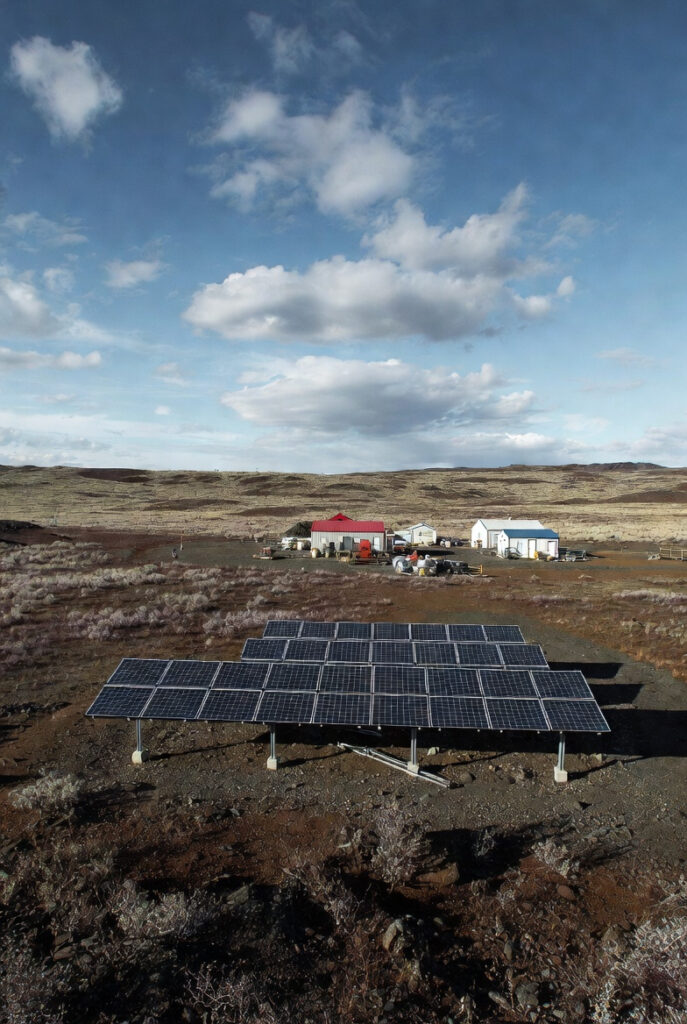
Solar power for remote mining is not a cost-saving exercise. It is a logistics survival strategy. I reviewed a diesel generator maintenance log from a diamond exploration camp in northern Ontario that had been running a 150kVA Caterpillar genset at approximately 18% average load for eight months. The camp drew 12 to 15kW for lighting, satellite, heating controls, and core processing equipment. The generator was rated for 120kW continuous. Running at 18% load for extended periods caused severe wet stacking, with unburnt fuel and carbon deposits accumulating in the exhaust system and cylinder walls. By month six the exhaust was producing visible black smoke at startup and the fuel consumption had climbed from the rated 28 litres per hour to 38 litres per hour. An additional 10 litres per hour at $3.50 per litre by helicopter delivery is $35 per hour of additional fuel cost, $840 per day, $25,200 per month just in excess fuel from wet stacking alone. The solution was not a new generator. It was a 40kW solar array with a 200kWh LFP battery bank that carried the camp baseload 18 hours per day, allowing the generator to run only during drilling operations at 70 to 85% load, the range where diesel engines run clean and efficiently. For the system sizing hub that covers the load calculation foundation this architecture scales from, the hub covers the numbers.
Why Solar Power for Remote Mining Starts With the Generator’s Maintenance Log
Generator wet stacking at loads below 30% of rated capacity is the leading cause of unplanned maintenance shutdowns on remote exploration sites. A diesel generator running at 18% load does not reach combustion chamber temperatures sufficient to fully burn the fuel and oil vapour entering the cylinder. Carbon deposits accumulate on piston rings, valve stems, and exhaust components. Fuel consumption rises, power output drops, and unplanned maintenance becomes necessary. Industry standard guidance recommends that diesel generators not be operated below 30% of rated load for extended periods.
The hybrid solution carries the baseload during daylight and battery discharge hours, allowing the generator to start only when the battery reaches a configured discharge threshold or when a high-draw drilling load is called. The generator runs at 60 to 85% load during its operating window, burns clean, and requires standard scheduled maintenance rather than emergency carbon cleaning. This distinction determines whether the generator lasts its rated 20,000-hour service life or fails at 8,000 hours from wet stacking damage. Every successful solar power for remote mining installation treats the generator as a precision load-matched power source that runs when it can operate efficiently, not as a backup device running at idle.
The Hybrid Solar-Diesel Microgrid: Operating Logic for a Mining Site
The load profile of a typical exploration camp includes a continuous baseload of 10 to 20kW covering lighting, satellite, heating controls, water treatment, and core processing equipment, plus an intermittent drill rig load of 80 to 150kW during active drilling shifts. During solar production hours the array carries the camp baseload and charges the battery bank. During battery discharge hours the bank carries the baseload without the generator running. When the battery reaches the configured discharge threshold, typically 30 to 40% SoC, or when the drill rig starts, the generator starts and runs at 60 to 85% of rated capacity. The generator never runs below 30% load. The carbon cleaning interval extends from every 500 hours to every 2,000 hours with this hybrid approach. The Victron MultiPlus-II manages the AC output stage of the skid, and the Cerbo GX handles the microgrid controller function, managing generator start-stop logic based on battery SoC thresholds and load demand automatically. For the community microgrid architecture that applies these same operating principles at community scale, Article 177 covers the island mode and load priority standard.
The Mining Solar Skid: Design Standard for a Deployable Power System
The deployment time difference between a skid-mounted system and a conventional racked installation is not marginal. I was on a site visit when a 200kWh mining solar skid arrived by flatbed. The skid was lifted off the truck by the site crane, set on compacted gravel, and the main DC busbar connection was made within 40 minutes of the truck arriving. The system was producing power before the truck had left the site. A comparable conventionally racked installation on the same site would have required a crew of four, two days of assembly, and a concrete pad that would have needed three weeks to cure. In a fly-in exploration context where every camp day costs $15,000 to $30,000 in fixed costs, a two-day installation delay is $30,000 to $60,000 in lost productive time. The skid pays for its premium in the first deployment.
The skid design requirements are non-negotiable. A hot-dip galvanised steel frame with forklift pockets at standard 1,219mm centres and certified crane lifting points rated for 150% of the loaded skid weight. NEMA 4X enclosures for all electrical components with vibration-damped mounting to isolate inverters and battery management systems from road and crane shock. All busbar connections torqued to specification and secured with thread-locking compound. Terminal blocks rated for vibration environments per IEC 60947-7-1. A connection that reads 0.1 ohm resistance at the bench will read 0.8 ohm after 200km of winter road travel if it is not properly torqued and sealed. At 200A that 0.7 ohm increase dissipates 28,000 additional watts as heat. That is a fire, not a maintenance item. For the van and mobile solar wiring standard that covers vibration-proof terminal and connection standards at smaller scale, the mobile guide covers the mechanism.
Bifacial Panels and Albedo: The Solar Power for Remote Mining Winter Advantage
Snow-covered ground reflects 70 to 90% of incident solar radiation. A bifacial panel at 0.5 to 1.5 metre mounting height above snow captures this reflected radiation from the rear glass layer and adds it to the front face production. Measured bifacial gain in northern Ontario and NWT winter conditions is 15 to 25% above monofacial production. On a 40kW array that represents 6 to 10kW of additional effective capacity at zero hardware cost. The mounting height requirement is specific: the rear surface must have clear sightlines to the reflective snow surface. Ground-mounted bifacial arrays at standard 0.6 metre minimum clearance above grade capture full albedo benefit. Roof-mounted arrays on camp buildings do not benefit from ground albedo. For solar power for remote mining in northern latitudes, ground-mounted bifacial arrays on the skid at correct clearance height are the standard. For the cold climate solar production calculation that determines total kWh available from a northern array including bifacial gain, the cold climate guide covers the Ontario and NWT derate factors.
Battery Selection: IEC 62619 and the Ruggedised LFP Standard
Standard residential rack batteries fail in mining applications because they do not meet the IEC 62619 industrial battery standard. This standard requires mechanical abuse testing for vibration, shock, and crush, environmental stress testing for temperature cycling and humidity, and electrical abuse testing beyond the residential IEC 62133 standard. A residential LFP rack battery transported over a winter road does not meet IEC 62619 and is not covered by insurance for industrial deployment. The ruggedised LFP blade cell specification requires welded terminal connections, shock-mounted cell modules, a BMS rated for operating temperatures from minus 30°C to plus 55°C, and vibration test data per IEC 60068-2-6. Sodium-ion chemistry from manufacturers including CATL is an emerging option at mining scale for cold climate applications where LFP charging restrictions below 0°C create operational complexity. For a 200kWh mining battery bank in 2026, ruggedised LFP blade cells are the current proven standard. Sodium-ion is the 2027 to 2028 watch item. For the low-frequency inverter standard that covers the transformer-core inverter requirement for high-current industrial loads, the workshop solar guide covers the mechanism.
The Solar Power for Remote Mining Skid: Minimum Viable vs Full Expedition Standard
Every solar power for remote mining decision starts with the same question: what is the site’s access logistics and how long is the program.
The minimum viable hybrid skid is the correct choice for a camp drawing 10 to 15kW baseload on a site accessible by road with a 60 to 90-day exploration program. It includes a 20kW solar array, 100kWh ruggedised LFP bank, single inverter-charger, NEMA 4X enclosure, and standard skid frame with forklift pockets. Capital cost runs $80,000 to $120,000 CAD. Fuel displacement of 12 to 15 hours per day of generator operation produces a payback at helicopter fuel prices of 80 to 120 days.
The full expedition standard is the correct choice for a fly-in camp drawing 15 to 25kW baseload with helicopter-only fuel access and a 10-month exploration program where fuel logistics are the primary operational risk. It includes a 40kW bifacial solar array, 200kWh ruggedised LFP bank with IEC 62619 certification, dual redundant inverter-chargers, NEMA 4X vibration-damped enclosures, hot-dip galvanised skid with certified crane points, and Cerbo GX microgrid controller with generator auto-start and satellite remote monitoring. Capital cost runs $180,000 to $280,000 CAD. Fuel displacement of 18 to 20 hours per day produces a payback of 100 to 160 days at helicopter fuel prices.
| System | Daily Fuel Saving | Payback Period at $3.50/L |
|---|---|---|
| Minimum Viable Skid (20kW/100kWh) | 252 to 315 litres per day | 80 to 120 days |
| Full Expedition Standard (40kW/200kWh) | 378 to 420 litres per day | 100 to 160 days |
| Diesel-only baseline | 0 litres saved | No payback |
NEC and CEC: What the Codes Say About Solar Power for Remote Mining
NEC 705 covers interconnected power production sources and applies to hybrid solar-diesel microgrids where the solar array and generator operate in parallel or in transfer. NEC 705.12 requires that the total of all power sources not exceed the busbar rating of the distribution system. For a mining skid with a 40kW solar array and a 150kVA generator, a load flow study is required to verify busbar ratings at maximum combined output. NEC 500 through 516 cover hazardous locations and apply to any electrical installation within the classified area of a fuel storage or chemical processing operation on a mine site. Solar skid enclosures must meet the appropriate hazardous location classification if the skid is sited within the classified zone of a fuel farm or explosive storage area.
In Canada, industrial solar installations including mining skids are subject to CEC Section 64 for the PV source circuits. Mining sites operating under federal jurisdiction including those on Crown land and First Nations territories may be subject to both provincial CEC requirements and federal safety standards under the Canada Labour Code. In Ontario, a mining solar skid installation requires an ESA permit if the installation is permanent or semi-permanent. Fly-in exploration camps with temporary electrical installations may qualify for exemption under CEC Rule 2-030 for temporary wiring, but the exemption does not reduce the engineering standards required for the installation. All mining electrical installations in Ontario are subject to the Ontario Occupational Health and Safety Act electrical safety requirements regardless of ESA permit status. An electrical engineer licensed in Ontario must stamp the design.
Pro Tip: Before specifying the solar array size for a mining skid, pull three months of generator run hours and fuel consumption logs from the site. If the genset is running more than 18 hours per day at loads below 35%, the wet stacking cost alone justifies the solar capital investment before you calculate a single litre of displaced fuel. The maintenance log is the business case.
The Verdict
Solar power for remote mining built to the expedition standard does not just cut fuel costs. It eliminates the diesel logistics failure mode that shuts sites down.
- Start with the generator’s maintenance log. If the genset has been running below 30% load for more than 500 hours, wet stacking damage is already occurring. The hybrid solar system fixes the operating condition, not just the fuel bill.
- Specify ruggedised LFP blade cells with IEC 62619 certification for the battery bank. A residential rack battery on a winter road is a fire waiting to happen, not a cost saving.
- Choose the minimum viable skid for road-access sites with 60 to 90-day programs. Choose the full expedition standard for fly-in sites with 6 to 10-month programs. The payback period is under 160 days at helicopter fuel prices in both cases.
In the shop, we use Loctite for a reason. On the mining skid, every connection is torqued, sealed, and tested before the truck leaves the yard.
This post contains affiliate links. If you purchase through our links, we may earn a small commission at no extra cost to you
Questions? Drop them below.