
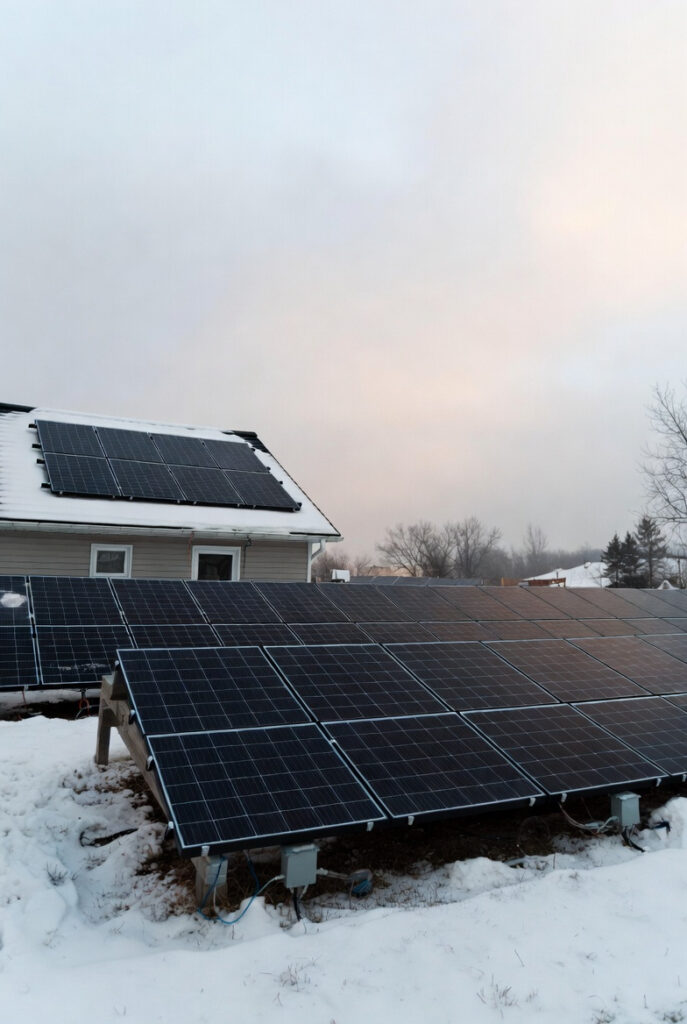
A 1200W array producing 180W at noon on a clear day. Four 300W panels wired in series one long daisy chain. Four inches of snow on the bottom edge of the lowest panel barely covering the junction box. That partial shadow drops the entire series string to near-zero. Solar panels series vs parallel is the decision that determines whether a coffee-cup worth of snow shuts down your entire array or merely reduces it by 25%. Before configuring your array understand how much solar power you actually need so you know how many panels you are wiring and in what configuration.
A client called me in February from Rockwood. His 1200W array was putting out 180W at noon on a clear day. Four 300W panels wired in series. I drove out and found 4 inches of snow on the bottom edge of the lowest panel just barely covering the junction box. That partial shadow was dropping the entire string to near-zero. I reconfigured to two strings of two panels each wired in parallel. His next morning with partial snow coverage he was producing 340W instead of 40W. Series wiring had turned a 1200W array into a system a 4-inch snow shadow could shut down completely.
Solar Panels Series vs Parallel: What Changes in Each Configuration
Series wiring – how it works: In a series string you connect the positive terminal of one panel to the negative terminal of the next positive to negative, daisy chain. Voltage adds. Current stays the same. Two 12V 10A panels in series produce 24V at 10A. Four 12V 10A panels in series produce 48V at 10A. Total wattage is identical but the electrical characteristics are completely different.
Parallel wiring – how it works: In a parallel configuration you connect all positive terminals together and all negative terminals together positive to positive, negative to negative. Current adds. Voltage stays the same. Two 12V 10A panels in parallel produce 12V at 20A. Four 12V 10A panels in parallel produce 12V at 40A. Total wattage still the same but delivered at low voltage and high current.
The wattage math that stays constant: Watts = Volts × Amps. Whether you wire four 300W panels in series (high voltage, same current) or parallel (same voltage, high current) the theoretical maximum output is 1200W. Configuration does not change the total energy available it changes how that energy is delivered and how shading affects it.
The Series Shading Penalty -The Christmas Tree Problem
Why series shading is catastrophic: In a series string the current through every panel must be identical it is the same current flowing through each panel in sequence. When one panel is shaded its current output drops. Because the series string requires identical current through every panel the entire string drops to the output of the weakest panel. A panel producing 10% of its rated output due to shading pulls the entire string to 10%.
The Ontario partial shading reality: In Rockwood in winter partial shading is not an edge case it is a daily event. Snow slides off panels unevenly. The bottom edge of a roof-mounted panel may be shaded for 2-3 hours on a cold morning. Vent pipe shadows move across panels as the sun angle changes. Tree branches cast moving shadows. With solar panels series vs parallel in a series configuration any of these partial shading events drops the entire string.
The Christmas tree failure mode: A series string of solar panels behaves exactly like old Christmas tree lights one bad bulb and the entire string goes dark. The bypass diodes in modern panels prevent complete failure from reverse-biasing but the shaded panel drops to bypass diode conduction typically 0.5V forward drop removing its voltage contribution from the string. If string voltage drops below the MPPT minimum operating voltage the controller stops charging entirely.
The Parallel Shading Advantage
Why parallel shading is manageable: In a parallel configuration each panel operates independently contributing its own current to the shared voltage bus. When one panel is shaded its current output drops but the other panels continue producing their full current. The total output drops by the fraction that the shaded panel represents not to near-zero.
The 4-inch snow example: Four 300W panels wired in parallel. One panel has 4 inches of snow on the bottom edge operating at 30% output (90W). The other three panels are clear at 100% (300W each). Total output: 90W + 300W + 300W + 300W = 990W. The same scenario in a series string: all four panels drop to 30% = 360W at best often significantly less due to bypass diode voltage losses.
The parallel current challenge: The parallel advantage comes with a cost high current. Four 300W 12V panels in parallel produce approximately 80A at 12V. Moving 80A requires very heavy wire as covered in our Wire Gauge guide 80A at any meaningful run length requires 4/0 AWG or larger. This is expensive, heavy, and difficult to route from roof to equipment room.
The 2S2P Sweet Spot – The Professional Configuration
What 2S2P means: 2S2P means 2 panels in Series, 2 strings in Parallel a hybrid configuration capturing the advantages of both methods. For a 4-panel array of 12V panels: two panels wired in series create a 24V string. Two of these 24V strings wired in parallel create a 24V array at double the current.
For a 48V Victron system – four 24V panels:
- 2 panels in series: 48V, 10A per string
- 2 strings in parallel: 48V, 20A total
- Total: matched for 48V LiFePO4 charging at manageable current
This configuration matches the Victron SmartSolar MPPT 100/50 accepts up to 100V input and 50A output ideal for a 2S2P 48V array. The wire run from roof to equipment room carries 20A manageable with 10 AWG rather than the 80A requiring 4/0 AWG in a fully parallel 12V configuration.
The shading advantage in 2S2P: If one panel in one series string is shaded that string drops but the parallel string continues producing at full output. Total output drops by approximately 50% rather than near-zero. In a Rockwood February morning with partial snow coverage 2S2P regularly outperforms series-only by 3-5x in real-world partial shading conditions.
The MPPT Minimum Voltage Rule Why Pure Parallel Often Fails
What MPPT needs to start charging: A Victron SmartSolar MPPT charge controller requires the array voltage to exceed the battery voltage by a minimum margin typically 5V before it begins charging. This is the start voltage threshold.
The 48V system problem with parallel-only: A 48V LiFePO4 battery bank charges at 54-58V. In a pure parallel configuration of 12V panels the array open circuit voltage is approximately 22V well below the 54V minimum needed. The Victron SmartSolar MPPT 100/30 will not start charging. Pure parallel wiring is fundamentally incompatible with 48V battery systems using standard 12V panels.
The series minimum: At least two 24V panels in series or four 12V panels in series are required to produce sufficient voltage for a 48V system. Always verify your series string open circuit voltage does not exceed the MPPT maximum input voltage especially on cold winter mornings when panel Voc is at its highest.
The Ontario cold morning Voc increase: Solar panel Voc increases as temperature decreases. A panel rated at 37V Voc at 25°C may produce 42-44V Voc at -20°C. A string of three such panels in series produces 126-132V at -20°C potentially exceeding a 100V MPPT input rating. Always calculate cold-weather Voc for your specific panels and string configuration before finalizing wiring.
Solar Panels Series vs Parallel — Quick Reference
| Configuration | Voltage | Current | Shading Impact | Wire Size |
|---|---|---|---|---|
| Series (4 × 12V panels) | 48V | Same as 1 panel | Catastrophic — entire string | Light — low current |
| Parallel (4 × 12V panels) | 12V | 4× single panel | Minimal — partial loss only | Heavy — very high current |
| 2S2P (4 × 12V panels) | 24V | 2× single panel | Moderate — 50% loss max | Medium — balanced |
| 2S2P (4 × 24V panels) | 48V | 2× single panel | Moderate — 50% loss max | Medium — 48V system ideal |
Pro Tip: Calculate your series string open circuit voltage at -20°C before finalizing your array configuration not at standard test conditions (25°C). Most solar panels have a voltage temperature coefficient of approximately -0.3% per °C. At -20°C (45°C colder than STC) a panel rated 37V Voc at STC produces approximately 37V × (1 + 0.003 × 45) = 42V Voc. For a string of three such panels: 3 × 42V = 126V. If your MPPT controller is rated for 100V maximum input that string will exceed it on a cold Rockwood morning and may damage the controller. Size your string for cold-weather Voc not STC Voc.
The Verdict
Solar panels series vs parallel is not a theoretical debate in Rockwood in February it is the difference between an array that produces through partial snow coverage and one that a 4-inch shadow shuts down completely.
Series: high voltage, light wire, early morning MPPT wake-up, catastrophic shading penalty. Parallel: low voltage, heavy wire, shadow-resistant, MPPT voltage compatibility issues at 48V. 2S2P: the professional balance adequate voltage for MPPT, manageable wire gauge, 50% maximum shading loss instead of near-zero.
For a 48V Victron system with Renogy 100W panels or equivalent the 2S2P configuration with a Victron SmartSolar MPPT 100/50 is the correct professional specification for Ontario winter conditions.
Disclosure: This article contains affiliate links. If you buy through them, GridFree Guide earns a small commission at no extra cost to you.
Questions? Drop them below.
Pingback: MC4 Connector Solar: Why Cheap Ones Cause Fires