
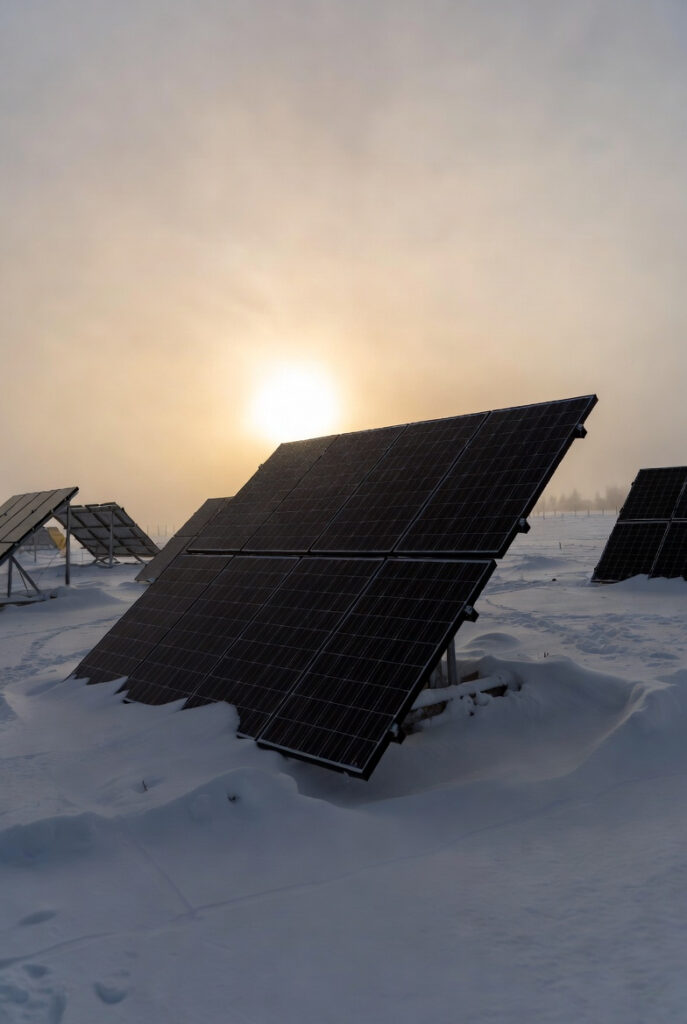
If your solar panels are tilted for the summer sun you are starving your batteries in December. Your solar panel tilt angle for winter is the difference between a charging system and a snow-covered ornament and most off-grid owners in Ontario, Minnesota, and Montana never adjust it.
Think of it like headlight aiming. If your headlights are pointed at the ground you cannot see the road ahead. If your panels are aimed at the summer sky they cannot see the winter sun. You have to aim the tool at the target.
I had our Rockwood panels fixed at 35 degrees the installer said it was fine for year-round use. First December those panels sat under 8 inches of snow for four days straight. Second winter I switched to an adjustable mount. December output went up 40%.
Solar Panel Tilt Angle for Winter: The Latitude Plus 15 Rule
Winter sun in Ontario sits only 20-25° above the horizon at solar noon. A panel tilted at 35° is nearly parallel to those rays not perpendicular to them. To capture the low winter sun properly you need to steepen the angle significantly.
The formula: Latitude + 15 degrees = optimal solar panel tilt angle for winter
Your location:
- Rockwood/Guelph at 43.6°N → winter tilt 58-60°
- Minneapolis at 44.9°N → winter tilt 60°
- Missoula Montana at 46.9°N → winter tilt 62°
- Northern Ontario (Sudbury) at 46.5°N → winter tilt 62°
The fixed compromise: If your installation cannot be adjusted seasonally set panels at your exact latitude approximately 44° for southern Ontario. This sacrifices 10-15% of winter production compared to the optimized winter angle but performs consistently year-round without adjustment.
The seasonal adjustment benefit: Adjusting twice per year recovers 15-25% more annual production compared to a fixed latitude angle. For an off-grid system in Ontario where winter production is already limited this recovery is meaningful often the difference between running on solar and running a generator.
The Cosine Effect Why Angle Matters More Than You Think
Solar panel output is directly proportional to the cosine of the angle between the sun’s rays and the panel surface. When sunlight hits perpendicular cosine of zero = 1.0 you capture 100% of available energy. As the angle becomes less perpendicular output falls.
The numbers:
- 20° off perpendicular: cos(20°) = 94% output – minor loss
- 40° off perpendicular: cos(40°) = 77% output – significant loss
- 60° off perpendicular: cos(60°) = 50% output – half your panels’ potential gone
What this means in Ontario: A fixed 35° panel on a January day in Guelph with the sun at 23° elevation may have an angle of incidence of 35–40° or more. You are operating at 77% or less of potential output — before accounting for any snow on the panels. Steepening to 60° brings the angle of incidence much closer to perpendicular and recovers that lost production.
Why Gravity Is Your Best Solar Snow Shovel
The snow shelf problem: A panel tilted at 30-35° in Ontario is a snow shelf. Snow accumulates, compacts, and stays for days. A panel under snow produces exactly zero watts regardless of how good your equipment is.
The snow slide solution: Panels tilted at 60° or steeper become snow slides. Fresh snow sheds within hours of a storm ending. Many Ontario off-grid owners report that panels at 65° never need manual snow clearing even after heavy snowfall.
The minimum for self-clearing: Panels need at least 55-60° tilt to shed snow reliably in Ontario and Minnesota conditions. Below 50° snow tends to stick and stay. Above 60° it reliably slides within hours.
The practical rule: If you cannot safely access your roof to clear snow and you should not be climbing an icy roof in January your panels must be tilted at minimum 60° for winter. Anything less and you are relying on above-freezing temperatures to clear them. In a cold January stretch that can mean days of zero production.
The Albedo Bonus – Snow as a Solar Asset
What albedo is: Albedo is the reflectivity of a surface. Fresh snow has an albedo of 0.8-0.9 it reflects 80-90% of incoming sunlight. The snow-covered ground around your panels is acting as a giant mirror.
How steep panels capture reflected light: A panel tilted at 60-65° has a significant portion of its surface facing toward the snow-covered ground. Solar radiation reflecting upward from that snow enters the panel from below adding to the direct radiation from the sky above.
The production boost: Steep panels in northern climates show albedo contribution of 5-15% additional production in winter conditions. Combined with the improved angle of incidence from proper solar panel tilt angle for winter the total production recovery can be 20-40% compared to a fixed shallow angle.
Fixed vs Adjustable Mounts
Fixed mounts: Set at installation and never changed. Typically installed at latitude angle for compromise year-round performance. Lower cost. No maintenance required. Approximately 10-15% production sacrifice in winter compared to optimized angle. Acceptable for grid-tied systems where winter shortfall is covered by utility power.
Adjustable mounts: Allow angle change 2-4 times per year. Set to 60–65° for winter. Set to 30–35° for summer. Production improvement 15-25% annually. Best suited for ground-mounted systems where access is easy and safe year-round.
The cost reality: Adjustable mount cost difference vs fixed: approximately $30-80 per panel. Over a 10-year system life that investment recovers 10-40% more winter production. For an off-grid system where winter output determines whether you run a generator the math pays back in the first season.
The Seasonal Adjustment Calendar
For Ontario, Minnesota, and Montana installations:
| Month | Tilt Angle | Sun Elevation at Noon | Priority |
|---|---|---|---|
| Dec/Jan | Latitude + 15° | 20–25° | Snow shed + winter sun |
| Feb/Mar | Latitude + 10° | 30–40° | Transition still steep |
| Apr–Sep | Latitude – 15° | 55–70° | Summer production |
| Oct/Nov | Latitude + 10° | 30–45° | Begin steepening |
The simple rule: Two adjustments per year. October 15 steep. April 15 flat. Takes less than an hour. Recovers weeks of production over the course of an Ontario winter.
Pro Tip: If you are building a new ground-mount system in Ontario or Minnesota specifically design for adjustability. The material cost difference between a fixed mount and a two-position adjustable mount is typically $30-80 per panel. Over a 10-year system life that investment recovers 10-40% of winter production hundreds of kilowatt-hours per year that would otherwise be lost. For an off-grid system where winter production determines whether you run a generator the math pays back in the first season.
The Verdict
Your solar panel tilt angle for winter in Ontario, Minnesota, and Montana is not a set-it-and-forget-it decision. The difference between a fixed 35° angle and an optimized 60° winter angle is 20-40% more production during the months when you need it most combined with panels that shed snow naturally instead of sitting dark under ice.
Latitude plus 15 degrees. Steepen by October 15. Flatten by April 15.
Two adjustments. One number. The difference between a solar system that struggles through Ontario winters and one that keeps your battery bank healthy until March.
Disclosure: This article contains affiliate links. If you buy through them, GridFree Guide earns a small commission at no extra cost to you.
Pingback: Ground Mount vs Roof Mount Solar The Northern Survival Guide