
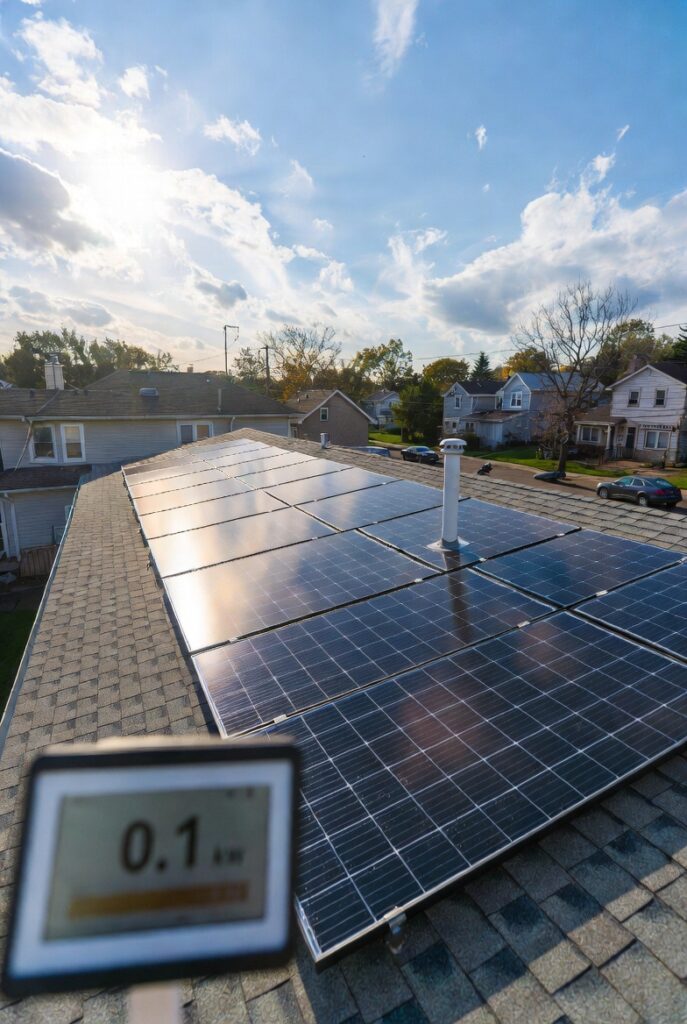
Every solar panel shading call I get from Ontario homeowners follows the same script: full sun, clear sky, and a monitoring app showing 25% of expected output from a Renogy 400W array. The homeowner is certain a panel has failed or the charge controller has faulted. Neither is true. The culprit in most cases is a shadow the size of a paperback book hitting one corner of one panel at a specific time of day. Understanding why that shadow drops the whole string, and how to stop it, is the most valuable diagnostic knowledge an Ontario solar owner can have.
In September 2025 a homeowner on Kortright Road West in Guelph, Wellington County texted me at 2:13 PM on a clear afternoon. Her monitoring app showed 287W output from a 1,200W array. Two weeks earlier the same system had been producing 900 to 1,050W at the same hour. I asked her to walk the roof line and look for anything casting a shadow.
She found it immediately: a white PVC plumbing vent stack on the east side of the roof was casting a diagonal shadow across the bottom-left corner of one panel in the first series string. The shadow was approximately 15 cm wide and covered three cells of that single panel. I explained the series string physics over the phone before I arrived. In a series-connected string all panels share the same current. The string current equals the current of the most-shaded cell. That shaded cell was producing approximately 20% of its rated output. Because the entire string had to match the weakest cell, the four-panel first string dropped from approximately 400W to approximately 80W.
The other two strings continued producing normally at approximately 95 to 100W each. Total output: 80W plus 200W equals 280W. Her monitoring app showed 287W, which matched my phone calculation within 2.5%.
The fix took twelve minutes on site. I relocated that one panel 30 cm to the right along the same roof rack, clearing the vent stack shadow path completely. After repositioning, the first string recovered to 388W at 2:05 PM and total array output climbed from 287W to 1,041W. The September monthly output increase was approximately 18.4 kWh based on that 2 PM shadow appearing from September 8th through October 22nd each year at that roof geometry. At $0.12/kWh that is $2.21 per month recovered, or $26.50 per year. Solar panel shading from one plumbing vent had been costing her the equivalent of one full panel’s entire September output.
What solar panel shading actually does to a series string in Ontario
The Kortright Road numbers reveal the core physics. The vent stack shadow covered 3 cells out of 144 total cells across the four-panel string. That is 2.1% of the total cell count. The output loss from that string was 80%. The amplification factor between shaded area and output loss was approximately 38 to 1. This is the number that surprises every beginner. Solar panel shading is not proportional in a series-connected array. A shadow on 2% of your cells does not cost 2% of your output. It can cost 80%.
| Wiring Type | Array Size | One Panel Shaded to 20% | Output Loss | Remaining Output |
|---|---|---|---|---|
| Series (4 panels) | 400W rated | Full string drops to 20% | 80% | ~80W |
| Parallel (4 panels) | 400W rated | One panel at 20%, others unaffected | 20% | ~320W |
| 2S+2P (2 series pairs in parallel) | 400W rated | One pair drops to ~50% | 25% | ~300W |
The reason the series string amplifies shade so severely is that current cannot split paths in a series circuit. Every electron must travel through every panel in sequence. When the shaded cell restricts current to 20% of normal, that restriction applies to every other panel in the string regardless of how much sun they receive. The unshaded panels are physically capable of producing full output. However, the series circuit forces them to match the shaded cell’s current. Their excess capacity has nowhere to go. This is why solar panel shading from a single chimney stack can look like a hardware failure on the monitoring app.
The solar panel shading bypass diode: how modern panels limit the damage
Bypass diodes are built into every modern solar panel. A standard 36-cell panel like the Renogy 100W divides its cells into three zones of approximately 12 cells each. Each zone has one bypass diode wired in parallel across it. When a zone is heavily shaded and its cells drop to near-zero voltage, the bypass diode activates automatically and routes current around the damaged zone. The panel loses approximately one third of its output voltage from that zone but continues producing current from the other two zones. Without bypass diodes, a shadow on a single cell could force the entire panel to near-zero output as the shaded cell acted as a resistive load against the rest of the string.
The Kortright Road shadow covered 3 cells in one of the three bypass zones. The bypass diode activated and the panel dropped from 100W to approximately 67W, preserving two-thirds of its output. However, the bypass diode only solved the within-panel problem. The panel’s reduced 67W output still limited the entire series string current, dropping the four-panel string from 400W to approximately 80W. Bypass diodes are a crucial protection mechanism for solar panel shading scenarios, but they do not eliminate series string amplification. They reduce the within-panel damage from 100% to 33%. The between-panel series string problem remains. That distinction is what the Kortright Road fix addressed by physically moving the panel out of the shadow path entirely.
Series vs parallel wiring: why your array design determines your shading risk
In a parallel-connected array each panel maintains its own voltage independently and contributes its own current to the combined output. If one panel in a four-panel parallel array is shaded to 20% output, the total array output is 20% + 100% + 100% + 100% = 80% of rated. The loss is 20%, not 80%. The unshaded panels are completely unaffected because current from each panel flows independently. The trade-off is wire sizing: parallel wiring multiplies current, requiring heavier gauge cable for the combined run to the charge controller. Four Renogy 100W panels in parallel produce 4 x 5.75A = 23A combined. Four panels in series produce 5.75A. The series run uses much thinner wire for the same power.
In October 2025 I visited a 400W ground-mount array on the 15th Sideroad in Puslinch Township, Wellington County. The owner had wired four 100W Renogy panels as one series string. A maple tree cast a morning shadow across one panel from 8 AM to 10:15 AM. Monitoring data across October showed 68W average output during that window.
After rewiring into two 2-panel series strings connected in parallel using MC4 branch connectors, the morning shade on one panel dropped only one 2-panel string from 200W to approximately 48W. The other string continued at 196W unaffected. Total morning output during the shadow window recovered from 68W to 244W. The morning harvest from 8 AM to 10:15 AM improved from 153Wh per day to 549Wh per day across the October monitoring period. I would separate any shade-exposed panel into its own string before any other modification on an Ontario ground-mount installation.
The Ontario shadow map: why September shadows appear where July had none
Guelph sits at 43.5 degrees north latitude. On the summer solstice the sun altitude at 2 PM is approximately 55 degrees above the southern horizon. By the autumn equinox it drops to approximately 40 degrees. At the winter solstice it reaches only 22 degrees. As the sun tracks lower and further south each autumn, objects to the north of the array that cast no shadow in summer begin projecting long afternoon shadows across panels that were clear from May through August. The Kortright Road vent stack shadow appeared on September 14th because the sun angle had shifted enough to bring the shadow line onto the panel face for the first time that season.
The practical Ontario shadow mapping method requires three site observations. Visit the array at 2 PM on September 21st, December 21st, and March 21st and photograph what is in shadow at each date. Those three observations capture the full range of seasonal solar panel shading exposure for that installation. A 15-minute September equinox visit reveals every object that will cast a shadow on the array from October through February.
For the hot weather solar output context the array faced no shading issues through the summer. The shadow problem was entirely a function of the autumn sun angle shift. Most Ontario homeowners discover seasonal shading for the first time in September or October. See our winter solar power guide for how the same sun angle shift affects output from November through February.
The Puslinch Township parallel rewire: from 153Wh to 549Wh per morning
The 15th Sideroad Puslinch Township result illustrates what parallel wiring recovers in a real Ontario shade situation. The original single series string averaged 68W from 8 AM to 10:15 AM across October, delivering 153Wh per morning from a 400W rated array. The maple tree shadow covered the upper portion of one panel for that 2.25-hour window. After the 2-plus-2 parallel rewire the same shadow dropped only one 2-panel string from approximately 200W to 48W. The parallel string continued unaffected at 196W. Total morning output: 244W. Morning harvest: 549Wh. The improvement was 396Wh per October morning, which across a 31-day October accumulated to approximately 12,276Wh of additional harvest.
The wire gauge upgrade was the only additional cost beyond the MC4 branch connectors. The original series wiring carried 5.75A and used 10 AWG cable, which is adequate for that current level.
After the parallel rewire each 2-panel series pair still produced 5.75A. However, the combined cable from the MC4 branch connector to the charge controller carried both pairs together. Because the two pairs were connected in parallel at the branch connector and then in series before the controller, the combined cable still carried 5.75A. The existing 10 AWG cable remained adequate. For a true full-parallel four-panel connection the combined current would be 23A and require 8 AWG minimum for a safe run to the charge controller. Always calculate the combined current before rewiring from series to parallel on any Ontario solar panel shading fix involving more than two panels.
NEC and CEC: code compliance for solar panel installations in Ontario
NEC 690 governs solar photovoltaic system design and wiring including series string configuration, overcurrent protection, and rapid shutdown requirements. NEC 690.7 requires that maximum system voltage be calculated at the lowest expected operating temperature. NEC 690.9 governs overcurrent protection sizing for PV source circuits. For Ontario arrays with series strings that may be reconfigured to parallel to address solar panel shading problems, any rewiring that changes the current carrying capacity of the conductors requires verification that the existing overcurrent protection and wire gauge remain appropriate for the new configuration. Contact the NFPA at nfpa.org for current NEC 690 requirements applicable to solar PV installations in your jurisdiction.
In Ontario all solar PV installations are governed by CEC Section 50. An ESA permit is required before installation and before any modification that changes the electrical configuration of the system, including rewiring from series to parallel to address solar panel shading losses. The permit application must reflect the as-built wiring configuration including conductor sizing and overcurrent protection ratings. CEC Section 50 also requires that installations be designed to minimize shading losses where practicable, which is the code basis for shadow analysis before installation. Contact the Electrical Safety Authority Ontario at esasafe.com for current permit requirements before beginning or modifying any solar installation in Ontario.
Pro Tip: Before concluding that a hardware fault is causing low output on a clear afternoon, run the shade calculation first. Check your monitoring app for the exact output, then check which string is underperforming. Walk the roof line at the same time of day and look for any shadow crossing any panel face, no matter how thin. A shadow as narrow as 10 cm crossing three cells of one panel in a four-panel series string can drop that string from 400W to 80W. If moving your eye along the shadow line until it clears the panel face makes the math work out, you have found your solar panel shading problem. The fix is almost always a panel relocation, not a component replacement.
The solar panel shading verdict: three fixes ranked by cost and effectiveness
- Move the panel. Cost: time plus rack hardware, typically under $30 in fasteners. This is the correct first response to any fixed predictable solar panel shading source like a plumbing vent, chimney stack, or roof ridge. The Kortright Road result confirmed the approach: twelve minutes of repositioning recovered $26.50 per year in lost production and restored the array from 287W to 1,041W at noon on a clear September afternoon. Before purchasing any additional hardware or optimization equipment, always ask whether the shaded panel can be physically moved to a clear position on the same rack. In most Ontario rooftop installations there is enough lateral flexibility on the rack rails to clear a vent stack or chimney shadow with a 20 to 40 cm shift.
- Rewire from series to parallel. Cost: MC4 branch connectors approximately $15 to $25 plus wire upgrade if needed. This is the correct response when the shade source cannot be removed and the shaded panel cannot be relocated. The Puslinch Township 15th Sideroad result confirmed the approach: splitting one four-panel series string into two 2-panel strings in parallel recovered 396Wh of morning harvest per day across October. The total cost was one MC4 4-into-2 branch connector set and approximately two hours of rewiring work. Before rewiring, calculate the new current on every conductor and verify that the existing wire gauge and overcurrent protection remain adequate for the parallel configuration. See our solar sizing guide for wire gauge tables.
- Microinverters or power optimizers. Cost: $80 to $150 per panel premium over string wiring. This is the correct solution when shade is unavoidable, complex, or dynamic from multiple sources that cannot be predicted or relocated. A microinverter mounted on each panel converts DC to AC at the panel level, making each panel electrically independent of all others. A power optimizer performs the same DC-level independence without the AC conversion. For an Ontario roof with a chimney on one side, a tree on another, and a rooftop HVAC unit blocking a third corner, no amount of series-to-parallel rewiring solves the solar panel shading problem completely. Individual panel optimizers are the engineering solution. For more context on how shading losses accumulate financially, see our article on the solar shading impact on Ontario systems.
Frequently Asked Questions
Q: How much output does solar panel shading actually cost in a series-connected string?
A: The loss is disproportionate to the shadow size. At Kortright Road in Guelph, a shadow covering 3 cells out of 144 total (2.1% of the string’s cell area) dropped one series string from 400W to 80W, an 80% output loss. The amplification factor was approximately 38 to 1 between shaded cell percentage and output loss percentage. That is the defining characteristic of solar panel shading in a series array. A parallel array exposed to the same shadow would lose approximately 25% of output, not 80%.
Q: Do bypass diodes solve the solar panel shading problem in a series array?
A: Bypass diodes solve the within-panel problem but not the between-panel series string problem. At Kortright Road the bypass diode prevented the shaded panel from dropping below 67W (two of three zones still producing). Without the bypass diode that panel could have dropped to near-zero, making the full-string loss even worse. However, the panel’s reduced 67W output still limited the entire string current, dropping the four-panel string from 400W to approximately 80W. Bypass diodes are essential protection. They are not a complete solution for solar panel shading in a series-connected Ontario array.
Q: What is the cheapest fix for a solar panel shading problem on an Ontario roof?
A: Moving the shaded panel is almost always the cheapest and most effective first step. The Kortright Road fix required no new components. Repositioning one panel 30 cm along the existing rack rails took twelve minutes and recovered $26.50 per year in lost production. Before purchasing MC4 branch connectors for a parallel rewire or microinverters for panel-level optimization, spend one afternoon on a September equinox shadow walk. Identify every object casting a shadow on the array at 2 PM and determine whether any shaded panel can be relocated to a clear rack position. For most Ontario solar panel shading problems caused by vent stacks, the answer is yes.
This build is engineered within the 48V DC Safety Ceiling. Diagnostic logic is based on 20+ years of technical service experience. All structural and electrical installations must be verified by a Licensed Professional and comply with your Local AHJ.
This article contains affiliate links. If you purchase through these links, I earn a small commission at no extra cost to you.