
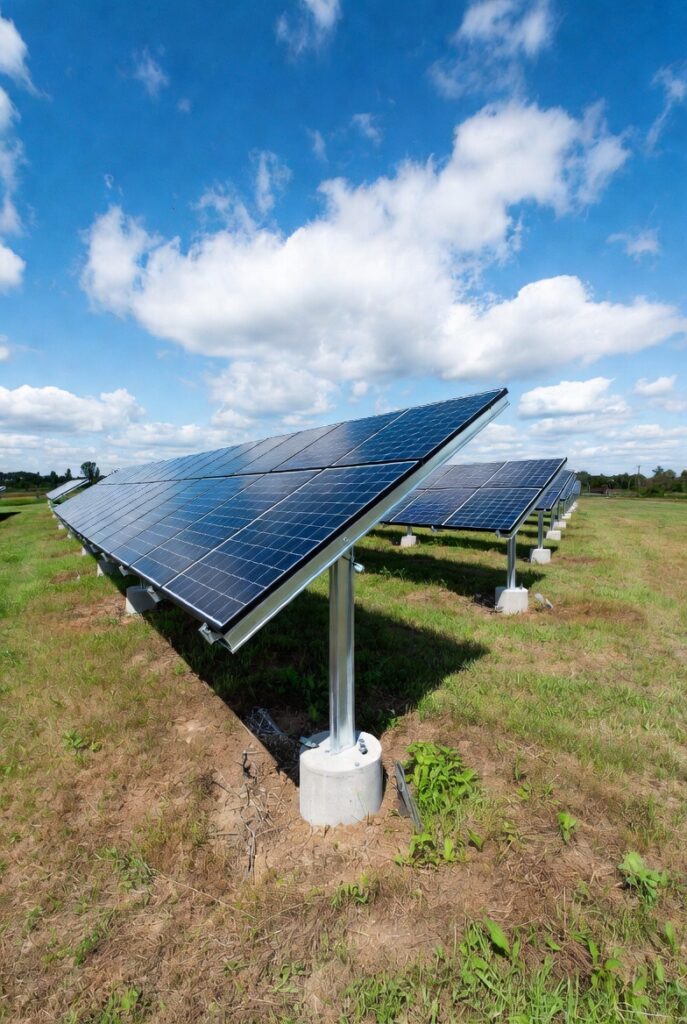
Solar ground mount decisions are not about available roof space or installation convenience. They are the moment a property owner realizes his north-facing roof with mature maple shading would produce 40% less power than the same panels mounted in an open south field. I was helping a property owner near Rockwood in Wellington County, Ontario plan a 6kW array in spring 2024. His house had a 30-year-old asphalt roof facing northwest with two 60-foot sugar maples shading the southwest corner from 2 PM onward. The roof could physically hold the panels. The production math said otherwise.
I ran the shading analysis using his property survey and tree heights. The roof location would produce approximately 4,200 kWh annually due to suboptimal orientation and afternoon shading losses. The open pasture 80 feet south of the house had zero obstructions from sunrise to sunset. The same 6kW array mounted on a solar ground mount structure in that field would produce approximately 7,100 kWh annually. The difference was 2,900 kWh per year, worth roughly $410 annually at Ontario rates. Over the 25-year panel lifespan, the roof location would cost him $10,250 in lost production compared to the solar ground mount option.
The solar ground mount installation cost $2,400 more than the roof mount would have. The concrete footings, steel racking, and additional cable run added expense. However, the $2,400 premium recovered in under 6 years through increased production. The remaining 19 years were pure gain. The property owner also gained seasonal tilt adjustment, easier cleaning access, and no roof penetrations to maintain. His 30-year-old roof will need replacement within a decade. The ground mount array will not need to come down and go back up when that happens. For the solar system sizing that determines how many panels belong on that ground mount, The Solar Sizing Guide covers the full specification.
Why Solar Ground Mount Beats Roof Installation for Rural Properties
The math favours solar ground mount when roof orientation is suboptimal, when shading exists for any part of the day, when roof condition requires replacement within 10 years, or when the property has available land within reasonable cable run distance. Anything other than south-facing at 30 to 40 degrees qualifies as suboptimal. The thermal advantage of 360-degree airflow adds 3% to 5% summer production. The accessibility advantage means cleaning, inspection, and maintenance without ladders or roof harnesses. The longevity advantage means the array never needs to come down for roof work.
In Rockwood, the north-facing shaded roof would have produced 40% less power compared to an open-field ground mount. This translates to $10,250 in lost production over 25 years. Ground mounts also offer seasonal tilt adjustment and easier maintenance. These benefits compound over time, making them a smarter choice for rural properties with available land.
The decision framework is straightforward. If you have land and your roof is compromised by orientation, shading, age, or condition, the solar ground mount wins on production math alone. The premium pays for itself. For the wiring that connects the ground mount array to the house, The Solar DC Distribution Standard covers the full specification.
The Thermal Advantage: 360-Degree Airflow and Cooler Operation
Roof-mounted panels sit inches above shingles that reach 65°C to 75°C on summer afternoons. The panel backsheet absorbs that radiant heat and raises cell temperature. Every degree Celsius above 25°C costs approximately 0.4% to 0.5% in output efficiency. A roof-mounted panel operating at 55°C loses 12% to 15% of rated output. A solar ground mount with 360-degree airflow operates 5°C to 10°C cooler. The cooler operation recovers 2% to 5% of rated output on hot days.
Over a summer, the thermal advantage of ground mounting adds 3% to 5% to total seasonal production compared to a heat-soaked roof array. A Victron SmartShunt monitoring both installations would show the ground mount producing measurably more over summer months. The thermal advantage compounds over 25 years of operation, making it a significant factor in long-term performance.
The Snow Shed Protocol: 60-Degree Winter Tilt for Ontario Conditions
Ontario roof mounts with standard 20-degree to 30-degree tilts accumulate snow that does not slide off until partial melt creates a lubrication layer. That melt-freeze cycle can take days. The snow-covered panels produce zero power during the wait. A solar ground mount allows seasonal tilt adjustment to 60 degrees or steeper for winter. At 60 degrees, fresh snow slides off within hours. The cells never ice over because the snow departs before the melt-freeze cycle begins.
A ground mount owner in Muskoka reported gaining 12 additional production days per winter compared to his neighbour’s fixed roof array. Those 12 days at 15 kWh per day recovered 180 kWh annually. The seasonal adjustment capability is a solar ground mount advantage that fixed roof arrays cannot match, making it essential for maximizing year-round performance. For the panel wiring configurations that apply to ground mount arrays, The Solar Panel Wiring Standard covers series vs parallel options.
The Solar Ground Mount Foundation: Concrete Footings vs Post-in-Dirt
I was called to assess storm damage at a property near Shelburne in Dufferin County, Ontario after a November 2024 windstorm. The property owner had installed a 4kW solar ground mount array the previous spring using pressure-treated 4×4 posts set 24 inches into the ground without concrete. The array had lifted out of the ground and landed 15 feet away in his vegetable garden. Two panels were destroyed. The racking was bent beyond reuse.
The wind that night had gusted to 95 km/h according to Environment Canada data. The array was tilted at 45 degrees for fall production. At that angle, the 4-panel array presented approximately 75 square feet of surface area to the wind. The uplift force at 95 km/h exceeded 800 pounds. The 4×4 posts in loose soil without concrete footings could resist perhaps 200 pounds of lateral force each. The math was never close. The array became a sail and the posts became levers that pried themselves out of the ground.
I helped him rebuild with proper engineering. We installed four concrete footings 42 inches deep below the frost line, each 12 inches in diameter with J-bolts cast into the top. The galvanized steel racking bolted directly to the J-bolts. The new solar ground mount structure weighs 340 pounds empty and anchors to footings that resist 2,400 pounds of uplift each. The same 95 km/h wind would now need to overcome 9,600 pounds of combined anchor resistance. The rebuild cost $1,800 in materials and labour. The original installation had cost $600 in materials. The $1,200 he saved on the original build cost him $1,400 in destroyed panels and $1,800 in rebuild costs. His true savings was negative $2,000.
Solar Ground Mount Racking: Pressure-Treated Lumber vs Galvanized Steel
The material science decision determines your rebuild timeline. Pressure-treated lumber is the budget path at $400 to $800 for the racking structure. Ground-contact rated lumber is required. Stainless steel hardware is required. Lifespan runs 10 to 15 years before wood replacement becomes necessary. Galvanized steel or aluminum is the 25-year path at $1,200 to $2,500 for racking. It matches panel warranty lifespan. No rot, no checking, no replacement mid-life.
A Renogy 100W panel mounts to either lumber or steel racking with the same hardware. The racking choice determines whether you rebuild at year 12 or not. For structural load requirements and wind resistance standards, contact CSA Group for current Canadian codes.
The 36-Inch Clearance Rule: Preventing Snow Burial and Splash Debris
The bottom edge of a solar ground mount should sit at least 36 inches above grade. Lower mounting creates three problems. First, winter snow accumulation can bury the bottom row of panels even after the array itself has shed its load. Second, rain splashing off the ground carries dirt and debris onto the panel glass, requiring more frequent cleaning. Third, vegetation growth in spring and summer can shade the bottom cells before the owner notices. The 36-inch minimum clearance prevents all three problems.
Some installers mount at 24 inches to save racking cost. The cleaning and shading losses exceed the racking savings within two years. The ground mount advantage disappears if the ground buries your panels. Proper clearance ensures optimal performance year-round, making it a critical consideration for long-term success.
Minimum Viable vs Full Standard: Choosing Your Foundation Path
The minimum viable solar ground mount for a small cabin or shed installation requires ground-contact rated lumber, stainless steel hardware, and proper bracing against wind loads. A 2kW to 4kW array on pressure-treated lumber racking with concrete deck blocks as footings suits low-wind areas with well-drained soil and arrays under 500 pounds total weight. Capital cost runs $400 to $800 for the racking structure. Lifespan is 10 to 15 years before wood replacement becomes necessary.
The full foundation standard for a permanent residential solar ground mount installation requires engineered drawings in some jurisdictions, footer depth of 42 to 48 inches in Ontario, and proper J-bolt or post base connections. A 4kW to 10kW array on galvanized steel or aluminum racking with concrete footings below frost line suits all wind zones, handles arrays up to 2,000 pounds, and provides 25-year structural lifespan matching panel warranty. Capital cost runs $1,500 to $3,500 for the racking and foundation.
| Specification | Minimum Viable | Full Standard | Difference |
|---|---|---|---|
| Foundation Type | Concrete deck blocks | Concrete footings below frost line | More robust, longer-lasting |
| Racking Material | Pressure-treated lumber | Galvanized steel or aluminum | No rot, no checking, 25-year lifespan |
| Cost | $400-$800 | $1,500-$3,500 | Higher initial cost, lower long-term maintenance |
| Wind Resistance | Suitable for low-wind areas | Handles all wind zones | Greater structural integrity |
| Lifespan | 10-15 years | 25+ years | Matches panel warranty |
Both paths connect to the same Victron MPPT 100/50 charge controller. The foundation choice determines whether the array survives the first major windstorm.
Frequently Asked Questions
Q: How much more does a ground mount cost compared to a roof installation?
A: A solar ground mount typically costs $1,500 to $3,500 more than a comparable roof installation due to concrete footings, steel racking, and additional cable run. However, the increased production from optimal orientation and cooler operation often recovers this premium within 4 to 8 years, with the remaining system lifespan as pure gain.
Q: How deep should ground mount footings be in Ontario?
A: Concrete footings for a solar ground mount in Ontario should extend 42 to 48 inches below grade to reach below the frost line. Footings above the frost line can heave during freeze-thaw cycles, shifting the array out of alignment or cracking the concrete. The frost line depth varies by region but 42 inches is the safe minimum for most of Southern Ontario.
Q: Can I build a ground mount with pressure-treated lumber instead of steel?
A: Yes, but expect a 10 to 15 year lifespan instead of 25 years. Pressure-treated lumber suitable for ground contact will eventually rot, check, and require replacement. The lumber racking costs $400 to $800 compared to $1,200 to $2,500 for galvanized steel. If your panels have a 25-year warranty, steel racking matches that lifespan without mid-life rebuild.
Pro Tip: Before you pour concrete footings for a solar ground mount, call your municipality about permit requirements. Some Ontario townships require building permits for ground-mounted arrays over a certain size or height. Others require setback distances from property lines. I have seen property owners pour $2,000 in concrete footings and then receive a stop-work order because they needed a permit first. The permit process adds 2 to 4 weeks but prevents the enforcement nightmare of an unpermitted structure. Call before you dig.
Verdict
- The Rockwood Production Standard. A north-facing shaded roof would produce 40% less power compared to an open-field solar ground mount. This translates to $10,250 in lost production over 25 years. The ground mount installation cost $2,400 more but recovered the premium in under 6 years through increased production. The remaining 19 years were pure gain.
- The Shelburne Foundation Standard. Proper foundation engineering is critical for wind resistance. A 95 km/h windstorm destroyed a $600 post-in-dirt array and cost the owner $1,400 in panels and $1,800 in rebuild costs. The $1,200 he saved on proper concrete footings resulted in negative $2,000 true savings.
- The Material Choice Standard. Pressure-treated lumber suits small installations with a 10 to 15 year lifespan at $400 to $800. Galvanized steel or aluminum racking matches the 25-year panel warranty at $1,200 to $2,500 and provides long-term structural integrity without mid-life rebuilds.
This build is engineered within the 48V DC Safety Ceiling. Diagnostic logic is based on 20+ years of technical service experience. All structural and electrical installations must be verified by a Licensed Professional and comply with your Local AHJ.
This article contains affiliate links. If you purchase through these links, I earn a small commission at no extra cost to you.
Questions? Drop them below.