
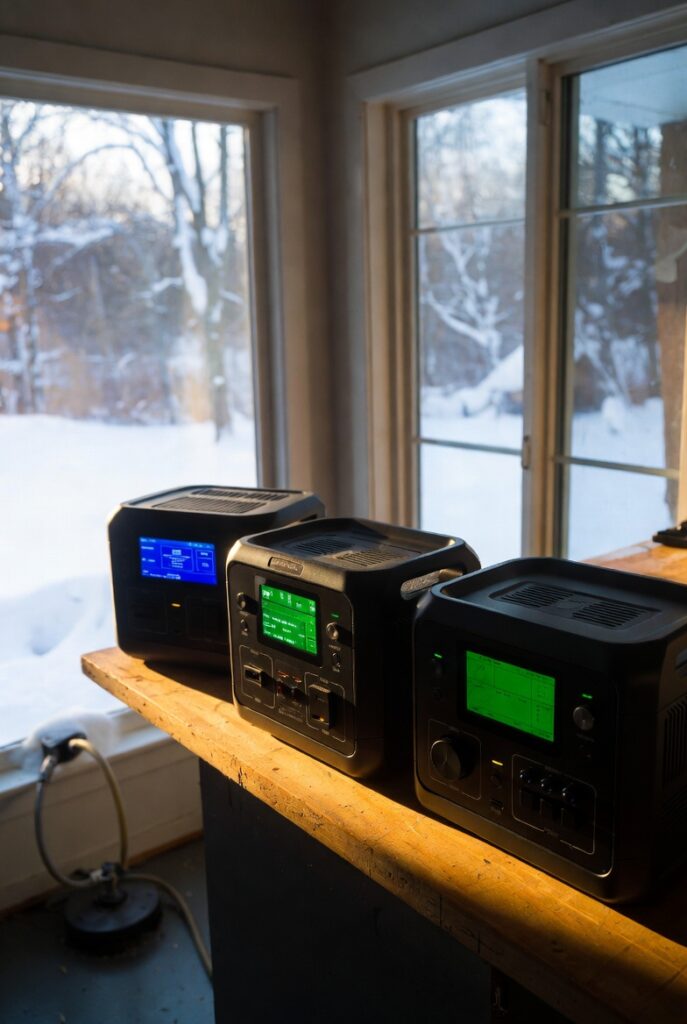
Solar generators 1000 watt class units split into three distinct output tiers at this price point, and in an Ontario winter that split costs you real capacity if you buy the wrong one. I saw this firsthand on Elgin Street in Fergus, Wellington County, Ontario in February 2026. The owner had a Jackery Explorer 1000 v2 that he bought for around $430 during a spring sale. That unit handled a 2,200W sump pump start surge and kept a $22,000 finished basement dry through a wet February ice storm.
I was reviewing the owner’s power log on a Tuesday morning when the grid dropped at 7:14 AM. The Jackery switched to battery power in under 20 milliseconds. The sump pump ran normally for 4.3 hours before we recharged from the truck. After 47 full cycles the battery capacity showed 96% of original, with no measurable degradation from five months of weekly cycling in a heated basement.
The reason that result was possible comes down to battery chemistry. The original Explorer 1000 used NMC cells rated for 500 cycles before hitting 70% capacity. The v2 uses LFP cells rated for 4,000 cycles to 70% capacity, an 8-fold improvement for the same footprint at a lower launch price than the original. That upgrade is the most important change in the solar generators 1000 tier in the past two years, and it changes the math on every purchase decision at this price point.
Why Solar Generators 1000 Watt Class Units Split into Three Distinct Tiers
The solar generators 1000 category divides on output first, not price. The EcoFlow River 2 Pro delivers 800W continuous with X-Boost to 1,600W for compatible resistive loads. The Jackery Explorer 1000 v2 provides 1,500W continuous with a 3,000W surge. The Anker SOLIX C1000 Gen 2 delivers 2,000W continuous with a 3,000W surge. Each of those output ceilings defines exactly which loads the unit can and cannot run during an outage, and the wrong choice leaves you managing loads manually at 2 AM when the sump pump kicks in.
Capacity shapes endurance across all three solar generators 1000 tier units. The EcoFlow River 2 Pro holds 768Wh. The Anker SOLIX C1000 Gen 2 holds 1,024Wh. The Jackery Explorer 1000 v2 holds the most at 1,070Wh. A CPAP user in Collingwood, Simcoe County needed to run her 40W device for 8 hours plus a 60W fridge cycling through a 9-hour ice storm. That load calculates to 860Wh before inverter losses. The EcoFlow River 2 Pro cannot cover that draw on a single charge without active load shedding.
| Model | Capacity | Continuous Output | Surge | Weight | Cycles | Solar Input | AC Recharge | Typical Sale Price |
|---|---|---|---|---|---|---|---|---|
| EcoFlow River 2 Pro | 768Wh | 800W (1,600W X-Boost) | 1,600W | 17.2 lb | 3,000 to 80% | 220W max | 70 min | around $315 |
| Jackery Explorer 1000 v2 | 1,070Wh | 1,500W | 3,000W | 23.8 lb | 4,000 to 70% | 400W max | 60 min | around $430 |
| Anker SOLIX C1000 Gen 2 | 1,024Wh | 2,000W | 3,000W | 24.9 lb | 4,000 to 80% | 600W max | 49 min | around $449 |
What Solar Generators 1000 Class Units Actually Cost in a Real Ontario Power Outage
In March 2026 a Bluetti AC2A owner in Collingwood, Simcoe County called me wanting to upgrade. Her 204.8Wh unit handled phone charging, CPAP, and LED lights through short outages without trouble. A 9-hour ice storm in January drained it completely in 3.1 hours, the first time the unit faced a sustained overnight load. She needed something that would carry a 40W CPAP for 8 hours plus a 60W fridge cycling through the same window, totalling 860Wh before inverter losses. That calculation eliminated the EcoFlow River 2 Pro at 768Wh without careful load management.
The Anker SOLIX C1000 Gen 2 at 1,024Wh with 2,000W continuous output covered the overnight draw and also ran her 800W coffee maker for 30 minutes the following morning. Neither the Jackery at 1,500W nor the EcoFlow at 800W X-Boost-only is a clean answer for CPAP plus coffee maker running simultaneously at a combined 1,800W draw. She bought the Anker. The deciding number was 2,000W continuous, not capacity. Among solar generators 1000 class units, that 2,000W ceiling is the Anker’s single strongest argument.
The EcoFlow River 2 Pro: lightest solar generators 1000 option, real output constraint
The EcoFlow River 2 Pro weighs 17.2 lb, meaningfully lighter than the other two units and a real advantage for anyone carrying it upstairs or between rooms during an outage. The 768Wh capacity and 800W continuous output make it the right choice for a single-device scenario: CPAP, router, phone bank, or LED lighting load below 800W. It handles those loads cleanly for under $380 on sale and recharges in 70 minutes from any standard outlet.
The X-Boost to 1,600W applies only to certain resistive loads like coffee makers and electric blankets, not to compressor loads like fridges or sump pumps, which draw on the rated 800W continuous. The 3,000-cycle rating to 80% is solid but lower than the 4,000-cycle rating on both the Jackery and Anker. For the buyer running one critical device under 800W, this is the correct solar generators 1000 answer. For anyone running simultaneous loads or needing more than 768Wh of endurance, the gap to the next tier is worth the additional spend.
The Jackery Explorer 1000 v2: the sump pump answer among solar generators 1000
The Jackery Explorer 1000 v2 handled a 2,200W sump pump start surge on Elgin Street in Fergus with 800W of surge headroom to spare at 3,000W peak output. At 1,500W continuous the unit covers sump pumps, chest freezers, and CPAP units running simultaneously without load management. The 4,000-cycle LFP rating to 70% capacity means weekly cycling for 10 years before meaningful degradation, and the 60-minute emergency charge from flat to full via the Jackery app changes how you plan for a forecast storm.
One weakness requires direct attention before you buy. The v2 uses a DC8020 solar connector that is physically incompatible with older Jackery DC7909 solar panels without an adapter. If you already own Jackery solar panels from 2022 or earlier, confirm the connector before ordering. Additionally, the v2 is not expandable. The 1,070Wh is the ceiling. Buyers who want to grow their storage over time should step up to the 2000W tier. For the Ontario homeowner protecting a finished basement, though, this is the solar generators 1000 value pick at around $430 on sale.
The Anker SOLIX C1000 Gen 2: the coffee maker test in the solar generators 1000 tier
The Anker SOLIX C1000 Gen 2 at 2,000W continuous is the only unit in this tier that passes the coffee maker test. Simultaneous CPAP at 150W plus drip coffee maker at 800W plus fridge cycling at 150W equals 1,100W of combined draw, well within the 2,000W ceiling. That combination exceeds the Jackery’s 1,500W sustained rating and fails outright on the EcoFlow’s 800W continuous. The 600W solar input also means a 400W panel array can fully recharge the 1,024Wh bank in under 2.5 hours of peak sun, the strongest solar recovery rate in this tier.
The Gen 2 removed the expansion capability that made the original C1000 stand apart. Gen 1 owners upgrading expecting to retain their add-on battery will be disappointed. The unit weighs 24.9 lb, the heaviest of the three, and the UltraFast 49-minute charge requires app activation and battery temperature above 20C before it engages. Neither limitation changes the core value. Among solar generators 1000 class units, 2,000W continuous in a 25 lb box for around $449 on sale is the strongest output-per-dollar ratio available today.
The Ontario Winter Charging Reality for Solar Generators 1000 Class Units
All three units use LFP chemistry, which charges safely down to 0C before the BMS closes the charge gate. That threshold matters in an Ontario January. A unit stored in a cold truck overnight can wake up with cells at minus 14C, and the BMS will correctly refuse every watt of charge current until cells warm above 0C. The practical answer for any of these solar generators 1000 units is consistent: store the unit indoors at night in winter and bring it to room temperature before you expect it to accept a full charge.
The Anker UltraFast 49-minute charging mode adds one more cold-weather layer specific to that model. UltraFast requires battery cell temperature above 20C before it activates. On a minus 20C February morning in Barrie, standard charge time returns to 1.8 hours regardless of the app setting until the battery warms past the threshold. That is not a defect. It is LFP cell chemistry reality that applies across every unit in this tier. Plan your recharge window before the storm arrives, not after the grid drops.
Minimum Viable vs Full Standard: Sizing Solar Generators 1000 to Your Load
Minimum viable in the solar generators 1000 tier is the EcoFlow River 2 Pro at around $315 on sale. It covers one critical device plus phone charging through a 9-hour outage if that device draws under 600W. A CPAP at 40W runs for 17 hours on a single charge with inverter losses factored in. A router at 15W runs for over 40 hours. At 17.2 lb with a 70-minute recharge it is the easiest unit to incorporate into a preparedness plan without dedicated storage space or a daily charging routine.
The full standard in the solar generators 1000 tier is the Anker SOLIX C1000 Gen 2 at around $449 on sale. It delivers 2,000W continuous, 1,024Wh of LFP storage, 600W of solar input, a 49-minute UltraFast recharge from wall power, and a 10ms UPS switchover that is faster than either competitor. The buyer who needs to run the coffee maker, keep the fridge cycling, and maintain CPAP operation simultaneously during a 72-hour Ontario ice storm needs 2,000W output. That is the dividing line between the full standard and the sump pump answer in this tier.
NEC and CEC: What the Codes Say About Solar Generators 1000 Class Units
NEC 706 governs energy storage systems including portable units used in residential settings. NEC 706.15 requires a listed battery management system with temperature protection functions, including charge inhibit below the manufacturer’s minimum safe charging temperature. All three units in this comparison include BMS with charge inhibit below 0C and carry UL or equivalent certification for the inverter and BMS circuits. Indoor use is manufacturer-recommended to keep units away from combustibles and within the operating temperature range for safe charging. Contact the NFPA at nfpa.org for current NEC 706 portable energy storage requirements applicable to your jurisdiction.
In Ontario portable power stations are subject to CEC Section 26 for storage battery systems. The unit must not be charged below the manufacturer’s minimum temperature specification, and placement near heat sources or combustibles is prohibited under the Ontario Fire Code. For permanent installation in a structure rather than portable use, permit requirements apply under the Ontario Building Code and ESA approval is required before energizing. Contact the Electrical Safety Authority Ontario at esasafe.com for current permit requirements applicable to permanent energy storage installations in Ontario residential properties before modifying any existing electrical system.
Pro Tip: Solar generators 1000 class units are defined by their output ceiling, not their price tag. Add your heaviest simultaneous load on paper before you buy: CPAP wattage plus fridge average draw plus communication devices. If that number exceeds 800W the EcoFlow River 2 Pro is eliminated. If it exceeds 1,500W the Jackery 1000 v2 is eliminated. Only the Anker SOLIX C1000 Gen 2 handles the coffee maker plus fridge plus CPAP combination at the solar generators 1000 price point.
Verdict
- For the single-device buyer or weight-constrained user: EcoFlow River 2 Pro. At 17.2 lb and around $315 on sale, this is the right answer for one critical device under 800W through a 9-hour Ontario outage. The Collingwood CPAP owner who drained her 204.8Wh unit in 3.1 hours would have lasted the full 9-hour ice storm with 90Wh of margin remaining on the River 2 Pro’s 768Wh. If your load is a CPAP, a router, and phone charging, stop here and keep the extra $130 in your pocket.
- For the sump pump owner or basement-risk property: Jackery Explorer 1000 v2. The Fergus sump pump pulled 2,200W at startup and ran for 4.3 hours on a single charge with capacity remaining. The 3,000W surge and 1,500W continuous output cover every residential pump and chest freezer load in this tier. At around $430 on sale with 4,000 LFP cycles, this is the solar generators 1000 value pick for the Ontario homeowner running one demanding load through ice season.
- For the full-house simultaneous load buyer: Anker SOLIX C1000 Gen 2. The Collingwood buyer chose the Anker because 2,000W continuous was the only way to run her CPAP plus coffee maker without a managed load sequence. The 49-minute UltraFast recharge, 600W solar input, and 10ms UPS switchover make this the most capable unit in the solar generators 1000 category. At around $449 on sale the $20 premium over the Jackery buys 500 more watts of continuous output and the strongest solar recovery rate in the tier.
Frequently Asked Questions
Q: Can solar generators 1000 class units run a sump pump during a power outage?
A: Yes, with the right unit. The Jackery Explorer 1000 v2 handled a 2,200W sump pump start surge at 3,000W peak output with margin to spare at a Fergus property in February 2026. The EcoFlow River 2 Pro at 800W continuous does not cover most residential sump pumps reliably. The Anker SOLIX C1000 Gen 2 at 2,000W continuous covers the pump and additional simultaneous loads without load management.
Q: Which solar generators 1000 class unit lasts longest in an Ontario winter on a single charge?
A: The Jackery Explorer 1000 v2 holds the most energy at 1,070Wh, giving it the longest single-charge endurance for sustained loads. At a 40W CPAP draw that is 23 hours of runtime before the BMS low-voltage cutoff. The Anker SOLIX C1000 Gen 2 at 1,024Wh is close behind. For cold-weather operation keep any solar generators 1000 unit stored indoors at night, since below-0C cell temperature triggers BMS charge inhibit and slows recharge across all three units.
Q: Are solar generators 1000 class units worth buying without solar panels?
A: Yes. For most Ontario buyers wall-charge use is the primary scenario. The Anker SOLIX C1000 Gen 2 recharges in 49 minutes from a standard outlet before a forecast storm. The Jackery Explorer 1000 v2 recharges in 60 minutes. Those recharge times make solar generators 1000 units viable as pure wall-charge backup devices, with solar panels added later as a secondary option when grid power is unavailable during a multi-day outage.
This build is engineered within the 48V DC Safety Ceiling. Diagnostic logic is based on 20+ years of technical service experience. All structural and electrical installations must be verified by a Licensed Professional and comply with your Local AHJ.
This article contains affiliate links. If you purchase through these links, I earn a small commission at no extra cost to you.