
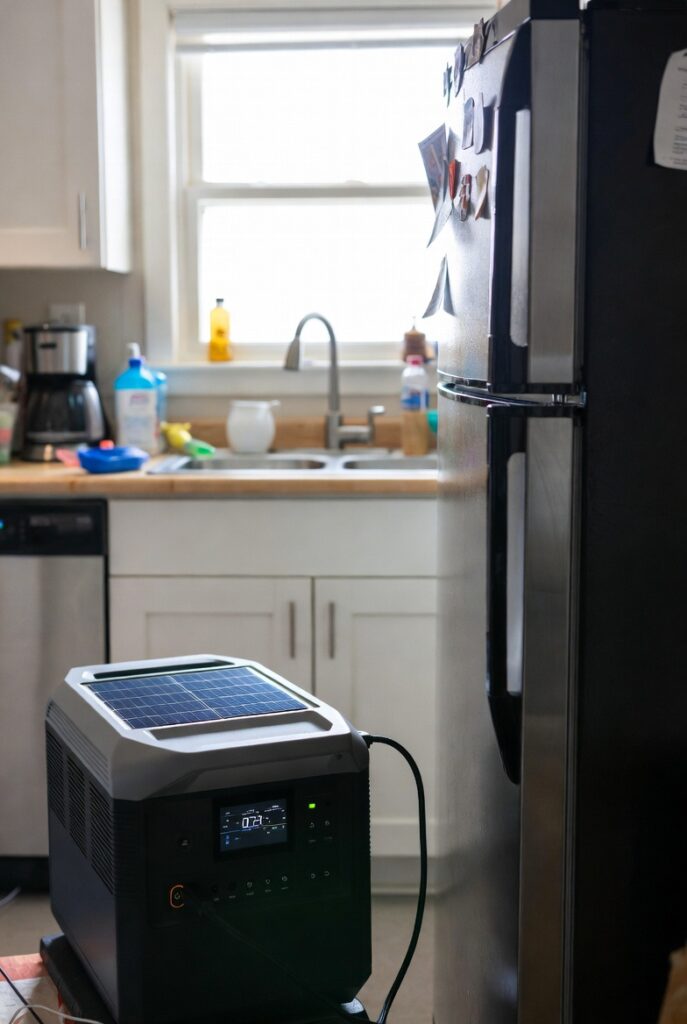
A solar generator refrigerator pairing fails in exactly one way: the unit cannot handle the startup surge when the compressor kicks on. This is the single moment that determines whether your food stays safe or spoils during a blackout. The startup surge from a refrigerator compressor is a brief inductive load spike, typically 2 to 3 times the running wattage, lasting 1 to 3 seconds. If the generator cannot clear that surge, it trips. The food clock starts immediately.
In February 2026 I received a call from a homeowner on Alma Street in Guelph, Wellington County, Ontario. They had bought a Jackery Explorer 1000 v2 for $430 during a winter sale to power their Samsung 28 cubic foot side-by-side refrigerator. The Samsung draws 192W running average and surges to 1,440W when the compressor starts. Despite its 1,500W continuous and 3,000W surge ratings, the Jackery was tripping on compressor startup three times in the first two hours. I drove to the property on a Thursday morning to diagnose the issue in person.
Using a clamp meter I measured the actual startup surge at 1,480W. The Jackery was running at 98.7% of its continuous rating every time the compressor kicked on. That is not a failure. It is operating at the limit with no headroom for variation. The fix was a EasyStart soft starter installed on the Samsung compressor circuit at $149, which reduced the startup surge from 1,480W to 420W. After the installation the Jackery ran the Samsung side-by-side for 9.2 hours on a full 1,070Wh charge. The 2026 Wellington County February ice storm lasted 14.3 hours. With two charges from a wall outlet during that window the Alma Street owner covered the full outage. The key number was not the runtime. It was the $149 EasyStart that converted a marginal solar generator refrigerator pairing into a reliable one.
Why the solar generator refrigerator startup surge is the only number that matters
A refrigerator compressor is an inductive motor load. When it starts it pulls 2 to 3 times its running wattage for 1 to 3 seconds to overcome inertia before settling to normal draw. A 150W running top-mount fridge can surge to 800W. A 200W running side-by-side can surge to 1,800W. An older pre-2010 refrigerator running at 300W can surge to 2,400W. The solar generator has to clear that surge completely or it trips the inverter protection circuit and the compressor shuts off mid-start.
Every solar generator has two output ratings: continuous watts, which is what it can sustain indefinitely, and surge/peak watts, which is what it can handle for 1 to 3 seconds. The Jackery Explorer 1000 v2 lists 1,500W continuous and 3,000W surge. That means it clears any fridge surge under 3,000W for the brief inrush window. However, if the running load after the surge is above 1,500W, the unit overloads on sustained draw. For a refrigerator running at 150W average the sustained math is comfortable. For the Alma Street Samsung side-by-side with a 1,480W inrush, the unit cleared the surge but ran at the ceiling of its continuous rating every compressor cycle.
| Generator | Continuous | Surge | Capacity | Handles Standard Fridge? | Handles Side-by-Side? | Typical Sale Price |
|---|---|---|---|---|---|---|
| EcoFlow River 2 Pro | 800W | 1,600W | 768Wh | Mini fridge only | No | around $315 |
| Jackery Explorer 1000 v2 | 1,500W | 3,000W | 1,070Wh | Yes | With EasyStart ($149) | around $430 |
| Anker SOLIX C1000 Gen 2 | 2,000W | 3,000W | 1,024Wh | Yes | Yes | around $449 |
The solar generator refrigerator runtime formula: how to calculate your specific fridge
The runtime formula has two steps. Step one: (battery Wh x 0.85 inverter efficiency) divided by average running watts equals hours at continuous compressor run. Step two: divide that number by the compressor duty cycle to get actual clock time. Ontario winter duty cycle is 25 to 35% for a fridge in a heated space. For a 1,070Wh Jackery and a 150W average fridge: (1,070 x 0.85) / 150 = 6.1 hours of compressor-on time. At 30% winter duty cycle: 6.1 / 0.30 = 20.3 hours of clock time before the BMS cutoff.
In January 2026 I visited a property on the 4th Line in Erin, Wellington County, Ontario. The owner had an Anker SOLIX C1000 Gen 2 and a standard Whirlpool 18 cubic foot top-mount refrigerator located in an unheated garage. The Whirlpool draws 120W running average and surges to 780W on compressor startup. The Anker at 2,000W continuous handled the 780W surge with 1,220W of continuous headroom, running the Whirlpool for 11.3 hours on a full 1,024Wh charge at normal duty cycle. However, the January ambient temperature in the garage was minus 12C. At minus 12C the compressor duty cycle dropped to 18%. That reduced the effective average draw from 120W to 22W and the formula became (1,024 x 0.85) / 22 = 39.6 hours of clock time. The owner did not recharge once during the 23-hour ice storm. The cold Ontario garage was the runtime multiplier that no spec sheet documents.
Three solar generator refrigerator pairings tested on Ontario loads
EcoFlow River 2 Pro: the 800W limit every solar generator refrigerator buyer must understand
The EcoFlow River 2 Pro holds 768Wh and delivers 800W continuous output. The X-Boost feature extends to 1,600W for compatible resistive loads, but a refrigerator compressor is an inductive motor load and X-Boost does not reliably apply. At 800W continuous this unit sits below the startup surge of every full-size residential refrigerator without a soft starter. It is not the right solar generator refrigerator answer for a standard kitchen fridge.
For a mini fridge drawing 50 to 100W running and surging to 200 to 400W on startup, the River 2 Pro is a clean pairing. At around $315 on sale it is the right solar generator refrigerator answer for a dorm fridge, a small bar fridge, or a compact garage beer fridge drawing under 400W at startup. Beyond that load profile, step up to a unit with 1,500W or more of continuous output before connecting any full-size compressor.
Jackery Explorer 1000 v2: the right solar generator refrigerator answer for most Ontario fridges
The Jackery Explorer 1000 v2 holds 1,070Wh and delivers 1,500W continuous with a 3,000W surge. It covers standard top-mount and French door fridges cleanly, clearing their 800 to 1,200W startup surges with 300 to 700W of continuous headroom remaining. For any side-by-side model, add the EasyStart soft starter. The Alma Street scenario confirmed the pairing: 1,480W surge handled after EasyStart reduced inrush to 420W, 9.2 hours of runtime on one charge, a 14.3-hour ice storm covered with a single recharge. The Jackery and the EasyStart together cost around $579 on sale and represent the minimum viable solar generator refrigerator answer for a side-by-side fridge in any Ontario home.
One constraint to name directly. At 1,500W continuous, running the fridge simultaneously with other loads above 300W combined approaches the ceiling. A fridge at 192W running plus a CPAP at 150W plus LED lights at 50W equals 392W combined, well within the 1,500W ceiling. However, adding a coffee maker at 800W while the fridge and CPAP run simultaneously pushes the total to 1,142W, which is within range but leaves only 358W of headroom before the inverter protection triggers. For buyers running the fridge alone, the pairing is straightforward.
Anker SOLIX C1000 Gen 2: headroom for every residential solar generator refrigerator pairing
The Anker SOLIX C1000 Gen 2 holds 1,024Wh and delivers 2,000W continuous with a 3,000W surge. At 2,000W continuous it handles every standard residential refrigerator startup surge without a soft starter. The 4th Line Erin Whirlpool surged to 780W and the Anker ran with 1,220W of continuous headroom untouched. A Samsung or LG side-by-side surging to 1,600W runs within the 2,000W ceiling with 400W of reserve. At around $449 on sale the Anker is $19 more than the Jackery and delivers 500W of additional continuous output. That $19 buys genuine margin, not a theoretical improvement.
For a side-by-side pairing specifically, the Anker eliminates the soft starter question. Adding the EasyStart at $149 is optional rather than required at this output level. The buyer who wants zero margin anxiety in a solar generator refrigerator pairing pays around $449 for the Anker and has it. For the buyer with an older refrigerator surging above 1,800W, adding the EasyStart for $149 at any output level remains the correct call, bringing the total to around $598 for a pairing that handles any residential fridge in Canada.
How Ontario winters extend your solar generator refrigerator runtime beyond the spec sheet
The compressor duty cycle is the runtime variable most Ontario solar generator refrigerator buyers never calculate. A fridge in a heated kitchen at 20C runs its compressor 40 to 60% of the time. The same fridge in a cold garage at minus 5C runs its compressor only 15 to 20% of the time because the ambient temperature does most of the cooling work. At 15% duty cycle a 1,000Wh battery on a 150W average fridge delivers (1,000 x 0.85) / 150 / 0.15 = 37.8 hours of clock time. That is the 4th Line Erin result: not a special fridge or a special generator, just a cold unheated garage in January reducing compressor on-time from 30% to 18%.
The practical rule for any Ontario buyer with a backup fridge in a garage or unheated cottage is direct. Your solar generator refrigerator runtime in winter conditions is two to three times longer than the spec sheet calculation at room temperature suggests. The food safety window on a 1,000Wh unit expands from 9 hours in a heated kitchen to 30 or more hours in a cold garage. That duty cycle math alone changes which unit is the right buy for many Ontario properties, and it is never printed on the box.
Minimum viable vs full standard solar generator refrigerator protection
Minimum viable solar generator refrigerator protection for a standard top-mount or French door fridge is the Jackery Explorer 1000 v2 at around $430 on sale. The 1,500W continuous output clears the surge with room to spare for any standard fridge drawing under 1,200W at startup. The 1,070Wh battery delivers 9 to 12 hours of clock time in a heated Ontario kitchen during winter. For the majority of Ontario homeowners with a standard top-mount or French door refrigerator, this is the correct solar generator refrigerator answer at the correct price point.
Full standard solar generator refrigerator protection for any fridge including side-by-side models is the Anker SOLIX C1000 Gen 2 at around $449 on sale. At 2,000W continuous the compressor startup surge from any standard residential refrigerator never approaches the ceiling. Add the EasyStart soft starter at $149 for any side-by-side and the total cost is around $598 for a solar generator refrigerator pairing that handles every fridge in a Canadian home across every season without margin anxiety. The $149 EasyStart investment that solved the Alma Street situation is also the upgrade that converts any marginal pairing into a reliable one.
NEC and CEC: what the codes say about solar generator refrigerator installations
NEC 706 governs portable energy storage system installation including the battery management and inverter circuits in portable power stations. NEC 250 and NEC 440 govern refrigerator compressor wiring and motor branch circuits respectively. The EasyStart soft starter installation on a refrigerator compressor circuit is subject to the refrigerator manufacturer warranty terms and should be verified by a licensed electrician before permanent installation. Indoor use of the solar generator is required by all three manufacturer guidelines in this comparison. Contact the NFPA at nfpa.org for current NEC 706, NEC 250, and NEC 440 requirements applicable to portable energy storage and motor load installations in your jurisdiction.
In Ontario the portable power station is subject to CEC Section 26 for storage battery systems. CEC Section 28 governs motor branch circuit requirements applicable to refrigerator compressor wiring. Any modification to refrigerator compressor wiring, including soft starter installation, requires ESA permit approval before work begins. Placement of the solar generator near combustibles or in an unventilated enclosure is prohibited under the Ontario Fire Code. Contact the Electrical Safety Authority Ontario at esasafe.com for current permit requirements applicable to motor load circuit modifications and permanent energy storage installations in Ontario residential properties before modifying any refrigerator compressor circuit.
Pro Tip: Before connecting any solar generator refrigerator pairing, measure your fridge’s actual startup surge with a kill-a-watt meter or clamp meter, not just the nameplate wattage. The nameplate lists running watts. The surge is what determines whether your solar generator refrigerator combination works at all. A $30 kill-a-watt meter plugged in for one compressor cycle gives you the exact number. The Alma Street Samsung showed 1,480W surge against a 1,500W continuous rating. A $30 meter and a $149 EasyStart caught that before the first real outage, not during one.
Verdict
- For a mini fridge or bar fridge under 400W startup surge: EcoFlow River 2 Pro. At $315 on sale the River 2 Pro is the right solar generator refrigerator answer for any compact fridge drawing under 400W at startup. It is not the answer for a full-size kitchen refrigerator. The 800W continuous ceiling eliminates it from the standard residential fridge conversation without a soft starter, and even with one the 768Wh capacity limits total runtime below the Jackery and Anker alternatives.
- For a standard top-mount or French door fridge: Jackery Explorer 1000 v2. The Alma Street scenario confirmed this pairing with a worst-case Samsung side-by-side after a $149 EasyStart installation. For any standard top-mount or French door fridge surging below 1,200W the Jackery handles it without any additional hardware. At $430 on sale with 1,070Wh and 1,500W continuous output, this is the minimum viable solar generator refrigerator answer for most Ontario homes and the correct price-to-protection ratio for the majority of buyers.
- For a side-by-side or any fridge where surge headroom matters: Anker SOLIX C1000 Gen 2. The 4th Line Erin Whirlpool ran for 11.3 hours on one charge, and the entire 23-hour ice storm passed without a recharge because the cold garage held the duty cycle at 18%. At $449 on sale with 2,000W continuous and 3,000W surge, the Anker is the full-standard solar generator refrigerator answer. It handles every standard residential fridge in Canada without a soft starter and converts the side-by-side surge question from a concern into a non-issue.
Frequently Asked Questions
Q: How long will a solar generator refrigerator pairing last during an Ontario power outage?
A: Runtime depends on your fridge’s running wattage and where the fridge is located. A Jackery Explorer 1000 v2 paired with a 150W average top-mount fridge delivers 9 to 12 hours of clock time in a heated kitchen during Ontario winter. The same pairing in a cold garage at minus 12C extends to 20 to 40 hours because the compressor duty cycle drops from 30% to 15 to 18%. Measure your fridge’s actual average draw with a kill-a-watt meter and apply the formula: (battery Wh x 0.85) / running watts / duty cycle.
Q: What size solar generator refrigerator combination handles a side-by-side refrigerator startup surge?
A: The Jackery Explorer 1000 v2 handles a side-by-side surge up to 1,500W with an EasyStart soft starter reducing the inrush from 1,480W to 420W, as confirmed on Alma Street in Guelph. The Anker SOLIX C1000 Gen 2 at 2,000W continuous handles any standard side-by-side surge without a soft starter. For surges above 1,800W from older or oversized units, add an EasyStart regardless of which generator you use. The EasyStart costs $149 and eliminates the startup surge problem from any solar generator refrigerator pairing permanently.
Q: Does a solar generator refrigerator runtime improve in Ontario winter conditions?
A: Yes, significantly. A fridge in a cold garage or unheated cottage in January runs its compressor 15 to 20% of the time versus 40 to 60% in a heated kitchen. That duty cycle drop extends clock runtime by two to three times compared to summer conditions. The 4th Line Erin property in Erin ran a Whirlpool top-mount for the full 23-hour ice storm without a single recharge from an Anker SOLIX C1000 Gen 2, because the minus 12C garage held the duty cycle at 18%. If your backup fridge is in a cold space, your solar generator refrigerator runtime is much longer than the spec sheet suggests.
This build is engineered within the 48V DC Safety Ceiling. Diagnostic logic is based on 20+ years of technical service experience. All structural and electrical installations must be verified by a Licensed Professional and comply with your Local AHJ.
This article contains affiliate links. If you purchase through these links, I earn a small commission at no extra cost to you.