
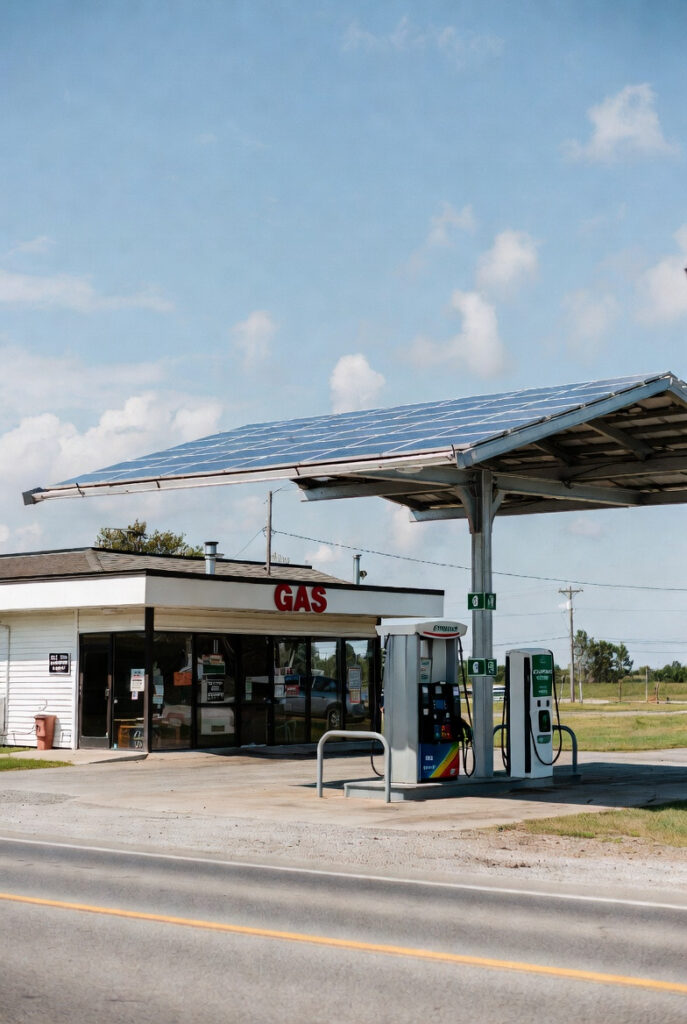
Solar gas station projects fail at the cash register before they fail at the pump. I was called to diagnose a power quality problem at a rural service station on Highway 6 north of Fergus that had installed a 15kW solar array and a 30kWh LFP battery bank the previous spring. The owner had been complaining since installation that the point-of-sale terminal was rebooting intermittently, sometimes three or four times per day, always coinciding with a customer activating a fuel pump. I connected a power quality analyser to the POS circuit. The data was clear: every time the 1.5HP pump motor started, the voltage on the shared AC circuit dropped from 120V to 98V for 180 milliseconds. The POS terminal’s minimum operating voltage was 105V. At 98V the terminal brown-out reset triggered. The Victron MultiPlus-II inverter was sized at 3,000W continuous and 6,000W surge, adequate for the pump’s running load of 1,100W but only marginally adequate for the 4,500W startup surge. Under three consecutive pump starts the battery voltage had sagged and the inverter was delivering only 98V instead of 120V. The fix was a dedicated 500Wh LFP sub-bank on a separate circuit feeding only the POS terminal and Starlink, completely isolated from the pump circuit. Total additional hardware cost: $380. The POS has not rebooted from a pump start since. For the full system sizing hub that covers the load calculation this solar gas station system is built on, the hub covers the numbers.
Why a Solar Gas Station Fails at the Cash Register First
A fuel pump’s AC induction motor draws 3 to 5 times its running current during startup for 150 to 300 milliseconds, and this inrush current causes a voltage sag on a shared inverter circuit that can brown-out sensitive electronics including POS terminals, credit card readers, and network equipment. A 1.5HP fuel pump draws approximately 1,100W running and 3,300 to 5,500W during the startup surge. On a shared 120V AC circuit fed from a 3,000W inverter, three consecutive pump starts in rapid succession can reduce the inverter output voltage to 95 to 105V for the duration of each startup. Most commercial POS terminals and credit card readers have a minimum operating voltage of 100 to 108V and will brown-out reset if the supply voltage drops below their minimum for more than 100ms.
The solution is circuit isolation. The pump motor circuit and the electronics circuit must be on separate inverter output breakers or ideally on separate inverter outputs entirely. The Victron MultiPlus-II handles the main pump circuit with its 6,000W surge rating. A dedicated 500Wh LFP sub-bank on an isolated 12V DC circuit feeding the POS terminal and Starlink through a DC-DC inverter rated for the electronics load only ensures that every transaction completes without interruption. For the MPPT charge controller standard that feeds the dedicated POS sub-bank independently from the main array circuit, Article 16 covers the configuration.
The Bifacial Canopy Array: Solar Gas Station Power Generation Standard
A bifacial solar canopy over the pump island serves five functions simultaneously: power generation, weather protection for customers, EV charging shade, winter snow albedo capture, and marketing visibility to every driver on the highway. A standard concrete canopy surface reflects 15 to 30% of incident solar radiation year-round. A bifacial panel mounted 3 to 5 metres above this surface captures both the direct irradiance on the front surface and the reflected albedo on the rear surface. In Ontario winter with snow cover the albedo increases to 70 to 90%. The annual energy gain over a roof-mounted monofacial array of the same rated capacity is 15 to 25%. On a 15kW bifacial canopy array in Ontario this represents 2,250 to 3,750 additional kWh per year, enough to run the POS, Starlink, and lighting for 6 to 10 additional months at zero additional panel cost. The canopy mounting height minimum is 3 metres to allow tractor-trailers to pass and to maximise the rear-surface view angle to the reflective concrete below. For the winter bifacial albedo calculation that determines the additional January production from the canopy array, Article 160 covers the Ontario winter derate factors.
The Dedicated POS Circuit: Transaction Protection on a Solar Gas Station
The POS terminal, credit card reader, Starlink, and networking equipment must be on a dedicated 500Wh LFP sub-bank with its own DC-DC inverter, completely isolated from the pump circuit. The sub-bank charges from the main LFP bank through a controlled charge circuit that limits current draw to 5A maximum so the POS sub-bank never competes with the pump circuit for inverter capacity. The Victron SmartShunt on the POS sub-bank circuit confirms the actual current draw and SoC in real time, allowing the operator to verify the isolation circuit is functioning correctly before opening for the day. At 500Wh and 30W typical POS plus Starlink draw, the sub-bank provides 16.7 hours of POS autonomy if the main system fails completely. The transaction that was in progress when the main system went down completes. The credit card charge processes. The customer drives away satisfied. For the Starlink DC-native setup that reduces the Starlink draw on the POS sub-bank from 75W to 20 to 40W, Article 175 covers the POE bypass standard.
The Solar Gas Station EV Charger: Level 2 as a Dwell-Time Revenue Engine
Solar gas station economics change completely when EV chargers are added as a dwell-time revenue tool rather than a fuel replacement. I reviewed the first-season revenue data from a rural service station operator near Elora who had added two 7kW Level 2 chargers to an existing solar system in April. The chargers were positioned under the canopy alongside the gas pumps. Over the first 16 weeks the chargers logged 847 charging sessions averaging 52 minutes per session. During those 52 minutes the station’s convenience store saw an average transaction of $14.80 per EV visitor compared to $6.20 per gasoline customer. The EV customers were in the store longer, buying more food and coffee, and returning more frequently because the charging experience was reliable and the canopy kept them dry. The Level 2 charger revenue from electricity was $2,840 over 16 weeks at $0.35 per kWh. The incremental convenience store revenue attributable to EV dwell time was estimated at $8,900. The electricity was the minor revenue stream. The dwell time was the major revenue stream.
At $0.35 per kWh and 7kW output the electricity revenue per session is $8.51 for a 52-minute session. The convenience store revenue uplift at $8.57 per EV visitor above the gasoline customer average is roughly equal to the electricity revenue. The total revenue per EV charging session: approximately $17. At 53 sessions per week on two chargers the weekly EV-attributable revenue is approximately $900. The Level 2 charger does not need to be a fast charger to be profitable. It needs to be reliable, covered, and adjacent to good coffee. For the off-grid EV charging standard that covers the Level 2 charger circuit sizing and solar diversion controller, Article 180 covers the full EV charging architecture.
The AI Microgrid Controller: Storm Forecast Load Management
An AI microgrid controller that integrates 72-hour weather forecasts automatically throttles Level 2 EV charger output from 7kW to 3kW per charger during a forecast multi-day low-solar event, preserving battery reserve for critical loads including fuel pumps, POS systems, and lighting without any manual intervention. During a 3-day Ontario winter storm a 30kWh battery bank at 80% DoD provides 24kWh of usable storage. The critical station load two fuel pumps, POS, lighting, and Starlink draws approximately 4kW continuously, requiring 96kWh over 3 days. Without load management the battery depletes in 6 hours. With AI throttling the EV chargers drop to 3kW each, non-critical lighting drops to 50%, and the critical load draws approximately 2.5kW continuously, providing 9.6 hours of battery autonomy. Combined with even 10% of rated solar production on overcast days the station stays operational through the full 3-day event. The operator receives a notification that throttling has been activated and no manual intervention is required. For the community solar microgrid architecture that applies the same AI load management logic at community scale, Article 177 covers the island mode and priority load standard.
The Solar Gas Station System: Minimum Viable vs Full Energy Hub Standard
The decision follows the operator’s primary goal: energy cost reduction and EV revenue, or full regional energy hub with commercial uptime guarantees.
The minimum viable solar gas station is the correct choice for a single-pump rural service station wanting to reduce diesel generator dependency and add basic EV charging. It includes a 15kW bifacial canopy array, 30kWh LFP bank, Victron MultiPlus-II with pump and POS circuit isolation, two 7kW Level 2 EV chargers, and Starlink on a dedicated DC circuit. Capital cost runs $65,000 to $95,000. It reduces grid energy purchase by 60 to 80%, adds EV dwell-time revenue, and provides generator-free overnight operation.
The full energy hub standard is the correct choice for a regional service station serving both ICE and EV customers as a destination fuel stop. It includes a 30kW bifacial canopy array, 60kWh LFP bank, AI microgrid controller with 72-hour weather forecast integration, four Level 2 EV chargers with dynamic load management, redundant POS isolation circuit with independent 500Wh sub-bank per register, and satellite backup communications. Capital cost runs $140,000 to $220,000. It provides commercial-grade uptime through 3-day Ontario winter storms with no manual intervention and no transaction failures. For the solar remote monitoring standard that provides SoC alerts for both the main bank and POS sub-bank on the operator’s phone, Article 187 covers the full monitoring architecture.
NEC and CEC: What the Codes Say About Solar Gas Stations
NEC 514 covers motor fuel dispensing facilities and establishes the electrical classification requirements for the hazardous areas surrounding fuel dispensing equipment. NEC 514.3 requires that all electrical equipment within the classified hazardous area of a fuel dispenser be rated for the hazardous location classification, Class I Division 1 or Division 2 depending on proximity to the dispenser. Solar inverters, battery banks, and charge controllers must be located outside the classified hazardous area or in explosion-proof enclosures rated for the classification. The solar array wiring is subject to NEC 690 for PV source circuit requirements. The Level 2 EV charger installation is subject to NEC 625 for electric vehicle charging systems.
In Ontario, a solar installation at a gasoline retail facility is subject to the Technical Standards and Safety Authority (TSSA) regulations for petroleum facilities in addition to the CEC. The TSSA Liquid Fuels Handling Code requires that all electrical equipment within the hazardous area of a fuel dispenser meet the requirements of CEC Section 18 for hazardous locations. The solar inverter, battery bank, and charge controller must be installed outside the TSSA-defined hazardous area boundary or in equipment rated for the hazardous location classification. An ESA electrical permit is required for the solar installation. A TSSA permit is required for any electrical modifications within the petroleum facility. Contact the TSSA and the local ESA district office before beginning any electrical work at a fuel retail facility in Ontario.
| Customer Type | Average Transaction | Dwell Time |
|---|---|---|
| Gasoline customer | $6.20 | 5 minutes |
| EV visitor | $14.80 | 52 minutes |
Pro Tip: Before sizing the battery bank for a rural solar gas station, pull 12 months of utility bills and identify the three highest-consumption months. Those months determine your solar array size, not the annual average. In Ontario a rural service station typically peaks in December and January from heating, lighting, and EV battery pre-conditioning draws. Size for December. The summer months will generate surplus that builds reserve for the following winter.
The Verdict
A solar gas station built to the fuel standard keeps every transaction processing, every pump running, and every EV charging through an Ontario winter storm without a generator and without a fuel delivery.
- Isolate the POS and Starlink on a dedicated 500Wh LFP sub-bank from the first day. A $380 isolation circuit prevents every pump-start reboot that loses a transaction. The customer whose credit card processes correctly comes back. The customer whose terminal rebooted mid-transaction does not.
- Install the solar array as a bifacial canopy above the pump island. The canopy does five jobs: generates power, provides weather cover, captures snow albedo, shades EV chargers, and tells every driver on the highway that this station is different.
- Size the EV chargers for dwell time, not fast charging. Two 7kW Level 2 chargers generate $900 per week in combined electricity and convenience store revenue when the experience is reliable, covered, and close to good coffee.
In the shop, we do not run the diagnostic computer on the same circuit as the air compressor. At the station, the POS and Starlink run on their own isolated tank.
Questions? Drop them below.
This post contains affiliate links. If you purchase through our links, we may earn a small commission at no extra cost to you.