
Solar fuse sizing failures are not electrical failures. They are a wire fire that starts 4 minutes after a DIY builder replaces the third blown 15A fuse in a row with a 30A fuse from the automotive section because the 15A keeps blowing and the builder has decided the fuse is the problem. I was called to inspect a solar installation at an off-grid seasonal property on the 3rd Concession of Clearview Township in Simcoe County, Ontario near Stayner where the owner had installed a 200Ah 12V LFP battery bank, a Victron MultiPlus-II 12/3000 inverter, and a secondary 14AWG wire run feeding a sub-panel for the workshop tools. The original 15A fuse on the 14AWG workshop circuit had blown twice in the same week when the owner ran an angle grinder and a shop vacuum simultaneously, drawing 18A continuously through a circuit rated for 15A. The owner had replaced the blown 15A fuse with a 30A fuse from his truck’s spare fuse kit because the 30A had not blown in 3 days of workshop use.
On the fourth day the owner ran the angle grinder, the shop vacuum, and a corded drill simultaneously, drawing 24A through the 14AWG circuit. The 14AWG conductor has a resistance of 8.286 milliohm per metre. At 24A through 14AWG wire the I²R heating is 24² × 0.008286 = 4.77W per metre. The workshop circuit run was 6 metres long. The total resistive heating in the 6-metre 14AWG run at 24A was 28.6W. The 30A fuse did not blow because 24A was below its trip threshold. However, the 14AWG insulation was absorbing 28.6W of continuous heat in a conductor rated for 15A continuous. The PVC insulation reached its softening temperature of 90°C in approximately 6 minutes and began deforming against the cable tray bracket at the mid-run support point. The owner smelled burning plastic at the 7-minute mark and switched the circuit off.
The cable tray showed visible insulation deformation at the support bracket contact point over a 40mm section of the conductor. The fuse had not blown. The wire had become the fuse. I replaced the 14AWG run with 12AWG wire rated for 20A continuous, installed a 20A MIDI fuse on the circuit at the Lynx Distributor, and explained the correct solar fuse sizing principle: the fuse rating must be equal to or less than the wire ampacity, not equal to the load draw. The 15A fuse had been correct the circuit was undersized for the simultaneous tool load. The fix was upgrading the wire and matching the fuse to the new wire ampacity, not replacing the fuse with a larger one to stop it blowing. The 12AWG upgrade and MIDI fuse replacement cost $80. The cable tray fire it prevented on the next simultaneous tool use was unquantifiable. For the full system sizing hub that covers the load calculation foundation, the hub covers the numbers.
Why Solar Fuse Sizing Protects the Wire Not the Appliance
Solar fuse sizing protects the wire, not the load. The fuse rating must equal or be less than the ampacity of the wire it protects because the purpose of the fuse is to open before the wire reaches its insulation damage temperature from overcurrent heating. A 15A fuse on 14AWG wire means the fuse opens before the wire reaches 15A continuous, which is the maximum safe continuous current for 14AWG copper at 30°C ambient in free air. If the load draws more than 15A the correct response is to upgrade the wire to the gauge rated for the actual load current and match the fuse to the new wire ampacity.
Replacing a blown fuse with a larger one reverses this solar fuse sizing protection relationship entirely. It allows the wire to carry more current than its rated ampacity, which produces I²R heating in the wire that the fuse no longer prevents because the fuse trip point is now above the wire’s damage threshold. A 30A fuse on 14AWG wire allows 24A continuous draw through a conductor rated for 15A, producing 28.6W of resistive heating over a 6-metre run that reaches insulation softening temperature in 6 minutes without tripping the fuse once. The wire becomes the fuse in that circuit and the wire is not designed to fail safely.
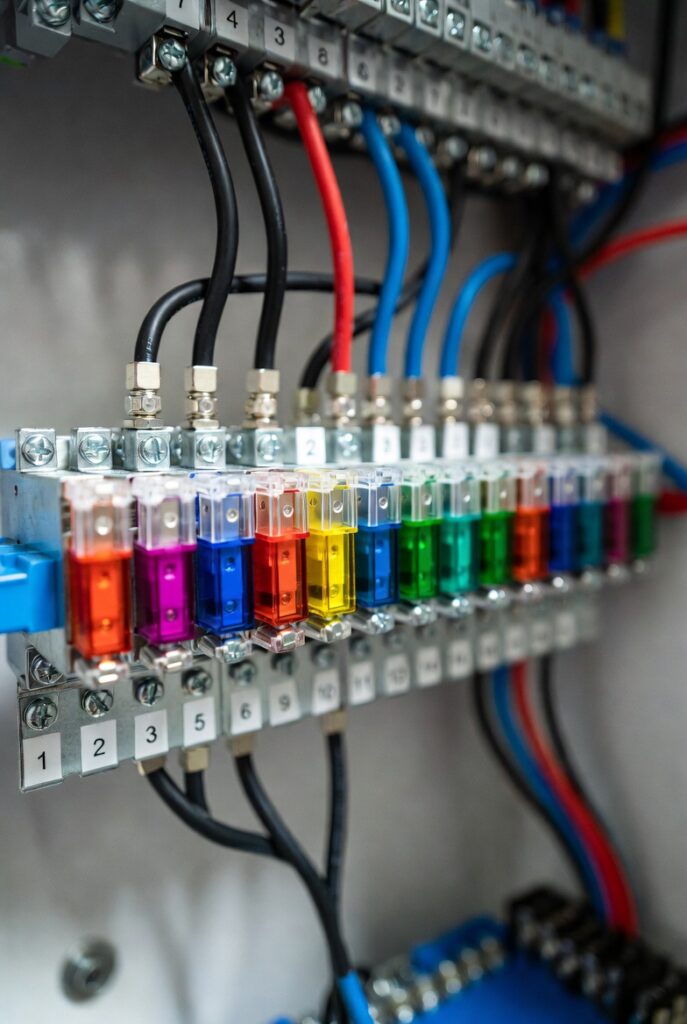
The correct solar fuse sizing architecture places the fuse between the power source and the wire it protects, sized to the wire ampacity at that point in the circuit. The Victron Lynx Distributor provides individual MIDI fuse positions for each circuit, each fuse sized to the ampacity of that circuit’s wire rather than to the load draw, ensuring that any overcurrent event opens the fuse before the wire reaches damage temperature. For the solar DC distribution Lynx MIDI fuse architecture and circuit isolation standard that covers the same wire-matched fuse sizing principle for DC distribution boards, Article 248 covers the full specification.
| Fuse Type | AIC Rating | Correct Application |
|---|---|---|
| Automotive blade fuse | 1,000A at 32V DC | Low-current auxiliary circuits under 30A on secondary fuse block |
| Marine ANL fuse | 2,000A at 32V DC | Mid-current circuits – not suitable as LFP main battery fuse |
| Class T fuse | 20,000A at 125V DC | Main LFP battery positive terminal – required for all LFP installations |
| MIDI fuse | 1,000A at 58V DC | Individual Lynx Distributor output circuits up to 200A |
The Class T Fuse and AIC Rating for LFP Banks
Solar fuse sizing AIC failures are the failure mode that does not blow the fuse at all — it sustains the arc across the fuse element after the element melts, because the fuse’s arc interruption capacity is lower than the battery bank’s available short-circuit current. I reviewed a fuse failure at a year-round off-grid home on the 6th Line of Grey Highlands Township in Grey County, Ontario near Markdale where the owner had installed a 400Ah 12V LFP battery bank with a 200A ANL fuse as the main battery protection fuse at the battery positive terminal. The ANL fuse was the 200A automotive-grade version rated for 32V maximum DC and 2,000A interrupting capacity. The LFP battery bank’s available short-circuit current at 12V is approximately 2,000 to 2,400A depending on the BMS configuration and the internal resistance of the bank at full charge.
On a February morning the MultiPlus-II’s DC input wiring developed a bolted fault at the inverter input terminal where the ring terminal had loosened from vibration and arced against the inverter chassis. The fault current reached 2,100A within 4 milliseconds. The 200A ANL fuse element melted at approximately 3 milliseconds as designed. However, the 32V maximum DC arc interruption rating of the ANL fuse was insufficient to quench the DC arc at 12V battery voltage with 2,100A of available fault current. The ANL fuse element had melted but the arc continued across the fuse body for 340 milliseconds before the battery BMS protection circuit reduced the fault current below the arc sustaining threshold. During the 340-millisecond arc event the fuse body reached 800°C and ignited the adjacent cable insulation. The owner extinguished the fire with the shop extinguisher before it spread to the battery enclosure. The damaged wiring and fuse holder replacement cost $640.
I replaced the ANL fuse with a 200A Class T fuse holder and Class T fuse rated for 125V DC and 20,000A interrupting capacity. The Class T fuse interrupts fault current in under 4 milliseconds at any current above its interrupting rating, including the 2,100A available from the bank, quenching the DC arc before it can sustain. The Victron Lynx Power-In provides the correct mounting position for the Class T fuse holder within 18cm of the battery positive terminal, accepting the main battery cable on its copper busbar. In 2 subsequent years without fault events the Class T fuse holder sits at the battery terminal providing correct arc interruption protection for an LFP bank at any system voltage up to 125V DC. The Class T fuse holder and fuse cost $68. The cable fire it prevents at the next bolted fault costs more than $68 every time.
The Solar Fuse Sizing Chart by Wire Gauge and System Voltage
Solar fuse sizing follows wire ampacity, not load wattage. The correct fuse for any circuit is the largest fuse that is equal to or less than the wire’s continuous ampacity rating at the installation temperature. For 12V systems: 14AWG wire rates 15A maximum fuse, 12AWG wire rates 20A maximum fuse, 10AWG wire rates 30A maximum fuse, 8AWG wire rates 50A maximum fuse, 6AWG wire rates 65A maximum fuse, 4AWG wire rates 85A maximum fuse, and 2AWG wire rates 115A maximum fuse. These ampacity ratings apply at 30°C ambient in free air with single conductor routing, and bundled conductors or conduit runs require derating by 20 to 25%.
For 24V systems the wire ampacity ratings are identical but the same wattage load draws half the current. A 1,000W load at 24V draws 41.7A, requiring 6AWG wire and a 50A fuse. The same 1,000W load at 12V draws 83.3A, requiring 4AWG wire and a 90A fuse. For 48V systems the same 1,000W load draws only 20.8A, allowing 10AWG wire and a 25A fuse. Higher system voltages require significantly smaller wire gauge for the same wattage load, which is one of the primary benefits of correct solar fuse sizing at higher bus voltages. For the solar air conditioning MultiPlus-II 48V system voltage and bus current standard that covers the same voltage-to-current relationship for high-wattage loads, Article 250 covers the full specification.
The Lug Torque Standard and Heat-Damaged Terminal Inspection
A loose lug connection at a battery terminal produces 0.003 to 0.010 ohm of contact resistance compared to 0.0001 ohm for a properly torqued lug, concentrating I²R heating at the 1cm² contact surface at 50W per cm² at 100A before any fuse in the system opens because the fault current is below the fuse trip threshold. This is the solar fuse sizing gap that no fuse chart addresses — the loose connection produces heat below the fuse trip point, meaning the fuse never opens while the terminal burns. The visual indicators of heat-damaged terminal connections visible without a thermal camera are: brown or black discolouration of the copper or tin plating on the lug face, brittle or cracked insulation within 20mm of the terminal, crystalline white deposits from oxidation accelerated by heat cycling, and deformation of the plastic terminal cover from heat transfer through the copper post.
The Victron SmartShunt detects rising contact resistance from a loose lug before visible discolouration occurs, showing abnormal current draw on a circuit that should be at the expected standby baseline. Manufacturer lug torque specifications for M8 battery terminals range from 8 to 12 Nm and for M10 terminals from 15 to 20 Nm, values that require a torque wrench to verify and that cannot be accurately applied by hand-tightening alone. For the solar DC distribution stacked ring terminal thermal failure and contact resistance standard that covers the same loose connection I²R heating mechanism for busbar connections, Article 248 covers the full specification.
The Solar Fuse Sizing Chart: Minimum Viable vs Full Overcurrent Standard
The solar fuse sizing decision follows whether the system has a correctly rated main battery fuse and whether each circuit fuse is matched to its wire ampacity rather than its load draw.
The minimum viable solar fuse sizing correction for a DIY system with blown fuses includes identifying whether the blown fuse is protecting undersized wire or indicating a genuine overloaded circuit, upgrading the wire to the correct gauge for the actual load ampacity, and installing a correctly rated MIDI fuse matched to the new wire ampacity. Capital cost runs $40 to $120 in wire and fuse hardware. It eliminates the blown fuse symptom by fixing the underlying wire sizing rather than bypassing the protection.
The full overcurrent protection standard for a complete off-grid system includes a Class T fuse at the main battery positive terminal within 18cm of the battery post, MIDI fuses on each Victron Lynx Distributor output circuit sized to wire ampacity, blade fuses on each low-current auxiliary circuit, a Blue Sea 600A disconnect for manual isolation before wiring work, and a torque-verified lug inspection confirming all terminal connections are within manufacturer torque specification. Capital cost runs $180 to $320. It provides correct arc interruption protection at every fault current level from LFP short-circuit current at the main fuse to the 15A auxiliary circuit level at the blade fuse block.
NEC and CEC: What the Codes Say About Solar Fuse Sizing
NEC 690.9 requires overcurrent protection for all current-carrying conductors in a solar installation, and the overcurrent protection device must be rated at no more than the ampacity of the conductor it protects under NEC 310. NEC 690.71 requires the main battery overcurrent protection device to be rated for the battery’s maximum available fault current and installed within 18cm of the battery positive terminal. The Class T fuse meets both NEC 690.71 fault current rating and proximity requirements for LFP battery installations at any system voltage up to 125V DC. Contact the NFPA for current NEC 690.9, NEC 690.71, and NEC 310 requirements applicable to solar fuse sizing and wire ampacity at Ontario residential and rural properties.
In Ontario, solar fuse sizing and overcurrent protection are subject to CEC Section 14 for conductor ampacity and overcurrent protection sizing, and CEC Section 64 for PV source circuit overcurrent protection. The main battery overcurrent protection device must be rated for the battery bank’s maximum available short-circuit current under CEC Section 14. Contact the Electrical Safety Authority Ontario for the current permit requirements applicable to solar fuse sizing and overcurrent protection at Ontario residential and rural properties before modifying any existing solar battery system fusing.
Pro Tip: Before sizing any fuse in a solar system, ask one question: what is the ampacity of the wire this fuse protects? I have reviewed solar installations where every fuse in the system was sized to the load wattage divided by the system voltage rather than to the wire ampacity. A 500W load at 12V draws 41.7A, so the installer specified a 45A fuse. The wire was 14AWG rated for 15A. The 45A fuse allowed the 14AWG wire to carry 3 times its rated ampacity before tripping. The wire was the fuse in that system and it was a wire fire waiting to happen. Size the fuse to the wire. Always.
The Verdict
A solar fuse sizing system built to the overcurrent standard means the Clearview Township Simcoe County owner never smells burning plastic at the 7-minute mark from 14AWG wire carrying 24A because the 30A replacement fuse was rated above the wire’s 15A damage threshold and the I²R heating of 28.6W over 6 metres had no protection to stop it, and the Grey Highlands Township Grey County owner never reaches for the shop extinguisher at 340 milliseconds into a bolted fault because a 200A ANL fuse with 2,000A AIC could not quench the arc from a 2,100A LFP short-circuit event.
- Match every fuse in the system to the wire ampacity it protects, not to the load wattage. The Clearview Township 15A fuse was correct. The 14AWG circuit was undersized for the simultaneous tool load. The fix was a 12AWG upgrade and a 20A fuse matched to the new wire. The fix cost $80. The wire fire it prevented was unquantifiable. Size the fuse to the wire. The wire does not fail safely.
- Replace every ANL fuse on every LFP battery bank main terminal with a Class T fuse rated for 20,000A AIC at 125V DC before the next fault event. The Grey Highlands ANL fuse had the correct trip current but the wrong arc interruption rating. It melted as designed and then sustained an 800°C arc for 340 milliseconds because 2,100A exceeded its AIC. The Class T fuse costs $68. The cable fire it prevents costs more every time.
- Torque-verify every lug connection in the system with a calibrated torque wrench before closing the electrical enclosure. A loose M8 lug producing 0.005 ohm of contact resistance generates 50W per cm² at 100A without tripping any fuse because the fault current is below the fuse threshold. M8 terminals require 8 to 12 Nm. M10 terminals require 15 to 20 Nm. Use the torque wrench.
In the shop, we do not replace a 15A fuse with a 30A fuse to stop it blowing. We find out why the 15A is blowing and fix the circuit. At the solar installation, we do the same thing. The fuse blowing is the diagnosis. The bigger fuse is not the cure.
Frequently Asked Questions
Q: Why does my solar fuse keep blowing and should I replace it with a bigger one? A: A fuse blowing means the circuit is drawing more current than the fuse’s trip rating continuously. The correct response is to identify why the circuit is drawing excess current — either the load requires more current than the wire is rated for, requiring a wire upgrade and a matched fuse, or a fault exists in the circuit producing overcurrent. Replacing a blown fuse with a larger one allows the wire to carry current above its rated ampacity, producing I²R heating that the new fuse will no longer prevent. The wire becomes the fuse and the wire is not designed to blow safely.
Q: What is AIC rating and why does it matter for a lithium battery bank? A: AIC is Ampere Interruption Capacity, the maximum fault current a fuse can safely interrupt without sustaining a DC arc after the fuse element melts. A standard ANL fuse has a 2,000A AIC at 32V DC. An LFP battery bank of 200Ah at 12V can produce 1,500 to 2,500A of short-circuit current. If the available fault current exceeds the fuse’s AIC rating the fuse element melts but the arc continues across the fuse body, producing sustained arcing at 800°C that ignites adjacent wiring. A Class T fuse has a 20,000A AIC at 125V DC, providing correct interruption for any LFP bank short-circuit event.
Q: How do I check if my battery terminal connections are causing heat damage without a thermal camera? A: Visually inspect each lug connection for brown or black discolouration on the copper or tin plating, brittle or cracked insulation within 20mm of the terminal lug, crystalline white deposits on the copper from heat-accelerated oxidation, and any deformation of the plastic terminal cover. Any of these indicators means the connection has been operating at above-rated temperature from loose contact resistance. Retorque the connection to manufacturer specification using a torque wrench, M8 terminals require 8 to 12 Nm and M10 terminals require 15 to 20 Nm, and reinspect at 30 days to confirm the discolouration has not progressed.
Questions? Drop them below.
Master Tech Advisory: This build is engineered within the 48V DC Safety Ceiling. Diagnostic logic is based on 20+ years of technical service experience. All structural and electrical installations must be verified by a Licensed Professional and comply with your Local Authority Having Jurisdiction (AHJ).
This post contains affiliate links. If you purchase through our links, we may earn a small commission at no extra cost to you.