
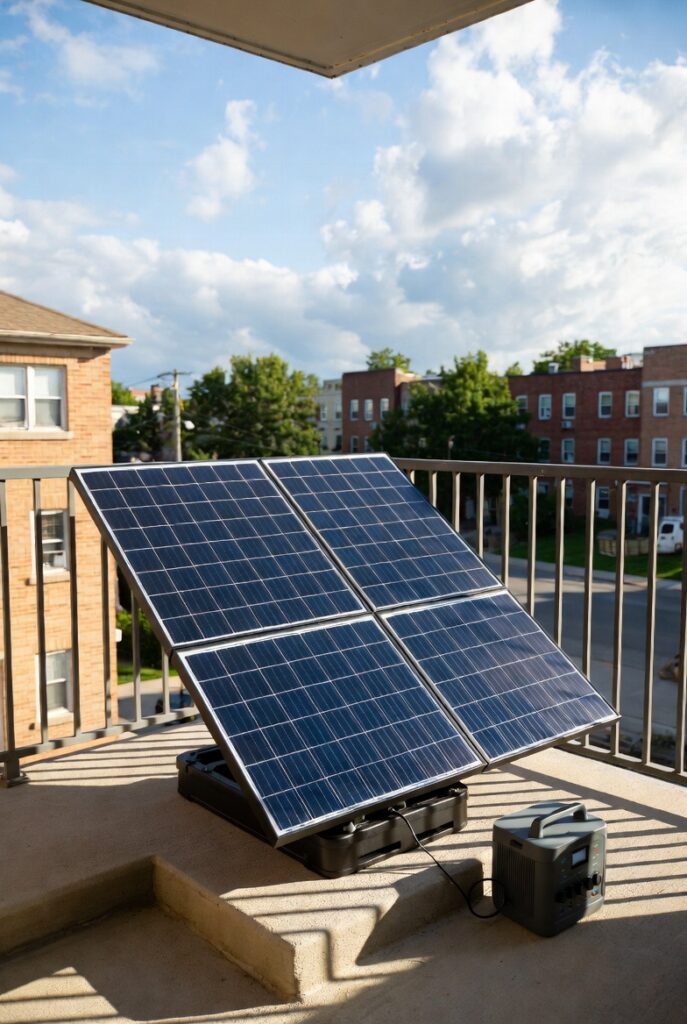
Solar for renters is not about roof mounts or permanent installations. It is the moment a young professional realizes his south-facing balcony can power his home office for free using equipment that fits in a closet. I helped a renter in a Kitchener apartment building set up a portable solar system in summer 2025. He worked from home three days per week. His laptop, monitors, and desk lamp drew approximately 180W for 8 hours daily. His monthly electricity bill included $45 just for his home office equipment. He wanted to reduce that cost but could not modify the building.
We designed a solar for renters setup using a 200W foldable panel on a weighted floor stand positioned on his south-facing balcony. The panel connected to an Anker SOLIX C1000 Gen 2 portable power station stored inside his apartment. The balcony received direct sunlight from 10 AM to 4 PM. The 200W panel produced approximately 1.2 kWh on clear days and 0.6 kWh on overcast days. His average daily production was 0.9 kWh. His home office consumed 1.44 kWh daily. The solar covered 62% of his office load on average.
The equipment cost $1,850 total. His monthly electricity savings averaged $28. The simple payback period was 66 months or 5.5 years. However, he enrolled in ULO rates and added overnight charging to his routine. He now charges the power station at 3.9 cents per kWh from 11 PM to 7 AM, topping up whatever the solar did not provide. His combined solar and arbitrage savings reached $52 monthly. The payback dropped to 36 months. More importantly, when he moves to a new apartment next year, the entire system goes with him. For the ULO arbitrage strategy that accelerates payback for any solar system, The Solar Payback Standard covers the full calculation.
Why Solar for Renters Works: The Portable Power Advantage
The solar for renters advantage is portability. A permanent roof mount stays with the building. A portable system stays with you. The renter who moves every 2 to 3 years builds no equity in a permanent installation. The renter who owns portable equipment accumulates a personal energy asset that follows him from apartment to apartment.
The Kitchener renter’s setup will have paid for itself before he moves. When he leaves, the system goes in the trunk of his car. His next apartment gets the same benefit with zero additional investment. The portability transforms solar from a building improvement into a personal asset.
This shift in ownership matters for young professionals who expect to move multiple times before buying property. A permanent installation benefits the landlord. A portable installation benefits the renter. For the solar system sizing principles that apply to any installation, The Solar Sizing Guide covers the full specification.
The Solar for Renters Setup: Balcony Panels and Power Stations
The core solar for renters setup has three components. First, foldable or portable panels that deploy on a balcony and store inside when not in use or during storms. Second, a portable power station like the Anker SOLIX C1000 Gen 2 that stores production and powers devices. Third, a weighted stand that positions panels at optimal tilt without drilling or permanent mounting.
The 200W to 400W panel range suits most balcony spaces. The 1 to 2 kWh power station range stores a full day of production. The complete setup fits in a closet when collapsed. Storm preparation takes 5 minutes to bring panels inside.
The integration is simple. The panel connects to the power station via included cables. The power station charges from solar during the day and from wall outlet overnight on ULO rates. Devices plug directly into the power station outlets. No electrician required. No permits required. No building modifications required.
The Zero-Drill Rule: Weighted Stands and Lease Compliance
The zero-drill rule is non-negotiable for solar for renters installations. Any drilling, bolting, or permanent attachment to the building structure violates most leases and can result in damage charges or eviction. Weighted floor stands use sandbags or concrete blocks for stability. The stand sits on the balcony floor and supports the panel at optimal tilt angle.
Suction mounts work on glass surfaces but require careful weight limits. Clamp mounts on railings fall into a grey area and may violate aesthetics clauses. The safest path is a freestanding weighted stand that touches nothing but the floor. It leaves zero footprint when removed.
A 200W panel in a weighted stand requires approximately 20 to 30 pounds of ballast weight to remain stable in moderate wind. Sandbags are the easiest ballast option. They can be emptied for moving and refilled at the new location. The entire stand and ballast system costs $50 to $100.
Window vs Balcony: Why Glass Kills Your Production
Placing panels behind glass loses 30% to 50% of potential production. Glass filters UV spectrum and reduces light intensity. A 100W panel behind a window produces 50W to 70W effective output. The same panel on a balcony produces full rated output.
A Renogy 100W flexible panel on a balcony outproduces a 150W rigid panel behind glass. Always choose outdoor placement when available. Window placement is the fallback for apartments with no balcony access. Even poor outdoor placement beats good indoor placement.
The glass loss applies to all types of windows including double-pane, low-E coated, and tinted glass. Low-E coating designed to reject solar heat also rejects the solar energy your panel needs. Tinted glass can reduce production by 60% or more. If window placement is your only option, choose a window with clear glass and no low-E coating.
Lease Considerations: Checking Before You Buy
I received a message from a renter near Barrie in Simcoe County, Ontario in fall 2025. He had mounted two 100W panels on his apartment balcony railing using clamp brackets. His landlord had sent a notice citing lease violation for “unauthorized exterior modifications.” The panels were visible from the parking lot. Other tenants had complained about the “industrial appearance.” He faced a choice between removing the panels or fighting the notice.
I reviewed his lease with him. The lease contained standard language prohibiting “drilling, bolting, or otherwise modifying the building exterior.” It also contained a clause about “maintaining balcony aesthetics consistent with building standards.” The clamp brackets arguably fell into a grey area on the modification clause. The aesthetics clause was clearly violated by the visible panel installation. The landlord had grounds to enforce removal. The solar for renters setup had to come down or be reconfigured.
We redesigned using a low-profile weighted floor stand that kept the panels below the railing height. The panels were no longer visible from ground level. The stand used sandbag weights rather than any attachment to the building. The landlord accepted this configuration as compliant with both clauses. The output dropped by approximately 15% due to the lower mounting angle and partial railing shadow. However, 85% of his production was better than zero production and an eviction notice. The lesson for solar for renters is to check your lease before you buy, not after. For the ground mount principles that apply to balcony weighted stands, The Solar Ground Mount Standard covers tilt angles and stability.
Solar for Renters Payback: ULO Arbitrage and Combined Savings
The solar for renters payback accelerates dramatically with ULO arbitrage. Solar production alone on a 200W balcony setup saves $25 to $35 monthly depending on sun exposure. Adding ULO arbitrage with overnight charging at 3.9 cents adds another $15 to $25 monthly. Combined savings reach $40 to $60 monthly.
A $1,850 setup achieves payback in 30 to 46 months depending on sun exposure and usage pattern. The Kitchener renter hit 36-month payback with combined strategy. His $52 monthly savings will exceed his equipment cost before his lease ends.
For current ULO program enrollment, visit Ontario Electricity Rates. The enrollment is free and takes effect on the next billing cycle. Any renter with a portable power station can benefit from ULO arbitrage even without solar panels. For the Ontario rebate programs that may eventually extend to renters, The Ontario Solar Rebate Standard covers current homeowner incentives.
The Exit Strategy: Your System Moves When You Move
Unlike permanent installations, a portable solar system is a personal asset. The renter who installs a roof mount adds value to the landlord’s property. The renter who owns portable equipment adds value to his own life. When the lease ends, the panels fold up, the power station unplugs, the stand disassembles, and everything fits in a car trunk or moving box.
The next apartment gets immediate benefit with zero additional investment. A system that has already achieved payback provides free electricity at every subsequent address. The Kitchener renter will move to a new apartment in 2026. His solar for renters system goes with him. His new landlord benefits zero. He benefits completely.
The portability is not a limitation. It is the primary advantage of solar for renters. A homeowner’s roof mount is tied to the property. A renter’s portable system is tied to the renter. Over a career of multiple rentals, the portable system provides value at every address while the renter builds toward eventual homeownership.
Minimum Viable vs Full Standard: Choosing Your Investment Level
The minimum viable solar for renters setup includes a single 100W foldable panel, a 500Wh power station like the Bluetti Elite 200 V2, and a simple weighted stand. Cost runs $500 to $700. Daily production is 0.4 to 0.6 kWh. Payback period is 4 to 6 years. This level suits renters testing solar for renters viability before larger investment.
The full portable solar standard includes dual 200W panels, a 2kWh power station like the Anker SOLIX C1000 Gen 2, and an adjustable weighted stand with tilt capability. Cost runs $1,800 to $2,400. Daily production is 1.5 to 2.5 kWh. Payback period is 3 to 4 years with ULO arbitrage. This level suits renters committed to maximum savings.
| Setup Level | Components | Cost | Daily Production | Payback |
|---|---|---|---|---|
| Minimum Viable | 100W panel + 500Wh station + stand | $500-$700 | 0.4-0.6 kWh | 4-6 years |
| Full Standard | 400W panels + 2kWh station + adjustable stand | $1,800-$2,400 | 1.5-2.5 kWh | 3-4 years |
Both solar for renters approaches use the same portable principles. The difference is production capacity and payback speed.
Frequently Asked Questions
Q: Is solar for renters worth the investment if I only stay 2 to 3 years?
A: Yes, because the system moves with you. A solar for renters setup that achieves 36-month payback at your current apartment continues producing free electricity at every subsequent address. Unlike permanent installations that stay with the building, portable equipment is a personal asset that follows you from rental to rental.
Q: Can I do solar for renters without a balcony?
A: Yes, but with reduced production. Window placement behind glass loses 30% to 50% of potential output. However, a power station alone enables ULO rate arbitrage without any panels. Charging at 3.9 cents overnight and using stored power during peak hours saves $7 to $15 monthly depending on capacity. The solar for renters concept includes grid arbitrage even without solar production.
Q: Will solar for renters violate my lease agreement?
A: It depends on your specific lease language. Most leases prohibit drilling or permanent modifications. Weighted floor stands that touch only the balcony floor typically comply. Railing clamps may violate aesthetics clauses. Always check your lease before purchasing equipment. A below-railing setup that is not visible from ground level is the safest approach for solar for renters compliance.
Pro Tip: Before you buy any solar for renters equipment, take photos of your balcony at 10 AM, noon, and 2 PM on a sunny day. Check for shadows from upper balconies, building features, or nearby structures. A south-facing balcony that gets direct sun only from noon to 2 PM produces half the power of one with 6 hours of exposure. The Kitchener renter’s south-facing balcony had clear sun from 10 AM to 4 PM. That 6-hour window made his solar for renters setup viable. A 2-hour window might not justify the investment.
Verdict
- The Kitchener Solar for Renters Standard. The apartment renter reduced his home office electricity cost by $52 monthly using a balcony setup that fits in a closet. His $1,850 investment achieves 36-month payback through combined solar production and ULO arbitrage. When he moves next year, the entire system goes in his trunk. His next apartment gets immediate benefit with zero additional cost.
- The Barrie Lease Compliance Standard. The renter who mounted panels visibly on his railing received a lease violation notice and faced removal or eviction. He redesigned with a below-railing weighted stand that kept 85% of production while staying compliant. The lesson is to check your lease before you buy equipment, not after the landlord sends a notice.
- The Portable Asset Standard. A solar for renters system is a personal asset that moves with you from rental to rental. Unlike permanent installations that benefit the landlord, portable equipment benefits the renter. A system that achieves payback at your first apartment provides free electricity at every subsequent address for the rest of your renting career.
This build is engineered within the 48V DC Safety Ceiling. Diagnostic logic is based on 20+ years of technical service experience. All structural and electrical installations must be verified by a Licensed Professional and comply with your Local AHJ.
This article contains affiliate links. If you purchase through these links, I earn a small commission at no extra cost to you.
Questions? Drop them below.