
Solar DC distribution failures from stacked battery terminals are not electrical failures in the conventional sense. They are thermal failures, slow and invisible accumulations of contact resistance at a 3cm² battery post that produce 460W of concentrated heat at 240A until the ABS plastic terminal cover softens and the insulation on the bottom ring terminal melts into the post thread. I was called to inspect a solar installation at a residential property on the 6th Line of Essa Township in Simcoe County, Ontario where the homeowner had built a 200Ah 12V LFP battery bank using two Battle Born 100Ah modules and connected eight separate loads directly to the battery positive terminal: the MultiPlus-II inverter at 200A peak, the MPPT charge controller at 30A, LED lighting circuits at 8A total, the refrigerator at 6A, the water pump at 12A, two USB charging strips at 4A combined, and a propane heater fan at 3A. Each load had its own ring terminal crimped to its own wire, stacked in order of installation from the bottom of the post upward. The stack was 8 ring terminals deep on a single M8 thread, secured with the original M8 nut at the top. The owner had noticed LED light flickering for 3 weeks and assumed the LED driver was failing.
On inspection I found the bottom three ring terminals had fused together from thermal bonding. The tin plating on the copper terminals had reached its melting point of 232°C from resistive heating and cold-welded to each other and to the battery post thread. The M8 nut at the top of the stack was finger-loose because the terminal stack had compressed from thermal cycling. Each ring terminal contact interface has a contact resistance of approximately 0.001 ohm when new and clean. Eight stacked terminals in series produced 0.008 ohm of total contact resistance at the battery positive post. At the system’s peak simultaneous load current of 240A the resistive heating was I²R = 240² × 0.008 = 460W concentrated at the battery terminal. The LED flickering was caused by the loose M8 nut allowing the terminal stack to move under vibration, intermittently dropping the voltage to the lighting circuit by 0.4 to 0.8V. The thermal damage to the bottom terminals had been accumulating for the entire 4 months the system had been operating.
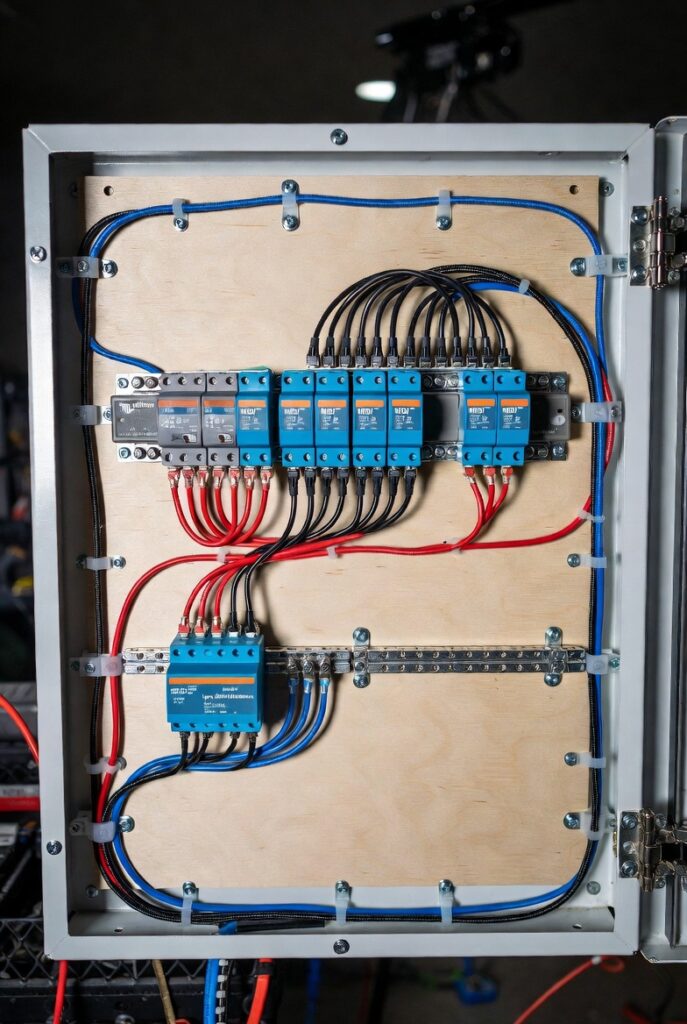
I replaced the entire DC distribution system with a Victron Lynx Power-In as the main battery connection point and a Victron Lynx Distributor as the centralized fused output busbar. The Lynx Power-In accepts the main battery cables on its copper busbar and provides a single Class T fuse protection point for the entire bank’s short-circuit current. The Lynx Distributor provides four individual MIDI fuse-protected output circuits for the inverter, MPPT, and high-current loads, each on its own fused connection to the copper busbar. The low-current lighting, refrigerator, pump, and USB circuits connect to a secondary 6-circuit fuse block wired from a single 30A output on the Lynx Distributor. As a result the battery positive terminal has exactly one connection, the main cable to the Lynx Power-In. The copper busbar contact resistance is 0.00003 ohm per connection point, producing 1.7W of heating at 240A compared to 460W at the stacked terminal. The Lynx installation cost $420. For the workshop solar power Victron MultiPlus-II DC bus current and LF transformer architecture that covers the same DC bus current management principle for high-wattage resistive loads, Article 243 covers the full specification. For the full system sizing hub that covers the load calculation foundation, the hub covers the numbers.
Why Solar DC Distribution Fails at the Battery Terminal
A ring terminal on a copper battery post has approximately 0.001 ohm of contact resistance when new and properly torqued. After 6 to 12 months of thermal cycling the oxidised tin plating increases this to 0.003 to 0.008 ohm per interface. Eight stacked terminals in series produce 0.008 to 0.064 ohm of total contact resistance, and at 200A the I²R heating is 320 to 2,560W concentrated in a 3cm² surface area. The Victron Lynx Distributor copper busbar has 0.00003 ohm per lug connection, producing 1.2W at 200A, 267 times less heating than the stacked ring terminal at the same current.
As a result the LED flickering, intermittent voltage drops, and melted terminal plastic are not symptoms of a wiring fault. They are symptoms of a thermal failure accumulating at the battery post that the Lynx busbar architecture eliminates entirely. For the solar water pump DC bus voltage drop and resistive heating standard that covers the same I²R heating principle in conductor resistance, Article 246 covers the full specification.
| Distribution Method | Contact Resistance at Battery Post | Resistive Heating at 200A |
|---|---|---|
| Stacked ring terminals – 8 terminals on M8 post | 0.008 to 0.064 ohm – increases with thermal cycling | 320 to 2,560W – concentrated in 3cm² surface area |
| Victron Lynx Distributor copper busbar | 0.00003 ohm per lug connection | 1.2W – 267 times less than stacked ring terminals |
The Class T Fuse and Short-Circuit Protection
Solar DC distribution fire risks from unfused battery cables are not theoretical. They are a 2AWG wire running 1.8 metres from a 200Ah LFP battery positive terminal to an inverter with no overcurrent protection between the battery terminal and the inverter input. I reviewed a near-miss DC fire at a seasonal property on the 3rd Concession of Tiny Township in Simcoe County, Ontario near Penetanguishene where a solar installer had run a 2AWG positive cable from the battery bank to the MultiPlus-II inverter with no main fuse between the battery terminal and the inverter. The installer had assumed the MultiPlus-II internal protection circuit would handle any fault.
The MultiPlus-II’s internal protection is designed to protect the inverter from overload, not to protect the wiring from battery short-circuit current. On a June morning the MultiPlus-II’s DC input capacitor bank failed from a surge event, creating a direct short circuit across the inverter’s DC input terminals. The 200Ah LFP bank’s short-circuit current capability is approximately 2,000A at 12V. The 2AWG cable from the battery to the inverter began carrying 2,000A through conductors rated for 95A. At 2,000A through 2AWG wire the I²R heating is 2,000² × 0.000528 = 2,112W per metre of cable. The cable insulation ignites at approximately 300°C, which the cable reaches from ambient in approximately 280 milliseconds at 2,112W per metre. The cable insulation ignited in the cable tray before the battery BMS could respond. The property owner smelled burning plastic and disconnected the battery using a manual switch before the fire spread. The cable replacement and inverter replacement cost $1,840.
I installed a Class T fuse holder with a 200A Class T fuse on the battery positive terminal within 18cm of the battery post before any other connection point. The Class T fuse interrupts fault current in under 4 milliseconds at 2,000A, before the cable insulation reaches ignition temperature. Any future inverter DC input fault is interrupted at the fuse in under 4 milliseconds without any cable heating event. The Class T fuse holder and fuse cost $68. The Victron Lynx Power-In provides the correct mounting point for the Class T fuse holder within 18cm of the battery positive terminal, accepting the main battery cable on its copper busbar and routing all downstream circuits through the Lynx Distributor from a single protected connection. For the generator ground bond Class T main fuse and DC overcurrent protection standard that covers the same short-circuit current and fuse interrupting rating principle for MultiPlus-II DC bus protection, Article 245 covers the full specification.
The MIDI Fuse Architecture and Circuit Isolation
The Victron Lynx Distributor provides four MIDI-fused output positions, each with its own 58V-rated MIDI fuse sized for the individual circuit’s maximum current demand. The inverter output position accepts a 200A MIDI fuse for the MultiPlus-II peak current demand. The MPPT output accepts a 40A MIDI fuse for the charge controller maximum output. The auxiliary high-current output accepts a 30A MIDI fuse feeding the secondary fuse block for low-current loads.
As a result when the refrigerator compressor fails and creates a sustained overcurrent event the 10A fuse on the refrigerator circuit in the secondary fuse block opens while the inverter, MPPT, lighting, and USB circuits continue operating normally on their independent Lynx and fuse block positions. In a stacked terminal architecture the same refrigerator overcurrent event propagates a voltage drop spike through the shared resistance path to every circuit simultaneously because they share the same battery post resistance. The circuit isolation benefit of the Lynx architecture means that fault diagnosis is reduced to the specific blown MIDI fuse rather than an intermittent voltage symptom on every circuit at once. For the remote well solar dry-run current detection and per-circuit fault isolation standard that covers the same independent circuit fault isolation principle for DC pump monitoring systems, Article 241 covers the full specification.
The Solar DC Distribution System: Minimum Viable vs Full Lynx Standard
The decision follows whether the system has more than 3 high-current loads requiring individual fuse protection and whether a main disconnect for safe wiring isolation is required.
The minimum viable solar DC distribution system for a single battery bank with an inverter, MPPT, and up to 4 auxiliary loads includes a Victron Lynx Power-In as the main battery connection with Class T fuse protection and a Victron Lynx Distributor with 4 MIDI-fused output circuits. Capital cost runs $280 to $380. It eliminates stacked ring terminal thermal failure and provides individual overcurrent protection for every high-current circuit from a single copper busbar connection to the battery bank.
The full Lynx standard for a complete residential off-grid build includes a Victron Lynx Power-In, a Victron Lynx Distributor, a Blue Sea 600A disconnect between the Lynx Power-In and the battery, a secondary 6-circuit fuse block for low-current auxiliary loads, and a Victron SmartShunt on the Lynx Power-In shunt connection logging total system current. Capital cost runs $480 to $680. It provides main disconnect isolation, individual circuit protection, system current monitoring, and a fully serviceable DC distribution architecture that any electrician can diagnose from the fuse positions alone.
NEC and CEC: What the Codes Say About Solar DC Distribution
NEC 690 governs the overcurrent protection and disconnecting means for solar DC distribution systems including the PV source circuits, battery bank circuits, and inverter input circuits. NEC 690.9 requires overcurrent protection for all conductors in a solar DC distribution system, and NEC 690.71 requires the main battery overcurrent protection device to be rated for the battery’s maximum available fault current and installed within 18cm of the battery positive terminal. The Class T fuse meets both NEC 690.71 fault current rating and the 18cm proximity requirement for LFP battery banks. Contact the NFPA for current NEC 690 requirements applicable to solar DC distribution overcurrent protection at Ontario residential and rural properties.
In Ontario, the solar DC distribution system is subject to CEC Section 64 for PV source circuits and CEC Section 26 for battery storage installations. The main battery overcurrent protection device must be rated for the battery’s maximum available short-circuit current under CEC Section 14. Contact the Electrical Safety Authority Ontario for the current permit requirements applicable to solar DC distribution systems at Ontario residential and rural properties before connecting any battery bank to a fixed DC distribution busbar.
Pro Tip: Before connecting anything to a battery bank, count the number of ring terminals you are planning to stack on the positive post and multiply by 0.001 ohm. Then multiply by the square of your peak simultaneous current to get the watts of resistive heating you are building into the terminal. I have reviewed solar builds where the math produced 640W of heating on a single M8 battery post terminal at a peak load of 280A. That is not an electrical system. That is a soldering iron pointed at the ABS battery case. The Lynx Distributor costs $180. The battery fire it prevents is uninsurable.
The Verdict
A solar DC distribution system built to the Lynx standard means the Essa Township Simcoe County homeowner never finds 460W of resistive heating cold-welded across the bottom three ring terminals of an 8-terminal M8 stack after 4 months of operation while blaming the LED driver for flickering lights, and the Tiny Township Simcoe County property owner never smells burning plastic from a 2AWG cable carrying 2,000A for 280 milliseconds because there was no Class T fuse between the LFP bank and the MultiPlus-II inverter input.
- Replace every stacked ring terminal connection on every battery positive post with a Victron Lynx Power-In and Lynx Distributor before commissioning any system where the simultaneous load current exceeds 50A. The Essa Township terminal stack was producing 460W of heating at 240A peak current from 0.008 ohm of stacked contact resistance. The Lynx Distributor produces 1.2W at the same current from 0.00003 ohm of busbar resistance. The Lynx installation cost $420. The thermal repair it prevents cost more on the first call-out.
- Install a Class T fuse within 18cm of the battery positive terminal before any other connection in every LFP battery bank installation. The Tiny Township installer assumed the MultiPlus-II internal protection would handle the fault. It handles inverter overload. It does not handle 2,000A of LFP short-circuit current through 2AWG cable rated for 95A. The Class T fuse interrupts that current in under 4 milliseconds. The cable insulation ignites in 280 milliseconds without it. The fuse costs $68. The shed fire it prevents is uninsurable.
- Wire every circuit in the system to its own MIDI fuse position on the Lynx Distributor rather than sharing a battery post with any other circuit. The circuit isolation means a blown refrigerator fuse does not produce a voltage spike on the inverter, the MPPT, or the lighting circuits simultaneously. The fault shows up as a single dark blown MIDI fuse rather than an intermittent symptom on every circuit at once.
In the shop, we do not wire six accessories to one ignition circuit and call it a distribution system. We run a fused home run from the battery to each circuit through a fuse block. At the solar installation, we do not stack six ring terminals on one battery post and call it wiring. We run a single cable to the Lynx busbar and protect every circuit from there.
Frequently Asked Questions
Q: Why do stacked ring terminals on a battery post cause LED lights to flicker? A: Each ring terminal contact interface adds approximately 0.001 ohm of contact resistance. Eight stacked terminals produce 0.008 ohm of total contact resistance at the battery post. At 200A the resistive heating is 320W concentrated at the terminal stack, which causes the M8 nut to loosen from thermal expansion and contraction cycles. The loose nut allows the terminal stack to shift under vibration, intermittently dropping the voltage to all circuits sharing that post by 0.4 to 0.8V. The LED driver interprets the voltage drop as a low-battery event and dims the output.
Q: What is the difference between a Class T fuse and an ANL fuse for a lithium battery bank? A: An ANL fuse at 200A requires 10 to 40 milliseconds to interrupt current at 2,000A fault levels. A Class T fuse at the same rating interrupts current in under 4 milliseconds at 2,000A. The 36-millisecond difference is the difference between 2AWG cable reaching 180°C and reaching above the copper melting point of 1,085°C during a battery short-circuit event. A Class T fuse provides protection against hard fault conditions that an ANL fuse cannot interrupt quickly enough to prevent conductor damage at LFP battery short-circuit current levels.
Q: Why does the Lynx Distributor use MIDI fuses rather than standard blade fuses for DC circuit protection? A: MIDI fuses are rated for 32V to 58V DC and have an interrupting rating sufficient for the short-circuit current available from a LFP battery bank at the Lynx Distributor’s position downstream of the Class T main fuse. Standard blade fuses are rated for 32V maximum and have lower interrupting ratings unsuitable for high-voltage DC bus protection. The MIDI fuse format also allows individual circuit replacement without tools, with the fuse pulling directly from the Lynx Distributor carrier, which makes circuit fault diagnosis and restoration faster than any alternative format.
Questions? Drop them below.
Master Tech Advisory: This build is engineered within the 48V DC Safety Ceiling. Diagnostic logic is based on 20+ years of technical service experience. All structural and electrical installations must be verified by a Licensed Professional and comply with your Local Authority Having Jurisdiction (AHJ).
This post contains affiliate links. If you purchase through our links, we may earn a small commission at no extra cost to you.