
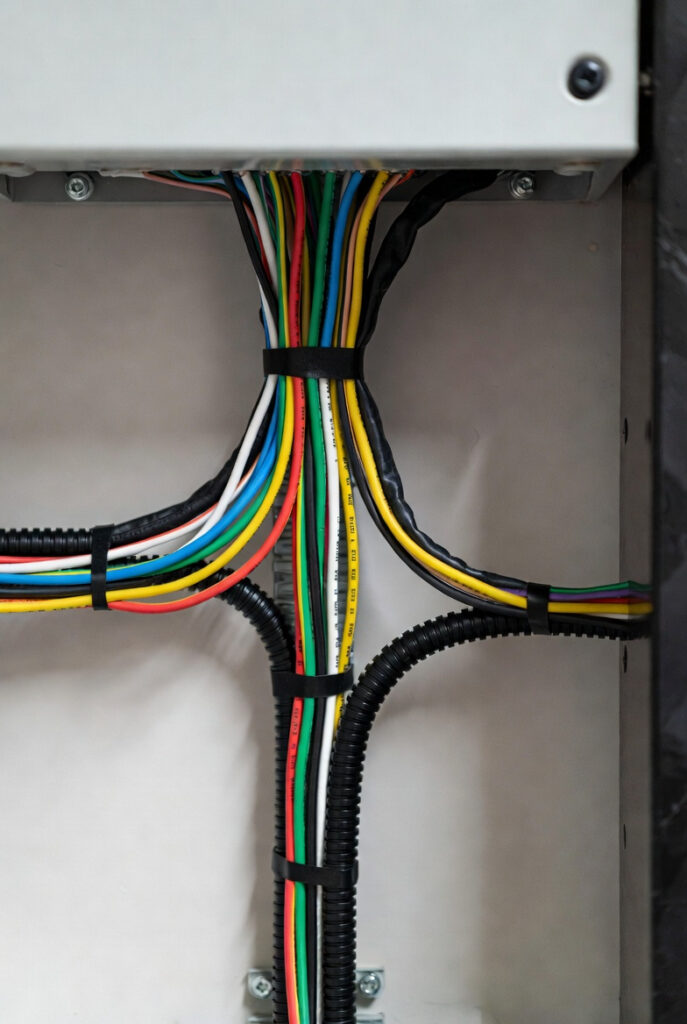
Eight solar panel strings running loose wires to a charge controller is not a system it is a fire waiting for the right conditions. A solar combiner box is the management tier of your array the point where eight messy wires become two clean cables, every string gets its own protection, and lightning has somewhere safe to go that is not your inverter. Before wiring your array understand how much solar power you actually need so you know how many strings you are combining.
I inspected a DIY system last summer where someone had used a plastic food storage container as a combiner box wire nuts and electrical tape inside. The lid had warped from summer heat before the electricity ever caused a problem. That container was 6 inches from the panels on a south-facing roof. In January it would crack from cold. In July it nearly melted. A proper solar combiner box costs $40. The consequences of skipping it cost much more.
Solar Combiner Box: The Rule of Three
When you need one: Two parallel strings of panels can be safely connected with MC4 branch connectors the back feed current from one string to another is limited enough that panel wiring handles it without damage. Three or more parallel strings change the equation. NEC Article 690 requires fused overcurrent protection for each string when three or more strings are paralleled.
Why three strings is the trigger: With three parallel strings a fault in one string a shorted cell, damaged wire, water-infiltrated junction box draws back feed current from the other two strings simultaneously. That combined back feed exceeds the rated capacity of the panel wiring and junction boxes. Without individual string fuses in a solar combiner box this current flows unchecked. The fault becomes a fire.
The junction block analogy: You would not run 8 separate wires from 8 batteries to a single starter motor. You run them to a junction block one organized connection pointthen one heavy cable to the starter. A solar combiner box is the junction block of your array. Organization, protection, and the ability to troubleshoot any string from one location without climbing the roof.
What Is Inside a Solar Combiner Box
A quality solar combiner box contains four functional elements. Understanding each one tells you what to look for when buying.
1 – Positive and Negative Busbars: Heavy copper or aluminum bars that collect positive conductors from all incoming strings onto one output terminal and all negative conductors onto another. The busbar is what physically merges multiple strings into a single output cable. Size matters a busbar rated for 100A handles more strings than one rated for 40A.
2 – Individual String Fuses or Breakers: One per string. Each positive conductor runs through its own fuse or breaker before reaching the positive busbar. If one string develops a fault the fuse opens that circuit preventing back feed from other strings and allowing remaining strings to continue producing. A system without individual string protection has no way to isolate a fault without shutting down the entire array. See our DC Fuse Sizing guide for correct fuse sizing for your string current.
3 – Surge Protection Device (SPD): The solar combiner box is the optimal location for lightning surge protection. An SPD clamps transient overvoltages from nearby lightning strikes redirecting surge energy to the ground bus rather than allowing it to travel to the charge controller, battery bank, and inverter. Induced voltage from a strike 500 meters away can destroy every piece of electronics in the system. An SPD at the combiner box costs $20-50. A Victron SmartSolar MPPT costs $200-400. Install the SPD. For the complete grounding picture see our Solar Inverter Grounding guide.
4 – Ground Bus: All equipment grounds from panel frames, array mounting structure, and the SPD connect here. From the ground bus a single conductor runs to the system ground. This ensures the entire array is bonded to ground at one location through one conductor.
The Cold Climate Enclosure Requirement
This is the cold climate detail completely absent from every solar combiner box guide.
NEMA ratings explained:
- NEMA 3R: Rainproof. Protects against rain and sleet. Not sealed against windblown dust or ice. Adequate for protected outdoor locations under a roof overhang or in a covered equipment bay.
- NEMA 4X: Watertight and corrosion-resistant. Protects against rain, sleet, windblown dust, and hose-directed water. Stainless steel or fiberglass construction resists rust. Required for exposed outdoor installations in wet and corrosive environments.
The Ontario winter reality: A solar combiner box on a ground mount array in Rockwood faces 4 months of snow, freezing rain, ice accumulation, and freeze-thaw cycles. A plastic enclosure rated IP65 may handle summer rain but becomes brittle below -20°C cracking at seal points and admitting moisture. Standard zinc-plated steel enclosures corrode within 2–3 Ontario winters. For outdoor exposed installations in cold climates NEMA 4X is the minimum. For protected locations under an equipment cover NEMA 3R is acceptable.
Budget vs Pro – Choosing the Right Solar Combiner Box
The budget entry – ECO-WORTHY 4 String: The ECO-WORTHY 4 String PV Combiner Box is the right choice for a 3-4 string system up to 500V on a budget. Includes string fuses, surge protection device, and circuit breaker. IP65 waterproof. Pre-wired MC4 connections. Cost approximately $40–60. Limitation: plastic enclosure becomes brittle in extended Ontario cold. Best suited for protected installations where the box is out of direct weather exposure.-The pro choice – Midnite Solar MNPV6: The Midnite Solar MNPV6 is the most installed PV combiner in North America for residential and commercial off-grid systems. Gray aluminum NEMA 3R enclosure. Accepts six 150VDC breakers or four 600VDC fuse holders. ETL listed for US and Canada. Made in the USA. 5-year warranty. Breakers and fuse holders sold separately allowing exact configuration for your string voltage and current. Cost: $120-180 for the enclosure plus $15–25 per breaker.
When to choose which:
- 3-4 strings, 12V or 24V system, protected location: ECO-WORTHY is adequate
- 4-6 strings, any voltage, exposed outdoor Ontario installation: Midnite Solar MNPV6
- Any system with LiFePO4 batteries where lightning protection is critical: Midnite Solar MNPV6 with dedicated SPD
The String Management Advantage
The solar combiner box does something beyond protection that most guides miss entirely it makes your system diagnosable from the ground.
The troubleshooting advantage: If one of your strings stops producing shading, a failed panel, a connection issue you can diagnose it at the combiner box. Open the box. Use a multimeter to check voltage across each string’s fuse or breaker. The string that reads zero or low voltage while others read correctly is your problem string. No roof access required. Five minutes at the combiner box tells you exactly which string has the fault. Our Series vs Parallel guide covers how string configuration affects which faults appear where.
The home run concept: Without a solar combiner box 8 panel strings means 16 wires running to the charge controller a tangled mess nearly impossible to trace a fault through. With a solar combiner box those 16 wires terminate at one organized location and exit as 2 clean cables running to the controller. Neater installation. Faster troubleshooting. Less voltage drop from shorter combined cable runs.
The Lightning Protection Reality
Why the combiner box is the right location for SPD: A surge protection device diverts transient voltage to ground. For this to work the path from the SPD to ground must be short and straight. Installing the SPD at the combiner box close to the array and close to the ground rod keeps the ground lead short and effective.
What an SPD cannot do: An SPD clamps voltage surges from nearby strikes not direct hits. A direct lightning hit on the array will likely destroy panels and wiring. SPDs protect against the much more common induced voltage from nearby strikes. If you are in a lightning-prone area of Ontario or Minnesota a combiner box SPD plus a dedicated lightning rod and grounding system for the array mounting structure is the complete protection package.
Should I Buy a Solar Combiner Box? The Checklist
You need a solar combiner box if:
- ☐ You are running 3 or more parallel strings of solar panels
- ☐ Your array is on a ground mount more than 10 metres from the charge controller
- ☐ You are in Ontario, Minnesota, or Montana where lightning storms are seasonal
- ☐ You have a LiFePO4 battery bank where lightning surge could destroy thousands of dollars of equipment
- ☐ You want to troubleshoot string faults from the ground without roof access
- ☐ You are building a system designed to last 15-25 years
You can skip a combiner box if:
- You have only 1 or 2 parallel strings
- Your array is within 3 metres of the charge controller
- Your system is under 400W total
Pro Tip: Mount the solar combiner box as close to the array as possible ideally within 3 meters of the panels. The goal is to minimize the length of unprotected string wiring between the panels and the fused protection in the box. Every meter of unfused string wiring between a panel and the combiner box is a potential fire source in a fault event. On ground mounts the combiner box can mount directly to the racking structure. On roof mounts mount it to the fascia or inside the attic near the roof penetration keeping unfused wiring runs to a minimum.
The Verdict
A solar combiner box is not optional for any off-grid system with three or more parallel strings. It is the management tier of your array the point where individual string protection, lightning protection, and organized wiring come together.
Eight wires into a food storage container is not a system. Eight wires into a properly rated solar combiner box with individual string fuses, an SPD, and a clean two-cable output is a system built to last 25 years in an Ontario winter.
The combiner box costs $40-180. What it protects costs $5,000-15,000. Install it first.
Internal Links
- How Much Solar Power Do I Actually Need?
- DC Fuse Sizing
- Series vs Parallel Solar Panels
- Solar Inverter Grounding
- Midnite Solar MNPV6 specs
Disclosure: This article contains affiliate links. If you buy through them, GridFree Guide earns a small commission at no extra cost to you.
Questions? Drop them below.
Pingback: Solar Lightning Protection: Save Your Inverter This Summer