
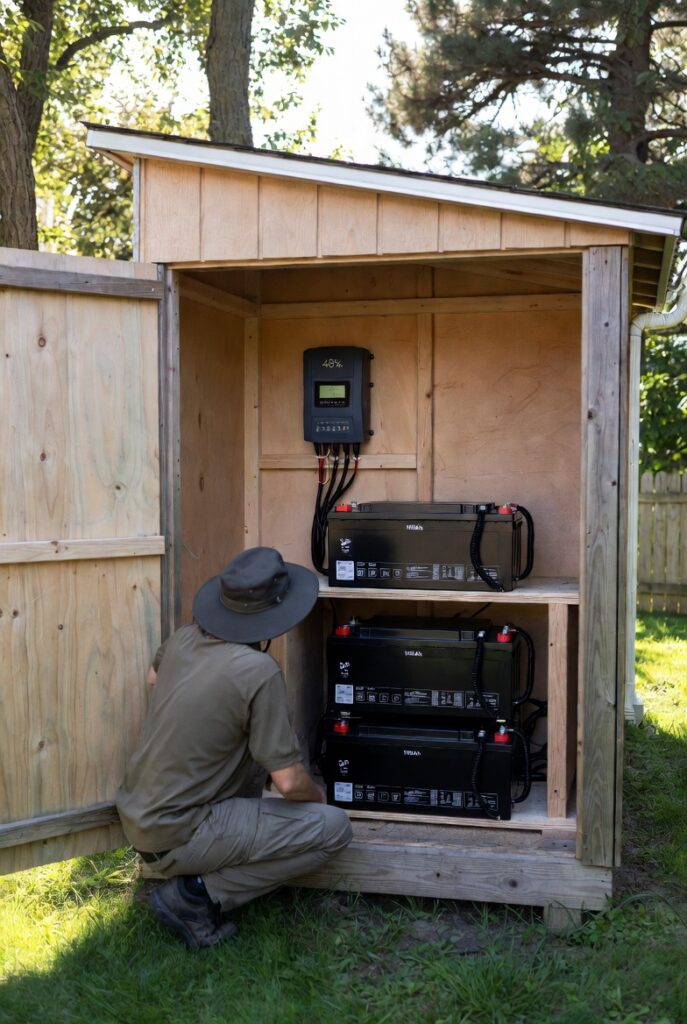
Solar battery lifespan is measured in cycles, not years, and that single distinction changes every buying decision. A homeowner on Edinburgh Road South in Guelph, Wellington County installed a 100Ah LFP battery bank in the spring of 2023. He read the spec sheet, saw 3,000 cycles at 80% depth of discharge, and assumed he had approximately 8 years of service life at one full cycle per day. In July 2025 he reviewed his charge controller logs and noticed his daily discharge had been averaging approximately 85 to 90% of capacity each night because his evening load was larger than he had sized for.
At 90% depth of discharge, the same LFP cells deliver approximately 1,500 to 2,000 cycles, roughly 4 to 5 years instead of the 8 years he had expected. He added a second 100Ah LFP bank, splitting his nightly load across twice the capacity and dropping his average discharge to approximately 45 to 50%. At 50% depth of discharge his original cells have a projected cycle life of approximately 5,000 to 8,000 cycles, which works out to approximately 13 to 22 years. The solar battery lifespan difference between 90% depth of discharge and 50% depth of discharge on the same bank is not marginal. It is the difference between a 4-year and a 13-year service interval on an $800 component.
I walked him through the same math two weeks after he made the change. His revised system was showing average nightly discharge of approximately 48%, exactly where the 5,000-cycle floor begins for quality LFP chemistry. He had not changed his loads or his panels. He had changed his bank size, and the solar battery lifespan of his original cells extended by approximately a decade as a result.
The brake pad analogy is exact: the pad does not care how many years you drive, it cares how hard you brake. Understanding solar battery lifespan in terms of cycles rather than years is the single most valuable diagnostic shift an Ontario off-grid owner can make. See our Ontario solar sizing guide before sizing your battery bank to avoid the same over-discharge pattern.
Solar battery lifespan in cycles: why the odometer reading beats the calendar
The cycle count is the only reliable way to compare solar battery lifespan across chemistries. AGM batteries at 50% depth of discharge deliver approximately 300 to 500 cycles, which at one cycle per day works out to approximately 0.8 to 1.4 years of service life. LFP batteries at 80% depth of discharge deliver approximately 2,000 to 4,000 cycles, approximately 5.5 to 11 years under the same conditions. On a full-time Ontario off-grid system with one deep cycle per day, the chemistry choice determines whether you are replacing the bank every year or every decade. The cycle comparison makes the LFP premium case without any other argument needed.
| Chemistry | Typical DoD | Cycle life | Years at 1 cycle/day | Usable Ah per 100Ah bank |
|---|---|---|---|---|
| Flooded Lead Acid | 50% | 200 to 400 | 0.5 to 1.1 years | 50Ah |
| AGM | 50% | 300 to 500 | 0.8 to 1.4 years | 50Ah |
| AGM | 30% | 700 to 900 | 1.9 to 2.5 years | 30Ah |
| LFP (standard) | 80% | 2,000 to 4,000 | 5.5 to 11 years | 80Ah |
| LFP (Battle Born) | 80% | 3,000 to 5,000 | 8 to 13+ years | 80Ah |
| LFP (Battle Born) | 50% | 5,000 to 8,000+ | 13 to 22+ years | 50Ah |
For a seasonal Ontario cottage cycling approximately 104 days per year, the numbers stretch further. An AGM at 400-cycle life reaches its end after approximately 3.8 cottage seasons. An LFP at 3,000 cycles reaches its end after approximately 29 cottage seasons. The solar battery lifespan comparison on a seasonal property is essentially permanent LFP versus a replacement every four years with AGM. A Victron SmartShunt logs every charge and discharge event, giving you an accurate cycle count and average depth of discharge in real time. See our LFP vs AGM chemistry guide for the full electrochemical comparison.
LFP vs AGM: the 10-year total cost comparison
The 10-year total cost comparison is where the LFP premium pays for itself in full. A 100Ah AGM bank costs approximately $250 and lasts approximately 400 cycles at 50% depth of discharge, approximately 1.1 years at one cycle per day. Over 10 years that requires approximately 9 replacement banks at $250 each, totalling approximately $2,250. A 100Ah Battle Born LFP bank costs approximately $800 and lasts approximately 3,500 cycles at 80% depth of discharge, approximately 9.6 years at one cycle per day.
Over 10 years that requires the initial bank and approximately one replacement, totalling approximately $1,600. LFP saves approximately $650 over 10 years on equivalent 100Ah capacity, and that is before accounting for the fact that LFP delivers 80Ah of usable energy per cycle versus AGM’s 50Ah.
A cottage owner on Tremaine Road in Milton, Halton County had replaced his lead acid battery bank every spring for three consecutive years at approximately $250 per replacement. Each October he left the bank at approximately 80% state of charge. Each May he returned to a battery measuring 0V or near it, completely sulfated from months of self-discharge below the 50% state-of-charge threshold where sulfation begins.
In the spring of 2024 he replaced the lead acid bank with a Battle Born 100Ah LFP unit and installed a Victron SmartShunt to log the storage period. He returned in March 2025 to find the battery at 87% state of charge after five months. The SmartShunt log identified phantom draws from an always-on inverter consuming approximately 0.5% per month. He removed the inverter from the circuit before the next winter departure and has not had a dead battery since. His 10-year battery cost dropped from approximately $2,500 in lead acid replacements to $800 in LFP. See our seasonal LFP self-discharge guide for the full winter storage protocol.
Solar battery lifespan and depth of discharge: the DoD trade-off table
Depth of discharge is the most powerful variable in determining solar battery lifespan. LFP at 100% depth of discharge delivers approximately 1,500 to 2,000 cycles. The same chemistry at 80% depth of discharge delivers 2,000 to 4,000 cycles. At 50% depth of discharge the cycle life extends to 5,000 to 8,000 or more. The Guelph Edinburgh Road homeowner experienced this directly: the same cells shifted from a 4 to 5 year projection to a 13 to 22 year projection simply by adding a second battery and halving the nightly discharge. The cost of the second battery is recovered in the extended service life of the original bank within approximately five years.
The BMS enforces the DoD floor automatically. Without a BMS, an LFP bank can be discharged to 0V and permanently damaged, just like AGM. The BMS low-voltage cutoff, typically 10V for a 12V LFP bank, disconnects the load when cells approach critical depletion. Above that hard floor, the charge controller’s load disconnect setting determines the operational DoD. Setting the load disconnect at 50% state of charge on the charge controller enforces the optimal 50% DoD without relying on user discipline.
The Guelph homeowner implemented this setting alongside his second battery, ensuring neither bank ever drops below 50% state of charge regardless of load size on any given night. See our battery bank sizing guide for calculating the correct bank capacity to stay within your target DoD under your actual Ontario load.
Temperature management: why Ontario summer heat kills batteries faster than winter cold
The Arrhenius chemistry rule states that every 10C above 25C ambient temperature approximately halves the calendar life of a battery. An Ontario equipment shed in July routinely reaches 50 to 60C interior temperature. A battery stored at 50C ages at approximately 4 to 8 times its rated calendar rate, meaning a 10-year calendar-rated battery stored in a hot shed degenerates toward a 1 to 2 year effective lifespan through heat exposure alone, independent of cycle count. The correct Ontario installation for any battery is a temperature-controlled enclosure: an insulated shed, a buried battery box with thermal mass, or an interior installation inside a conditioned space.
Ontario winter presents the opposite problem. Below 0C, the LFP battery management system blocks charging to prevent lithium plating on the anode, a form of permanent cell damage that occurs when lithium ions deposit unevenly during cold-temperature charging. On a cold Ontario morning the solar panels produce power but the battery cannot accept it until the cells warm above 0C. The Battle Born 100Ah heated LFP solves this by activating an internal heater from the battery’s own stored energy before the BMS accepts charge current.
For any Ontario installation in an uninsulated outbuilding, a backyard shed, a detached garage, or a seasonal structure, the heated LFP variant is the correct specification. Saving $150 to $200 on the standard unit costs you every cold morning from November through March when the array produces power that the bank cannot absorb.
NEC and CEC: battery installation code requirements for Ontario off-grid systems
NEC 690 governs solar PV installations. NEC 690.71 specifically addresses battery systems used in PV installations, covering enclosure requirements, disconnecting means, short-circuit current ratings, and charge control. A lithium battery bank with a BMS requires a disconnect accessible without tools that can isolate the battery from both the solar array and the loads simultaneously. NEC 690.71(B) requires that battery terminals capable of supplying more than 25A short-circuit current be protected by overcurrent devices sized for the available fault current. The Victron SmartShunt and charge controller combination satisfies the monitoring requirement but does not replace the required disconnect and overcurrent protection hardware. Contact the NFPA at nfpa.org for current NEC 690 battery system requirements.
CEC Section 64 governs battery systems in Ontario, including off-grid solar battery banks. An ESA permit is required before installing any new battery bank in a fixed off-grid system. The permit covers the battery enclosure, disconnect, overcurrent protection, and wiring between the battery and the charge controller. LFP batteries require a charge controller profile specifically set for lithium chemistry, using an AGM voltage profile on an LFP bank risks overcharging the cells to a voltage above the BMS high cutoff, triggering a protective shutdown that can prevent charging for hours.
The permitted system documentation must specify the battery chemistry and the charge controller profile used. Contact the Electrical Safety Authority Ontario at esasafe.com for current permit requirements before installing or replacing a battery bank in any Ontario off-grid system.
Pro Tip: The fastest solar battery lifespan diagnostic available to any Ontario off-grid owner costs nothing and takes 90 seconds. Open your charge controller app or display at the end of any evening and look at the state of charge reading before the morning charge cycle begins. If it reads below 60% state of charge regularly, your bank is undersized for your loads and you are cycling deeper than the optimal trade-off zone. If it reads between 70 and 85% regularly, you are in the healthy operating range. If it reads above 90% most mornings, your bank is oversized and your capital is not working efficiently. The Edinburgh Road Guelph homeowner found his 85 to 90% average depth of discharge simply by reading the controller log he had been ignoring for two years. The Victron SmartShunt generates this data automatically and stores it for review. Check the logs before you budget for a battery replacement. In most cases the problem is DoD, not chemistry failure, and the solution is an additional battery rather than a replacement.
The solar battery lifespan verdict: three Ontario buyer profiles
- Ontario homeowner building a new permanent off-grid system: specify LFP from day one with a heated variant for any uninsulated outbuilding. The 10-year cost comparison confirms LFP saves approximately $650 on equivalent 100Ah capacity over AGM, delivers 60% more usable energy per cycle at 80Ah versus 50Ah, and eliminates the spring sulfation problem that writes off AGM and lead acid banks left in cold storage. Size the bank for 50% average depth of discharge by calculating your actual daily load in watt-hours, dividing by your battery voltage, and multiplying by two. A 1,200Wh daily load on a 12V system requires 100Ah at 100% DoD or 200Ah for 50% DoD. The second 100Ah is the cheapest insurance available for solar battery lifespan in Ontario conditions.
- Ontario homeowner with an existing AGM bank that keeps dying before the rated cycle count: check depth of discharge before replacing the chemistry. Open the charge controller log or install a Victron SmartShunt and review the average end-of-day state of charge over the past month. If average depth of discharge is above 70%, the bank is undersized for the loads and the early failure is a sizing problem, not an AGM chemistry problem. Either reduce loads or add capacity. If depth of discharge is within the 40 to 60% target range but the bank is still failing early, the bank has reached its rated cycle count and replacement with LFP is the correct decision. The 10-year LFP total cost of approximately $1,600 versus $2,250 for AGM cycling makes the switch straightforward on any system planning a 10-year operational window.
- Ontario seasonal cottage owner who leaves the system unattended for 4 to 6 months: LFP is the correct chemistry, and the Victron SmartShunt is the correct monitoring tool. The Milton Tremaine Road result confirms the case: LFP retained 87% state of charge over five unattended months while lead acid was writing off a $250 bank every spring. The SmartShunt identified the phantom inverter draw that caused the small remaining loss, and removing the inverter from the winter circuit eliminated the problem entirely. LFP solar battery lifespan in seasonal storage conditions is effectively unlimited compared to the regular spring battery funeral that lead acid and AGM require after every Ontario winter. Install the heated LFP variant if the battery location falls below 0C for extended periods during winter storage.
Frequently Asked Questions
Q: How many years does a solar battery lifespan last in an Ontario off-grid system?
A: Solar battery lifespan depends on chemistry, depth of discharge, and how many cycles per year your system completes. AGM at 50% depth of discharge delivers 300 to 500 cycles, approximately 0.8 to 1.4 years at one cycle per day on a full-time system, or 3 to 5 years on a seasonal cottage system. LFP at 80% depth of discharge delivers 2,000 to 4,000 cycles, approximately 5.5 to 11 years on a full-time system, or effectively the lifetime of the installation on a seasonal cottage.
The Edinburgh Road Guelph result confirms that adjusting depth of discharge from 90% to 50% on an LFP bank extends the projected solar battery lifespan from approximately 4 to 5 years to approximately 13 to 22 years without changing any other hardware.
Q: Why does my AGM solar battery die every 1 to 2 years even with proper charging?
A: The most common cause is depth of discharge. AGM batteries rated at 300 to 500 cycles assume 50% depth of discharge. If your nightly discharge averages 70 to 80% of capacity, the effective cycle life drops to 150 to 250 cycles, approximately 0.4 to 0.7 years at one cycle per day. A Victron SmartShunt or charge controller log shows your average depth of discharge. If the reading is consistently above 60% at end of day, your bank is undersized for the loads.
The fix is either reducing loads, adding capacity, or switching to LFP which handles deeper discharge without the same cycle penalty. The second common cause is heat, an AGM stored in an Ontario equipment shed at 50 to 60C in July ages 4 to 8 times faster than its rated calendar life.
Q: Can a LiFePO4 solar battery charge during an Ontario winter below freezing?
A: A standard LFP battery cannot charge below 0C because the BMS blocks charge current to prevent lithium plating on the anode. On a cold Ontario morning the panels produce power, the charge controller is active, but the battery shows zero incoming current until the cells warm above 0C. This is protective and correct, it is not a malfunction. The solution for Ontario installations in uninsulated structures is the heated LFP variant.
The Battle Born 100Ah heated LFP activates an internal heater from the battery’s own stored energy before accepting charge current, allowing charging on any morning above approximately -20C. For any Ontario off-grid system in a detached shed or uninsulated seasonal structure, the heated variant is the correct specification for reliable year-round solar battery lifespan.
This build is engineered within the 48V DC Safety Ceiling. Diagnostic logic is based on 20+ years of technical service experience. All structural and electrical installations must be verified by a Licensed Professional and comply with your Local AHJ.
This article contains affiliate links. If you purchase through these links, I earn a small commission at no extra cost to you.