
Should you wire your panels in a chain or a cluster? The answer determines your wire size, your safety margin, and how much power you lose to the shade tax. Get it wrong and you either fry a controller on a cold Ontario morning or lose half your array output every time a cloud crosses one panel.
Think of it like a battery jump start. When you parallel two batteries you keep the 12V but add the cranking amps. When you connect batteries in series like a 24V heavy-duty truck you double the voltage for the punch needed to push current through long cables. Solar panels work on exactly the same principle.
Series vs Parallel Solar Panels: The Golden Rules
Series Wiring The Voltage Booster
The connection: Positive terminal of panel 1 connects to negative terminal of panel 2. Continue the chain.
What changes: Voltages add together. Current stays the same.
Example 3 × 100W panels, Vmp 18V, Imp 5.5A wired in series:
- String Vmp: 18V × 3 = 54V
- String current: 5.5A (unchanged)
- String power: 54V × 5.5A = 297W
The practical advantages:
- Higher voltage travels through wire with less resistance loss critical for long runs
- MPPT controllers wake up earlier in the morning because the voltage threshold is reached sooner with a higher-voltage series string
- MPPT controllers stay on later in the evening for the same reason
- Allows thinner cheaper wire for the same power over the same distance
The cold climate kill zone – Ontario, Minnesota, Montana: Series strings add voltage. Cold temperatures add more on top. A string that measures 66V at STC (25°C) may produce 82V on a -30°C Rockwood morning. If your controller is rated for 75V maximum input it dies instantly.
The calculation you must do before wiring series in Ontario: String Voc × number of panels × 1.25 = worst-case winter voltage
This must be less than your controller’s maximum input voltage. No exceptions.
Parallel Wiring The Amperage Booster
The connection: All positive terminals connect together. All negative terminals connect together.
What changes: Currents add together. Voltage stays the same.
Example – same 3 × 100W panels wired in parallel:
- String voltage: 18V (unchanged)
- String current: 5.5A × 3 = 16.5A
- String power: 18V × 16.5A = 297W (same total watts different voltage/current combination)
The practical advantages:
- Shade tolerance one shaded panel reduces only its own output not the entire string
- Safe for controllers with lower maximum input voltage
- No voltage stacking to calculate for cold weather
The critical disadvantage I²R loss: Power loss in wire equals current squared times resistance. Double the current and you quadruple the heat loss.
The math:
- Parallel array current: 16.5A
- Series array current: 5.5A
- Wire heat loss ratio: 16.5² ÷ 5.5² = 272 ÷ 30 = 9× more heat loss in the parallel array
For a 10-metre run producing 400W:
- Series at 54V / 5.5A → 10AWG wire handles this cleanly
- Parallel at 18V / 22A → requires 4AWG wire for equivalent voltage drop significantly heavier and more expensive
Why Ontario Winters Favor Series Wiring
For most Ontario, Minnesota, and Montana MPPT installations series wiring delivers more usable power across a typical winter day.
The MPPT threshold advantage: MPPT controllers require panel string voltage to exceed a minimum threshold before they begin charging — typically 15-16V for a 12V battery bank. A single panel on a heavily overcast Ontario morning may produce only 12-14V — below threshold. Zero output.
Three panels in series on that same morning: 12V × 3 = 36V. Threshold cleared by 20 volts. Charging begins.
Short winter days mean every production window counts. A series string captures dawn and dusk production that a low-voltage parallel system misses entirely because the MPPT never wakes up.
The safety calculation for Ontario series wiring: Two 100W panels in series. Voc 22V each.
- Series Voc at STC: 44V
- Ontario winter correction: 44V × 1.25 = 55V safe on a 100V controller
Four panels in series. Same panels.
- Series Voc at STC: 88V
- Ontario winter correction: 88V × 1.25 = 110V kills a 100V controller in January
Do the math before you wire.
The Shade Tax When Parallel Wins
Series wiring has one genuine weakness: the Christmas light problem.
One shaded panel in a series string activates its bypass diodes and drags the entire string current down to match its reduced output. Two fully producing panels get throttled by one shaded panel.
Example:
- Unshaded 3-panel series string: 297W
- One panel 50% shaded: Output drops to approximately 148W
- Loss: 149W from one partially shaded panel
In a parallel array with one panel 50% shaded:
- Shaded panel: 50W instead of 100W
- Other two panels: 100W each completely unaffected
- Total: 250W significantly better
Choose parallel when:
- Chimneys, vent pipes, or trees create partial shade at any time of day
- Panels face different directions or roof pitches
- Consistent full-sun exposure cannot be guaranteed
The 2S2P Hybrid Best of Both
For most systems with 4 or more panels the right answer combines both approaches.
2S2P 2 panels in series forming 2 strings in parallel:
- Each string: 22V × 2 = 44V Voc at STC
- Ontario winter correction: 44V × 1.25 = 55V safe on 100V controller with 45V headroom
- Parallel strings: current doubles, voltage stays at string level
- Result: Higher voltage for MPPT morning advantage + shade resilience from parallel strings
This is the recommended configuration for most Ontario residential and cabin installations with 4 panels. It appears throughout the Advanced Components cluster for exactly this reason.
Practical Hardware
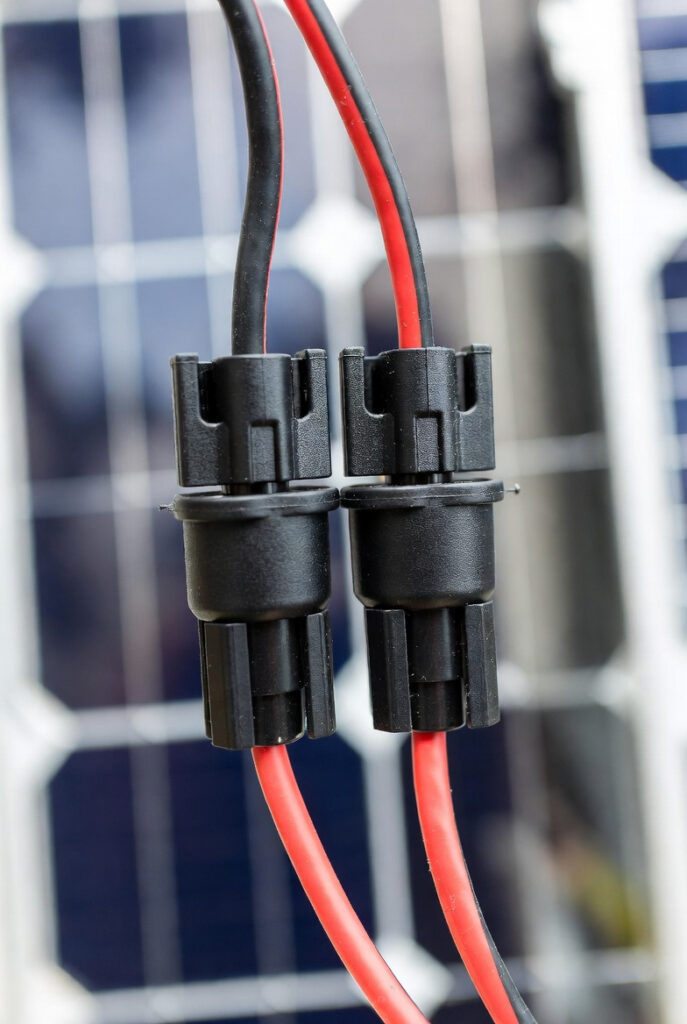
For series wiring: Panel MC4 cables connect directly positive-to-negative. For longer runs you need extension cable.
10AWG Solar Extension Cable rated for outdoor UV exposure, correct gauge for most series runs under 15 metres.
For parallel wiring: MC4 Y-connectors combine multiple panel cables into a single output run.
MC4 Parallel Branch Connectors weatherproof, rated for full panel current.
For the full wire gauge sizing table see our Solar Wire Gauge Guide.
The Decision Framework
Choose series if:
- You have an MPPT controller almost always the right answer
- Your panel-to-controller run exceeds 5 metres
- Your installation has minimal shading risk
- You are in Ontario, Minnesota, or Montana and want maximum winter production windows
- You want cheaper thinner wire
Choose parallel if:
- You have a PWM controller on a 12V system
- Significant shade risk exists that cannot be mitigated
- Your controller has low maximum input voltage
- Your panel run is under 3 metres
Choose 2S2P hybrid if:
- You have 4 or more panels
- You want MPPT voltage advantage plus shade resilience
- You are building a permanent cold climate installation
Pro Tip: Before finalizing any wiring configuration write down three numbers: worst-case winter string Voc (string Voc × 1.25), maximum string current (Imp × number of parallel strings), and wire run length in metres. Those three numbers tell you whether your wiring plan is safe, what wire gauge you need, and whether your controller survives January. Five minutes of math prevents hundreds of dollars of destroyed equipment.
The Verdict
Series vs parallel solar panels is an engineering decision driven by your controller type, your run length, your shade exposure, and your cold climate voltage reality.
For most Ontario, Minnesota, and Montana installations with an MPPT controller series or 2S2P hybrid is the right answer. Higher voltage. Better wire efficiency. Longer production windows at dawn and dusk. Just calculate your winter Voc before connecting anything.
Shade you cannot eliminate go parallel or hybrid. PWM controller on 12V go parallel. Everything else series wins.
Disclosure: This article contains affiliate links. If you buy through them, GridFree Guide earns a small commission at no extra cost to you.