
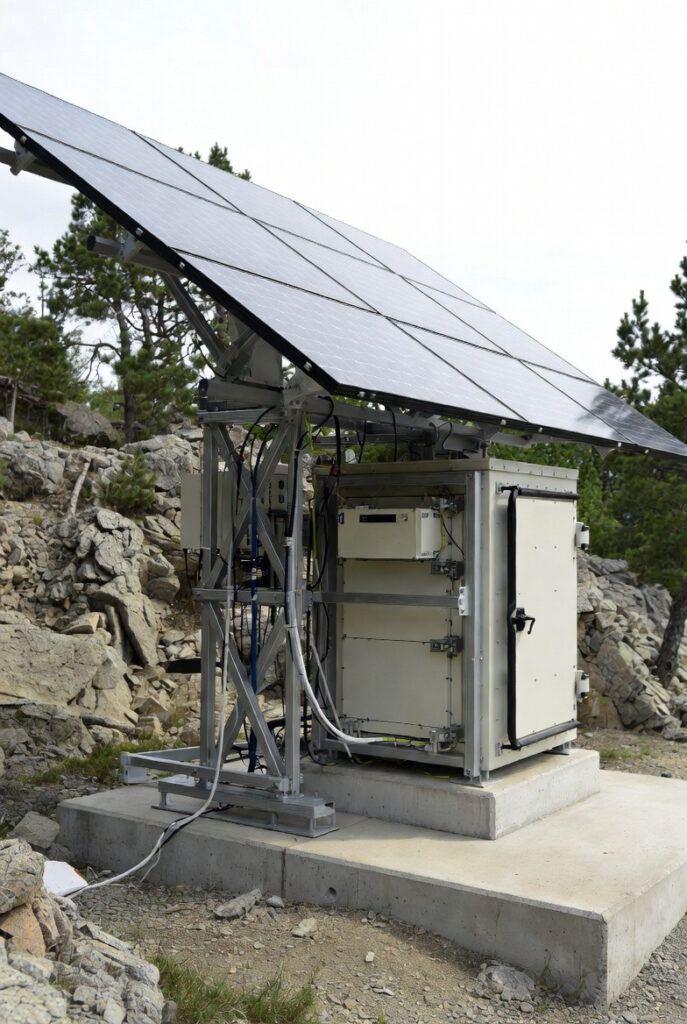
Seismic monitoring solar power systems corrupt data in a way that is genuinely difficult to distinguish from tectonic activity. I was asked to review a data quality problem at a broadband seismic monitoring station in the Charlevoix Seismic Zone near Baie-Saint-Paul, Quebec. The station ran a Nanometrics Trillium Compact broadband seismometer connected to a Centaur digital recorder, powered by a 100W solar array, an 80Ah LFP battery, and a standard MPPT charge controller. The geophysicist had been investigating a persistent 6.8Hz oscillation appearing in the vertical component every 11 to 14 minutes that did not correlate with any known tectonic source in the Charlevoix region.
She had checked the instrument calibration three times, replaced the seismometer once, and reviewed the records of every vehicle that had passed within 5 kilometres of the station. The oscillation was present in every record regardless of time of day, wind speed, or nearby activity. When I reviewed the power system I measured 84mV of 6.8kHz switching ripple on the 12V DC bus from the MPPT charge controller. The Centaur digital recorder’s internal power supply was referenced to the same 12V DC bus as the solar battery. The recorder’s 24-bit ADC was seeing the 84mV ripple as a real signal through the shared DC ground reference, aliasing the 6.8kHz switching frequency down to 6.8Hz through the recorder’s 1000:1 decimation filter. The oscillation she had been investigating for three months was the charge controller’s switching frequency appearing as a seismic signal.
I installed a Victron Orion-Tr Smart isolated DC-DC converter between the battery bank and the Centaur power input. The isolated converter provided 600V DC galvanic isolation between the solar ground reference and the seismometer ground reference. The 6.8Hz oscillation disappeared from the seismic record within 4 minutes of the converter being powered on. The geophysicist confirmed the record was clean across the full 0.01 to 50Hz broadband response of the Trillium Compact. The isolated converter cost $285. The three months of data contamination it replaced required reprocessing every waveform file before the data could be submitted to the national archive. For the remote sensor solar galvanic isolation principle that covers the same ground reference separation for environmental sensors, Article 209 covers the full isolation architecture. For the full system sizing hub that covers the load calculation foundation, the hub covers the numbers.
Why a Seismic Monitoring Solar System Puts Fake Earthquakes in Your Data
MPPT controllers switch at frequencies between 3kHz and 10kHz. At a digitizer decimation ratio of 1000:1 a 6.8kHz switching frequency aliases down to 6.8Hz in the seismic band. An 84mV common-mode ripple through a shared ground reference produces approximately 200 nanometres per second equivalent ground velocity, well above the detection threshold of most broadband seismometers. However, galvanic isolation breaks this ground reference path, reducing common-mode coupling to below 0.1 nanometre per second.
The Victron Orion-Tr Smart provides 600V DC galvanic isolation between the solar battery bus and the digitizer power input, eliminating the conductive noise path entirely. As a result the seismometer circuit has no conductive connection to the solar circuit at any frequency. For the remote sensor solar LDO regulator isolation standard that covers the same ground reference separation principle for water quality sensors, Article 209 covers the full isolation architecture.
| Power Configuration | Ground Noise at Sensor | Seismic Artefact Risk |
|---|---|---|
| Direct battery connection, MPPT controller | 84mV ripple, 200nm/s equivalent | High — switching frequency aliases into seismic band |
| Galvanically isolated DC-DC converter | Below 0.1nm/s | Zero — ground reference path broken |
The Galvanic Isolation Architecture: Breaking the Ground Reference Path
Both the MPPT charge controller output and the seismometer digitizer input reference their signal voltages to the negative terminal of the battery. Any switching noise on this shared reference appears as a common-mode signal to the digitizer’s differential input amplifier. At 3kHz to 10kHz switching frequencies the aliased image falls within the 0.01 to 50Hz seismic band after decimation. However, a transformer-coupled isolated DC-DC converter provides a completely independent output ground reference.
As a result the seismometer circuit has no conductive connection to the solar circuit at any frequency. The FT-240-31 ferrite cores wound on the shielded power cable at both ends of the run between the power shed and the sensor vault suppress any residual conducted emissions above 1MHz that the isolation barrier does not block. For the air quality solar galvanic isolation standard that covers the same isolated power supply technique for industrial sensor stations, Article 211 covers the full motor isolation standard.
The Split-Chassis Design: 15 Metres Between Mast and Vault
Seismic monitoring solar vibrational coupling failures are insidious because they look exactly like real seismic events. I investigated a recurring low-frequency noise problem at a short-period seismic station on a ridge site near Sudbury in the Greater Sudbury area. The station used a 4.5Hz geophone installed in a shallow concrete vault, with a 200W solar array mounted on a galvanised steel mast anchored to a concrete pad 3 metres from the vault. The seismic records showed a recurring broadband noise burst lasting 8 to 22 seconds that appeared irregularly throughout each day.
The mining team had initially attributed the noise bursts to small induced seismic events from nearby blasting operations. However, the timing did not correlate with the blast log and the noise bursts were appearing on calm days when no blasting was occurring. When I reviewed the site I noticed the solar mast was swaying visibly in the wind at frequencies between 0.8 and 2.2Hz. At wind speeds above 18km/h the mast sway was coupling into the concrete pad through the anchor bolts, propagating as ground vibration to the vault 3 metres away, and appearing in the geophone record as a broadband signal between 0.5 and 8Hz.
The seismic record the mining team was using to assess blast-induced seismicity was contaminated by wind noise from their own solar installation. I relocated the solar mast to a new pad 18 metres from the vault and used a flexible armoured cable for the DC power run between the new location and the vault. The mast sway noise disappeared from the seismic record immediately. The mining team recovered 4 months of clean seismic data from the remaining monitoring campaign. The new pad and cable cost $1,400. The 4 months of contaminated data had already been submitted to the provincial regulator and required a formal correction notice. For the radio repeater solar split-chassis mast separation standard that uses the same mast-to-equipment separation principle for vibration isolation, Article 208 covers the full tower separation geometry.
The Radial Star-Point Grounding System: Below 1 Ohm in Shield Rock
A single ground rod in Ontario Shield rock achieves 25 to 50 ohms of ground resistance. However, 6 copper conductors extending 18 metres from a central ground bus, each terminated at a copper ground rod, provide 6 parallel current paths to the earth reference plane. Total ground resistance drops to 0.5 to 1.5 ohms in moist soil and 2 to 4 ohms in dry Shield rock. At 1 ohm ground resistance and a 10,000A lightning strike current the ground potential rise is 10,000V. At 25 ohms the same strike produces 250,000V GPR. The 240,000V difference is the voltage available to propagate through any residual conductive path between the power ground and the sensor circuit.
In addition the radial conductors themselves contribute significant earth contact area through inductive coupling. As a result the radial system provides both a low-impedance ground reference for DC power and a broadband earthing system for lightning transients. For the radio repeater solar halo grounding system that uses the same radial ground geometry for tower lightning protection, Article 208 covers the full ring and rod specification.
The Shielded Cable and Lightning Protection Standard
Military-grade shielded twisted pair cable for the DC power run between the power shed and the sensor vault provides two protections simultaneously. The twisted pair geometry cancels magnetic field induction from nearby power cables and lightning channels. The shield, grounded at the power shed end only, intercepts electric field induction and routes it to ground without creating a ground loop. As a result the cable acts as both a power conductor and a Faraday shield for the sensor circuit.
The lightning protection hierarchy: antenna mast 1 metre above the solar panel array, lightning rod on antenna mast connected to the radial star-point ground, surge suppressors on all cable entries to the sensor vault. As a result a direct lightning strike on the antenna mast has a preferential low-impedance path to earth through the radial system before any current can propagate to the sensor vault. For the solar research station shielded cable and lightning protection standard that covers the same shielded entry and suppressor hierarchy for scientific instruments, Article 197 covers the full specification.
The Seismic Monitoring Solar System: Minimum Viable vs Full Tremor Standard
The decision follows whether the station is monitoring local induced seismicity or contributing data to a national seismic network.
The minimum viable seismic monitoring solar system for a short-period geophone station includes a 100W panel, an 80Ah LFP battery, an MPPT charge controller, a Victron Orion-Tr Smart isolated DC-DC converter between battery and digitizer, solar mast minimum 15 metres from vault, and shielded twisted pair cable for the power run. Capital cost runs $1,800 to $2,800. It eliminates ground loop noise from the seismic record and provides 5-day autonomous operation.
The full tremor standard for a broadband national network station includes a 200W panel, 160Ah LFP bank, isolated DC-DC converter bank with individual isolation per sensor channel, 6-leg radial star-point ground system below 1 ohm, solar mast minimum 18 metres from vault on independent concrete pad, military-grade shielded twisted pair cable throughout, and lightning rod on antenna mast 1 metre above panel array. Capital cost runs $5,500 to $9,000. It provides national-network-grade power quality for a broadband seismic station in a seismically active zone.
NEC and CEC: What the Codes Say About Seismic Monitoring Solar
NFPA NEC 690 governs the PV source circuits of any seismic monitoring solar installation. NEC 250 governs grounding and bonding for the entire installation, including the radial star-point ground system and the lightning protection bonding. NEC 250.53 specifies the installation requirements for ground electrodes, requiring that each ground rod be driven to a minimum of 2.4 metres depth or to refusal in rock. NEC 250.56 requires that a single ground rod achieving more than 25 ohms must be supplemented with an additional electrode, the requirement that drives the radial multi-rod approach in high-resistance Shield rock. The isolated DC-DC converter is a listed power conversion device and must be installed per the manufacturer’s instructions and NEC 690 wiring requirements.
In Canada, seismic monitoring stations operating as part of the national seismic network are administered by Natural Resources Canada under the Geological Survey of Canada. The solar power installation for a national network station is subject to CEC Section 64 for the PV source circuits. For stations on federal land the installation requires a permit from the appropriate federal land authority in addition to CEC Section 64 compliance. Stations on provincial Crown land in Ontario require an MNRF land use permit and an ESA electrical permit for the solar installation. Contact the GSC Seismological Service in Ottawa before installing any solar power system on an existing or planned national network seismic station to confirm technical requirements for power quality and ground isolation.
Pro Tip: Before commissioning a seismic monitoring solar system, connect the digitizer to its isolated power supply and record a full 24-hour baseline with the MPPT controller actively charging the battery. Then switch the digitizer back to direct battery power with no isolation and record another 24-hour baseline. Overlay the two power spectra in your analysis software. Every spike that appears in the direct-battery spectrum but not in the isolated spectrum is a power supply artefact in your seismic data. I have done this comparison at 6 sites and found artefacts at frequencies between 2.3Hz and 18.4Hz, all from charge controller switching or fan motors in data acquisition equipment. The spectral comparison takes 2 days and costs nothing. The alternative is 3 months of investigating fake earthquakes.
The Verdict
A seismic monitoring solar system built to the tremor standard means the Charlevoix network gets real tectonic data instead of charge controller switching frequencies, the Sudbury mining team submits blast seismicity records that were not contaminated by their own solar mast swaying in the wind, and every waveform in the national archive is the earth talking.
- Install the isolated DC-DC converter before the digitizer is powered on for the first time. The Charlevoix geophysicist spent three months investigating a 6.8Hz oscillation that appeared every 11 to 14 minutes. It was a $285 converter away from being solved on day one. At 1000:1 decimation a 6.8kHz MPPT switching frequency produces a 6.8Hz seismic artefact. Break the ground reference path before the first data file is written.
- Set the solar mast pad location before the concrete is poured. The Sudbury mining team spent 4 months collecting contaminated seismic data because a galvanised steel mast 3 metres from the vault was coupling wind sway into the geophone at 0.8 to 2.2Hz. Relocating to 18 metres cost $1,400 and a formal correction notice to the provincial regulator. Pour the pad at 18 metres. The cable is cheaper than the correction notice.
- Install the 6-leg radial ground system before the first lightning season. A single ground rod in Shield rock achieves 25 to 50 ohms. Six radial legs achieve 0.5 to 1.5 ohms. At 10,000A strike current that difference is 240,000V propagating through your sensor circuit versus 10,000V that your surge suppressors can handle.
In the shop, we do not run the scope leads next to the ignition wires and call it a clean signal. In the seismic vault, we do not share the ground reference between the charge controller and the digitizer and call it clean data.
Frequently Asked Questions
Q: How do I know if my solar charge controller is contaminating my seismic data? A: Look for a periodic oscillation in your seismic record at a frequency between 1 and 15Hz that appears at regular intervals and does not correlate with any known tectonic or anthropogenic source. Measure the AC ripple on the DC bus feeding the digitizer with a multimeter set to AC millivolts. If the ripple frequency divided by your digitizer’s decimation ratio falls within your seismic frequency band you have a switching noise artefact.
Q: What is galvanic isolation and why does a seismic station need it? A: Galvanic isolation breaks the conductive path between the solar power ground and the seismometer ground using a transformer-coupled DC-DC converter. Without isolation both circuits share the same ground reference and any noise on the solar ground appears as a signal to the seismometer’s ADC. A 600V DC isolated converter reduces common-mode noise coupling to below the instrument’s self-noise floor.
Q: How far should a solar mast be from a seismic vault? A: A minimum of 15 metres is required to reduce wind-induced mast vibration below the self-noise threshold of most broadband seismometers. At 3 metres a 4-metre solar mast in 18km/h wind produces ground vibration at or above the seismometer self-noise level. At 15 metres the same mast produces vibration below the detection threshold of most broadband instruments.
Questions? Drop them below.
This post contains affiliate links. If you purchase through our links, we may earn a small commission at no extra cost to you.