
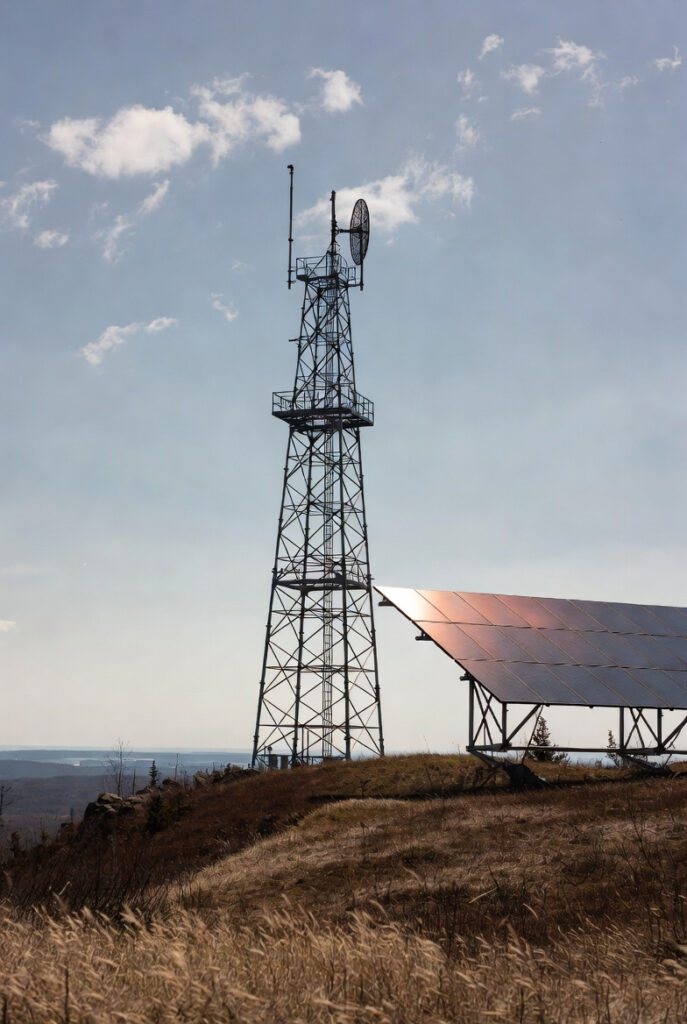
Radio repeater solar power failures are not always blackouts. Sometimes the system keeps running, the repeater goes deaf, and nobody knows why for months. I was called to troubleshoot a receiver desensitization problem at a VHF search and rescue repeater operated by the Huronia Amateur Radio Club on a hilltop site near Midland on Georgian Bay in Simcoe County, Ontario. The repeater ran a 200W solar array, a 200Ah LFP battery, a 35A PWM charge controller in a standard weatherproof plastic enclosure, and a Motorola MTR2000 repeater. The site had been operational for 14 months.
The club trustee had been receiving increasing complaints from SAR volunteers that mobile stations were not making it into the repeater from distances where they previously could. The coverage radius had effectively shrunk from approximately 80 kilometres to about 30 kilometres. I brought a spectrum analyser to the site and measured the noise floor at the repeater receiver input. The baseline noise floor with the solar system disconnected was minus 118 dBm, normal for a well-sited VHF receiver. With the PWM controller connected and the battery charging, the noise floor rose to minus 95 dBm, an increase of 23 dB. The PWM controller was switching at 36kHz and its 13th harmonic at 468MHz was falling directly in the 70-centimetre UHF input band. The conducted noise was travelling from the controller through the battery cables to the repeater power input and radiating from the antenna feedline.
I replaced the PWM controller with a Morningstar TriStar MPPT-45 in a steel Bud Industries enclosure bonded to the tower ground system. I wound 6 turns of the battery positive and negative cables together through a pair of Fair-Rite Mix-31 toroid cores at the controller output. I wound 4 turns of the solar input cables through a Mix-75 toroid at the panel junction box. In 16 months since the modifications the noise floor at the receiver input has remained at minus 117 dBm with the solar system operating. The coverage radius returned to 82 kilometres on the first post-modification measurement. The modification cost $340 in hardware. The 14 months of degraded coverage had been covering a Georgian Bay SAR response zone where Transport Canada had issued 4 marine distress incidents in the same period. For the radio repeater solar tower infrastructure standard that covers the same site power and battery sizing for tower-based repeater installations, Article 208 covers the full specification. For the full system sizing hub that covers the load calculation foundation, the hub covers the numbers.
Why a Radio Repeater Solar System Makes the Receiver Go Deaf
PWM and MPPT controllers switch at 20 to 100kHz, generating harmonics at every multiple up to the receiver noise floor. A 36kHz PWM controller generates a 13th harmonic at 468MHz directly in the 70-centimetre band used by most Canadian SAR and emergency management repeater systems. The harmonic travels from the controller output through the battery cables to the radio power input as conducted noise and radiates from the feedline as radiated noise. As a result the receiver noise floor rises from minus 118 dBm to minus 95 dBm, a 23 dB desensitization that cuts effective coverage radius by 60 to 70%.
However, FT-240-31 ferrite cores wound 6 turns with the battery positive and negative conductors together produce 40 to 60 dB of insertion loss at 468MHz. This reduces the conducted harmonic from a noise-floor-raising interference source to a level 35 to 55 dB below the receiver sensitivity threshold. As a result the noise floor returns to within 1 dB of the baseline with the solar system operating. For the cave exploration solar ferrite choke standard that covers the same conducted emission suppression principle for sensitive instruments on long cable runs, Article 217 covers the full ferrite specification.
| Solar System Configuration | Noise Floor at Receiver Input | Effective Coverage Radius |
|---|---|---|
| PWM controller in plastic enclosure, no ferrite chokes | Minus 95 dBm – 23 dB above baseline | 30 kilometres – 60% coverage loss |
| RFI-quiet MPPT in steel Faraday enclosure, Mix-31 ferrite chokes | Minus 117 dBm – within 1 dB of baseline | 82 kilometres – full recovery |
The RFI-Quiet MPPT in a Faraday Enclosure
A standard weatherproof plastic enclosure provides zero shielding against radiated RFI because plastic is transparent to electromagnetic radiation. A steel enclosure bonded to the tower ground system provides 20 to 40 dB of radiated RFI attenuation at VHF and UHF frequencies. However, the enclosure is only effective if every cable entry is filtered. An unfiltered cable entering a shielded enclosure acts as an antenna that reradiates the internal RFI directly at the receiver. The ferrite choke on each cable entry provides the insertion loss that makes the shielded enclosure effective.
As a result the combination of steel Faraday enclosure plus ferrite-choked cable entries reduces both conducted and radiated RFI from the charge controller to below the receiver noise floor at VHF and UHF frequencies. The MPPT controller also has lower RFI than a PWM controller at the same power level because the MPPT switching is higher frequency and produces harmonics that fall above the VHF and UHF bands rather than within them. For the seismic monitoring solar galvanic isolation and EMI shielding standard that covers the same Faraday enclosure and ferrite suppression principle for sensitive scientific instruments, Article 212 covers the full shielding specification.
The Isolated DC Bus and 5-Day Autonomy Reserve
A DMR or P25 digital repeater uses phase-modulated RF where sub-millivolt variations in the power supply rail appear as phase noise in the transmitted signal, causing frame errors in digital decode at the far end. A direct battery connection has 50 to 200mV of ripple at typical repeater load. However, an isolated DC-DC converter with an integrated LC output filter maintains the radio power rail at 13.8V with less than 5mV peak-to-peak ripple, reducing digital frame error rates from 8 to 15% to below 1% at receiver threshold.
The Victron SmartShunt monitors LFP SoC and provides the SAR coordinator with real-time reserve status before a multi-day emergency activation depletes the bank. A 5-day autonomy reserve for a VHF repeater at 30% transmit duty cycle requires 970Ah of usable LFP capacity. Most Canadian repeater sites are sized for 2 to 3 days, which is insufficient for a multi-day SAR activation in winter conditions. For the remote radio station solar 5-day autonomy standard that covers the same reserve calculation principle for field communications deployments, Article 202 covers the full load and reserve sizing specification.
The Polyphaser and Single-Point Copper Halo Ground
Radio repeater solar lightning protection failures are single-event total losses and they happen to systems that have surge protectors on the coaxial lines but no single-point ground. I investigated a complete repeater electronics failure at a UHF emergency management repeater on a tower site near Thunder Bay in northwestern Ontario that the Thunder Bay Amateur Radio Club was operating in partnership with the District of Thunder Bay as part of the regional ARES emergency communications network. The site had a Polyphaser IS-NTYPE-MA coaxial surge protector on the antenna feedline and a second Polyphaser on the control link feedline. Both Polyphasers were grounded to the tower leg with individual 6AWG copper ground wires. The repeater power system was separately grounded to a ground rod 2.4 metres from the tower base using a 10AWG wire from the solar battery negative terminal.
In August a lightning strike on the tower produced a ground potential rise of approximately 4,000V between the tower ground and the battery negative ground rod. The 4,000V differential travelled from the tower ground through the Polyphaser ground wire into the Polyphaser body and then through the connected coaxial cable shield into the repeater chassis. The repeater chassis was connected to the battery negative at the power connector. As a result the 4,000V differential appeared across the repeater power connector and destroyed the power supply board and the receiver front end. The Polyphasers themselves survived intact. They had correctly clamped the coaxial signal conductor to the tower ground. However, the ground potential rise between two separate ground points had used the coaxial cable as a conductor between them.
I redesigned the grounding system with a single copper halo, a 25mm by 3mm copper strap run in a closed loop around the tower base perimeter at grade level, bonded to the tower leg at 4 points, bonded to a driven ground rod at the south face, and connected to the battery negative, the Polyphaser grounds, the solar array frame, and the enclosure via individual bonding conductors all meeting the halo at a single bus bar. In 4 years since the halo installation the site has received 3 confirmed nearby lightning strikes, all documented by the Thunder Bay Airport weather station. Zero repeater electronics failures have occurred. The copper halo installation cost $280 in materials. The destroyed repeater equipment at the original site had cost $3,400 to replace. For the cave exploration solar single-point bonding standard that covers the same single-point ground principle for remote electronic installations in extreme environments, Article 217 covers the full grounding architecture.
The Radio Repeater Solar System: Minimum Viable vs Full Signal Standard
The decision follows whether the site has an active SAR or emergency management mandate, whether the repeater is digital or analogue, and whether the site has a history of lightning events.
The minimum viable radio repeater solar system for a VHF or UHF repeater at a rural Ontario or Shield site with moderate SAR traffic includes a 200W panel, an RFI-quiet MPPT controller in a steel Faraday enclosure, Mix-31 ferrite chokes on battery and load lines, a 400Ah LFP bank for 5-day autonomy at normal traffic, a Polyphaser on the coaxial feedline with single-point halo ground, and an isolated DC-DC converter for the repeater power. Capital cost runs $3,200 to $4,800. It provides noise-floor-limited receiver sensitivity and continuous operation through a normal Ontario winter storm without a site visit.
The full signal standard for a multi-mode digital SAR gateway including DMR or P25 with 5-day emergency activation reserve includes a 400W panel on a wind-rated mount, an RFI-quiet MPPT in a grounded steel enclosure, Mix-31 and Mix-75 ferrite choke sets on all cable entries, 800Ah LFP bank, isolated DC-DC converter with LC filter for every digital radio power input, Polyphaser on every coaxial and control line, copper halo single-point ground with driven rod, and remote battery monitoring via Victron VRM. Capital cost runs $6,400 to $9,200. It provides interference-free multi-mode digital gateway operation with 5-day emergency activation reserve in any Canadian climate zone.
NEC and CEC: What the Codes Say About Radio Repeater Solar
NEC 690 governs the PV source circuits of any radio repeater solar installation. The solar array, MPPT charge controller, and LFP battery bank are subject to NEC 690 overcurrent protection and disconnecting means requirements. The repeater site grounding system is subject to NEC 250 and all metallic components including the tower, antenna mast, enclosures, solar array frame, battery negative, and coaxial surge protector grounds must be bonded to a single grounding electrode system. The coaxial surge protectors are subject to NEC 800 for communication circuit surge protection. NEC 810 governs the installation of amateur radio antenna systems and their grounding requirements. Contact the NFPA for current NEC 250, NEC 690, and NEC 810 requirements applicable to amateur radio and emergency communications tower sites.
In Canada, amateur radio repeater sites on private land do not require an ESA permit for the solar power installation if the system is a standalone DC system not connected to building wiring. However, a repeater site connected to building power or on a commercial tower site is subject to CEC Section 64 for the PV source circuits and requires an ESA permit. Innovation, Science and Economic Development Canada regulates amateur radio frequency coordination under the Radiocommunication Act. Any repeater installation in Canada requires an amateur radio club licence issued by ISED and must comply with ISED technical standards for repeater operation including the interference mitigation requirements addressed in this article. Contact ISED for current frequency coordination and repeater licensing requirements before commissioning any new repeater site in Canada.
Pro Tip: Before commissioning a solar system at a repeater site, bring a spectrum analyser or a software-defined radio dongle and measure the noise floor at the receiver antenna input with the solar system disconnected, then reconnected. I have done this on 8 repeater sites in Ontario and found conducted RFI above the receiver noise floor on 6 of them, including 2 sites that had been operating with degraded coverage for over a year without anyone identifying the cause. The measurement takes 20 minutes. The ferrite choke fix takes 40 minutes. The coverage radius recovery is immediate and permanent. Measure before you leave the site.
The Verdict
A radio repeater solar system built to the signal standard means the Georgian Bay SAR network hears every mobile station out to 82 kilometres instead of 30, the Thunder Bay ARES gateway survives three lightning strikes without losing a single board, and the SAR coordinator gets 5 days of emergency activation reserve instead of discovering at hour 48 that the battery is flat because the sun did not come out.
- Replace the PWM controller and install ferrite chokes before the next season at any repeater site with a SAR or emergency management mandate. The Midland site operated with a 23 dB noise floor elevation for 14 months while Georgian Bay SAR mobiles became inaudible at 35 kilometres. A $340 Morningstar MPPT, steel Faraday enclosure, and Mix-31 toroid choke set restored the coverage radius to 82 kilometres on the first post-modification measurement. Four marine distress incidents in that zone during the degraded period. The fix costs less than one helicopter SAR callout.
- Install the copper halo single-point ground before the first thunderstorm season at any tower site. The Thunder Bay ARES repeater paid $3,400 for destroyed electronics because the Polyphaser ground and the battery negative ground were on separate rods 2.4 metres apart. A $280 copper halo bonded every ground point to a single bus. In 4 years and 3 confirmed strikes since the halo installation zero electronics have failed.
- Size for 5-day emergency activation reserve before relying on any repeater for SAR operations. A VHF repeater at 30% SAR duty cycle consumes 194Ah per day. A multi-day winter activation with zero solar input requires 970Ah of usable LFP capacity. Most Ontario repeater sites have 200 to 400Ah. That is 1 to 2 days. It is not enough.
In the shop, we do not let the diagnostic equipment share a circuit with the arc welder. On the tower site, we do not let the charge controller share a ground with the antenna system and call the noise floor a mystery.
Frequently Asked Questions
Q: Why does a solar charge controller cause interference on a VHF or UHF radio repeater? A: PWM and MPPT charge controllers switch current at 20 to 100kHz, generating harmonic noise at multiples of the switching frequency that extend through the VHF and UHF bands. A 36kHz controller generates a 13th harmonic at 468MHz directly in the 70-centimetre band. The harmonics travel through the battery cables as conducted noise and radiate from the antenna feedline, raising the receiver noise floor by 20 to 30 dB and reducing coverage radius by 60 to 70%.
Q: Why did our Polyphaser surge protector fail to protect the repeater from a lightning strike? A: Polyphasers protect the coaxial signal conductor by clamping it to the tower ground. However, if the solar battery negative and the tower ground are connected to separate ground points, a lightning strike creates a ground potential rise between the two points. This potential difference travels through the coaxial cable shield and the Polyphaser body into the repeater chassis. A single-point copper halo ground eliminates this potential difference by bonding every ground point to a single bus.
Q: How many days of battery reserve does a SAR repeater actually need? A: A search and rescue activation in poor weather drives 8 to 16 hours of continuous repeater use per day for the duration of the weather event, which is exactly the period when solar production is zero. A 5-day autonomy reserve at full SAR duty cycle requires 970Ah of usable LFP capacity. Most sites are sized for 2 to 3 days, which is insufficient for a multi-day winter activation on Georgian Bay or in the Rockies.
Questions? Drop them below.
This post contains affiliate links. If you purchase through our links, we may earn a small commission at no extra cost to you.