
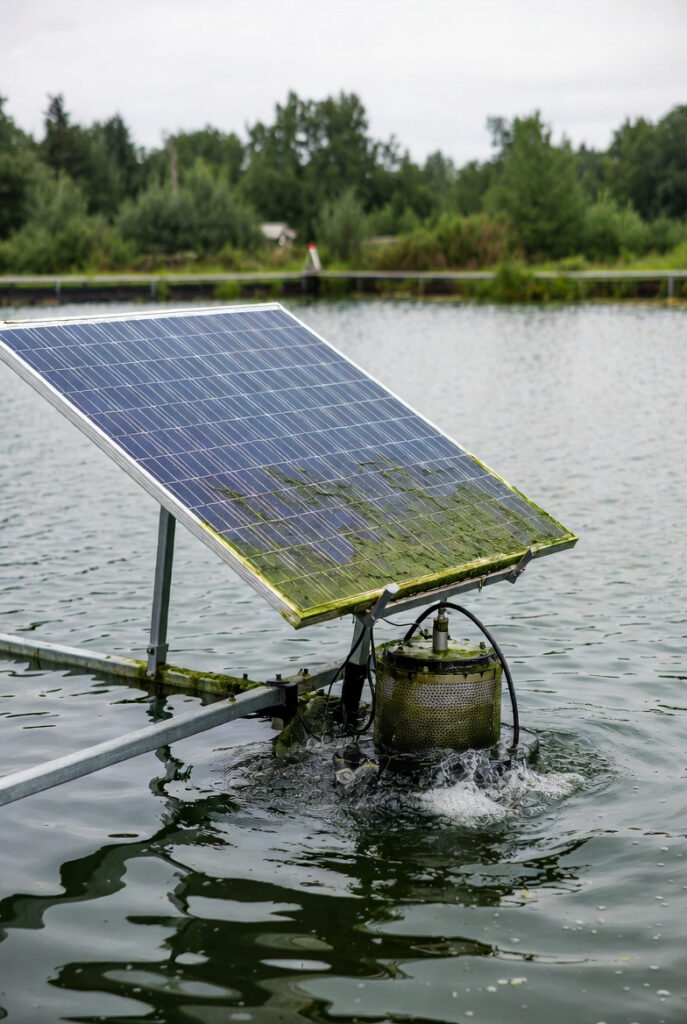
Pond aeration solar failures happen at 4 AM in July when the algae bloom is heaviest and the overnight aerator has been pulling the LFP bank down for 10 hours straight. I was asked to review the power system at a brook trout nursery operated by the Nipissing-Mattawa Conservation Authority on the South River near Powassan in Parry Sound District, Ontario. The nursery reared approximately 18,000 fingerling brook trout in three 12-metre circular flow-through raceways fed by a cold spring creek at 9°C. The aeration system ran a 370W DC surface aerator drawing 8.6A continuous from a 48V bus powered by a 600W solar array, a 300Ah LFP battery, and a Victron MPPT charge controller.
The system had been running for 6 weeks into a warm dry July when the site manager arrived at 6:15 AM to find all three raceways showing fish gasping at the surface. The dissolved oxygen meter read 2.4mg/L in the primary raceway. The aerator was running but produced only 60% of rated airflow. When I inspected the panel I found the glass covered with a dense green-brown biofilm from airborne algae spores and nutrient mist from the raceway aeration. The optical transmission reduction measured 31% using a reference cell comparison. Production had dropped from a rated 600W to approximately 414W. The overnight battery draw at 8.6A for 10 hours was 86Ah. The 300Ah LFP bank at 50% depth of discharge had only 150Ah of usable capacity. The bank had been depleted to 14% SoC by 4 AM and the aerator had been running on an undervoltage reduced-flow condition for 2 hours before the fish showed distress. Total mortality was 2,400 fingerlings at $0.85 per fingerling, a loss of $2,040.
I replaced the standard panel glass with a WO3/TiO2 dual-oxide photocatalytic coated panel of the same wattage and upgraded the LFP bank from 300Ah to 500Ah. The photocatalytic coating decomposes organic matter including algae cell walls under UV exposure and prevents biofilm adhesion. In 14 months since the upgrade including two full summer seasons the panel has required zero manual cleaning and biofilm optical reduction has remained below 3% between rain events. The 31% soiling event that killed 2,400 fingerlings has not recurred. The panel upgrade cost $240 and the LFP bank upgrade cost $680. The 2,400 fingerling loss at $2,040 paid for both upgrades simultaneously. For the fish hatchery solar full system sizing standard that covers the aerator load calculation and battery bank sizing foundation for this installation type, Article 207 covers the full specification. For the full system sizing hub that covers the load calculation foundation, the hub covers the numbers.
Why a Pond Aeration Solar System Kills 2,400 Fingerlings by Dawn
Warm water holds less dissolved oxygen than cold. At 25°C pond temperature DO saturation is only 8.7mg/L. The fish distress threshold is 5mg/L, leaving 3.7mg/L of margin. A July algae bloom consumes DO at 0.8 to 1.2mg/L per hour overnight without aeration. As a result the distress threshold is reached in 3 to 4.6 hours after aerator failure at peak summer temperature.
The WO3/TiO2 dual-oxide photocatalytic coating prevents the biofilm that caused the 31% production drop at Powassan by decomposing algae cell wall organic matter under both UV and visible light at wavelengths up to 550nm. As a result the coating remains active on overcast summer days when single-oxide TiO2 would be inactive. The Victron SmartShunt monitors the LFP SoC and triggers a DO-threshold SMS alert before the aerator reaches the undervoltage reduced-flow condition that preceded the Powassan fish kill. For the fish hatchery solar full system sizing standard that covers the aerator load calculation and battery bank sizing foundation, Article 207 covers the full specification.
| Pond Temperature | DO Saturation | Hours to Distress Threshold Without Aeration at 0.8mg/L per hour |
|---|---|---|
| 5°C | 12.8mg/L | 9.75 hours — full overnight buffer |
| 25°C standard | 8.7mg/L | 4.6 hours — dawn mortality risk |
| 25°C over-oxygenated to 110% | 9.6mg/L | 5.75 hours — 1.15 hours extra buffer |
The DC-Direct 48V Aerator and WO3/TiO2 Panel
A pure sine wave inverter converting 48V DC to 120V AC at 88% efficiency driving a single-phase AC induction aerator motor at 84% efficiency produces a combined system efficiency of 74%. However, a 48V brushless DC aerator on a direct DC bus at 95% MPPT controller efficiency and 94% motor efficiency achieves 89 to 90% total system efficiency. As a result the DC-direct architecture delivers 15 to 20% more airflow per watt of solar production than an AC aerator through an inverter.
The Victron MPPT 100/50 provides a dedicated 48V load output terminal connecting directly to the brushless aerator pump, bypassing the inverter entirely. In addition eliminating the inverter removes the primary failure point, the component most likely to fail at high temperature in a humid hatchery enclosure. For the disaster relief solar DC-direct pump standard that covers the same inverter-bypass architecture for critical water supply systems, Article 220 covers the full DC-direct specification.
The Supercapacitor Feeder Buffer and DO-Linked Shunting
Pond aeration solar battery failures from automatic feeder motor startup surge are not visible on the monitoring dashboard until the LFP bank capacity has already degraded by 15 to 20%. I reviewed a progressive LFP bank capacity loss at a rainbow trout pond at a private fish farm near Englehart in Timiskaming District, Ontario where the owner was running 6 automatic fish feeders on a single 24V solar-LFP power bus alongside a 250W DC aerator. The feeders were Sweeney Enterprises 12V units rated at 1.5A running draw but with a documented startup inrush of 22A for 0.15 seconds each time the motor activated. The LFP bank had been installed as a 400Ah 24V bank and tested at 398Ah at installation.
At the 8-month service check the bank tested at 332Ah, a 17% capacity reduction in 8 months. I analysed the charge-discharge log from the Victron SmartShunt and found 847 charge-discharge events per day with 214 events per day showing current spikes above 18A for 0.1 to 0.2 seconds corresponding to feeder motor startups. LFP cells subjected to repeated high-current pulses develop lithium plating at the anode that permanently reduces capacity. As a result the 214 daily feeder startup events were progressively degrading the bank faster than normal cycle aging.
I installed Maxwell 16V 500F supercapacitor modules wired in a 2S configuration giving 250F at 32V across the 24V bus. The supercapacitor bank absorbs the 0.15-second feeder startup surge entirely, delivering the peak current from its internal capacitance rather than pulling from the LFP cells. In 12 months since the supercapacitor installation the LFP bank capacity at the annual service check was 330Ah, essentially unchanged from the 332Ah measured at installation. The supercapacitor modules cost $420. The LFP bank degradation they prevented would have required a full bank replacement at $1,200 within 2 to 3 years. The DO-linked shunting assigns aerator as the last load to shed at 20% SoC, feeders first at 40% SoC, and monitoring gateway at 30% SoC. For the off-grid hospital solar Tier-1 critical load priority standard that uses the same life-safety last-to-shed architecture, Article 200 covers the full load priority specification.
The Titanium Submersible Pump and Over-Oxygenation Protocol
Stainless steel submersible pump housings develop pitting corrosion in freshwater mineral environments above 200mg/L total dissolved solids within 3 to 5 years of continuous immersion. A Northern Ontario cold spring creek with limestone bedrock geology typically has TDS of 180 to 340mg/L. However, titanium housings are immune to pitting corrosion at any TDS level in freshwater and resist chloride attack in brackish or marine aquaculture applications indefinitely. As a result a titanium submersible pump in a Northern Ontario hatchery environment provides a service life of 10 to 15 years without a pump replacement event, compared to 3 to 5 years for stainless steel in the same environment.
The over-oxygenation protocol uses the afternoon solar surplus above the aerator baseline load to push DO to 110% saturation. At 25°C pond temperature 110% saturation is approximately 9.6mg/L. As a result the overnight DO margin before reaching the 5mg/L distress threshold extends from 3.7mg/L to 4.6mg/L, buying an additional 1.15 hours of protection if the aerator efficiency is reduced by biofilm or undervoltage during the night. For the remote sensor solar DO monitoring and threshold alert standard that covers the same dissolved oxygen measurement and telemetry principle for stream and lake monitoring, Article 209 covers the full DO sensor specification.
The Pond Aeration Solar System: Minimum Viable vs Full Aquatic Standard
The decision follows stocking density, whether automatic feeders are on the same power bus as the aerator, and whether the pond is in a canopy-shaded environment with algae bloom risk.
The minimum viable pond aeration solar system for a small conservation pond or estate pond with 2,000 to 5,000 fingerlings includes a 400W WO3/TiO2 coated panel, a 200Ah LFP battery on a 48V DC-direct aerator bus with no inverter, a titanium submersible aerator pump, and supercapacitor surge buffers on any automatic feeder circuits. Capital cost runs $3,200 to $4,800. It provides continuous overnight aeration through a full Northern Ontario summer without a biofilm service event or feeder surge battery degradation event.
The full aquatic standard for a commercial hatchery or conservation authority nursery with 10,000 to 25,000 fingerlings includes an 800W WO3/TiO2 dual-panel array, 500Ah LFP bank on a 48V DC-direct aerator bus, DO-linked load shunting with aerator as last-to-shed at 20% SoC, titanium submersible pump, Maxwell supercapacitor bank across all feeder circuits, and Victron SmartShunt with real-time DO threshold SMS alert. Capital cost runs $7,200 to $10,400. It provides zero-mortality overnight aeration through a full Northern Ontario hatchery season including algae bloom peaks and 10-hour overnight aerator loads in July.
NEC and CEC: What the Codes Say About Pond Aeration Solar
NEC 690 governs the PV source circuits of any pond aeration solar installation. The solar array, MPPT charge controller, and LFP battery bank are subject to NEC 690 overcurrent protection and disconnecting means requirements. The DC aerator pump circuit connected directly to the MPPT load output is a DC load circuit subject to NEC 690 wiring methods for DC circuits. The supercapacitor bank is an energy storage device and must comply with NEC 706 for energy storage systems including overcurrent protection and disconnecting means. Contact the NFPA for current NEC 690 and NEC 706 requirements applicable to solar-powered aquaculture and conservation pond aeration installations.
In Ontario, fish hatcheries and conservation authority aquaculture facilities are subject to the Ontario Fishery Regulations and require provincial aquaculture licences from the Ontario Ministry of Natural Resources and Forestry. The solar power installation for a pond aeration system is subject to CEC Section 64 for the PV source circuits if the system includes any connection to building fixed wiring. A fully self-contained solar aeration system with no connection to building wiring is a portable power assembly exempt from ESA permit requirements under the Ontario Electrical Safety Code. Contact the Ontario MNRF Aquaculture Unit to confirm whether the specific hatchery or conservation nursery facility requires an Environmental Compliance Approval under the Environmental Protection Act before installing any solar power infrastructure at a licensed aquaculture facility in Ontario.
Pro Tip: Before sizing the LFP bank for any pond aeration solar system, measure the actual aerator draw at the lowest battery voltage the system will reach, not at full voltage. I have measured aerator draw at 13.2V on a 12V bus and found it drawing 18% more current than at 14.4V because the brushless DC motor controller compensates for lower voltage by increasing current to maintain speed. On a 48V bus at 44V the same compensation effect increases aerator draw from 8.6A to approximately 10.1A. Size the overnight battery draw calculation for the low-voltage current draw, not the nominal. Otherwise your bank will be 18% undersized for the overnight window when it is already at its lowest SoC.
The Verdict
A pond aeration solar system built to the aquatic standard means the Powassan brook trout nursery never wakes up to 2,400 fingerlings dead at 2.4mg/L because a 31% biofilm cut production for 10 hours overnight, and the Englehart rainbow trout farm never loses $1,200 worth of LFP bank capacity to feeder motor startup surges that a $420 supercapacitor bank absorbs entirely.
- Specify WO3/TiO2 dual-oxide photocatalytic glass before any pond aeration solar installation within 30 metres of a raceway or pond with summer algae bloom risk. The Powassan nursery lost 2,400 fingerlings and $2,040 because a standard panel accumulated 31% biofilm in 6 weeks of July operation. A $240 panel upgrade has maintained below 3% biofilm optical reduction for 14 months and two full summer seasons. The panel upgrade cost less than 12% of the fish loss it prevents each season.
- Install Maxwell supercapacitor modules across every automatic feeder circuit before the first season. The Englehart farm lost 17% of a 400Ah LFP bank in 8 months from 214 daily feeder startup surge events at 22A for 0.15 seconds each. A $420 supercapacitor bank stopped all further degradation immediately. The bank was 330Ah at the 12-month check instead of the projected 276Ah without intervention. The capacitor costs 35% of one bank replacement.
- Program DO-linked load shunting with the aerator as the absolute last shed load before commissioning any hatchery solar system. The feeders matter. The monitoring gateway matters. The aerator is the only thing that keeps the fish alive through a 10-hour July night. It sheds last at 20% SoC. Everything else is negotiable.
In the shop, we do not cut power to the cooling fan to save the battery for the radio. At the hatchery, we do not shed the aerator to keep the feeder schedule running.
Frequently Asked Questions
Q: Why does a biofilm on solar panels kill fish in a hatchery overnight? A: A dense algae biofilm reduces panel optical transmission by 20 to 35%, cutting aerator pump power proportionally. If the LFP battery bank is sized for normal overnight draw the additional deficit from reduced panel charging during the day depletes the bank to undervoltage by 3 to 5 AM. The aerator runs at reduced airflow and dissolved oxygen drops below the fish distress threshold of 5mg/L before dawn. WO3/TiO2 photocatalytic glass prevents biofilm adhesion using UV and visible light activation.
Q: Why use a supercapacitor between the LFP battery and automatic fish feeders? A: Automatic feeder motors draw 10 to 22A at startup for 0.1 to 0.2 seconds, producing repeated high-current pulses on the battery terminal interconnects that cause micro-arcing and progressive capacity degradation of 15 to 20% per year. A supercapacitor bank across the feeder bus delivers the startup surge from its internal capacitance rather than the LFP cells, absorbing all pulse current before it reaches the battery. LFP capacity degradation stops immediately.
Q: How does over-oxygenation during the day protect fish overnight? A: Aerating to 110% DO saturation during afternoon solar surplus production builds a DO buffer above the normal saturation level. At 25°C the extra 0.9mg/L buffer extends the time before the distress threshold at 5mg/L is reached from 4.6 hours to 5.75 hours at a 0.8mg/L per hour overnight depletion rate. This extra 1.15 hours is often the difference between fish surviving until dawn aerator recovery and a mass mortality event.
Questions? Drop them below.
This post contains affiliate links. If you purchase through our links, we may earn a small commission at no extra cost to you.