
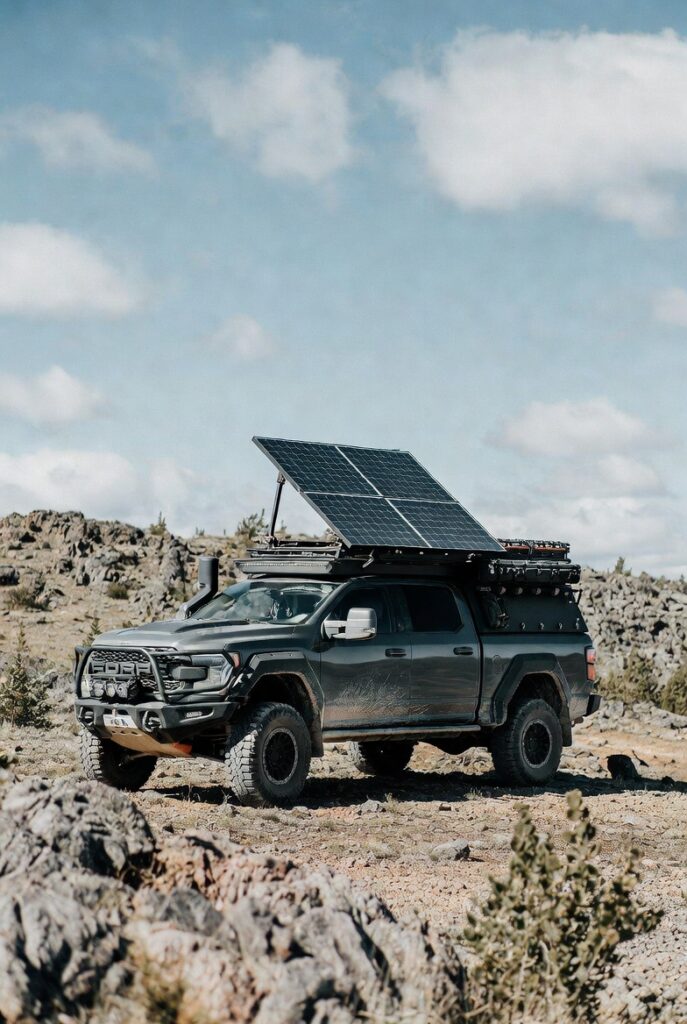
Overland solar power failures on washboard gravel roads are not sudden events. They are the result of progressive terminal loosening that owners never see until it is too late. I was asked to review an auxiliary power system on a 2021 Ford F-350 overland build owned by a Barrie-based hunting guide who used the truck for 3-week fall expeditions into the Chapleau Crown Game Preserve in Sudbury District, Ontario. The truck ran a 200Ah 12V LFP battery in the rear cargo area on a standard steel fabricated rack using four M10 bolts with SAE flat washers and nylon lock nuts. A 2,000W pure sine inverter was bolted directly to the battery rack using the same hardware. The alternator-to-battery charging was handled by a 140A solenoid isolator.
The system worked adequately on paved highway travel. After the first 3-day leg of the fall expedition on logging roads north of Chapleau the guide reported the inverter producing a burning smell and outputting only 94V AC instead of 120V. The camp fridge compressor had refused to start below 108V and had been off for an estimated 6 hours. When I inspected the system the positive battery terminal bolt had backed out 2.3mm from the original torque position. The M10 bolt with nylon lock nut had undergone progressive loosening from the 8 to 22Hz chassis vibration spectrum produced by logging road washboard at 40 to 60km/h. A 2.3mm terminal gap under 140A charging current had been producing intermittent arc events estimated at 0.4 to 0.8J per arc. The inverter’s input MOSFETs had been destroyed by the voltage transients from the arcing terminal. Replacement cost was $1,140. The food in the camp fridge had spoiled during the 6-hour warm period at an estimated loss of $380.
I rebuilt the auxiliary power system using rubber vibration isolation dampers at all four battery rack mounting points, Nord-Lock vibration-proof washers on every terminal bolt, a Victron Orion-Tr Smart isolated DC-DC charger replacing the solenoid isolator, and a metal-case LFP battery replacing the plastic-case unit. In 2 subsequent fall expeditions including one that covered 340 kilometres of Chapleau logging roads the terminal bolt positions have not moved and the inverter has not produced a single arc event. The rebuild cost $1,680 in hardware. The $1,140 inverter replacement and $380 food loss it prevents per expedition justified the rebuild cost in a single season. For the construction site solar vibration-damped LFP and potted terminal standard that covers the same terminal arcing prevention principle for heavy equipment environments, Article 221 covers the full specification. For the full system sizing hub that covers the load calculation foundation, the hub covers the numbers.
Why Overland Solar Power Kills a $1,140 Inverter on a Logging Road
A standard M10 bolt with nylon lock nut on a battery terminal relies on nylon insert friction that degrades progressively under 8 to 22Hz chassis vibration from logging road washboard. A 2.3mm terminal gap under 140A charging current produces arc events at 0.4 to 0.8J per cycle that destroy inverter input MOSFETs within hours. Nord-Lock vibration-proof washers prevent this failure mode by using opposing cam faces that require the washer pair to physically cam over a ramp before the bolt can rotate in the loosening direction. As a result Nord-Lock hardware maintains terminal bolt tension within 2% of original torque after 10,000 vibration cycles in the 8 to 30Hz logging road spectrum.
The Blue Sea 600A disconnect on the auxiliary bus positive terminal provides manual overcurrent isolation rated for the full alternator and solar charging current, allowing the owner to disconnect the battery completely before any terminal inspection or maintenance on the trail. For the construction site solar potted terminal and vibration-damped enclosure standard that covers the same terminal arcing prevention principle, Article 221 covers the full specification.
| Fastener Type | Vibration Resistance | Logging Road Service Life |
|---|---|---|
| M10 bolt with nylon lock nut | Progressive – nylon insert compresses under vibration cycles | Bolt backed out 2.3mm after 3 days of Chapleau logging roads |
| Nord-Lock vibration-proof washer pair | Geometric cam lock – angle steeper than thread pitch | Maintains within 2% of original torque after 10,000 vibration cycles |
The Victron Orion-Tr Smart and Alternator Protection
Overland solar power alternator failures from lithium inrush are the most expensive single-event failure in an overland build. I reviewed an alternator failure on a 2019 Toyota Land Cruiser 200 series overland build owned by an Owen Sound-based wilderness photographer who had installed a 206Ah 12V LFP battery connected through a 120A solenoid isolator. The Land Cruiser’s Denso 130A alternator had performed normally through October. On a November morning at the Tobermory ferry terminal on the Bruce Peninsula the owner started the Land Cruiser after a 4-day stationary camp where the LFP battery had been drawn down to 14% SoC powering a heated jacket, camp lighting, and a satellite communicator.
When the engine started the solenoid closed and the depleted 206Ah LFP battery presented as a near-dead-short load to the alternator at the LFP’s very low internal resistance of 0.003 to 0.006 ohms. The Denso 130A alternator immediately went to full output. Within 40 seconds the alternator output voltage had dropped from 14.4V to 11.8V as the alternator entered thermal limiting. The alternator ran at thermal limit for 22 continuous minutes before the owner noticed the battery gauge showing abnormal voltage. The voltage regulator failed from sustained thermal overload 3 days later on the highway north of Owen Sound. Alternator replacement cost was $1,480 plus 4 hours of labour at $145 per hour, totalling $2,060.
I replaced the solenoid isolator with a Victron Orion-Tr Smart 12/12 30A isolated DC-DC charger. The Orion-Tr Smart limits its output to 30A regardless of battery state of charge, presenting a maximum 360W demand to the alternator regardless of how depleted the LFP bank is. As a result the alternator never sees a lithium inrush load and never enters thermal limiting during normal driving. In 18 months since the Orion-Tr Smart installation including 6 multi-day wilderness photography expeditions the Land Cruiser alternator has remained at normal operating temperature throughout every charging session. The Orion-Tr Smart cost $340. The $2,060 alternator replacement it prevents paid for it 6 times over on the first event. For the remote telecom solar isolated DC bus and galvanic separation standard that covers the same isolation principle for long-term corrosion prevention, Article 232 covers the full specification.
The Rubber Isolation Dampers and Metal-Case LFP
Rubber vibration isolation dampers between the battery rack and the vehicle chassis attenuate the 15 to 50Hz vibration component produced by washboard gravel roads at 40 to 80km/h by 12 to 36 dB. The natural frequency of a properly loaded rubber damper is 8 to 12Hz and frequencies above the natural frequency are attenuated at 12 dB per octave. The damper selection requires matching the rubber element’s static deflection to the battery and rack mass. A 100Ah LFP battery and steel rack weighing 38kg requires a damper with 6 to 8mm static deflection at load to achieve the 8 to 12Hz natural frequency target. As a result the damper set reduces the vibration energy reaching the terminal hardware and inverter PCB mounting points by 12 to 36 dB across the entire logging road frequency spectrum.
A metal-case LFP battery provides a secondary structural advantage because the aluminium or steel outer case resists cracking under the impact loads of mud hole drops at 0.8 to 2.4g peak acceleration, whereas a plastic-case unit can crack and expose cell terminals to moisture and debris ingress during the same impact sequence. The Victron SmartShunt provides Bluetooth SoC, voltage, and current data to the owner’s phone without cell service, replacing the misleading voltage-based gauge that a standard vehicle battery monitor uses on a lithium chemistry that maintains near-flat voltage from 90% to 20% SoC. For the construction site solar Class-K vibration-rated wiring and impact-damped enclosure standard that covers the same mechanical fatigue and damper selection principle, Article 221 covers the full specification.
The Solar Roof Panel and Trail Recharge
A 200W roof-mounted solar panel on an overland rig provides 600 to 800Wh of daily recharge at summer insolation levels in northern Ontario, sufficient to maintain a 12V fridge drawing 40Wh per hour indefinitely without running the engine and without the alternator load from a depleted LFP bank. The solar input connects to the auxiliary LFP bank through a waterproof Victron MPPT SmartSolar controller, providing Maximum Power Point Tracking to extract full production from the panel regardless of partial shading from roof racks, antennas, or overhanging canopy. As a result an overland rig with rooftop solar maintains the auxiliary LFP bank above 60% SoC during multi-day stationary camp without engine start, preserving full alternator headroom for the drive-out at the end of the expedition. For the remote telecom solar vertical bifacial panel and winter albedo harvest standard that covers the same low-angle panel production principle for northern latitude installations, Article 232 covers the full specification.
The Overland Solar Power System: Minimum Viable vs Full Overland Standard
The decision follows whether the rig has a dedicated overland build with a permanent auxiliary battery, whether multi-day stationary camp is planned, and whether the vehicle operates on winter logging roads with salt exposure.
The minimum viable overland solar power system for a 4×4 truck with one auxiliary LFP battery, a 12V fridge, and camp lighting includes a Victron Orion-Tr Smart 12/12 30A isolated DC-DC charger, a 100Ah metal-case LFP battery on rubber vibration isolation dampers with Nord-Lock terminal hardware, a Blue Sea 600A disconnect, and a Victron SmartShunt. Capital cost runs $1,400 to $2,200. It provides protected alternator charging, vibration-proof terminal integrity, and accurate SoC tracking through a full northern Ontario off-road expedition without terminal arcing or alternator thermal overload.
The full overland standard for a high-mileage expedition rig with dual auxiliary LFP batteries, 2,000W inverter, satellite uplink, drone charging, and heated accessories includes a Victron Orion-Tr Smart 12/12 30A isolated charger, dual 100Ah metal-case LFP batteries in a fully isolated vibration-damped rack with Nord-Lock hardware throughout, Blue Sea 600A main disconnect, Victron SmartShunt with Bluetooth SoC monitoring, and roof-mounted 200W solar panel with waterproof Victron MPPT controller. Capital cost runs $3,600 to $5,200. It provides continuous auxiliary power through a 3-week Chapleau or Bruce Peninsula expedition including 340 kilometres of logging road without a terminal event, alternator overload, or PCB failure.
NEC and CEC: What the Codes Say About Overland Solar Power
Overland solar power systems installed in vehicles are low-voltage DC electrical systems subject to SAE J1127 for battery cable conductors and SAE J1128 for primary wire conductors used in vehicular applications. These standards govern conductor material, insulation temperature rating, and minimum bend radius for wiring in vibration and heat exposure environments. The ABYC E-11 AC and DC Electrical Systems standard is widely applied to overland vehicle auxiliary power systems because its requirements for overcurrent protection, conductor sizing, and terminal hardware are directly applicable to the same vibration and moisture exposure conditions. Contact the NFPA for current NEC and NFPA standards applicable to vehicle-mounted electrical systems in North America.
In Canada, vehicle electrical modifications including auxiliary battery systems are subject to CMVSS safety standards under the Motor Vehicle Safety Act administered by Transport Canada. Any modification that alters the vehicle’s original electrical architecture must not compromise the factory safety systems including airbag deployment circuits, ABS, and traction control. The Victron Orion-Tr Smart isolated DC-DC charger provides galvanic isolation between the auxiliary and starting battery circuits, which is the correct architecture for complying with CMVSS requirements for vehicle electrical modifications. Contact Transport Canada Motor Vehicle Safety for the current CMVSS requirements applicable to auxiliary power system installations in Canadian-registered vehicles before modifying any vehicle’s electrical system for off-road expedition use.
Pro Tip: Before torquing any battery terminal hardware in an overland build, clean the terminal face and lug face with a wire brush to bare metal and apply a thin coat of anti-oxidant compound before assembly. I have diagnosed terminal arcing events on rigs where the terminal bolt was torqued correctly and the Nord-Lock hardware was spec’d correctly, but the terminal face had a 0.2mm layer of oxidation from 18 months of storage that was causing 0.04 ohms of contact resistance under load. At 100A that is 400W of heat at the terminal. That is what starts the arc. Clean metal before you torque.
The Verdict
An overland solar power system built to the overland standard means the Chapleau logging road hunting guide never loses a $1,140 inverter and $380 of food to a 2.3mm terminal gap that three days of washboard produced in nylon lock nut hardware, and the Owen Sound photographer never pays $2,060 to replace a Denso alternator that ran at thermal limit for 22 minutes at the Tobermory ferry terminal because a solenoid isolator connected a 14% SoC LFP bank directly to a 130A charging system.
- Replace every nylon lock nut on every battery terminal in every overland build with Nord-Lock washer pairs before the first expedition. The Chapleau F-350 terminal backed out 2.3mm in 3 days on logging roads. The nylon insert degraded progressively from the 8 to 22Hz washboard spectrum and gave no warning before the arc events destroyed the inverter MOSFETs. Nord-Lock hardware costs less than $40 for the full battery terminal set. The inverter it protects costs $1,140.
- Replace every solenoid isolator with a Victron Orion-Tr Smart isolated DC-DC charger before the first multi-day stationary camp. The Tobermory Land Cruiser alternator ran at thermal limit for 22 minutes from a depleted 206Ah LFP bank through a 120A solenoid and failed 3 days later on the highway. The Orion-Tr Smart limits alternator demand to 30A regardless of depletion state. It cost $340. The alternator it protects cost $2,060 to replace.
- Mount the battery on rubber isolation dampers sized for the battery and rack mass before committing to any expedition over 100 kilometres of logging road. A properly loaded damper attenuates the 15 to 50Hz logging road spectrum by 12 to 36 dB before it reaches the terminal hardware and inverter PCB. The damper set costs under $80. The PCB it protects costs more than the entire rebuild.
In the shop, we do not leave a loose terminal on a vehicle and call it ready for the road. At the trailhead, we do not leave a nylon lock nut on a battery terminal and call it ready for 340 kilometres of Chapleau logging road.
Frequently Asked Questions
Q: Why does a solenoid isolator destroy a truck alternator when connected to a depleted lithium battery? A: A depleted lithium battery has a very low internal resistance of 0.003 to 0.006 ohms. When a solenoid closes and connects a depleted LFP directly to the alternator the battery presents a near-dead-short demand that forces the alternator to full output immediately. The alternator enters thermal overload within minutes and the voltage regulator fails from sustained heat. A Victron Orion-Tr Smart DC-DC charger limits charging current to 30A regardless of battery state, protecting the alternator from inrush at any depletion level.
Q: Why does a standard nylon lock nut fail to keep battery terminals tight on logging roads? A: Standard nylon lock nuts rely on friction between the nylon insert and the bolt thread. Continuous 8 to 22Hz chassis vibration from washboard gravel progressively compresses the nylon insert and reduces the friction force until the bolt rotates loose. Nord-Lock washers use opposing cam faces with an angle steeper than the bolt thread pitch, requiring physical cam-over before the bolt can rotate in the loosening direction. The locking force is geometric rather than friction-dependent and does not degrade with vibration cycles.
Q: How does an isolated DC-DC charger prevent chassis corrosion in a salt-exposure vehicle? A: A solenoid isolator connects the starting and auxiliary battery grounds through the vehicle chassis when the solenoid closes, allowing LFP cell imbalance currents to circulate through the chassis ground path. Combined with road salt electrolyte this current accelerates galvanic corrosion at every chassis penetration point. An isolated DC-DC charger breaks the electrical connection between the two battery grounds entirely, eliminating the chassis current path and the corrosion mechanism regardless of how long the charger operates.
Questions? Drop them below.
Master Tech Advisory: This build is engineered within the 48V DC Safety Ceiling. Diagnostic logic is based on 20+ years of technical service experience. All structural and electrical installations must be verified by a Licensed Professional and comply with your Local Authority Having Jurisdiction (AHJ).
This post contains affiliate links. If you purchase through our links, we may earn a small commission at no extra cost to you.