
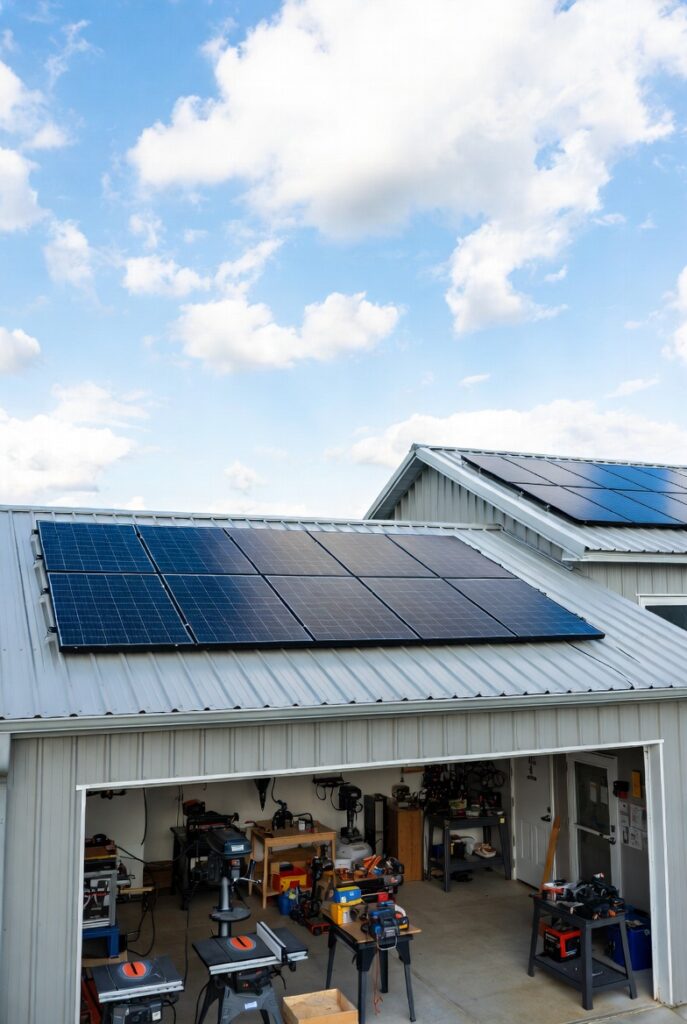
Off-grid workshop builds fail at the moment you hit the power switch on your first serious tool. I helped a property owner near Erin in Wellington County, Ontario diagnose this exact pattern in spring 2025. He had built a beautiful workshop with a 5kW inverter powering a 15A table saw, a 12A miter saw, and a 5HP air compressor. His system ran lights, dust collection, and small tools perfectly. Every time he hit the table saw switch, the inverter shut down instantly.
I examined his monitoring data and measured his inrush current with a peak-reading clamp meter. His 15A table saw drew 58A for 200 milliseconds on startup. His 5kW inverter had an 8kW surge rating for 100 milliseconds. The 58A spike at 240V equals 13,920W instantaneous demand. His 8kW surge capacity was exceeded by 74%. His inverter protected itself by shutting down. His off-grid workshop had an inrush current problem that no amount of battery capacity could solve.
I helped him install a soft-start module on his table saw motor. The module ramps voltage gradually over 2 seconds instead of applying full power instantly. His startup current dropped from 58A to 22A. His inverter now handles the saw startup at 5,280W instantaneous, well within its 8kW surge capacity. The soft-start module cost $180 installed. His off-grid workshop now runs the table saw, miter saw, and compressor without tripping. For the load management that sequences workshop tools with house loads, The Load Management Standard covers the automation.
Why Off-Grid Workshop Builds Fail at the Power Switch
Off-grid workshop builds fail at the power switch because motor inrush current exceeds inverter surge capacity. The Erin owner’s table saw ran at 15A continuous. His inverter could handle 15A indefinitely. The problem was the first 200 milliseconds when startup current spiked to 58A.
His off-grid workshop worked fine for everything except the moment he hit the switch on a large motor. The startup spike is invisible in normal operation but it triggers overcurrent protection instantly.
The distinction matters for system design. Running wattage determines continuous capacity needs. Inrush current determines surge capacity needs. Most workshop failures happen because owners size for running loads and ignore startup spikes.
The Inrush Current Problem: When Motors Attack Your Inverter
The inrush current problem exists because electric motors require massive current to overcome stationary inertia. A running motor draws its rated current. A starting motor draws 3x to 6x rated current until it reaches speed. A 15A motor may spike to 45A or 60A for 100 to 300 milliseconds.
The spike duration is brief but the magnitude is enormous. The Erin owner’s 15A saw drew 58A on startup. His inverter saw 13,920W demand for 200 milliseconds.
The inverter’s 8kW surge rating was designed for 100 milliseconds. The timing mismatch caused the shutdown. His motor needed 200 milliseconds of surge capacity. His inverter provided only 100 milliseconds.
Inverter Sizing: The 3x Surge Rule for Motor Loads
Inverter sizing for motor loads requires surge capacity of at least 3x running wattage. A 3,000W running tool needs 9,000W surge capacity. A 1,800W table saw with 58A inrush needs surge capacity exceeding 13,000W.
A Victron MultiPlus-II with 10kW continuous and 18kW surge handles most workshop motors comfortably. The surge rating matters more than continuous rating for motor-heavy workshops.
The Erin owner’s 5kW/8kW inverter was undersized for his table saw inrush. Upgrading to 10kW/18kW would have solved the problem but cost $2,500. The soft-start option achieved the same result for $180.
Soft-Start Modules: Reducing Startup Punch by 60%
Soft-start modules reduce motor inrush current by 50% to 65% by ramping voltage gradually. Instead of applying full voltage instantly, the module increases voltage over 1 to 3 seconds. The motor accelerates smoothly without the massive current spike.
The Erin owner’s table saw dropped from 58A inrush to 22A with soft-start installed. His inverter handles 22A at 240V easily. Soft-start modules cost $150 to $250 per motor.
Installing soft-start on 2 or 3 major tools costs $400 to $750. The alternative is a $2,500 to $4,000 inverter upgrade. The math favors soft-start for most workshop builds.
Inverter-Based Welders: The Only Choice for Battery Power
Inverter-based welders are the only practical choice for battery-powered workshops. Traditional transformer welders draw dirty, inefficient power with massive inrush. An inverter welder uses electronics to create clean arc power from DC input.
A quality 200A MIG or stick inverter welder draws 3,000W to 5,000W during welding. The power draw is steady and predictable unlike motor inrush. Duty cycle ratings matter for battery systems.
A 60% duty cycle welder at 200A can run 6 minutes per 10-minute period. Respecting duty cycle prevents overheating battery cables and inverter. Reference ESA for Ontario electrical installation standards.
DC Cabling: Preventing Voltage Sag with 4/0 AWG
DC cabling between batteries and inverter determines voltage sag under heavy load. When the table saw starts, current demand spikes. Undersized cables create voltage drop. The inverter sees low voltage and may shut down or reduce output.
The solution is oversized cable for the DC run. 4/0 AWG welding cable handles high current with minimal sag. Keep the DC run as short as possible. A Victron SmartShunt monitors voltage in real time during heavy loads.
The Erin owner’s 10-foot DC run uses 4/0 cable with less than 0.5V sag during table saw startup. Proper DC cabling ensures the inverter receives stable voltage during surge events.
The Solar Dump Load: Using Your Workshop as a Solar Sponge
I was reviewing production data with a property owner near Orangeville in Dufferin County, Ontario in summer 2025. His 14kW solar array filled his 30kWh battery bank by 10:30am on clear days. His charge controller throttled production from 11am to 4pm because the batteries were full. His monitoring showed 40 to 50kWh of potential production being curtailed daily during summer. He had a thickness planer, a jointer, and a dust collector sitting idle in his workshop while free solar went to waste.
I examined his workshop schedule. He typically did his milling work on weekends or evenings when he had time. His evening sessions drained his batteries significantly. His off-grid workshop was consuming stored energy while his daytime production was being thrown away. The timing was exactly backwards.
I helped him shift his heavy milling to the solar peak window between 10am and 2pm. His thickness planer draws 3,200W during passes. His jointer draws 1,800W. Running both during solar peak captures production that would otherwise be curtailed. He now schedules rough milling for late morning when his batteries are full and panels are producing maximum power. His evening battery reserves improved by 15 to 20kWh because he stopped draining them for daytime-appropriate work. His off-grid workshop became a solar sponge that improves overall system efficiency. For the expandable array that increases production capacity, The Expandable Solar System Standard covers the design.
Pneumatic Tools: Air Tanks as Mechanical Batteries
A large air compressor tank functions as a mechanical battery. The compressor motor runs during solar peak to fill the tank to 120 PSI. The stored air pressure runs pneumatic tools without touching the electrical system.
Impact wrenches, nail guns, die grinders, and spray equipment run on compressed air. A 60-gallon tank at 120 PSI stores significant work capacity. The compressor only runs during refill cycles.
Evening tool use draws from stored air instead of stored electrons. The strategy shifts electrical consumption to solar peak while maintaining evening capability. Pneumatic tools add flexibility to workshop scheduling without draining batteries.
The Off-Grid Workshop Strategy: Surge Capacity and Soft-Start
The off-grid workshop strategy combines surge-rated inverters with soft-start modules for motor loads. The inverter must handle the reduced inrush from soft-started motors. The soft-start modules reduce inrush by 50% to 65%. Together they create a system that handles workshop motors without oversizing everything.
A Victron Cerbo GX tracks production and battery state for scheduling heavy work during solar peak. The monitoring enables informed decisions about when to run power-hungry tools.
The Erin owner’s strategy of soft-start plus existing inverter cost $180 versus $2,500 for inverter upgrade alone. His off-grid workshop runs full capability at a fraction of the brute-force cost.
Planning Your Off-Grid Workshop: Components and Costs
Planning your off-grid workshop starts with listing your tools and their running wattage. Measure or estimate inrush current for each motor. The largest inrush determines your surge capacity requirement. Soft-start modules on major motors reduce the surge requirement significantly.
The Erin owner’s soft-start investment of $180 avoided a $2,500 inverter upgrade. The Orangeville owner’s scheduling shift captured 40 to 50kWh of curtailed solar daily.
Your off-grid workshop investment depends on your tools, your existing inverter capacity, and your willingness to schedule heavy work during solar peak. For the battery bank that supports workshop loads, The Budget Off-Grid System Standard covers the sizing.
Minimum Viable vs Full Standard: Choosing Your Workshop Level
The off-grid workshop approach offers two levels depending on your tools and production goals. The minimum viable level prevents inverter trips without major upgrades. The full standard provides professional capability with welding and pneumatics.
| Workshop Level | Key Components | Cost | Capability |
|---|---|---|---|
| Minimum Viable | Soft-start + DC cabling + scheduling | $200-$500 | Basic power tools |
| Full Standard | 10kW inverter + welder + pneumatics + soft-start | $6,000-$12,000 | Professional shop |
Both off-grid workshop approaches provide functional workspace. The difference is capability depth and tool flexibility. The minimum viable approach works for property owners with modest tool requirements and existing inverter capacity. The full standard provides professional capability that feels like grid power.
Frequently Asked Questions
Q: What size inverter do I need for an off-grid workshop with power tools?
A: An off-grid workshop with standard power tools needs an inverter with surge capacity of 3x your largest tool’s running wattage. A 3,000W table saw needs 9,000W or higher surge rating. Soft-start modules reduce this requirement by 50% to 65%. The Erin owner’s 5kW inverter with 8kW surge handles his 1,800W table saw after adding $180 soft-start. Without soft-start, he would need a 10kW inverter with 18kW surge. Your off-grid workshop sizing depends on whether you use soft-start on motor loads.
Q: Can I run a welder in my off-grid workshop on battery power?
A: Yes, you can run a welder in your off-grid workshop using an inverter-based welder. Traditional transformer welders are impractical for battery systems due to dirty power draw and poor efficiency. A 200A inverter MIG or stick welder draws 3,000W to 5,000W during welding. Respect the duty cycle rating to prevent overheating cables and inverter. Your off-grid workshop needs adequate battery capacity and properly sized DC cabling to handle welding loads.
Q: How do I prevent my inverter from tripping when I start power tools in my off-grid workshop?
A: Prevent inverter trips in your off-grid workshop by adding soft-start modules to high-inrush motors. Soft-start reduces startup current by 50% to 65% by ramping voltage gradually. The Erin owner’s table saw dropped from 58A inrush to 22A with a $180 soft-start module. His inverter stopped tripping immediately. Alternatively, upgrade to an inverter with surge capacity of 3x your largest tool’s running wattage. Soft-start is usually more cost-effective than inverter upsizing for off-grid workshop builds.
Pro Tip: Your off-grid workshop should run heavy tools when the sun is strongest, not when you have free time in the evening. The Orangeville owner shifted his milling work from evening to midday and recovered 15 to 20kWh of battery reserves. His off-grid workshop became a solar sponge instead of a battery drain. Schedule your thickness planer and jointer for the solar peak window. Save your batteries for evening lights and comfort loads. The timing makes all the difference.
Verdict
- The Soft-Start Off-Grid Workshop Standard. The Erin owner’s 15A table saw drew 58A inrush for 200 milliseconds, exceeding his 5kW inverter’s 8kW surge capacity by 74%. His inverter shut down every time he hit the switch. A $180 soft-start module dropped startup current to 22A. His off-grid workshop now runs all three major tools without tripping. The soft-start investment saved him from a $2,500 inverter upgrade.
- The Solar Sponge Timing Standard. The Orangeville owner was curtailing 40 to 50kWh of solar daily while draining his batteries during evening workshop sessions. Shifting heavy milling to the 10am to 2pm solar peak window captured that wasted production. His evening battery reserves improved by 15 to 20kWh. The scheduling change cost nothing but transformed his workshop from a battery drain to a production capture system.
- The Pneumatic Mechanical Battery Standard. A 60-gallon air tank at 120 PSI stores significant work capacity without touching the electrical system. Fill the tank during solar peak. Use pneumatic tools in the evening without draining batteries. Impact wrenches, nail guns, and die grinders run on stored air pressure. The strategy shifts electrical consumption to peak production hours while maintaining evening tool access.
This build is engineered within the 48V DC Safety Ceiling. Diagnostic logic is based on 20+ years of technical service experience. All structural and electrical installations must be verified by a Licensed Professional and comply with your Local AHJ.
This article contains affiliate links. If you purchase through these links, I earn a small commission at no extra cost to you.
Questions? Drop them below.