
Disclosure: This post contains affiliate links. If you purchase through our links, we may earn a small commission at no extra cost to you.
Off-grid surge protection is the standard that determines whether your Fortress electronics survive the one event that no breaker can stop. I have diagnosed the vehicle equivalent on the service drive: a car arrives after a nearby lightning strike, the engine cranks, fires, runs for three seconds, and then every sensor reading drops off and the system goes into limp mode. The alternator is fine. The starter is fine. The fuel system is fine. The ECUs are gone. The diagnosis takes 30 seconds. The repair takes three days waiting for replacement modules. The mechanical hardware survived the strike. The electronic brain did not. In your off-grid Fortress the same failure mode exists at a different scale. The inverter transformer weighs 15 kilograms and will survive almost anything a surge event can produce. The control board running the protection, monitoring, and AC synthesis functions will not. Off-grid surge protection is what keeps the brain alive when the hardware could survive without it. Make sure your system is sized and built correctly before addressing surge hardening; protecting an undersized system is the wrong sequence.
The Three Surge Threats and Why They Require Different Off-Grid Surge Protection
Not all surge events are the same threat. Three distinct scenarios require understanding before the protection hardware can be correctly specified.
The first is a direct or nearby lightning strike. This is the most common surge threat for a Rockwood off-grid installation and it is already addressed in the lightning arrestor guide. A Type 2 MOV-based surge protector and a properly mounted lightning arrestor at the Midnite Solar MNPV6 combiner box building entry point provide adequate protection against the induced voltage from a nearby strike. This is the baseline. Every Fortress should have it before considering the next two threat levels.
The second is a coronal mass ejection or geomagnetic storm. A CME event induces DC current in long parallel conductors through the mechanism of geomagnetic induction. The 1989 Quebec blackout, the 2003 Halloween storms, and the 1859 Carrington Event all operated through this mechanism. The grid fails in these events because it is built from conductor runs measured in hundreds of kilometres. An off-grid system with wire runs measured in tens of metres has a fundamentally different exposure profile. A client once asked me what would have happened to their Rockwood system during the 2003 Halloween storms that tripped relays across Quebec and Sweden. The honest answer was that their short wire runs, their isolated DC circuits, and a properly installed SPD gave their system meaningfully better survivability than any grid-connected property in the region. The CME threat is real and historically documented. The Fortress’s structural advantage is also real.
The third threat is nuclear electromagnetic pulse. The E1 component of a nuclear EMP generates its peak field in approximately 5 nanoseconds. A standard Type 2 MOV-based SPD responds in 25 to 100 nanoseconds. The timing gap means a Type 2 SPD is too slow to clamp the E1 pulse. Type 1 silicon avalanche diode SPDs respond in under 1 nanosecond and can intercept the E1 pulse. EMP hardening to this standard requires Type 1 SPDs at every entry point and Faraday shielding for spare components. This is the preparedness investment beyond the baseline lightning protection.
The off-grid system grounding guide covers the grounding electrode system that all three levels of surge protection depend on. A surge protection device without a low-resistance path to earth is a surge absorber with nowhere to send what it absorbs.
The Off-Grid Surge Protection Hardware Standard: Three Layers
Layer 1 is the Type 2 SPD at the combiner box. For lightning and CME protection, a Type 2 MOV-based surge protective device mounted at the building entry point combiner box is the minimum standard. It is the same mounting location as the lightning arrestor. The lightning arrestor guide specifies the arrestor. The Type 2 SPD is the companion device that handles the conducted surge energy that the arrestor diverts into the grounding system. Both devices are required. Neither alone is sufficient. The solar combiner box guide covers the combiner box installation that houses both devices at the building entry point.
Layer 2 is the Type 1 SPD upgrade for EMP hardening. For installations requiring EMP-level protection, the Type 2 MOV-based device is replaced or supplemented with a Type 1 silicon avalanche diode SPD rated for sub-nanosecond response. These devices are available from industrial surge protection suppliers and are specified for critical infrastructure applications. They cost significantly more than Type 2 devices. They are the correct specification for the E1 EMP threat.
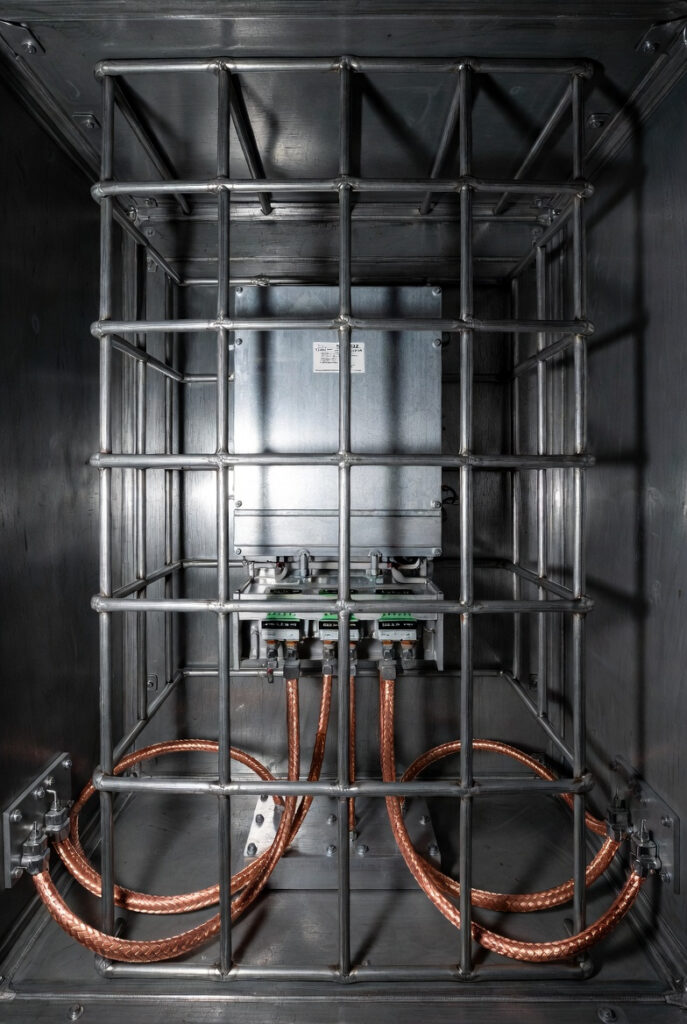
Layer 3 is the Faraday enclosure for spare components. A galvanized steel trash can with a tight-fitting lid and a non-conductive interior liner, rubber mat or heavy cardboard, creates a Faraday enclosure adequate for spare component protection. The lid must make continuous metal-to-metal contact around the entire perimeter; rubber gaskets or painted contact surfaces defeat the shielding. The enclosure must not be grounded during storage use; grounding connects it to the conductor network and provides an entry path for induced current. Store inside it: a spare charge controller, a small backup inverter, a handheld analog voltmeter, and any other electronic components needed to restart a stripped-down system if the primary electronics are damaged. The Victron Cerbo GX represents the class of sensitive monitoring electronics worth having a backup of; a spare unit in a Faraday enclosure is the reserve brain that survives what the primary unit cannot.
Ferrite core suppressors on communication cables, the Victron VE.Direct cables, the battery temperature sensor leads, and any CAT cable running between equipment, suppress high-frequency common mode noise that EMI events couple onto signal lines. They do not protect against direct surge on DC power conductors but they reduce the noise floor on the communication lines that carry the monitoring data the system depends on for normal operation.
The Analog Backup Standard
If the digital monitoring system fails, control boards erased, Cerbo GX offline, MPPT display dark, the ability to manage the system requires analog measurement capability that does not depend on any electronic processing. The minimum analog backup kit contains three items: a quality analog voltmeter covering 0-60V DC for battery bank voltage measurement, a DC clamp meter for current measurement, and a written copy of the key system parameters including the battery bank LVC voltage, the array open-circuit voltage, and the main fuse ratings. These three items, stored in the Faraday enclosure alongside the spare components, allow a stripped-down manual assessment of battery state and charging status with no electronic equipment whatsoever.
The emergency stop master kill switch is the mechanical backup disconnect that functions regardless of electronic system state. The analog voltmeter is the measurement backup. Together they give you the ability to assess battery voltage and safely disconnect the system manually if every electronic display and control system in the installation is non-functional.
NEC and CEC: What the Electrical Codes Actually Say
NEC 285.1 establishes the requirements for surge protective devices on premises wiring systems and requires that SPDs be listed for the application and installed in accordance with the manufacturer’s instructions. NEC 285.25 requires that SPDs be installed with the shortest possible lead length between the SPD and the conductors being protected; a long lead introduces inductance that slows the clamping response and reduces the device’s effectiveness. For the combiner box mounting location, the SPD must be installed as close as physically possible to the string circuit entry terminals. NEC 690.11 requires arc fault circuit protection for PV systems on or in buildings; the surge protection standard described in this article is complementary to but distinct from the arc fault protection requirement.
CEC Section 64-068 addresses surge protection requirements for photovoltaic installations in Canada, requiring that SPDs be installed at the point where the PV system conductors enter the building. In Ontario, the combiner box at the building entry point is the correct mounting location for surge protection compliance under both NEC 285.25 and CEC Section 64-068. CEC Rule 2-308 requires that electrical equipment be protected from the action of the elements; in the context of a rural Ontario installation, the electromagnetic environment, including lightning, geomagnetic activity, and the induced surge events that accompany severe weather, is a foreseeable element that the installation design must address.
Quick Reference – Off-Grid Surge Protection Layers
| Threat | Protection Layer | Device Type | Response Time |
|---|---|---|---|
| Nearby lightning strike | Lightning arrestor at combiner box | Listed lightning arrestor | Microseconds |
| Conducted lightning surge | Type 2 SPD at combiner box | MOV-based SPD | 25-100 nanoseconds |
| CME geomagnetic induction | Type 2 SPD plus short wire runs | MOV-based SPD | 25-100 nanoseconds |
| Nuclear EMP E1 component | Type 1 SPD at all entry points | Silicon avalanche diode SPD | Under 1 nanosecond |
| All surge events | Faraday enclosure for spare components | Galvanized steel, non-grounded | Passive shielding |
| Post-event diagnosis | Analog backup voltmeter and clamp meter | Non-electronic measurement | Instantaneous |
Test the Faraday enclosure before trusting it. Place an AM radio inside, close the lid, and tune the radio to a strong local station before sealing it. The radio signal should drop to silence inside a properly constructed enclosure. If you can still hear the station through the lid, the metal-to-metal contact is incomplete somewhere around the perimeter. Find the gap, ensure bare metal contact, and retest. A Faraday enclosure that fails the AM radio test is not an enclosure; it is an expensive container. Test it before you need it.
The Verdict
Off-grid surge protection is a layered standard, not a single device. The layer you need depends on the threat you are protecting against.
Before considering the electronics protected:
- Install the Type 2 SPD at the combiner box entry point alongside the lightning arrestor; these are companion devices and the installation is not complete without both
- Assess whether your installation warrants the Type 1 SPD upgrade for EMP hardening; if the system is intended to operate through grid-failure scenarios including worst-case electromagnetic events, the upgrade is the correct specification
- Build the Faraday enclosure with spare components and the analog backup kit and test it with an AM radio before you need it; a reserve brain that survives what the primary system cannot is the final layer of off-grid surge protection that no SPD can provide
The ECU that was fried on the service drive could not be rebuilt from parts stored in the car. Your Fortress electronics can be. Build the reserve before the event.
Questions? Drop them below.