
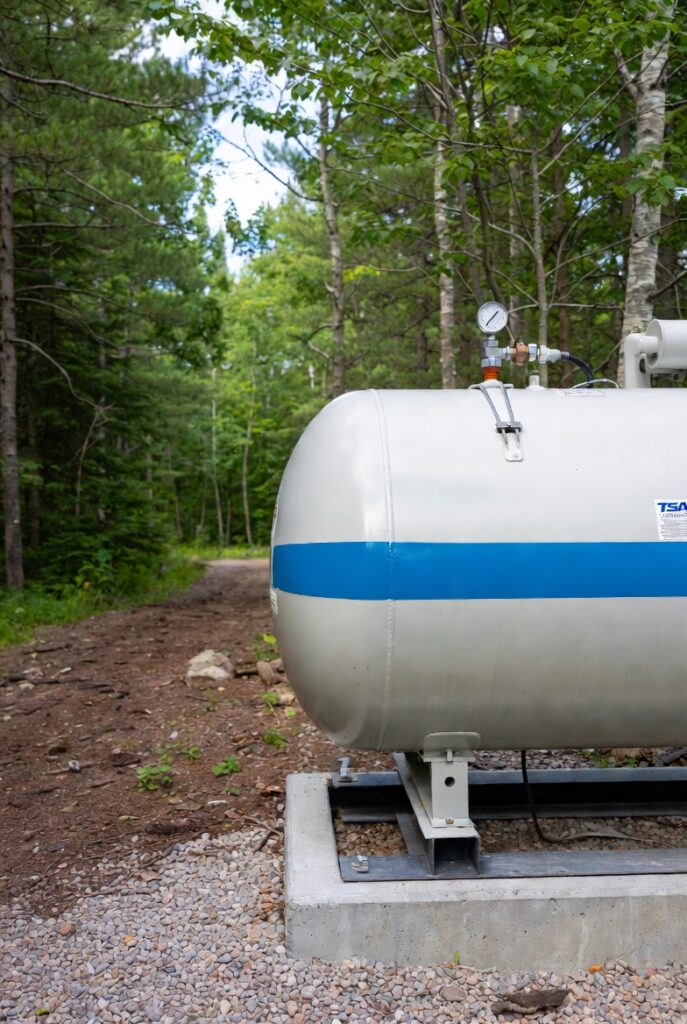
Off-grid propane provides reliable fuel storage that maintains vapor pressure when diesel gels and gasoline goes stale. I helped a property owner near Parry Sound in Parry Sound District, Ontario respond to a delivery refusal and TSSA violation in fall 2025. His 500-gallon propane tank sat on bare ground 6 feet from his cabin window. The delivery driver refused to fill it and reported the installation. A TSSA inspector arrived within two weeks and tagged the tank for removal. His off-grid propane system violated multiple code requirements and faced mandatory remediation.
I examined his installation and identified four separate violations. His 6-foot setback from the window violated the 10-foot minimum from building openings. His tank sat directly on soil with no foundation, creating frost heave risk. His single-stage regulator was undersized for his 80-foot line run. His propane detector was a plug-in AC unit that would fail during inverter shutdown. His off-grid propane setup had been installed by a handyman who did not know TSSA requirements.
I helped him relocate and reinstall the tank properly. We poured a concrete pad on an 8-inch gravel base 12 feet from the cabin. We installed two-stage regulation with a red first-stage at the tank and a green second-stage at the cabin. We added a DC-native propane detector near floor level in his utility room. His total cost was $2,800 for relocation, foundation, and new regulation. His off-grid propane now meets TSSA 2026 requirements with documented inspection. For the heating system that uses this propane supply, The Off-Grid Heating Standard covers the approach.
Why Off-Grid Propane Requires TSSA Compliance and Proper Setbacks
Off-grid propane requires TSSA compliance because improperly installed tanks create explosion and fire risk. The Parry Sound owner’s 6-foot setback from his window violated the minimum safe distance. His off-grid propane tank could have exposed occupants to flame or explosion through the nearby opening.
TSSA codes exist to protect lives and property from preventable incidents. Compliance is not optional, and violations result in mandatory remediation.
Delivery drivers are trained to identify violations and will refuse to fill non-compliant tanks. The first sign of a code problem is often a refused delivery.
The TSSA Violation Problem: When Your Delivery Driver Refuses to Fill
The TSSA violation problem begins when a delivery driver identifies code issues during a routine fill. Drivers are trained to recognize unsafe installations and report them. They are required to report violations to TSSA immediately.
The Parry Sound owner’s driver refused to fill and filed a report the same day. TSSA inspection followed within two weeks of the report.
His tank was tagged for removal until all violations were corrected. Delivery refusal is often the first sign of code problems property owners did not know existed.
The 10-Foot Rule: Clearances from Openings and Ignition Sources
The 10-foot rule requires minimum distance from building openings and ignition sources. Tanks must be 10 feet from any window, door, or ventilation intake. Tanks must also be 10 feet from AC units, generators, electrical outlets, or other ignition sources.
The Parry Sound owner’s 6-foot setback from his window violated this requirement clearly. His relocation to 12 feet provides code compliance with safety margin.
Reference TSSA Propane Safety for current clearance requirements and inspection procedures.
The 100-Foot Delivery Access: Tank Placement for Winter Refills
The 100-foot delivery access rule is practical rather than code-mandated but equally important. Delivery trucks carry hoses that reach approximately 100 feet from parking position. If your tank sits beyond hose reach from where a truck can safely park, drivers may refuse winter delivery.
The Parry Sound owner’s original location required 180 feet of backing down an unplowed driveway. His new location allows parking 60 feet from the fill valve on maintained road.
Plan tank placement for code compliance AND winter delivery access simultaneously. Both requirements must be satisfied for reliable fuel supply.
Two-Stage Regulation: Preventing Reliquification at Minus 30°C
I was troubleshooting intermittent flame failure with a property owner near Huntsville in Muskoka District, Ontario during a January 2025 cold snap. His propane furnace would ignite normally then shut down after 10 to 15 minutes. His tank gauge showed 60% full. His propane detector showed no leaks. The problem only occurred when outdoor temperature dropped below minus 25°C. His off-grid propane supply was failing during the coldest nights when he needed it most.
I examined his installation and found the problem. His 120-foot supply line ran from tank to cabin with a single regulator at the house. The high-pressure propane in the long line was reliquifying in the cold sections before reaching the regulator. Liquid propane cannot pass through a low-pressure regulator designed for vapor. His furnace starved for fuel as liquid pooled in the line. His off-grid propane system needed two-stage regulation to maintain vapor state throughout the run.
I helped him install proper two-stage regulation. We added a red first-stage regulator at the tank reducing pressure from tank pressure to 10 PSI. We kept the green second-stage regulator at the house reducing 10 PSI to 11 inches water column for appliances. The intermediate pressure prevents reliquification in lines up to 200 feet. His total cost was $380 for the first-stage regulator and installation. His off-grid propane now delivers consistent vapor at minus 35°C without flame failure. For the fire safety that includes propane detection, The Off-Grid Fire Safety Standard covers the approach.
Foundation Stability: Concrete Pads and Frost Heave Prevention
Foundation stability prevents frost heave from damaging supply lines and tank connections. A tank sitting directly on soil will rise and fall with freeze-thaw cycles. Movement stresses copper supply lines and can crack fittings over time.
The Parry Sound owner’s tank on bare ground had visible line stress at the connection point. His new concrete pad sits on 8 inches of compacted gravel for drainage.
The pad prevents heave movement that could rupture lines and cause propane release. Proper foundations are required for any permanent tank installation.
Propane vs Diesel: Energy Density and Cold Weather Reliability
Propane vs diesel involves tradeoffs between energy density and cold-weather reliability. Diesel provides 139,000 BTUs per gallon compared to propane at 91,500 BTUs. Diesel delivers 52% more energy per gallon of storage volume.
However, diesel gels at approximately minus 15°C without winterization additives. Propane maintains vapor pressure to minus 40°C without any modification.
The Huntsville owner uses propane for heating reliability and reserves diesel for summer generator operation only. Each fuel serves its optimal role in his system.
DC-Native Leak Detection: Protection When Your Inverter Is Off
DC-native leak detection maintains protection when your inverter shuts down for any reason. Standard plug-in propane detectors fail during inverter shutdown from low battery, faults, or maintenance. Propane is heavier than air and accumulates at floor level before dispersing upward.
A floor-level DC detector running on 12V operates regardless of inverter status. The Parry Sound owner’s plug-in detector would have failed during the exact conditions when leaks are most dangerous.
His replacement DC unit monitors continuously including during overnight inverter sleep. Safety protection must work when the power system does not.
The Off-Grid Propane Strategy: Two-Stage Regulation and Winter Security
The off-grid propane strategy combines code compliance with practical winter reliability. Tanks sit on concrete pads with proper setbacks and delivery access. Two-stage regulation prevents reliquification in lines of any length. DC-native detection works regardless of inverter status.
A Victron SmartShunt tracks generator fuel consumption powered by propane backup. The monitoring helps optimize fuel planning and identify efficiency opportunities.
The Parry Sound owner’s complete strategy provides 30-day winter reserve with documented TSSA compliance. His off-grid propane now delivers reliable fuel security through Ontario’s coldest months.
Planning Your Off-Grid Propane System: Components and Costs
Planning your off-grid propane system starts with calculating heating load and desired reserve days. A typical off-grid home uses 2 to 4 gallons of propane daily for heating in cold weather. A 1,000-gallon capacity provides 25 to 50 days of heating reserve at 80% usable capacity.
A Victron Cerbo GX tracks propane generator runtime for fuel planning. Twin 500-gallon tanks allow summer purchasing when prices are lowest.
Your off-grid propane investment provides winter fuel security independent of delivery schedules. The cost is minimal compared to emergency winter delivery fees or running out of fuel.
Minimum Viable vs Full Standard: Choosing Your Storage Level
The off-grid propane approach offers two storage levels depending on your heating load and desired reserve capacity. The minimum viable level provides basic backup. The full standard provides 30-day winter independence.
| Storage Level | Key Components | Cost | Heating Reserve |
|---|---|---|---|
| Minimum Viable | Single 250-gal + concrete pad + single-stage | $1,200-$1,800 | 2-3 weeks |
| Full Standard | Twin 500-gal + two-stage + DC detector + TSSA inspection | $4,500-$7,000 | 30+ days |
Both off-grid propane approaches require code compliance for safety and delivery access. The difference is storage capacity and cold-weather reliability features. Properties in remote areas should invest in the full standard for winter security.
Frequently Asked Questions
Q: What setbacks does off-grid propane require under TSSA regulations?
A: Off-grid propane requires minimum 10-foot setback from any building opening including windows, doors, and ventilation intakes. Tanks must also be 10 feet from ignition sources including AC units, generators, and electrical outlets. The Parry Sound owner’s 6-foot setback from his window resulted in TSSA violation and mandatory relocation. Off-grid propane installations should exceed minimum setbacks where possible for margin of safety.
Q: Why does off-grid propane need two-stage regulation in cold weather?
A: Off-grid propane needs two-stage regulation because high-pressure propane reliquifies in cold supply lines before reaching single-stage regulators. The Huntsville owner’s 120-foot line caused flame failure below minus 25°C as liquid pooled in cold sections. A red first-stage regulator at the tank reduces pressure to 10 PSI, preventing reliquification in lines up to 200 feet. Off-grid propane with runs over 50 feet should use two-stage regulation for reliable cold-weather delivery.
Q: Why do off-grid propane detectors need to be DC-native?
A: Off-grid propane detectors need DC-native operation because standard plug-in units fail when the inverter shuts down during low battery, faults, or overnight sleep. Propane is heavier than air and accumulates at floor level. The Parry Sound owner’s plug-in detector would have failed during exact conditions when leaks are most dangerous. Off-grid propane safety requires floor-level DC detectors that operate regardless of inverter status.
Pro Tip: Your off-grid propane should be purchased in summer when prices drop 20% to 30% below winter rates. The Parry Sound owner’s twin 500-gallon tanks allow him to buy 800 gallons in August at summer pricing. His off-grid propane cost drops by $400 to $600 annually compared to winter purchasing. Fill your tanks when delivery trucks are not busy and prices are lowest. Winter fuel security starts with summer buying strategy.
Verdict
- The TSSA Compliant Off-Grid Propane Standard. The Parry Sound owner’s 500-gallon tank on bare ground 6 feet from his window was tagged by TSSA for four violations after a delivery driver refused to fill and reported the installation. His $2,800 relocation to a concrete pad at 12 feet with two-stage regulation and DC-native detection now meets TSSA 2026 requirements. His off-grid propane provides 30-day winter reserve with documented inspection.
- The Two-Stage Regulation Standard. The Huntsville owner’s furnace failed during minus 25°C cold snaps because his 120-foot single-stage line reliquified propane in cold sections. His $380 first-stage regulator at the tank reduces pressure to 10 PSI, preventing reliquification in lines up to 200 feet. His off-grid propane now delivers consistent vapor at minus 35°C without flame failure.
- The DC-Native Detection Standard. Standard plug-in propane detectors fail when the inverter shuts down during low battery, faults, or overnight sleep. Propane is heavier than air and accumulates at floor level before dispersing. A 12V DC-native detector monitors continuously regardless of inverter status, protecting your family during exact conditions when leaks are most dangerous.
This build is engineered within the 48V DC Safety Ceiling. Diagnostic logic is based on 20+ years of technical service experience. All structural and electrical installations must be verified by a Licensed Professional and comply with your Local AHJ.
This article contains affiliate links. If you purchase through these links, I earn a small commission at no extra cost to you.
Questions? Drop them below.