
Off-grid heating is the load that exposes every weakness in an all-electric system during the coldest week of winter. It is the moment a property owner returns from a weekend away to find his cabin at 4°C because his heat pump drained his batteries to zero during a minus 28°C cold snap. I helped a property owner near Sundridge in Parry Sound District, Ontario recover from a near-disaster in January 2025. He had installed a cold-climate heat pump as his sole heat source. His 20kWh battery bank and 6kW solar array had handled November and December without issue. Then January arrived with five consecutive days below minus 25°C and heavy cloud cover.
I reviewed his monitoring data from the event. His heat pump COP dropped from 2.8 at minus 10°C to 1.4 at minus 25°C. At COP 1.4, his heat pump consumed 3,200W to deliver 4,500W of heat. His battery bank depleted from 100% to 20% on the first cloudy day. On the second day, it reached 0% by 2pm. His heat pump shut down on low voltage. His cabin temperature dropped from 20°C to 4°C over the next 36 hours before he returned. His pipes had not frozen only because he had set them to drain before leaving. His off-grid heating system had a single point of failure that nearly cost him $15,000 in freeze damage.
I helped him install a redundant heating system over the following month. We added a WETT-certified wood stove as primary backup heat requiring zero electricity. We installed a direct-vent propane heater as emergency heat that runs without any electrical connection. His heat pump now handles the efficient 80% of winter above minus 20°C. His wood stove handles the coldest periods when he is home. His propane heater provides automatic backup when he is away during extreme cold. The cascading system cost $4,200 for the wood stove installation and $1,800 for the propane heater. His off-grid heating now has three independent heat sources with no single point of failure. For the load management that optimizes heat pump operation, The Load Management Standard covers the automation.
Why Off-Grid Heating Creates Single Point of Failure Risk
Off-grid heating creates single point of failure risk when property owners rely on a single heat source. The Sundridge owner’s heat pump was his only option. When batteries depleted, he had no backup. Grid-connected homes can fall back on utility power during equipment failure. Off-grid properties have no such safety net.
A single-source system requires perfect operation of every component: panels, batteries, inverter, and heat pump. Any failure in the chain means no heat. The Sundridge owner’s experience highlights this risk clearly.
His all-electric system failed during a five-day cold snap, leaving his cabin without heat. Without redundant options, he faced significant damage and discomfort. Off-grid heating redundancy means multiple independent heat sources where at least one requires zero electricity.
The COP Cliff: When Heat Pumps Become Battery Drains
Cold-climate heat pumps experience dramatic efficiency loss as temperatures drop. At minus 10°C, a quality unit achieves COP of 2.5 to 3.0. This means 2.5 to 3.0 watts of heat per watt of electricity. The efficiency makes heat pumps excellent for mild winter days.
At minus 25°C, COP drops to 1.2 to 1.5. The heat pump becomes nearly as inefficient as electric resistance heating. The Sundridge owner’s COP drop from 2.8 to 1.4 doubled his electrical consumption precisely when solar production was lowest. A Victron SmartShunt tracks battery SOC during cold snaps and alerts to dangerous depletion.
The COP cliff creates maximum battery stress during minimum production periods. During the Sundridge event, the heat pump consumed twice as much power at minus 25°C compared to mild conditions. This strain drained his batteries rapidly, leading to system failure. Monitoring tools are essential for preventing such issues by alerting you to low battery levels before it is too late.
Cold-Climate Heat Pumps: The Efficient 80% of Winter
Cold-climate heat pumps rated to minus 25°C or minus 30°C handle the majority of Ontario winters efficiently. Most winter days in southern Ontario stay above minus 15°C. At these temperatures, heat pump COP remains above 2.0. The unit delivers twice the heat per watt compared to resistance heating.
The technology has improved significantly in recent years. Modern units maintain useful output down to minus 25°C. A Victron MultiPlus-II powers cold-climate heat pumps efficiently and provides remote monitoring of heating load.
The heat pump should be the primary heat source for its efficiency, not the only heat source for its reliability. The Sundridge owner’s heat pump handles efficient heating during mild conditions but requires backup for extreme cold. By combining his heat pump with wood and propane backups, he ensures reliable heating throughout winter.
Wood Stoves: Zero-Electricity Primary Backup
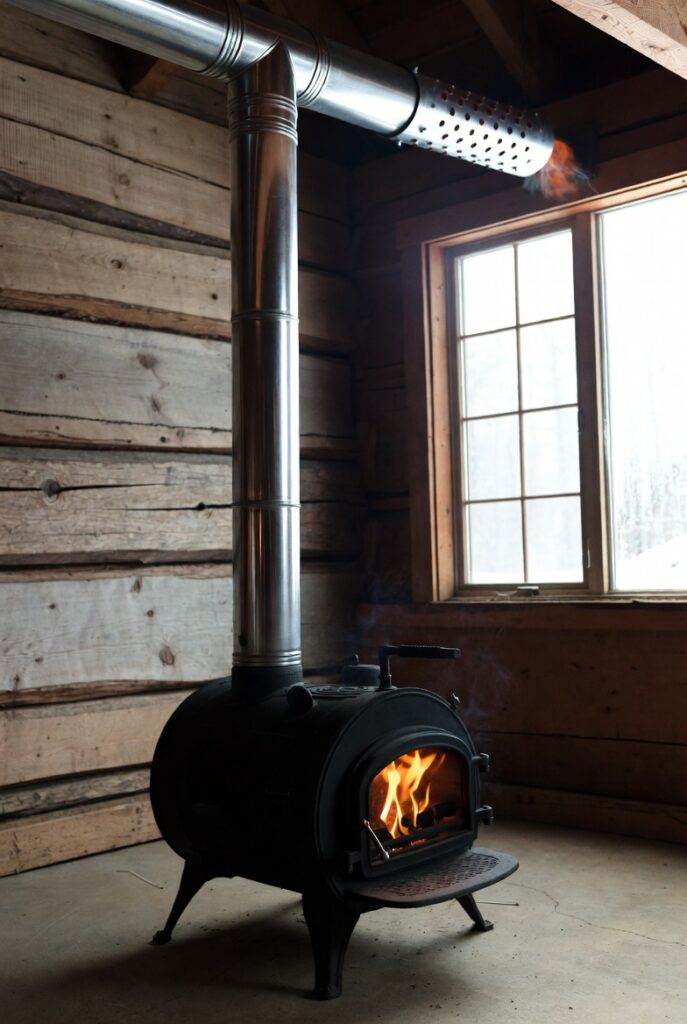
Wood stoves provide radiant heat with zero electrical dependency. A WETT-certified installation ensures safe operation and insurance compliance. The heat output is substantial. A quality wood stove rated at 50,000 to 70,000 BTU can heat a 2,000 square foot cabin during the coldest weather.
Wood is the ultimate off-grid fuel because it can be sourced locally and stored indefinitely. The Sundridge owner’s wood stove now handles the coldest periods when he is home and can tend the fire.
Wood heat requires active management but provides reliable warmth regardless of battery state, solar production, or equipment condition. When temperatures drop below minus 20°C, the Sundridge owner relies on his wood stove for consistent heat. This ensures that his cabin remains warm and comfortable even when other systems are strained.
Propane Backup: Emergency Heat Without Any Power
Direct-vent propane heaters operate without any electrical connection. The thermostat uses a millivolt system powered by the pilot flame itself. The unit starts, runs, and regulates temperature with zero grid or battery power. Empire and Williams manufacture reliable direct-vent units rated for residential heating.
The Sundridge owner’s propane heater provides automatic backup when he is away during extreme cold. The thermostat maintains safe temperature without human intervention. A 500-gallon propane tank provides weeks of emergency heating capacity.
The propane backup is the “survival layer” that prevents freeze damage during extended absence or complete system failure. This automatic backup is crucial for preventing costly damage and ensuring peace of mind during winter months.
Thermal Mass: Banking Heat for Overnight Release
I was monitoring overnight temperature data with a property owner near Haliburton in the Kawartha Highlands, Ontario in February 2025. His cabin had excellent insulation meeting SB-12 standards. His wood stove heated the space efficiently during evening hours. However, his overnight temperature dropped from 22°C at 10pm to 12°C by 6am despite banking the stove with hardwood before bed. His family woke to a cold cabin every morning and immediately restarted the fire. He wanted to understand why his heat dissipated so quickly.
I examined his cabin construction. His floors were plywood over joists with no thermal mass. His walls were insulated but lightweight. His stove sat on a small tile pad with no surrounding masonry. The cabin had nowhere to store heat. The insulation slowed heat loss to the outside, but there was nothing inside to hold heat once the fire died down. His off-grid heating system lacked thermal mass to bridge the overnight gap.
I helped him install a thermal mass system around his wood stove. We poured a 4-inch concrete pad extending 6 feet in front and beside the stove. We built a stone veneer wall behind the stove with 8 inches of mass. The materials cost $1,400 for concrete, stone, and installation supplies. His overnight temperature drop changed dramatically. The concrete and stone absorb heat during active burning. They release stored heat slowly through the night. His cabin now drops from 22°C to only 17°C by 6am. His family wakes to a comfortable cabin. The thermal mass bridges the overnight gap without additional fuel consumption. For the battery system that handles shoulder season heating, The Budget Off-Grid System Standard covers the sizing.
Ontario SB-12: Insulation Standards That Reduce Heating Load
Ontario Building Code Supplementary Standard SB-12 sets minimum insulation values for new construction. Attics require R-60 insulation. Walls require R-22 to R-27 depending on construction type. Below-grade walls require R-17 to R-22. These values determine heating load more than any equipment choice.
A cabin with R-30 attic and R-12 walls requires twice the heat input of a cabin meeting SB-12 standards. The Haliburton owner’s cabin met SB-12, which allowed thermal mass to bridge the overnight gap. Without adequate insulation, off-grid heating becomes a losing battle.
Every dollar spent on insulation reduces heating costs for the life of the building. Reference Ontario Building Code for current SB-12 requirements. Proper insulation is the foundation of an efficient off-grid heating system.
HRSP Rebates: Cutting Your Heat Pump Cost in Half
The Home Renovation Savings Program (HRSP) offers substantial rebates for cold-climate heat pump installation. Electrically heated homes can qualify for up to $7,500 in rebates. This effectively cuts the heat pump equipment cost in half for qualifying properties.
The rebate applies to cold-climate air source heat pumps rated to minus 25°C or colder. Installation must be performed by a registered contractor. The program runs through 2026 with annual funding limits. Applying early in the fiscal year improves approval chances.
The rebate makes cascading heat systems more affordable by offsetting the primary heat pump cost significantly. The Sundridge owner’s investment in redundancy was partially offset by HRSP rebates, reducing his overall expense and improving system reliability.
The Off-Grid Heating Strategy: Cascading Redundancy
The off-grid heating strategy uses cascading redundancy with three independent heat sources. Layer one is the cold-climate heat pump for efficient heating during the 80% of winter above minus 20°C. Layer two is the wood stove for primary backup during extreme cold when someone is home to tend the fire. Layer three is the propane heater for emergency backup when away or during extended cloudy periods.
Each layer operates independently with no shared components. The heat pump requires electricity. The wood stove requires human attention. The propane heater requires neither. Together they create true off-grid heating resilience.
A Victron Cerbo GX tracks system performance and enables remote monitoring of battery state during cold snaps. This ensures you can intervene before systems fail, maintaining a safe and comfortable environment year-round.
Planning Your Off-Grid Heating System: Components and Costs
Planning your off-grid heating system starts with assessing your current infrastructure and redundancy gaps. If you have only a heat pump, you need zero-electricity backup. If you have only wood heat, you need automatic backup for when you are away.
The Sundridge owner’s $6,000 investment in wood stove and propane heater created the redundancy his all-electric system lacked. The Haliburton owner’s $1,400 thermal mass investment improved overnight comfort without adding another heat source. Your off-grid heating investment should fill your specific gaps.
Properties with excellent insulation need less heating capacity. Properties with poor insulation need both heating capacity and insulation upgrades. Assessing these needs helps you plan a system that meets your requirements efficiently.
Minimum Viable vs Full Standard: Choosing Your Redundancy Level
The off-grid heating approach offers two redundancy levels depending on your existing infrastructure and risk tolerance. The minimum viable level provides emergency backup. The full standard provides complete cascading redundancy with thermal mass.
| Redundancy Level | Key Components | Cost | Protection Scope |
|---|---|---|---|
| Minimum Viable | Propane backup + basic thermal mass | $1,500-$2,500 | Emergency backup only |
| Full Standard | Heat pump + wood + propane + thermal mass + insulation | $8,000-$15,000 | Complete cascading redundancy |
The minimum viable off-grid heating includes adding direct-vent propane heater as zero-electricity backup to existing heat pump plus basic thermal mass. It costs $1,500 to $2,500. It provides emergency backup during extreme cold or system failure.
The full off-grid heating standard includes cold-climate heat pump for efficiency, WETT-certified wood stove for primary backup, direct-vent propane for emergency, thermal mass installation, and insulation meeting SB-12. It costs $8,000 to $15,000 depending on existing infrastructure. It provides three independent heat sources with no single point of failure. Both approaches improve resilience over single-source systems. For the DC-native mini-split that provides shoulder season heating, The Off-Grid AC Standard covers the technology.
Frequently Asked Questions
Q: Can a heat pump alone handle off-grid heating in Ontario winters?
A: A heat pump alone cannot reliably handle off-grid heating in Ontario winters due to the COP cliff at extreme temperatures. At minus 25°C, efficiency drops dramatically and battery consumption doubles or triples. Combined with reduced solar production during cloudy cold snaps, a heat pump alone creates single point of failure risk. The Sundridge owner’s cabin dropped to 4°C when his all-electric system failed during a five-day cold snap. Off-grid heating requires cascading redundancy with at least one zero-electricity backup.
Q: What backup heat source works best for off-grid heating when I am away?
A: Direct-vent propane heaters work best for off-grid heating backup when you are away because they require zero electricity. The millivolt thermostat runs on pilot flame power. The unit starts, runs, and maintains temperature automatically without battery or grid power. A 500-gallon propane tank provides weeks of backup capacity. The propane heater maintains safe temperature during your absence regardless of solar production, battery state, or electrical equipment condition.
Q: How much thermal mass do I need for off-grid heating overnight comfort?
A: Thermal mass of 500 to 1,000 pounds near your primary heat source provides meaningful overnight temperature bridging for off-grid heating comfort. A 4-inch concrete pad extending 6 feet around a wood stove plus a stone veneer wall provides approximately 800 pounds of mass. The Haliburton owner’s $1,400 installation reduced overnight temperature drop from 10°C to 5°C. More mass provides more storage, but diminishing returns apply. Start with thermal mass near your primary radiant heat source.
Pro Tip: Your off-grid heating system should survive your absence during the coldest week of winter. The Sundridge owner learned this lesson when his cabin dropped to 4°C while he was away for a weekend. His all-electric system had no backup when batteries depleted. His off-grid heating now includes propane that runs automatically without electricity. Heat pump for efficiency, wood for comfort, propane for survival. If you rely on only one source, you are not truly off-grid. You are waiting for a breakdown.
Verdict
- The Cascading Off-Grid Heating Standard. The Sundridge owner’s cabin dropped from 20°C to 4°C during a minus 28°C cold snap, nearly costing him $15,000 in freeze damage. His all-electric system had a single point of failure. He invested $6,000 in wood stove and propane heater backups. His off-grid heating now has three independent sources with no single point of failure. Heat pump for efficiency, wood for comfort, propane for survival.
- The Thermal Mass Standard. The Haliburton owner’s cabin dropped from 22°C to 12°C overnight despite excellent insulation meeting SB-12 standards. Installing a 4-inch concrete pad and stone veneer wall cost $1,400 in materials. His overnight drop changed from 10°C to only 5°C. His family now wakes to a comfortable 17°C cabin without additional fuel consumption.
- The Zero-Electricity Backup Standard. Direct-vent propane heaters operate on millivolt thermostats powered by the pilot flame itself. They require zero grid or battery power. A 500-gallon tank provides weeks of emergency capacity. The propane backup is the survival layer that prevents freeze damage during extended absence or complete electrical system failure.
This build is engineered within the 48V DC Safety Ceiling. Diagnostic logic is based on 20+ years of technical service experience. All structural and electrical installations must be verified by a Licensed Professional and comply with your Local AHJ.
This article contains affiliate links. If you purchase through these links, I earn a small commission at no extra cost to you.
Questions? Drop them below.