
Disclosure: This post contains affiliate links. If you purchase through our links, we may earn a small commission at no extra cost to you.
Off-grid fire suppression is not an optional upgrade for a completed Fortress. It is the layer that determines whether a thermal event at 3am stays in the battery cabinet or takes the building. I learned the stakes of the wrong suppression choice on the service drive: a shop apprentice reached for a water extinguisher on a burning wire harness. I stopped them before they pulled the trigger. I explained Class C. I explained that 120 volts AC and a water stream become a single conductive path from the fire to the person holding the extinguisher. In 20 years I have stopped that reach three times. Each time the apprentice thought they were helping. Each time the water would have killed them. In your off-grid Fortress nobody stops that reach unless you have built the correct off-grid fire suppression system into the room before anything ignites. The time to design the suppression is before the thermal event, not during it. Make sure your system is built and monitored correctly before addressing fire suppression; a well-built and well-monitored system is the first layer of fire prevention.
Why Off-Grid Fire Suppression Requires a Different Approach Than Residential Fire Safety
A residential fire is a combustion event that consumes fuel and requires oxygen. Remove the oxygen or cool the fuel below ignition temperature and the fire stops. Water works. Foam works. These are the tools built around this chemistry.
An off-grid equipment room fire has a different profile. The Victron MultiPlus-II inverter, the battery bank, the MPPT charge controller, and all associated wiring are energised at voltage levels that make water-based suppression an immediate electrocution hazard. A LiFePO4 battery cell entering thermal runaway generates its own heat and combustible gases; hydrogen fluoride, carbon monoxide, and hydrocarbons off-gas before any visible flame appears. Foam extinguishers leave electrically conductive residue on circuit boards. CO2 suppresses by displacing oxygen and creates an immediately dangerous atmosphere at the concentrations required to extinguish a fire, which makes it the wrong choice for any space where a person might be present. Off-grid fire suppression requires a non-conductive, residue-free clean agent that interrupts the combustion chemistry without creating secondary hazards to the person responding or to the electronics in the room.
The thermal audit guide covers the inspection standard that finds developing hot spots before they become ignition sources. The burn-in test covers the first-run thermal verification. This article covers what happens if both of those standards fail and a thermal event occurs anyway.
The Physics of Lithium Thermal Runaway and Why Off-Grid Fire Suppression Must Be Automatic
A single LiFePO4 cell entering thermal runaway generates enough heat to raise the temperature of adjacent cells above their own thermal runaway threshold. This is propagation. A single cell failure becomes a multi-cell failure in minutes. A 280Ah battery bank at full charge represents approximately 14.4 kWh of stored energy. If that energy releases in a propagating thermal event rather than through normal discharge, the heat and gas generation rate exceeds what any manually deployed extinguisher can address in time.
I walked a client through this scenario during a Rockwood equipment room design consultation. They had a 280Ah LiFePO4 bank under construction and were weighing the cost of automatic suppression. The numbers: a BMS failure event at 3am begins with off-gassing before visible flame. The smoke detector in the house alerts the family at minute four. The fire department arrives at minute eighteen in a rural Rockwood location. A Firetrace linear heat detection tube set to activate at 68°C floods the battery enclosure with clean agent at minute two, before propagation from the failed cell to adjacent cells can begin. The difference between minute two and minute eighteen in a sealed barn at minus 15°C outside is the difference between a replaced battery cell and a total loss. The client placed the Firetrace order before the consultation was over.
This is why off-grid fire suppression must be automatic rather than manual. Manual suppression assumes someone is present, awake, and has the correct extinguisher accessible. Automatic suppression assumes only that the temperature sensor is working. The Victron SmartShunt 500A provides the battery temperature data that feeds the early warning layer; the Firetrace tube is the automatic response layer that acts when temperature rises faster than any alert can be acknowledged. The LiFePO4 cold weather charging guide covers the thermal management standard that keeps the battery bank within its safe operating range; the fire suppression standard covered here is the backstop when thermal management alone is not enough.
The Off-Grid Fire Suppression Three-Layer Standard
Layer 1 is the interconnected smoke and heat detector. A dual-sensor detector combining photoelectric smoke detection and fixed-temperature heat detection, wired or wirelessly linked to a notification device that alerts the household and optionally a monitoring service, is the minimum first layer for any off-grid equipment room. Place the detector at ceiling level in the equipment room and test it monthly. This layer costs $30-$60 and is non-negotiable regardless of what other suppression hardware is installed.
Layer 2 is the external Class C extinguisher. A 10lb ABC dry chemical extinguisher mounted outside the equipment room door, never inside the room, is the manual intervention layer. ABC dry chemical is rated for Class C electrical fires. It is not a clean agent; it leaves conductive residue on electronics and should be treated as a sacrifice-the-equipment-to-save-the-building tool rather than a save-the-equipment tool. It is mounted outside the room because no one should enter an off-gassing lithium battery room to retrieve an extinguisher. The extinguisher comes to the door. The person does not go to the extinguisher. The emergency stop master kill switch is what you activate before approaching the door; de-energise the system before any suppression attempt.
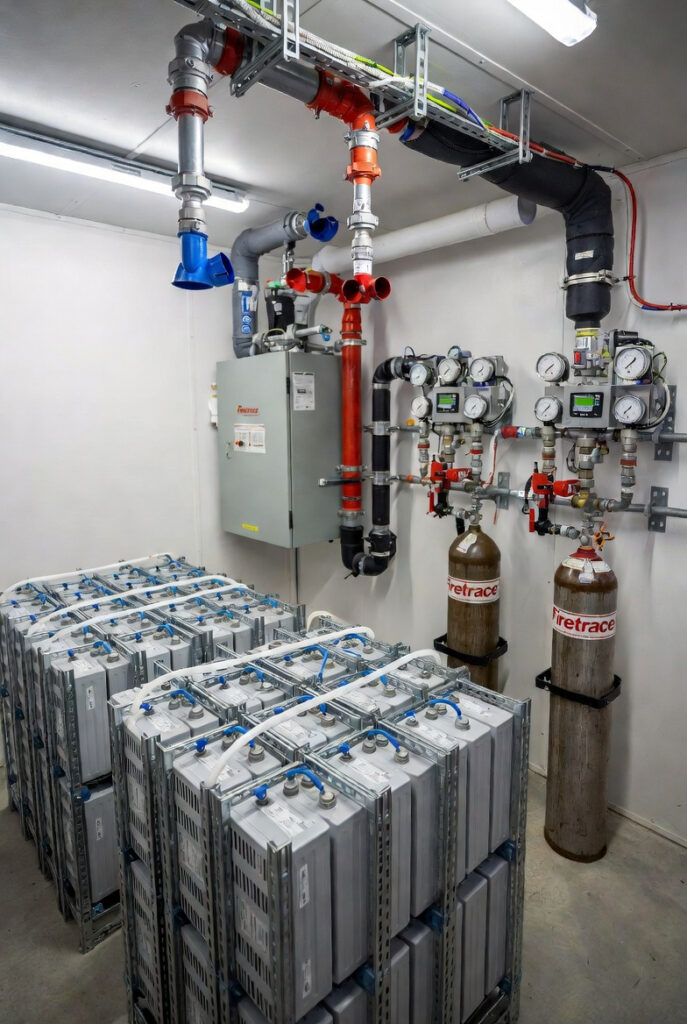
Layer 3 is the Firetrace automatic clean agent tube. A Firetrace linear detection tube is a pressurised polymer tube routed through the battery cabinet or inverter enclosure. When the tube surface temperature reaches the activation threshold, typically 68°C for standard tubing, the tube bursts at the hottest point and discharges the clean agent directly at the source. FM-200 requires a minimum design concentration of 6.25% by volume in the protected enclosure. Novec 1230 requires 4.2% by volume. Both leave zero residue, both are safe for electronics, and both work by interrupting the combustion chemistry in the pre-propagation window before lithium cells themselves are burning. This is the window that exists between minute one and minute two of the scenario above. The Firetrace system is designed to close that window automatically.
NEC and CEC: What the Electrical Codes Actually Say
NEC 706.30 requires that energy storage systems installed in buildings include fire protection and suppression measures appropriate to the installation environment and the energy capacity of the system. For LiFePO4 battery banks above a threshold capacity installed in residential or agricultural structures, the code requires that the fire protection measures address the specific thermal runaway propagation hazard of lithium battery chemistry. NEC 855.1 establishes that fire suppression systems serving energy storage applications be listed and rated for the hazard class of the protected equipment. A water-based or foam suppression system is not listed for Class C electrical energy storage applications and does not satisfy NEC 706.30 regardless of its general fire suppression capability.
CEC Section 64-800 governs the installation of energy storage systems in Canada, including fire protection requirements for battery rooms and enclosures. The section requires that battery installations include detection and suppression measures appropriate to the stored energy capacity and the installation environment. In Ontario, a residential or agricultural off-grid battery installation without a minimum first-layer smoke and heat detection system is not compliant with CEC Section 64-800. CEC Section 32 governs fire alarm systems and requires that detection devices be installed in accordance with their listing and the specific hazard profile of the protected space. A LiFePO4 battery room with off-gassing risk requires a detector rated for both smoke and heat, not a standard residential smoke detector alone, to satisfy the CEC Section 32 installation requirements for the specific hazard profile.
Quick Reference – Off-Grid Fire Suppression Standard
| Layer | Device | Cost Range | Protects Against |
|---|---|---|---|
| Layer 1 — Detection | Dual smoke and heat detector, phone notification | $30-$60 | Early warning of off-gassing and temperature rise |
| Layer 2 — Manual | 10lb ABC dry chemical, mounted outside room door | $40-$60 | Manual Class C suppression as last resort |
| Layer 3 — Automatic | Firetrace linear heat detection tube, FM-200 or Novec 1230 | $300-$500 installed | Automatic pre-propagation suppression inside enclosure |
| Do not use | Water or water-based extinguisher | N/A | Electrocution hazard on live Class C fires |
| Do not use | CO2 extinguisher in enclosed space | N/A | Oxygen displacement hazard in occupied or semi-enclosed space |
| Do not use | Foam extinguisher on electronics | N/A | Conductive residue damages circuit boards |
Label the suppression layer at the equipment room door with three lines of information on a laminated card: the suppression agent installed, the safe re-entry interval after automatic discharge (FM-200 and Novec 1230 dissipate in 10 minutes with ventilation), and the emergency shut-off location. A first responder who arrives after the Firetrace has discharged needs to know that the agent is not CO2, that the room is safe to enter after ventilation, and where the master kill switch is. That card takes five minutes to make and it is the briefing that saves the conversation at 3am.
The Verdict
Off-grid fire suppression is the layer that makes every other standard in this series worth having. It is the protection that operates when every other protection has already failed.
Before declaring the equipment room complete:
- Install the dual smoke and heat detector at ceiling level in the equipment room and link it to phone notification; this is the minimum viable layer and it is non-negotiable regardless of installation size or budget
- Mount a 10lb ABC dry chemical extinguisher outside the equipment room door, not inside it; the extinguisher is a last resort for a building-saving intervention, not an equipment-saving one, and it must be accessible without entering the hazard zone
- Install a Firetrace linear heat detection tube routed through the battery cabinet with FM-200 or Novec 1230 clean agent; this is the automatic layer that acts in the pre-propagation window that no manual response can reliably reach in a rural Rockwood installation
The correct suppression agent makes a Class C fire survivable. The wrong one makes it instantly more dangerous. Build the system that knows the difference before the event that requires it.
Questions? Drop them below.