
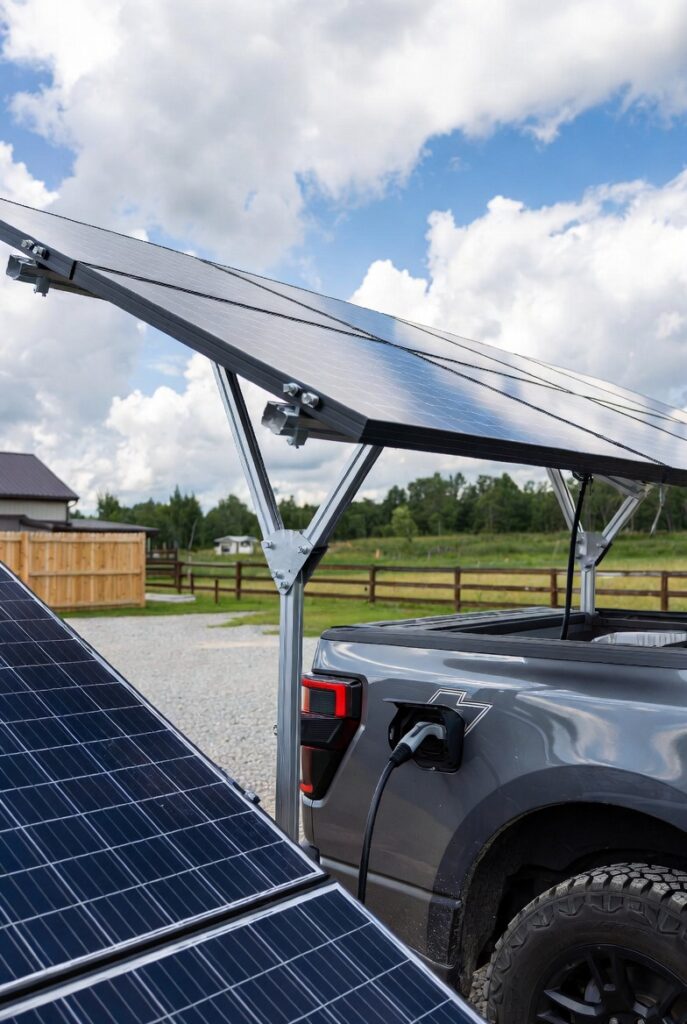
Off-grid EV charging is not like running a microwave for 2 minutes. It is a continuous load that pulls full rated amperage for hours, creating heat buildup that can destroy undersized wiring and overloaded inverters. I helped a property owner near Bancroft in Hastings County, Ontario diagnose a dangerous failure in summer 2025. He had connected a 32A Level 2 charger to his 5kW inverter through 10 AWG wire on a 30A breaker. His F-150 Lightning drew 7.2kW continuously for 6 hours every charging session. His inverter ran at 144% of rated capacity. His wiring ran hot enough to soften the insulation.
I examined his system after he reported a burning smell during charging. His 10 AWG wire showed heat discoloration at both terminations. His inverter’s internal MOSFETs had thermal damage from sustained overload. His 30A breaker had not tripped because the load was technically within its instantaneous rating. However, continuous loads require 80% derating. A 32A continuous load requires a 40A breaker minimum. His off-grid EV charging setup violated every continuous load rule in the electrical code.
I helped him rebuild the circuit correctly. We upgraded to a 10kW inverter that handles the 7.2kW load at 72% capacity. We ran 6 AWG copper wire rated for 55A continuous. We installed a 50A breaker providing proper 80% derating for his 32A charger. The materials cost $2,400 for the inverter upgrade and $380 for the wiring and breaker. His off-grid EV charging now runs cool through 8-hour sessions. His system handles the continuous load without stress. For load management that sequences EV charging with other heavy loads, The Load Management Standard covers the automation.
Why Off-Grid EV Charging Creates Continuous Load Risk
Off-grid EV charging creates continuous load risk because the charger pulls full rated amperage for hours, not minutes. A microwave runs for 2 minutes at high power. A coffee maker runs for 10 minutes. An EV charger runs for 4 to 10 hours at full rated current.
The electrical code defines a continuous load as any load running 3+ hours. The Bancroft owner’s 32A charger ran 6 hours daily. His off-grid EV charging session created continuous heat buildup that exceeded his wiring and inverter ratings.
The distinction matters for component selection. Instantaneous ratings do not apply to multi-hour loads. Every component in the charging circuit must be sized for continuous duty.
The Continuous Load Problem: When Chargers Run for Hours
The continuous load problem exists because instantaneous ratings do not apply to multi-hour loads. A 30A breaker can handle 30A instantaneously. It cannot handle 30A for 6 hours without overheating. The 80% rule requires derating breakers and wiring for continuous duty.
A 32A continuous load requires a 40A breaker (32 ÷ 0.80 = 40). The wiring must match the breaker rating, not the load. The Bancroft owner’s 30A breaker was undersized by 25%.
His 10 AWG wire was rated for 30A but his continuous load required 6 AWG rated for 55A. The heat buildup was inevitable given the undersized components. Proper sizing would have prevented the failure entirely.
Level 2 Charging: The 240V Threshold and Inverter Requirements
Level 2 charging at 240V delivers 6kW to 10kW depending on the charger rating. To charge an F-150 Lightning or Tesla Model 3 in under 10 hours, you need Level 2. A 32A charger at 240V delivers 7.68kW. Running this load continuously requires an inverter rated significantly higher than the load.
A 10kW Victron MultiPlus-II handles a 7.68kW continuous load at 77% capacity, well within safe operating range. A 5kW inverter at 144% capacity overheats and fails.
The Bancroft owner learned that inverter sizing for EV charging must account for hours of continuous operation, not just instantaneous peaks. The continuous duty requirement changes the math completely.
Solar Diversion: Charging Only When Excess Power Is Available
I was reviewing charging data with a property owner near Minden in Haliburton County, Ontario in fall 2025. He had installed a standard Level 2 charger without solar diversion capability. His charging pattern was simple: plug in when he got home at 6pm, charge until full. His 30kWh house battery bank dropped from 85% to 15% every night he charged his EV. His system entered low-voltage shutdown twice during cloudy weeks when solar could not recover the overnight drain. His off-grid EV charging was competing directly with his house loads.
I examined his solar production data. His 12kW array produced 8 to 10kW of excess power from 10am to 2pm on sunny days. His batteries reached 100% by 11am most days. His charge controller throttled production for 3 to 4 hours daily because the batteries were full. He was wasting 25 to 35kWh of potential production daily while draining his batteries at night. His timing was exactly backwards.
I helped him install a solar diversion charger that monitors battery SOC and solar production. The charger only activates when batteries exceed 90% SOC. The charging rate scales with available excess power. On a sunny day, his EV charges at 6kW from 10am to 3pm using power that would otherwise be curtailed. On cloudy days, the charger reduces to 2kW or pauses entirely. His house batteries no longer drop below 70% overnight. His off-grid EV charging now captures excess solar instead of draining his storage. The solar diversion charger cost $1,200 installed. For the expandable array that increases excess production capacity, The Expandable Solar System Standard covers the design.
Bidirectional V2H: Your EV as a 100kWh Backup Battery
Bidirectional chargers allow your EV to discharge back to the house. This is called Vehicle-to-Home or V2H. An F-150 Lightning has a 98kWh to 131kWh battery pack. A Tesla Model 3 has 57kWh to 82kWh. These capacities dwarf typical house battery banks.
The Enphase IQ Bidirectional charger enables V2H functionality. Your truck becomes a backup battery that can power your house for days during extended cloudy periods. The technology is maturing rapidly.
In 2026, V2H capability adds $2,000 to $4,000 to charger cost but provides enormous backup capacity without additional stationary batteries. The economics improve significantly when you consider the avoided cost of equivalent stationary storage.
Circuit Sizing: The 80% Derating Rule for Continuous Loads
Circuit sizing for continuous loads requires 80% derating of all components. A 32A continuous load requires a 40A breaker and wiring rated for 40A minimum. A 40A continuous load requires a 50A breaker and 6 AWG copper.
The Bancroft owner’s circuit was undersized at every point. His breaker, wiring, and inverter all failed to account for continuous duty. Reference ESA for Ontario electrical installation standards.
Proper sizing prevents heat damage and ensures safe operation through multi-hour charging sessions. The additional cost of larger wire and breakers is minimal compared to replacing damaged components.
Level 1 Fallback: Safe Charging for Small Systems
Level 1 charging at 120V pulls only 1.4kW from the inverter. This adds 5 to 8 km of range per hour. For property owners with small inverters under 5kW or battery banks under 20kWh, Level 1 is the safer choice.
A daily commute of 50km requires approximately 8 hours of Level 1 charging. The charger runs overnight when no other loads compete. The inverter operates at 28% capacity instead of exceeding 100%.
Level 1 requires only a standard 15A or 20A circuit. Every EV includes a Level 1 portable charger. No additional equipment purchase is necessary for basic charging capability.
ZEVIP Rebates: Cutting Your Charger Cost by 50%
The Zero Emission Vehicle Infrastructure Program (ZEVIP) offers substantial rebates for charger installation. Eligible installations can receive up to 50% of costs covered, with maximums reaching $5,000 for some configurations. Bidirectional chargers qualify for higher rebate amounts due to their grid-support capabilities.
The rebate makes solar diversion and V2H chargers more affordable. Applying through a registered installer improves approval chances. The program runs through 2026 with annual funding limits.
Reference Natural Resources Canada for current ZEVIP eligibility requirements. Early application in the fiscal year improves approval odds before funding limits are reached.
The Off-Grid EV Charging Strategy: Solar Diversion and Timing
The off-grid EV charging strategy uses solar diversion to capture excess production instead of draining house batteries. The charger monitors battery SOC and solar output continuously. When batteries reach 90%+ and production exceeds house load, charging begins automatically. When clouds pass or house loads increase, charging throttles or pauses.
A Victron Cerbo GX provides the monitoring data that solar diversion chargers use for smart decisions. The system tracks SOC, production, and consumption in real time. The charger responds to changing conditions within seconds.
The Minden owner’s strategy shift from nighttime charging to midday solar capture eliminated his low-voltage shutdowns entirely. His off-grid EV charging now improves system efficiency instead of competing with house loads.
Planning Your Off-Grid EV Charging System: Components and Costs
Planning your off-grid EV charging system starts with assessing your solar capacity, battery bank, and inverter headroom. If your inverter runs above 80% with current loads, adding EV charging requires an upgrade. If your batteries drop below 50% regularly, Level 2 charging will stress your system.
The Bancroft owner needed a $2,780 upgrade to handle Level 2 safely. The Minden owner needed a $1,200 solar diversion charger to optimize timing. A Victron SmartShunt provides accurate SOC data for planning and ongoing monitoring.
Your off-grid EV charging investment depends on your starting point and charging speed goals. Properties with excess solar capacity and adequate inverter headroom can add Level 2 charging with minimal upgrades.
Minimum Viable vs Full Standard: Choosing Your Charging Level
The off-grid EV charging approach offers two levels depending on your system capacity and charging speed requirements. The minimum viable level works for daily commuting with modest infrastructure. The full standard provides rapid charging with solar optimization.
| Charging Level | Key Components | Cost | Charging Speed |
|---|---|---|---|
| Minimum Viable (Level 1) | Portable charger + 20A circuit | $200-$400 | 5-8 km/hour |
| Full Standard (Level 2) | Solar diversion charger + 10kW inverter + 50A circuit | $3,500-$8,000 | 30-50 km/hour |
Both off-grid EV charging approaches work for daily commuting. The difference is charging speed and system integration depth. Level 1 adds 40 to 64 km overnight without stressing small systems. Level 2 captures excess solar and provides rapid charging when needed. For the battery bank that supports Level 2 charging, The Budget Off-Grid System Standard covers the sizing.
Frequently Asked Questions
Q: Can a small inverter handle off-grid EV charging safely?
A: A small inverter under 5kW can handle off-grid EV charging at Level 1 only. Level 1 pulls 1.4kW, leaving headroom for other loads. Level 2 at 7kW+ requires a 10kW or larger inverter to stay within safe continuous duty limits. The Bancroft owner’s 5kW inverter failed at 144% continuous load. Off-grid EV charging at Level 2 requires inverter sizing that accounts for multi-hour operation, not just peak capacity.
Q: How does solar diversion improve off-grid EV charging efficiency?
A: Solar diversion improves off-grid EV charging efficiency by capturing excess solar production that would otherwise be curtailed. The charger monitors battery SOC and only activates when batteries are full and production exceeds house load. The Minden owner was wasting 25 to 35kWh daily while draining his batteries at night. His solar diversion charger now captures that curtailed production. Off-grid EV charging with solar diversion uses free energy instead of depleting storage.
Q: Is bidirectional V2H practical for off-grid EV charging systems?
A: Bidirectional V2H is practical for off-grid EV charging systems with adequate battery capacity in the vehicle. An F-150 Lightning provides 98 to 131kWh of storage. This exceeds most house battery banks by 3x to 5x. During extended cloudy periods, the EV can discharge to power essential house loads. Off-grid EV charging with V2H capability adds $2,000 to $4,000 to charger cost but provides enormous backup capacity without additional stationary batteries.
Pro Tip: Your off-grid EV charging should happen at high noon when your panels are clipping and your batteries are full. The Minden owner’s timing shift from 6pm to 11am eliminated his low-voltage shutdowns entirely. His off-grid EV charging now captures 25 to 35kWh of solar that would otherwise be wasted. Use your EV as a dump load for excess production. Charge when the sun is strongest, not when you arrive home. The timing makes all the difference.
Verdict
- The Continuous Load Off-Grid EV Charging Standard. The Bancroft owner’s 5kW inverter ran at 144% capacity during 6-hour charging sessions. His 10 AWG wire showed heat discoloration. His MOSFETs suffered thermal damage. He upgraded to a 10kW inverter and 6 AWG wire on a 50A breaker for $2,780 total. His off-grid EV charging now runs cool through 8-hour sessions without stress.
- The Solar Diversion Timing Standard. The Minden owner’s nighttime charging drained his house batteries from 85% to 15% while wasting 25 to 35kWh of excess solar daily. His $1,200 solar diversion charger shifted charging to midday when batteries are full. His system no longer enters low-voltage shutdown. He charges with power that would otherwise be curtailed.
- The V2H Backup Capacity Standard. Bidirectional chargers allow your EV to power your house during extended cloudy periods. An F-150 Lightning provides 98 to 131kWh of storage, exceeding most house battery banks by 3x to 5x. The $2,000 to $4,000 premium for V2H capability provides enormous backup capacity without additional stationary batteries.
This build is engineered within the 48V DC Safety Ceiling. Diagnostic logic is based on 20+ years of technical service experience. All structural and electrical installations must be verified by a Licensed Professional and comply with your Local AHJ.
This article contains affiliate links. If you purchase through these links, I earn a small commission at no extra cost to you.
Questions? Drop them below.