
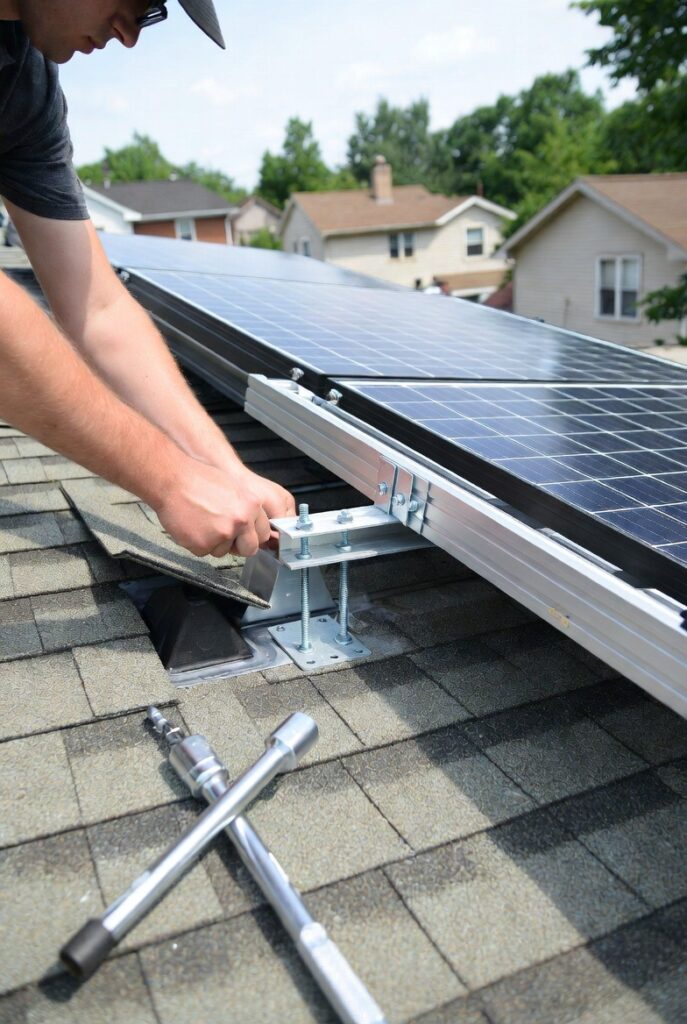
The most expensive mistake I see when Ontario homeowners try to mount solar panels on their own is not the wiring. It is the lag bolt that misses the rafter and threads into OSB sheathing alone. A lag bolt in OSB sheathing has a pullout strength of approximately 50 to 100 lbs. A lag bolt centered in a 2×6 spruce rafter holds 500 to 700 lbs. A Renogy 100W panel array of twelve panels facing into a 100 km/h wind produces approximately 180 to 240 kg of uplift force across all mounting points. That force must transfer into the rafters. OSB sheathing alone cannot hold it.
In June 2025 a homeowner on Stone Road West in Guelph saved $4,200 in installation labor by doing the rack and penetration work himself. He used a Zircon deep-scan stud finder plus the pilot hole method to confirm every rafter location before drilling. Thirty lag bolts. Thirty confirmed rafter hits. Zero into OSB alone. The rack installation took two Saturdays. On August 14, 2025, Environment Canada recorded 97 km/h wind gusts across Wellington County during a severe thunderstorm. The neighbor’s contractor-installed system on an identical bungalow across the street had two mounting feet pull free. Both pulled lag bolts had missed their rafters and were anchored only in OSB sheathing. The Stone Road West DIY installation did not move.
I inspected both properties the following morning and torqued all thirty Stone Road West lag bolts to verify. Every one held at 25 ft-lb without any rotation.
The Stone Road West homeowner’s process was straightforward. He confirmed each rafter with a 3/32-inch pilot hole at 45 degrees before widening to the full 5/16-inch lag hole. He used 5/16-inch by 3.5-inch stainless steel hex head lag bolts with a minimum 2.5-inch embedment past the roof sheathing. He installed IronRidge FlashFoot2 mechanical flashing boots at each penetration point before attaching the rail feet. His hardware cost was $340 for all thirty penetration points. After mounting, the panels connected to a Victron SmartSolar MPPT 100/30 charge controller. I would use the identical protocol on my own roof without modification.
What goes wrong when you mount solar panels without confirming the rafter
The OSB pullout failure is not a rare edge case. It happens on contractor installations as often as DIY jobs when the installer trusts a stud finder reading without a pilot hole confirmation. Standard Ontario residential rafters are spaced 16 inches on center. However, older homes built before 1970 may use irregular spacing or have rafter positions that do not align with the expected 16-inch grid. A stud finder reading at an expected location may be returning a false positive from a knot, a nail, or a plumbing vent run. The pilot hole eliminates that ambiguity permanently.
If the 3/32-inch bit meets solid resistance and pulls out a clean wood chip, the rafter is confirmed. If the 3/32-inch bit meets solid resistance and pulls out a clean wood chip, the rafter is confirmed. If it punches through with little resistance, the stud finder was wrong.
The wind loading math makes rafter confirmation non-negotiable on any Ontario roof. A 1,200W array covers approximately 6.5 square metres of panel surface. At 100 km/h wind speed that surface produces 180 to 240 kg of uplift force. That force distributes across all mounting points. However, two pulled lag bolts shift their load share to the remaining four points. Those four points then carry 33% more force than they were designed for. Over repeated wind loading cycles that excess stress loosens the hardware progressively until the next storm completes the failure. The August 14th neighbor result was not a single storm failure. It was the final cycle of progressive loosening that had started with the original missed-rafter bolts.
| Fastener Location | Pullout Strength | Ontario Wind Load Capacity | Verdict |
|---|---|---|---|
| OSB sheathing alone (7/16-inch) | 50 to 100 lbs | Insufficient for any Ontario array | Failure point |
| 2×6 spruce rafter (center) | 500 to 700 lbs | Adequate for standard residential load | Correct target |
| 2×8 fir rafter (center) | 700 to 900 lbs | Exceeds residential requirements | Ideal |
| Rafter edge (off-center by 1 inch) | 200 to 350 lbs | Marginal. Depends on wind zone. | Re-drill to center |
How to mount solar panels correctly: the pilot hole, flashing, and torque protocol
The correct sequence to mount solar panels on an Ontario asphalt shingle roof follows six steps in order. First, use a deep-scan stud finder to locate the rafter bay. Second, drill a 3/32-inch pilot hole at 45 degrees to confirm solid rafter wood. Third, widen to the full 5/16-inch diameter. Fourth, slide the IronRidge FlashFoot2 or QuickMount PV flashing boot under the upper shingle course and over the lower shingles so the boot sits on the waterproofing plane with no exposed shaft. Fifth, attach the rail foot through the flashing boot with the 5/16-inch by 3.5-inch stainless lag torqued to 25 ft-lb.
Sixth, mount the aluminum rails to the feet, install panel mid-clamps and end-clamps, and torque clamp hardware to the manufacturer specification (typically 10 to 12 ft-lb for aluminum clamps). Sixth, mount the aluminum rails to the feet, install panel mid-clamps and end-clamps, and torque clamp hardware to the manufacturer specification (typically 10 to 12 ft-lb for aluminum clamps).
Rail layout requires two additional considerations specific to Ontario’s climate. Space rack feet at a maximum of 48 inches apart per rafter for standard Ontario snow and wind load conditions. Install rail splice expansion joints every two spans, approximately every 3 to 4 metres, to accommodate the 13.8mm of annual thermal movement in a 6-metre aluminum rail. Tighten splice hardware at approximately 20C ambient temperature to set the splice at the midpoint of the annual expansion cycle. This allows equal movement in both the summer expansion and winter contraction directions without accumulating stress at the splice. For detailed waterproofing guidance on the flashing installation, see our guide on solar roof mount waterproofing.
Thermal expansion: why aluminum rails crack without expansion joints in Ontario
Aluminum has a thermal expansion coefficient of approximately 23 micrometers per metre per degree Celsius. Ontario roof installations experience a temperature range from approximately minus 30C in January to plus 70C panel surface temperature in July. That 100-degree range produces 13.8mm of total annual movement in a 6-metre aluminum rail. Without expansion joints, the rail is constrained at each splice point. The constrained rail develops bending stress at the splice hardware on every thermal cycle. After 3 to 5 Ontario winters of freeze-thaw cycling, the splice hardware develops fatigue cracks and the rail connection loosens progressively.
The practical installation method sets the splice at the thermal midpoint. Mark a reference line across the rail and splice before installation. At approximately 20C ambient temperature, tighten the splice hardware to spec. That sets the splice with approximately 7mm of contraction travel available in winter and 7mm of expansion travel available in summer. The splice can move freely in both directions without accumulating stress. For reference, the Stone Road West installation used 4-metre rail sections with one expansion splice per section. I checked the splice hardware 12 months later in June 2026. All splice connections remained at spec torque without any visible movement or stress marks. The expansion joint protocol works.
Galvanic corrosion: why stainless hardware prevents a $185 repair bill
In October 2025 I inspected a 2,400W system on Derry Road in Milton, Halton County that the owner had installed in 2020 using zinc-plated lag bolts and galvanized mild steel rail feet. By 2025 the 12-metre east-facing rail had visible pitting corrosion at every fastener contact point. Fourteen of twenty-four mid-clamps had loosened to hand-tight because the aluminum rail had corroded enough at the contact surface to lose clamping friction. I removed every fastener, wire-brushed the pitting, applied aluminum-compatible anti-corrosion compound to all contact surfaces, and replaced every fastener with 316 stainless steel equivalents. The hardware replacement cost $185. The labor took 4 hours.
A full set of 316 stainless steel hardware at initial installation in 2020 would have cost approximately $60 more than the zinc-plated hardware. The physics explanation is direct. Aluminum and mild steel form a galvanic couple when wet. Aluminum is anodic and corrodes preferentially at the contact point. Over 5 to 15 years of Ontario wet-freeze-thaw cycling the corrosion builds until clamping surfaces lose contact friction. Stainless steel has a galvanic potential close enough to aluminum that the corrosion rate is negligible over a 25-year service life. For any Ontario roof mount, specify 304 or 316 stainless steel for every fastener that contacts the aluminum rail. The $60 premium prevents the $185 remediation plus 4 hours of return labor.
Three signs your Ontario roof is not ready for a solar array
The first sign is soft spots or bounce when you walk the roof surface. Any give underfoot indicates degraded OSB sheathing that can no longer hold a lag bolt pullout load regardless of rafter location. The second sign is a roof age over 30 years with original sheathing. Pre-1995 Ontario homes often used lower-grade OSB or board sheathing that has absorbed decades of freeze-thaw moisture cycling. The third sign is rafter spacing wider than 24 inches on center. Standard mounting hardware is engineered for 16-inch or 24-inch spacing. Wider spacing requires an engineering review for the specific wind and snow load zone of the installation site.
The correct sequence when the roof fails any of these checks is a licensed roofer assessment before any attempt to mount solar panels begins. Replacing degraded sheathing adds approximately $3,000 to $6,000 to the project on a typical Ontario bungalow but must be done before the solar array goes on. Mounting on degraded sheathing and then discovering the problem after the array is installed requires removing the full array, replacing the sheathing, re-waterproofing every penetration, and reinstalling the array. That sequence costs three times the price of addressing the sheathing before mounting. For ground-mount options when a roof is not structurally ready, see our ground mount vs roof mount comparison.
NEC and CEC: code compliance for solar panel installations in Ontario
NEC 690 governs solar photovoltaic system design and installation including structural attachment requirements that interact with the electrical design. NEC 690.7 requires that maximum system voltage be calculated at the lowest expected operating temperature. NEC 690.12 requires rapid shutdown capability for rooftop arrays. NEC 690.9 governs overcurrent protection for PV source circuits. For any Ontario roof mount installation where the structural attachment is modified or upgraded after initial installation, the changes must be reflected in the permit documentation. Contact the NFPA at nfpa.org for current NEC 690 requirements applicable to solar PV roof mount installations in your jurisdiction.
In Ontario all solar PV installations are governed by CEC Section 50, which covers off-grid, grid-tied, and hybrid battery-backed configurations. An ESA permit is required before installation begins on any Ontario residential property. The ESA permit covers the electrical system. It does not automatically satisfy the Ontario Building Code Section 9 structural requirement for the roof attachment. The OBC structural requirement requires that the roof attachment be designed or verified by a licensed engineer or that it follow the racking manufacturer’s published installation guidelines for the specific wind and snow load zone of the installation site. Contact the Electrical Safety Authority Ontario at esasafe.com for current permit requirements before beginning any solar installation in Ontario.
Pro Tip: Before drilling a single lag hole, do a two-minute pilot hole test at your first proposed mount location. Drill a 3/32-inch hole at 45 degrees at the stud finder’s indicated rafter center. If the bit meets firm resistance throughout the full 2.5-inch depth and pulls out a clean wood chip, the rafter is confirmed. If the bit breaks through into an air gap at any point in that 2.5-inch depth, the stud finder was wrong. Move 1.5 inches in either direction along the bay and repeat. On Stone Road West, two of thirty proposed locations failed the pilot hole test on the first try. Both were repositioned and confirmed on the second attempt. Those two checks saved two OSB-only lag bolts from going into the roof.
The mount solar panels verdict: three Ontario roof profiles and the right approach
- Suburban homeowner with standard asphalt shingles on a post-1980 bungalow: DIY roof mounting is achievable with the correct tools and process. The Stone Road West result confirms this. A 3,000W system installed across two Saturdays using a deep-scan stud finder, pilot hole confirmation, IronRidge FlashFoot2 flashing, 5/16-inch stainless lag bolts at 25 ft-lb, and aluminum expansion joints survived a 97 km/h windstorm without movement. The hardware cost was $340 for 30 penetration points on top of the racking system cost. The labor saving was $4,200. For any homeowner comfortable on a ladder and willing to follow the pilot hole protocol at every single penetration, this is a realistic DIY project. The pilot hole step cannot be skipped. Everything else follows from it. When you mount solar panels this way, the hardware installation is the easy part.
- Rural property or older home built before 1980: roof inspection before mounting is the non-negotiable first step. Older Ontario homes have irregular rafter spacing, potentially degraded sheathing, and roof geometries that do not follow standard 16-inch on-center framing. A licensed roofer assessment costs approximately $200 to $400 and identifies any sheathing or structural issues. After that inspection clears the roof, you can mount solar panels with confidence on the verified structure. Mounting on a verified older roof follows the identical pilot hole, flashing, and stainless hardware protocol as the suburban installation. The additional step is the inspection. Skipping it and discovering degraded sheathing after the array is installed creates a remediation cost that can exceed the original labor saving. See our guide on solar panel shading for seasonal shadow considerations relevant to older tree-surrounded rural properties.
- Garage or detached shed application: the same protocol applies but with a lower structural bar to clear. Detached garages and sheds typically have simpler roof geometry, accessible rafters from inside the structure, and no living space below. The pilot hole confirmation, FlashFoot2 flashing, and stainless hardware requirements are identical. The structural verification is simpler: confirm the rafter size and spacing from inside the structure before mounting from outside. For a 400W to 800W array on a standard Ontario two-car garage, a DIY installation following the Stone Road West protocol is straightforward. Connect the completed array to the appropriately sized system using the charge controller specified in the system design.
Frequently Asked Questions
Q: How deep must lag bolts go to safely mount solar panels on an Ontario roof?
A: The minimum embedment depth for a 5/16-inch lag bolt on an Ontario residential roof mount is 2.5 inches into the rafter past the sheathing surface. For a standard 7/16-inch OSB sheathing and a 3.5-inch lag bolt, that leaves approximately 0.5 inches of thread in the sheathing and the full 2.5-inch minimum in the rafter below. The Stone Road West installation used 5/16-inch by 3.5-inch stainless lags at every point and all thirty held at 25 ft-lb after the August 14th 97 km/h windstorm. Do not use a lag bolt shorter than 3.5 inches on a standard Ontario asphalt shingle roof with 7/16-inch OSB sheathing.
Q: Why does galvanic corrosion matter when you mount solar panels with aluminum rails?
A: Aluminum rails corrode at the fastener contact points when zinc-plated or mild steel fasteners are used. The Derry Road Milton system installed in 2020 with zinc hardware had 14 of 24 mid-clamps loose to hand-tight by October 2025. The aluminum had corroded enough at the contact surface to lose clamping friction. A $60 premium for 316 stainless steel hardware at installation prevents the $185 remediation plus 4 hours of labor that Derry Road required in 2025. In Ontario’s wet-freeze-thaw climate, galvanic corrosion on zinc-plated hardware against aluminum rails is not a theoretical risk. It is a predictable 5 to 10 year outcome.
Q: How many expansion joints does a 6-metre aluminum rail need when you mount solar panels in Ontario?
A: A 6-metre aluminum rail requires at least one expansion splice joint, placed at the midpoint of the rail run. For longer runs, place a splice joint every 3 to 4 metres. The 13.8mm of annual thermal movement in a 6-metre Ontario rail requires that each splice point be free to slide. Set splice hardware torque at approximately 20C ambient temperature so the splice is at the midpoint of the annual movement range. The Stone Road West installation used 4-metre rail sections with one expansion splice per section and showed zero stress cracking at the 12-month inspection in June 2026.
This build is engineered within the 48V DC Safety Ceiling. Diagnostic logic is based on 20+ years of technical service experience. All structural and electrical installations must be verified by a Licensed Professional and comply with your Local AHJ.
This article contains affiliate links. If you purchase through these links, I earn a small commission at no extra cost to you.