
Do not get distracted by the colors. Whether your panels are black or blue matters far less than the technology inside the cells. Monocrystalline vs polycrystalline solar panels is not an aesthetic choice it is a performance and longevity decision that affects your system for 25 years.
Think of it like engine oil. Synthetic costs more upfront but delivers better long-term performance under stress. Conventional is fine for basic needs but loses out over time. Same logic applies to solar cell technology.
Monocrystalline vs Polycrystalline Solar Panels: The Big Three
Three cell technologies. Three different performance profiles. Three distinct use cases. Understanding the differences takes 10 minutes and saves you from buying the wrong technology for your situation.
Monocrystalline The High Performer
What it is: Solar cells cut from a single continuous crystal of silicon. The single-crystal structure allows electrons to move more freely resulting in higher efficiency and better performance in low-light conditions.
The specs:
- Efficiency: 19–23%
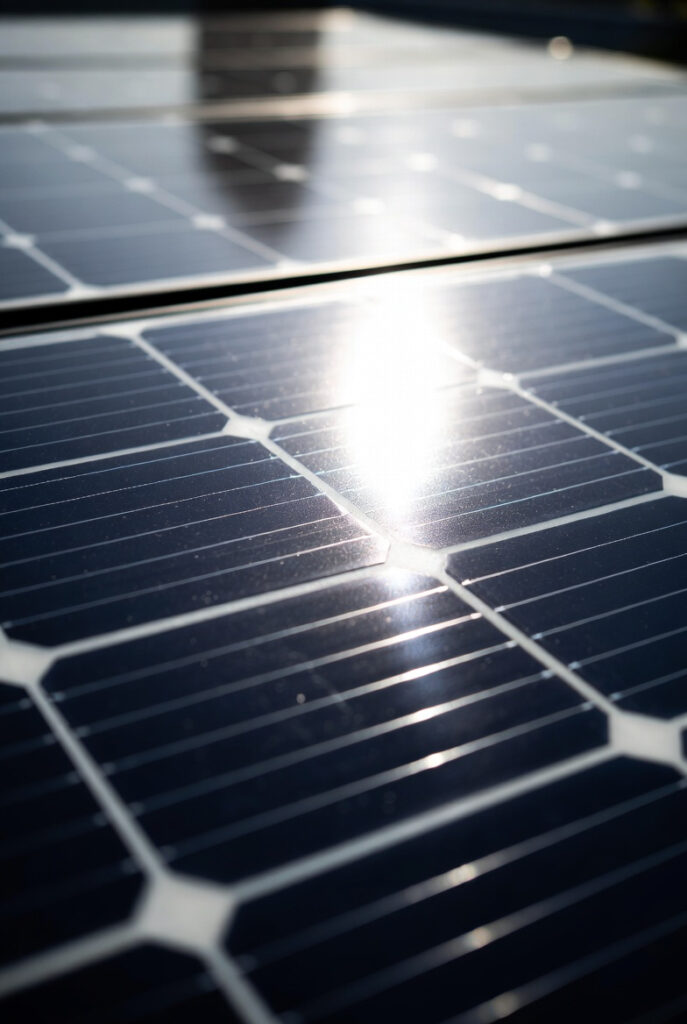
- Appearance: Uniform black cells with chamfered corners
- Lifespan: 25–30 years with quality manufacturers
- Temperature coefficient: -0.3% to -0.4%/°C better than poly in heat
Why it wins for Ontario: Mono panels perform better in diffused weak light exactly the conditions of an Ontario November with overcast skies and low sun angles. When light is scarce every percentage point of efficiency matters more not less.
The single-crystal structure also handles the temperature cycling of Ontario winters more consistently than polycrystalline cells over a 25-year lifespan.
In 2026 monocrystalline is the standard. The price premium over polycrystalline has largely disappeared. There is almost no scenario where choosing poly over mono makes financial sense for a new installation.
The Renogy 200W Monocrystalline Panel is a quality example at a reasonable price point for permanent installs.
Polycrystalline The Fading Budget Choice
What it is: Solar cells cast from multiple silicon crystals melted together. The multi-crystal structure creates visible grain boundaries giving poly panels their characteristic blue speckled “shattered glass” appearance.
The specs:
- Efficiency: 15–17%
- Appearance: Blue cells with visible crystal grain pattern
- Lifespan: 20–25 years
- Temperature coefficient: -0.4% to -0.5%/°C slightly worse than mono in heat
Where it used to make sense: Polycrystalline dominated the market from 2000–2015 when it was significantly cheaper than mono per watt. That price gap has largely closed. In 2026 the efficiency difference is real but the cost difference is minimal.
The honest verdict: Unless you find a legitimate deal on a used pallet of poly panels at a price that offsets the efficiency gap there is no compelling reason to choose poly over mono for a new installation. The market has moved on.
The space math: To produce the same output as 4 monocrystalline panels you might need 5–6 polycrystalline panels. On a limited cabin roof or van that extra space requirement is a real constraint.
Thin-Film The Specialized Tool
What it is: Semiconductor material deposited in thin layers onto a substrate glass, metal, or flexible plastic. Two technologies matter for off-grid use:
Amorphous Silicon (a-Si): The original thin-film technology. Efficiency of 6–10%. Low cost but lowest performance. Largely obsolete for serious applications.
CIGS (Copper Indium Gallium Selenide): The current standard for quality flexible panels. Efficiency of 10–13%. More importantly CIGS handles partial shading significantly better than crystalline silicon the flexible cell structure does not suffer the same bypass diode limitations as rigid panels.
Why CIGS matters for RV applications: An RV roof is rarely in full sun simultaneously. Different sections shade at different times as the vehicle moves or parks. CIGS flexible panels maintain better output under these variable partial-shading conditions than crystalline panels would.
The honest limitations:
- Lower efficiency means more panel area for equivalent output
- Shorter lifespan typically 10–15 years
- Higher cost per watt than rigid crystalline panels
- Not suitable for Ontario rooftop permanent install not rated for snow loads
When to Choose Thin-Film Solar
Thin-film is a legitimate choice in specific circumstances. It is not a general-purpose alternative to crystalline silicon.
Choose thin-film specifically when:
- Your mounting surface is curved and rigid panels physically cannot conform
- Weight is a critical constraint marine or ultralight builds
- Your application involves constant partial shading where CIGS performance advantages apply
- You are mounting on a vehicle that moves and panels experience vibration rigid glass cannot handle
Do not choose thin-film when:
- You have a flat or near-flat mounting surface
- Your installation is permanent and needs 25-year lifespan
- You are in Ontario and need snow load ratings
- You are trying to maximize output from limited space
Space vs Efficiency: The Practical Math
Producing 400W of solar output:
- Monocrystalline: 2 × 200W panels approximately 3.0m² of panel area
- Polycrystalline: 2–3 × 200W panels approximately 3.5–4.5m² of panel area
- Thin-film: 4–5 panels approximately 5–6m² of panel area
On a small cabin roof or cargo van every square metre of mounting space is finite. Monocrystalline produces the most power from the least space exactly what space-constrained installations need.
Temperature Performance in Ontario
All solar panels lose efficiency as temperature increases but not equally.
- Monocrystalline: -0.3% to -0.4%/°C
- Polycrystalline: -0.4% to -0.5%/°C
The difference seems small but compounds on hot July days when panel surfaces reach 65–70°C. More importantly for Ontario mono panels perform better in low-light diffused conditions. Overcast November days, smoke haze, early morning and late afternoon production mono captures more of this marginal light than poly does.
For the full temperature coefficient breakdown see our Solar Panel Efficiency Explained guide.
The Winner by Category
| Use Case | Winner | Reason |
|---|---|---|
| Home or cabin rooftop | Monocrystalline | Snow load, longevity, efficiency |
| Small cabin or van limited space | Monocrystalline | Most watts per square metre |
| Curved RV roof | Thin-Film CIGS | Only panel that conforms physically |
| Marine/sailboat | Thin-Film CIGS | Weight and flexibility |
| Budget found a deal on used panels | Polycrystalline | Only scenario poly makes sense |
| New installation any size | Monocrystalline | Price parity makes poly obsolete |
Pro Tip: The fastest way to identify monocrystalline vs polycrystalline at a glance look at the cell color and shape. Mono cells are uniform black with chamfered corners you will see small diamond-shaped gaps between cells. Poly cells are blue with a visible speckled grain pattern and square corners that tile together without gaps. If you are buying used panels this visual check confirms the cell type when the spec sheet is not available.
The Verdict
Monocrystalline vs polycrystalline solar panels in 2026 is not a close competition for most buyers. Mono is the standard better efficiency, better low-light performance, better temperature coefficient, and now at near price parity with poly. The efficiency gap represents real lost production every single day for 25 years.
Choose monocrystalline for any permanent installation. Choose thin-film CIGS specifically when your application genuinely requires flexibility. Consider polycrystalline only if you find a legitimate deal that makes the efficiency tradeoff worthwhile financially.
Match the cell technology to the job. For 90% of GridFree Guide readers that means monocrystalline specifically rigid glass panels from a Tier 1 manufacturer rated for Ontario winters.
Disclosure: This article contains affiliate links. If you buy through them, GridFree Guide earns a small commission at no extra cost to you.