
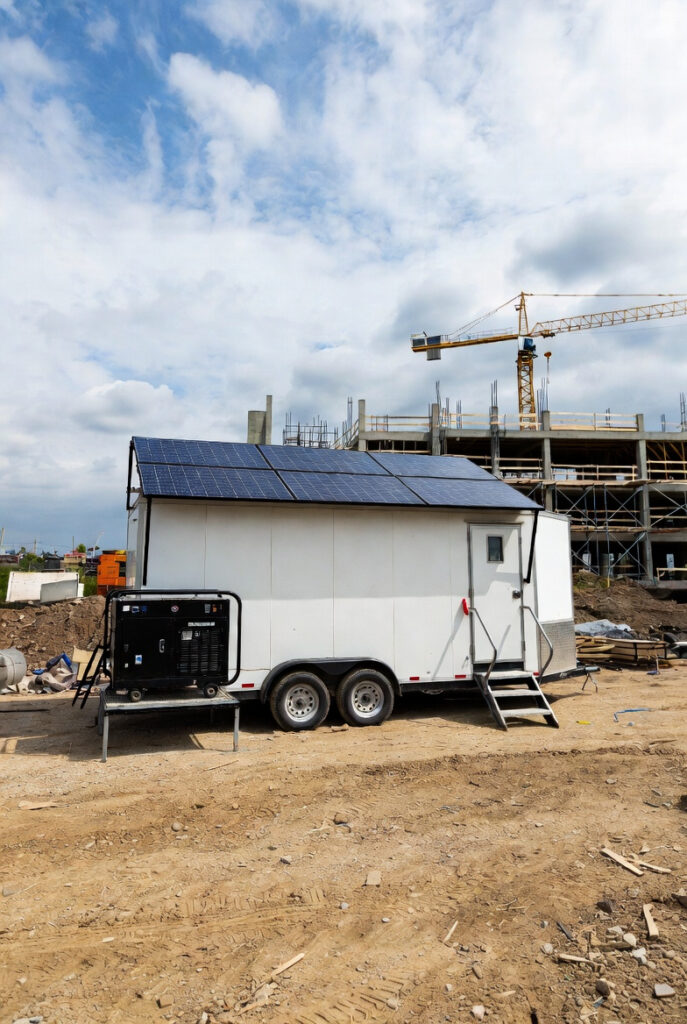
Mobile solar trailer projects start with a generator bill that surprises every project manager. I was brought in to review the power setup at a residential subdivision site near Cambridge in Waterloo Region. The site super was spending $1,140 per month on diesel for a 10kVA Generac running 24 hours a day. The overnight load was 4 security cameras at 12W each, a WiFi router at 18W, and the site office trailer standby draw at 40W. Total overnight load: 106W. The generator was producing 10,000W to deliver 106W. That is 1.06% load utilisation.
At 1.06% load a 10kVA diesel runs rich, does not fully combust, and deposits unburned carbon on the cylinder walls. This is called wet-stacking. Wet-stacking causes accelerated engine wear and eventually requires a $2,800 cylinder head service. The site super did not know his generator was destroying itself to power four security cameras overnight.
I replaced the overnight generator operation with a mobile solar trailer carrying a 3kW folding panel array and a 10kWh LFP battery bank. The trailer powered all overnight loads continuously. The generator was reprogrammed to auto-start only if the battery bank dropped below 20% SoC, which happened twice in 8 months during heavy overcast weeks. The diesel bill dropped from $1,140 per month to $87 per month. The generator accumulated 94 fewer running hours per month. After 8 months the site super told me the generator looked new inside at its first service interval. For the fixed construction site solar standard that covers the permanent solar installation this mobile trailer complements on longer projects, Article 183 covers the heavy-duty standard. For the full system sizing hub that covers the load calculation foundation, the hub covers the numbers.
Why a Mobile Solar Trailer Beats an Idling Generator Every Night (3)
The wet-stacking mechanism is straightforward. Diesel at 1.06% load produces incomplete combustion. Carbon deposits build on cylinder walls and exhaust valves. After 100 to 200 wet-stack hours the result is blow-by, reduced compression, and cylinder head failure at $2,400 to $3,200.
The BESS hybrid architecture solves this. The mobile solar trailer powers ghost loads overnight from the battery bank. The generator auto-starts only below 20% SoC via the Victron SmartShunt SoC trigger. As a result the generator runs 0 to 2 hours per day instead of 24.
The fuel saving is significant. A 10kVA generator idling at 1.06% load burns approximately 2.4 litres per hour, equalling 57.6 litres per day. However, a generator running 2 hours per day at 30% load burns approximately 3 litres total. The monthly saving at $1.80 per litre diesel is approximately $1,050. For the construction site solar security camera standard that covers the overnight camera load this mobile solar trailer powers, Article 194 covers the watchman standard.
| Power Source | Monthly Fuel Cost | Generator Hours per Month |
|---|---|---|
| 10kVA generator idling 24/7 | $1,140 | 720 hours |
| Mobile solar trailer hybrid | $87 | 26 hours |
The Sliding Solar Rack: Deploying 3kW on a Tight Job Site
The sliding rack geometry keeps panels flat under the trailer during road transport. On site the racks extend outward on both sides, adding 2.4 metres of panel width per side. In under 10 minutes the trailer goes from transport configuration to full 3kW array deployed. No tools required. No racking to assemble.
The shingled cell advantage matters on a construction site. Standard tabbed panels develop micro-cracks at solder joints after 500 to 1,000 hours of construction vibration at 20 to 50Hz. However, shingled cell panels distribute mechanical stress across the full cell overlap width. As a result shingled panels show less than 2% power degradation after 18 months versus 12 to 15% for standard panels in the same environment.
The weekly cleaning protocol is non-negotiable. Concrete dust reduces panel output by 30% within 7 days. A 5-minute hose rinse every Monday morning recovers that production. For the construction site dust soiling standard that confirmed a 43% harvest loss from concrete dust after 11 days near Burlington, Article 194 covers the full cleaning protocol.
The Rodent-Proof Enclosure: Protecting the BESS on an Active Site
I investigated a complete power failure at a commercial foundation site near Guelph in October where the site’s solar trailer had gone dark overnight. The trailer had been parked on site for 11 weeks. When I opened the battery and inverter enclosure I found that mice had entered through an unsealed conduit penetration and chewed through the positive DC bus cable between the battery bank and the inverter. The cable was a 2/0 AWG conductor rated for 200A.
The mice had chewed through the insulation and partially through the copper. The partially severed conductor had arced against the enclosure wall. The arc burned a 40mm hole through the 14-gauge steel enclosure panel and tripped the 200A main fuse. No fire. The fuse caught it. However, the enclosure, the bus cable, and the inverter output module all required replacement. Total repair cost: $1,840. The site had been offline for 14 hours before I arrived.
I rebuilt the enclosure with WAGO spring-cage connectors on all internal connections and sealed every conduit penetration with steel wool backed by expanding foam. I also wrapped all external cable runs in steel-braided armoured conduit. Not one rodent issue in the 14 months since. The armoured conduit cost $180. The repair it prevented cost $1,840. For the modular housing solar vibration-proof wiring standard that uses the same WAGO spring-cage connector principle for transport environments, Article 201 covers the full specification.
The DC-Direct Tool Charging Wall: Powering the Crew Without the Inverter
The inverter bypass saving adds up quickly. A standard tool charger on 120V AC draws 80 to 120W. However, a 48V to 20V DC-DC converter charging the same Milwaukee M18 or DeWalt 20V MAX battery draws 65 to 95W. The saving per charge cycle is 15 to 30W.
Over a 10-person crew charging 3 batteries each per day the daily saving is 450 to 900Wh. That is the equivalent output of one additional 150W solar panel at no added hardware cost. As a result the crew charges faster and the battery bank lasts longer before the generator auto-start triggers.
The DC charging wall setup: a bank of 48V to 20V DC-DC converters mounted in the enclosure, each fused independently, with USB-C and barrel connector outputs for the battery platforms used on site. For the home office solar DC-native charging hub architecture that uses the same DC-to-DC efficiency principle for laptop and phone charging, Article 188 covers the full standard.
The Mobile Solar Trailer System: Minimum Viable vs Full Tool Standard (6)
The decision follows site size and crew count.
The minimum viable mobile solar trailer for a residential construction site with a crew of 4 to 6 includes a 3kW folding panel skid, a 10kWh LFP battery bank, a Victron MultiPlus-II hybrid inverter with generator auto-start at 20% SoC, and a NEMA 3R armoured enclosure. Capital cost runs $18,000 to $28,000. It eliminates overnight generator operation entirely and reduces monthly diesel costs by 85 to 95%.
The full tool standard for a medium commercial site with a crew of 10 to 15 includes a 6kW shingled-cell sliding rack array, 20kWh LFP bank, DC-direct tool charging wall for 10-person crew, rodent-proof armoured conduit throughout, weekly panel cleaning protocol integrated into site SOP, and LTE-M battery monitoring via Victron SmartShunt. Capital cost runs $35,000 to $55,000. It provides complete daytime and overnight power independence with generator backup available but rarely needed.
NEC and CEC: What the Codes Say About Mobile Solar Trailers (8)
NEC 590 covers temporary electrical installations on construction sites and applies to any mobile solar trailer deployment. NEC 590.6 requires GFCI protection for all 120V AC receptacles on construction sites. The NFPA publishes NEC 590 as part of the National Electrical Code, providing the full temporary wiring requirements for construction site solar installations. The solar array wiring from the panels to the charge controller is subject to NEC 690 for PV source circuit overcurrent protection regardless of the temporary nature of the installation. The battery bank and inverter are subject to NEC 706 for energy storage systems. The DC tool charging wall circuits are low-voltage DC circuits subject to NEC 690 overcurrent protection at the battery connection.
In Ontario, a mobile solar trailer on a construction site is subject to CEC Section 76 for temporary wiring. The trailer’s internal pre-wired solar and battery system does not require a separate ESA permit if it is a self-contained certified unit not connected to the building’s fixed wiring. However, if the trailer’s AC output connects to the site’s temporary power distribution panel, that connection requires an ESA permit for the connection point. Contact the ESA before connecting a mobile solar trailer (10) to any fixed temporary wiring on a construction site in Ontario. The NEMA 3R enclosure and armoured conduit requirements align with CEC Section 12 for wiring methods in construction environments exposed to mechanical damage and moisture.
Pro Tip: Before specifying the battery bank size for a mobile solar trailer, ask the site super for the three highest-draw events in a typical day, not the average load but the peaks. I have seen mobile solar trailer specifications sized against 200W average overnight load that were blind to a 4,500W concrete vibrator running for 30 minutes every morning at 6 AM. The vibrator killed the battery bank by 7 AM every day for two weeks before anyone connected the dots. Size for the peaks. The average will take care of itself.
The Verdict
A mobile solar trailer built to the tool standard eliminates the generator idle, the wet-stacking damage, the rodent fire risk, and the $1,140 monthly diesel bill.
- Programme the generator to auto-start at 20% SoC and leave it off every other hour. The Cambridge site dropped from $1,140 per month to $87 per month in diesel without touching the generator itself. The mobile solar trailer did the work. The generator stayed healthy.
- Seal every conduit penetration with steel wool and armoured conduit before the trailer goes to site. The Guelph mice cost $1,840 in repairs and 14 hours of downtime. The armoured conduit cost $180. That is the whole calculation.
- Add the DC tool charging wall before the crew arrives. A 10-person crew charging tool batteries through a 120V inverter wastes 450 to 900Wh per day. The DC-DC converters cost less than one solar panel and save one solar panel’s worth of production every day.
In the shop, we do not idle a diesel engine at 2% load and call it running. On the site, we do not run a 10kVA generator overnight to power a WiFi router.
Frequently Asked Questions
Q: How much does a mobile solar trailer cost for a construction site? A: A minimum viable mobile solar trailer for a small residential site costs $18,000 to $28,000 installed. The full tool standard for a medium commercial site runs $35,000 to $55,000. Both eliminate overnight generator operation and recover the investment through diesel savings within 18 to 30 months.
Q: Can a mobile solar trailer replace a generator completely on a construction site? A: For overnight ghost loads like security cameras and WiFi, a mobile solar trailer can replace generator operation entirely. During daytime peak tool loads a hybrid system keeps the generator available as backup but typically runs it less than 2 hours per day versus 24 hours for a standalone generator.
Q: How often do mobile solar trailer panels need cleaning on a construction site? A: Weekly cleaning is the minimum standard for an active construction site. Concrete dust and drywall dust can reduce panel output by 30% within 7 days. A 5-minute hose rinse every Monday morning recovers that lost production and costs nothing beyond labour.
Questions? Drop them below.
This post contains affiliate links. If you purchase through our links, we may earn a small commission at no extra cost to you.