
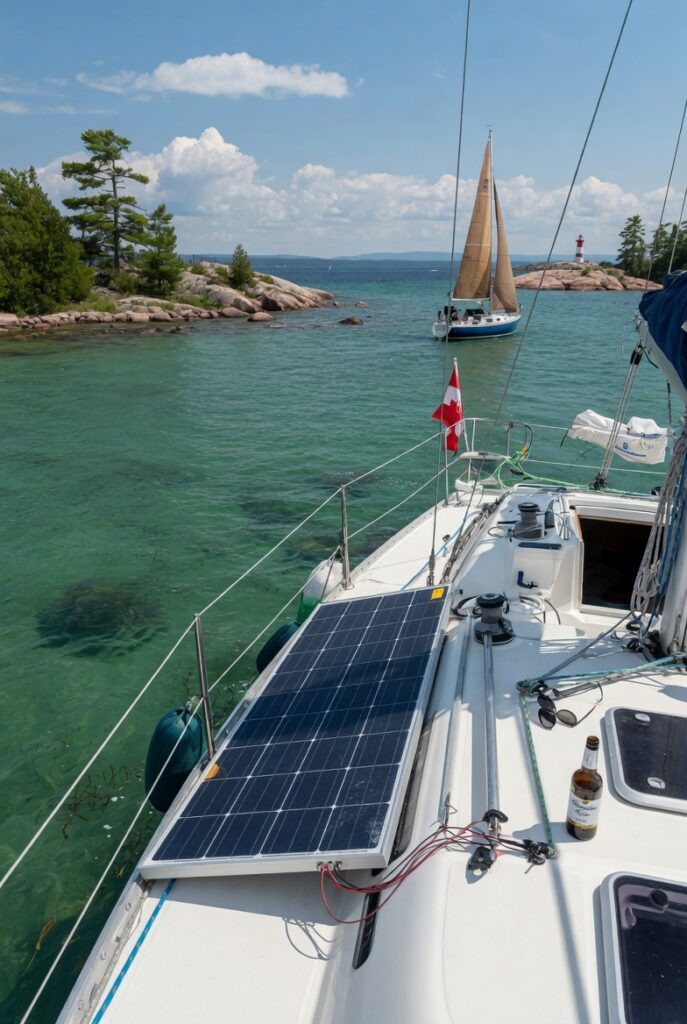
Marine solar system failures on Georgian Bay are not slow events. They are a sudden acrid smell from the bilge at 7 AM while anchored 5 miles off the Mink Islands, followed by smoke in the cabin and a VHF radio that will not key up. I was asked to review the electrical system on a 34-foot C&C 34 sloop that a Collingwood-based sailor had been using for extended cruises on Georgian Bay and the North Channel over the previous 3 seasons. The boat had a 200W residential monocrystalline panel on a stern arch mount, a pair of 6V 220Ah flooded lead-acid golf cart batteries wired in series for a 12V 440Ah bank, and a 2,000W residential pure sine inverter mounted in the starboard pilot berth locker immediately adjacent to the battery bank. The inverter was a standard residential unit with no conformal coating and no IP rating.
On the third season while anchored in Beaverstone Bay near the French River on the Georgian Bay shore the owner noticed an acrid chemical smell from the pilot berth locker at 7:12 AM. When he opened the locker he found the inverter’s ventilation slots and internal heat sinks coated in white crystalline deposits and the positive DC input terminal showing blue-green copper sulphate staining extending 40mm from the lug face along the cable insulation. A combination of sulphuric acid mist from the flooded battery bank and humidity over 3 seasons had corroded the inverter’s internal copper heat sinks from 3.2mm fin thickness to 0.8mm average. The thermal resistance of the degraded heat sinks had caused the inverter to operate at 74°C during the previous evening’s usage, driving additional electrolyte decomposition in the batteries overnight. The inverter shorted internally at 7:08 AM and the resulting arc tripped the 125A DC breaker, interrupting the VHF radio and GPS power supply on the same DC bus. The owner was without radio and GPS for 6 hours while he diagnosed and bypassed the failed inverter using the boat’s backup handheld VHF. Total replacement cost for the inverter was $1,340.
I rebuilt the electrical system replacing the flooded lead-acid bank with a sealed IP67 LFP battery mounted in a dedicated ventilated battery box with an overboard vent tube, replacing the residential inverter with a Victron MultiPlus-II with conformal-coated PCB and stainless steel hardware, and installing a Victron galvanic isolator on the shore power inlet. In 2 subsequent full seasons including a North Channel transit from Killarney to Sault Ste. Marie the inverter PCB shows zero corrosion and the battery terminals show zero copper sulphate staining. The rebuild cost $2,840. The $1,340 inverter replacement and 6-hour offshore radio blackout it prevents justified the rebuild on the first season. For the radio repeater solar RFI shielding and single-point ground standard that covers the same DC bus architecture and radio power supply protection principle, Article 223 covers the full specification. For the full system sizing hub that covers the load calculation foundation, the hub covers the numbers.
Why a Marine Solar System Fails Offshore When It Matters Most
A residential inverter in a sealed bilge locker adjacent to a flooded lead-acid battery bank accumulates sulphuric acid mist on its copper heat sinks at 0.1 to 0.4mg per square centimetre per month in a 40 to 60% relative humidity environment. Over 3 seasons the heat sink copper corrodes from 3.2mm to 0.8mm fin thickness, increasing thermal resistance by 300 to 400% and driving the inverter above its thermal protection threshold during normal use. However, a conformal-coated PCB sealed with polyurethane or ceramic-loaded resin shows zero patina development after 5 years of marine service because the coating prevents ionic contact between the atmosphere and the copper substrate.
The Victron MultiPlus-II PCB is conformal-coated with stainless steel hardware rated for the salt-air environment of a Great Lakes liveaboard through a full sailing season without corrosion event. For the remote telecom solar IP69K enclosure and sealed electronics standard that covers the same sealed PCB and corrosion-proof housing principle for harsh environments, Article 232 covers the full specification.
| Component | Residential Installation Lifespan | Marine Bilge Lifespan |
|---|---|---|
| Uncoated residential inverter PCB | 10 to 15 years in dry indoor air | 2 to 4 seasons – copper heat sinks corrode from 3.2mm to 0.8mm before thermal failure |
| Conformal-coated marine inverter PCB | 10 to 15 years | 5 years confirmed zero corrosion in salt-air bilge environment |
The Conformal Coating and Sealed LFP Battery
A sealed IP67 LFP battery mounted in a dedicated battery box with an overboard vent tube provides three advantages over a flooded lead-acid bank in a marine bilge environment: zero sulphuric acid mist that corrodes adjacent electronics, zero hydrogen off-gassing that creates an explosion risk in a sealed bilge space, and a sealed case that survives the splash and condensation environment of a marine bilge without terminal corrosion. Flooded lead-acid batteries in a 440Ah bank can off-gas up to 1.4 litres of hydrogen per hour at maximum charge rate in a sealed locker, producing a hydrogen concentration that reaches the 4% Lower Explosive Limit in a 35-litre locker volume in approximately 2.5 hours.
However, a sealed LFP battery produces zero gas under any normal charging or discharging condition. As a result the pilot berth locker can be sealed for sleeping comfort without explosion or corrosion risk from the battery chemistry. For the remote telecom solar self-heating LFP sealed enclosure standard that covers the same sealed battery chemistry and vent-free storage principle for enclosed spaces, Article 232 covers the full specification.
The Galvanic Isolator and Marina Stray Current Protection
Marine solar system galvanic corrosion failures at a marina dock are not visible until the haul-out, and by then the bronze through-hulls have lost wall thickness and the insurance surveyor is asking questions that do not have comfortable answers. I investigated a galvanic corrosion incident at a 28-foot Hunter sloop belonging to a Midland-based recreational sailor who had been keeping his boat in a slip at the Midland Bay Marina on Georgian Bay for 3 consecutive summer seasons. The boat was connected to 30A shore power through a standard shore power inlet with no galvanic isolator. The marina had 47 slips with mixed vessel types including several aluminum-hulled powerboats.
Stray DC currents from the marina’s mixed shore power system were flowing through the water from the aluminum-hulled vessels to the bronze-hulled sailboats at a measured average of 14mA. The Hunter’s two zinc anodes, which should have provided 18 months of protection, were consumed in 6 months because the 14mA stray current was accelerating the galvanic reaction at 4 to 5 times the normal consumption rate. At the summer haul-out the boatyard surveyor found the port shaft seal housing showing galvanic pitting to a depth of 1.4mm on the bronze outer face. The shaft seal required replacement at a cost of $1,640 in parts and labour.
I installed a Victron galvanic isolator at the shore power inlet. The galvanic isolator uses two sets of diodes in back-to-back configuration to block DC stray currents below 1.4V while passing the 60Hz AC shore power current normally. As a result stray DC currents from the marina cannot flow through the shore power ground conductor to the boat’s bronze underwater fittings. In 3 subsequent seasons at the same Midland Bay Marina slip the zinc anodes have lasted their full 18-month rated service life and the last haul-out showed zero new galvanic pitting on the shaft seal housing. The galvanic isolator cost $180. The $1,640 shaft seal replacement it prevented cost 9 times more than the isolator on the first haul-out. The Victron SmartShunt tracks LFP SoC and logs the shore power charging events that confirm the galvanic isolator is maintaining DC isolation at the shore power inlet. For the radio repeater solar single-point halo ground and galvanic isolation standard that covers the same DC isolation and stray current prevention principle, Article 223 covers the full specification.
The Flexible Panel and Mast Shadow Partial Shade Management
A rigid glass monocrystalline panel in a 12-cell string loses the production of all 12 cells when the mast shadow crosses any one cell because the shadow creates a current-limiting condition across the entire series string. A flexible panel with cell-level bypass diodes loses only the production of the 4 to 6 cells in the shadow zone while the remaining cells continue producing at full current. As a result a flexible panel under a mast shadow produces 65 to 80% of rated output compared to 8 to 25% for a rigid monocrystalline panel under the same shadow condition.
In addition a flexible panel can be walked on during crew movements on deck without glass shatter risk and conforms to curved deck and cabin top surfaces without requiring elevated mounting frames that create windage and shade the sail. The Renogy flexible panel mounts directly to the deck surface with adhesive and mechanical fasteners, providing walkable solar harvest from the cabin top and stern deck without any frame hardware above the deck surface. For the weather station solar bypass diode cell-level shading management standard that covers the same partial shade performance principle for panels in mixed irradiance environments, Article 222 covers the full specification.
The Marine Solar System: Minimum Viable vs Full Marine Standard
The decision follows whether the vessel is a day-sailer or an extended cruiser, whether it has flooded batteries in a sealed bilge space, and whether it is kept in a marina with mixed vessel types.
The minimum viable marine solar system for a Great Lakes day-sailer or weekend cruiser with basic electronics, refrigerator, and lighting includes a 100W Renogy flexible panel on the cabin top, a 100Ah sealed IP67 LFP battery, a conformal-coated Victron MultiPlus-II 12/1200 inverter-charger, and a Victron galvanic isolator on the shore power inlet. Capital cost runs $2,400 to $3,600. It provides ABYC E-11 compliant marine electrical architecture through a full Great Lakes sailing season without PCB corrosion or galvanic bronze fitting consumption.
The full marine standard for a liveaboard or extended cruiser on the North Channel or Georgian Bay includes a 400W flexible panel array on the deck and cabin top, a 200Ah sealed IP67 LFP bank, conformal-coated Victron MultiPlus-II 12/3000, Victron galvanic isolator, Victron SmartShunt with Cerbo GX monitoring, and all DC wiring in tinned copper marine-grade conductors. Capital cost runs $5,800 to $8,400. It provides complete galvanic isolation, corrosion-proof power electronics, and flexible on-deck solar harvesting through a full North Channel or Lake Superior extended cruise.
NEC and CEC: What the Codes Say About Marine Solar Systems
ABYC E-11 governs AC and DC electrical systems on boats and is the primary standard applicable to any marine solar system installation on a recreational vessel in North American waters. The LFP battery bank is subject to ABYC S-31 for lithium battery installations on boats including requirements for battery management systems, overcurrent protection, and the prohibition on unsealed lithium batteries in enclosed bilge spaces. The solar array source circuits are subject to ABYC E-11 Section 11 for DC systems and require tinned copper conductors throughout. Contact the NFPA for current NFPA 303 Fire Protection Standard for Marinas and Boatyards requirements applicable to marine solar systems at Ontario marina facilities.
In Canada, recreational vessel electrical systems are subject to Transport Canada’s Small Vessel Regulations under the Canada Shipping Act. The galvanic isolator installation is subject to Transport Canada’s requirements for shore power connections on recreational vessels. The ISO 13297 Small Craft Electrical Systems standard is adopted by Transport Canada as the technical reference for marine electrical installations on vessels under 24 metres. Contact Transport Canada Marine Safety for the current Small Vessel Regulations requirements applicable to solar power installations on recreational vessels operating on Ontario’s Great Lakes and Georgian Bay before modifying any vessel’s electrical system.
Pro Tip: Before commissioning any shore power connection at a new marina, bring a digital multimeter set to DC millivolts and measure the voltage between the shore power ground pin and the water at your slip before plugging in. I have measured marina stray voltages above 80mV DC at three Ontario marinas on Georgian Bay. One had 340mV DC between the dock water and the shore ground, which explained why every boat in that row was replacing zinc anodes every 6 weeks. The measurement takes 30 seconds. If you measure more than 30mV DC between the shore ground and the water, install the galvanic isolator before you plug in. Do not wait until haul-out to discover the bronze is missing.
The Verdict
A marine solar system built to the marine standard means the Beaverstone Bay C&C 34 never fills the cabin with acrid smoke at 7:12 AM because a residential inverter corroded its own copper heat sinks from 3.2mm to 0.8mm over 3 seasons of sulphuric mist and left the owner without VHF and GPS for 6 hours offshore, and the Midland Bay Marina Hunter never hauls out with 1.4mm of galvanic pitting on the shaft seal housing because 14mA of marina stray current was consuming zinc anodes in 6 months while the owner thought the shore power ground was protecting the boat.
- Replace every residential inverter in every bilge locker with a conformal-coated marine unit before the first season. The Beaverstone Bay C&C inverter corroded from 3.2mm to 0.8mm heat sink thickness in 3 seasons of sealed bilge exposure and cost $1,340 to replace plus 6 hours of offshore radio blackout. A conformal-coated Victron MultiPlus-II has shown zero corrosion in 5 years of the same environment. The corrosion clock starts the day the residential unit goes into the bilge.
- Install a galvanic isolator at the shore power inlet before the first marina season. The Midland Bay Marina stray current measured 14mA average and consumed the Hunter’s zinc anodes in 6 months at 4 to 5 times the normal rate. The isolator cost $180. The shaft seal replacement it prevented cost $1,640. Every marina slip with aluminum-hulled neighbours is a galvanic risk until the isolator is installed.
- Replace rigid glass deck panels with flexible walkable panels before commissioning any sailboat marine solar system with a mast. A rigid monocrystalline panel produces 8 to 25% of rated output under mast shadow. A flexible panel with cell-level bypass diodes produces 65 to 80%. On a moving sailboat under a rotating mast shadow the difference is the margin between a refrigerator that stays cold through the night watch and one that does not.
In the shop, we do not use residential brake components on a boat trailer and call them marine grade. At the marina, we do not install a residential inverter in a bilge locker and call it a marine power system.
Frequently Asked Questions
Q: Why does a residential inverter corrode and fail faster in a marine bilge environment than in a home installation? A: A sealed bilge locker adjacent to flooded lead-acid batteries maintains 80 to 95% relative humidity and sulphuric acid mist concentrations that corrode uncoated copper heat sinks from 3.2mm to 0.8mm thickness in 3 seasons. The degraded heat sinks increase thermal resistance by 300 to 400%, driving the inverter above its thermal protection threshold during use and eventually causing internal shorting. A conformal-coated marine inverter PCB sealed with polyurethane or ceramic resin shows zero corrosion after 5 years of the same exposure.
Q: How does a galvanic isolator protect bronze underwater fittings from marina stray current corrosion? A: When a vessel is connected to shore power at a marina with mixed aluminum and bronze hull vessels, DC stray currents flow through the water between the dissimilar metals. The shore power ground conductor provides a return path that accelerates the galvanic reaction and consumes zinc anodes 4 to 5 times faster than normal. A galvanic isolator uses back-to-back diodes to block DC stray currents below 1.4V at the shore power inlet while passing the 60Hz AC current normally, eliminating the stray current return path through the vessel.
Q: Why do flexible solar panels perform better than rigid panels on a sailboat deck under mast shadow? A: A rigid monocrystalline panel loses the production of its entire cell string when a mast shadow covers any single cell because the shadow creates a current-limiting condition across the full string. A flexible panel with cell-level bypass diodes isolates the shadow zone to the affected cells only, maintaining full production from the unshaded cells. The result is 65 to 80% output under mast shadow versus 8 to 25% for a rigid panel under the same condition.
Questions? Drop them below.
Master Tech Advisory: This build is engineered within the 48V DC Safety Ceiling. Diagnostic logic is based on 20+ years of technical service experience. All structural and electrical installations must be verified by a Licensed Professional and comply with your Local Authority Having Jurisdiction (AHJ).
This post contains affiliate links. If you purchase through our links, we may earn a small commission at no extra cost to you.