
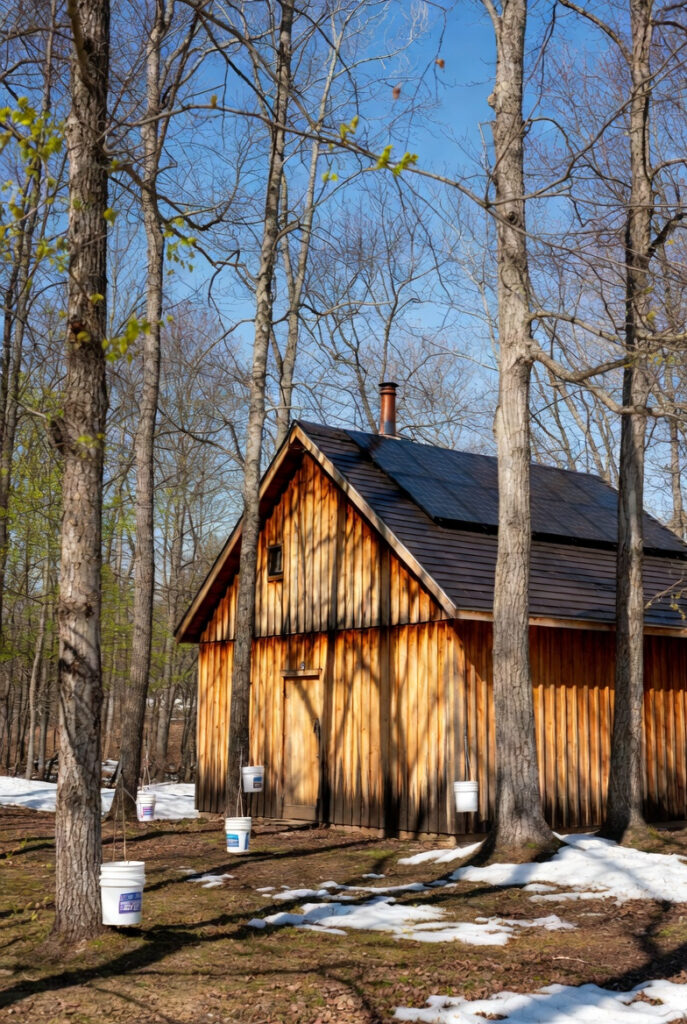
Maple syrup solar changed how I think about farm power after a producer in Puslinch Township called me during the first week of March. He had been running a 5kVA gasoline generator to power his AC vacuum pump through the peak sap run. On the fourth day of an unusually warm and productive run, sap flowing well with vacuum holding at 26 inches of mercury, the generator ran out of fuel at 2:15 PM. It took him 40 minutes to drive to town, fill jerry cans, return, and restart the system. During those 40 minutes the vacuum dropped to zero. Sap that had been held in negative pressure throughout the tubing lines drained back through the tap holes. The tap holes that had been pulling cleanly began producing cloudy, bacteria-contaminated sap the following morning, a condition called sap sickness. He lost the last three days of his best run in 11 years. The estimated yield loss was 180 litres of finished syrup at $18 per litre wholesale, $3,240 in a single afternoon. A DC-native solar system with a 400Ah LFP bank and a 12V diaphragm pump would have run continuously through that window without any fuel dependency. For the farm solar architecture that a sugar bush power system connects to, Article 184 covers the full farm power standard.
Why Maple Syrup Solar Replaces the Generator During Peak Sap Run
The generator dependency failure chain is clear: fuel runs out, vacuum drops, sap backflows, tap holes contaminate, three-day sap sickness event. A 12V DC diaphragm pump draws 120W compared to an AC 3HP pump drawing 2,200W through an inverter. The daily energy comparison: 960Wh for the DC pump versus 17,600Wh for the AC pump over 8 hours of operation. A 400Ah LFP bank at 80% DoD provides 3,840Wh of usable storage, enough to run the pump for four days without solar input. During a sap run a 600W array in Ontario March produces 1,800 to 2,400Wh per day, fully replenishing the 960Wh daily pump draw and building reserve. The generator never needs to start. For the pump circuit sizing standard that determines mainline diameter and tap count capacity for the DC diaphragm pump system, Article 174 covers the hydraulic standard.
| Power System | Daily Energy Draw | 30-Day Season Total |
|---|---|---|
| AC 3HP pump via inverter | 17,600Wh | 528kWh |
| 12V DC diaphragm pump | 960Wh | 28.8kWh |
| Saving with maple syrup solar | 16,640Wh per day | 499kWh per season |
The DC Diaphragm Pump: Maple Syrup Solar for Vacuum Extraction
An AC centrifugal vacuum pump requires single-phase 240V AC, a 3HP motor, hard starts, and inverter overhead, drawing 2,200W running. A DC diaphragm pump runs directly from a 12V or 24V battery bank with a brushless motor, soft start, and 96 to 144W running draw. Vacuum performance: 25 to 28 inches of mercury for a single-zone lateral line system supporting 400 to 600 taps. A 600W solar array in Ontario March produces approximately 54kWh over 30 days. The DC pump runs entirely on solar with no generator, no fuel cost, and no exhaust fumes near the evaporator. The Victron SmartShunt monitors real-time SoC so the producer knows before 6 AM whether the battery has sufficient reserve for a full pump day. For the full system sizing hub that covers the load calculation this maple syrup solar system is built on, the hub covers the numbers.
The CRI Lighting Standard: Maple Syrup Solar for Accurate Finishing
Maple syrup solar done right transforms the finishing process. I set up a lighting comparison at a sugar shack near Rockwood during draw-off on a March evening. The producer had been finishing by eye under a standard 4,000K LED work light with a CRI of 72. I mounted a 90+ CRI LED strip at the same position over the evaporator and asked him to call the draw-off at the moment the syrup reached the correct amber for No. 3 amber rich taste grade. Under the 72-CRI light he called the draw-off when the refractometer read 64.8 Brix, 1.2 Brix short of the 66 Brix legal minimum. Under the 90+ CRI strip he called it correctly at 66.1 Brix on the first attempt. The colour rendering difference between a CRI 72 and CRI 90+ source is significant enough to affect the finishing judgement of an experienced producer. At 65 Brix the syrup is legally under-grade and must be re-boiled, consuming additional propane and evaporation time. The $34 CRI 90+ strip investment directly protects the legal compliance and premium pricing of the finished product. The digital refractometer as backup: a USB-C rechargeable digital refractometer charges from the same DC hub as the producer’s phone. For the DC-native USB charging hub architecture that powers the refractometer and producer’s phone from the 12V bus without an inverter, Article 188 covers the DC-native charging standard.
Battery Thermal Management: Maple Syrup Solar Through the Freeze-Thaw Season
The freeze-thaw battery problem is specific to maple season in Ontario. Minus 8°C overnight and plus 5°C by 10 AM means a battery on an uninsulated concrete floor at minus 6°C at 8 AM cannot accept solar charge. The MPPT low-temperature cutoff prevents plating but also prevents charging until cell temperature reaches 0°C. In a sugar shack with a propane evaporator the interior may warm to 5°C by 9 AM, but a battery on concrete may not reach 0°C until 10 to 11 AM. Two lost charging hours in early March equals 200 to 400Wh of missed production from a 600W array. An XPS enclosure and a $28 silicone heating pad set to the 2°C/5°C thermostat protocol ensures the battery is ready to charge at 8 AM on every cold morning of the sap run. The propane evaporator provides ambient warmth in the shack that the XPS enclosure traps around the battery. A 100W heating pad on the MPPT load port set to 2°C/5°C in an R-10 enclosure draws approximately 150Wh per day during the March freeze-thaw cycle, a fraction of the charging that would be missed without it. For the full battery bank winterization standard that covers the XPS enclosure construction and heating pad thermostat protocol, Article 190 covers the deep freeze standard.
The Maple Syrup Solar System: Minimum Viable vs Full Sugar Bush Standard
The decision follows tap count and whether the producer needs remote monitoring during an unattended overnight sap run.
The minimum viable maple syrup solar system is the correct choice for a 300 to 400-tap operation with a producer present during pump hours. It includes a 12V DC diaphragm pump, a 200Ah LFP battery in an XPS insulated box, a 400W solar array, an MPPT controller with load port heating, a 90+ CRI LED strip over the evaporator, and a digital refractometer on a DC charging hub. The Renogy 100W starter kit provides the panel and controller foundation four kits or two 200W panels provide the 400W array. Capital cost runs $2,200 to $3,500. This system handles the full sap run without generator backup, no fuel dependency, and no exhaust near the evaporator.
The full sugar bush standard is the correct choice for a 400 to 800-tap operation with overnight sap collection and remote monitoring. It includes a 400Ah LFP bank with heated XPS enclosure, 600W solar array, DC diaphragm pump on dedicated circuit, 90+ CRI LED finishing lighting, digital refractometer charging hub, and Victron SmartShunt with VRM remote SoC monitoring. Capital cost runs $4,500 to $7,500. The producer checks SoC on the phone before leaving the house at 5:30 AM and arrives at the sugar shack knowing the pump will run. For the solar remote monitoring standard that integrates the VRM SoC alert into the producer’s phone, Article 187 covers the full monitoring architecture.
NEC and CEC: What the Codes Say About Maple Syrup Solar
NEC 547 covers agricultural buildings and applies to sugar shack electrical installations including solar-powered vacuum pump systems. NEC 547.5 requires that all electrical equipment in agricultural buildings be suitable for wet, corrosive, and dust-laden environments. A sugar shack during the sap run is a high-humidity steam environment from the evaporator. All electrical enclosures including the battery box, MPPT controller, and DC distribution panel must be rated for wet or damp locations. NEC 690 governs PV source circuits. NEC 547.5(F) requires that wiring methods in agricultural buildings be listed for use in wet locations. Standard NM cable is not permitted in a sugar shack environment. Use THWN-2 rated conductors in conduit throughout the shack wiring.
In Ontario, a sugar shack solar installation is subject to CEC Section 64 for PV source circuits and CEC Section 38 for agricultural building wiring. The high-humidity steam environment of an active sugar shack during boiling requires that all electrical installations comply with CEC Rule 18-152 for wet location wiring methods. An ESA electrical permit is required for the solar installation if it connects to fixed wiring in the shack. A stand-alone DC pump powered directly from a portable LFP battery through a portable MPPT controller without connection to the shack’s fixed wiring does not require an ESA permit. Contact the local ESA district office for permit requirements for sugar shack solar installations in Wellington County and Halton Region.
Pro Tip: Before the first sap run of the season, run the DC diaphragm pump for 4 hours on the battery bank with the solar array disconnected. Check the SoC before and after. If the bank drops more than 15% SoC over 4 hours, the pump is drawing more than its rated current or the battery capacity has degraded from the previous winter. Fix it before the run begins, not when the sap is flowing at peak pressure.
The Verdict
Maple syrup solar built to the sugar bush standard eliminates the generator, the fuel dependency, the exhaust near the evaporator, and the $3,240 afternoon that ends the best run in 11 years.
- Replace the AC pump and generator with a 12V DC diaphragm pump on a 400Ah LFP bank. The daily energy draw drops from 17,600Wh to 960Wh. The generator never needs to start. The sap run never stops for a fuel run.
- Mount 90+ CRI LED strips over the evaporator finishing pan. The $34 lighting upgrade protects legal compliance with the 66 Brix minimum and eliminates the re-boil that costs $80 in propane and 2 hours of evaporator time.
- Insulate the battery bank with an XPS enclosure and a 2°C/5°C thermostat heating pad. The March freeze-thaw cycle is the most demanding battery environment in the Ontario off-grid calendar. Two hours of lost morning charging because the battery was too cold costs more than the $45 enclosure that prevents it.
In the shop, we do not leave the engine running on empty waiting for fuel delivery. In the sugar bush, we do not wait for the vacuum to drop to fix the power system.
Questions? Drop them below.
This post contains affiliate links. If you purchase through our links, we may earn a small commission at no extra cost to you.