
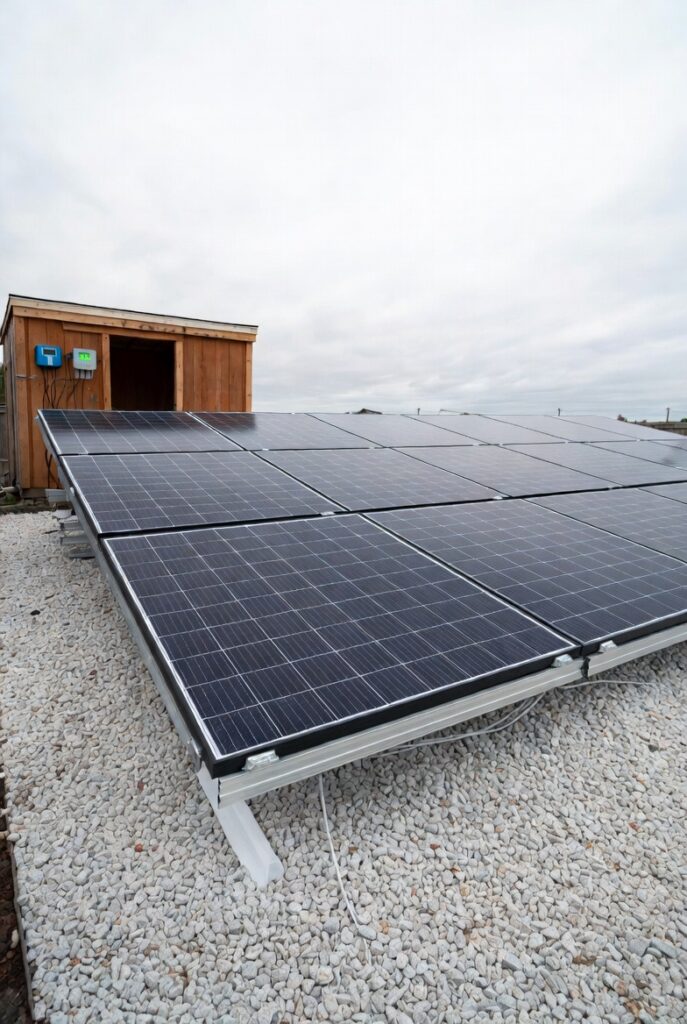
Low light solar is not zero solar, it is reduced solar, and the difference between harvesting it and missing it entirely comes down to two wiring decisions. A homeowner on Stone Road West in Guelph, Wellington County ran four 100W panels in parallel for two years on a 24V battery system. He noticed that on gray October mornings his charge controller showed zero charging activity until well past 10 AM even when the sky was clearly bright enough to see clouds.
He called it a dead system. It was not dead, it was voltage-starved. Four parallel 100W panels on an overcast Ontario morning produce approximately 16 to 18V open-circuit voltage. The Victron SmartSolar MPPT he had installed requires the panel array to exceed the battery voltage by approximately 5V to initiate charging. His 24V battery bank at 25V required approximately 30V from the array before the MPPT would start the charging cycle. His 16 to 18V parallel array on a gray morning never got there.
The fix was rewiring two pairs of panels from full parallel into a series-parallel configuration. Each series pair now produces approximately 32 to 36V on the same overcast morning that previously yielded 16 to 18V. That combined voltage comfortably exceeds the 30V start threshold of his 24V MPPT controller. His charge controller began showing morning harvest activity at approximately 7:45 AM instead of 10:15 AM on overcast October days, a gain of approximately 2.5 hours of low light solar harvesting per day. Over October’s 22 working days that 2.5-hour gain at approximately 100W average overcast output adds approximately 5.5 kWh of harvest per month that had previously been missed entirely because the controller never woke up.
I confirmed this result by checking his controller data from before and after the rewire. The October before the change showed an average of 0.6 kWh per overcast day. The October after the series-parallel conversion showed an average of 1.1 kWh per overcast day, an increase of approximately 83% on gray days with no new panels, no new controller, and no new battery. The improvement required one hour of rewiring and $0 in new hardware. Low light solar performance is often not a hardware problem. It is a configuration problem. See our Ontario solar sizing guide before making wiring changes to confirm your array size is appropriate for your system voltage.
The low light solar voltage problem: why your MPPT won’t start on a gray morning
The Victron SmartSolar MPPT controller requires the panel array Voc to exceed the battery voltage by approximately 5V before initiating the charging cycle. For a 12V battery at 12.5V the MPPT starts when panel Voc exceeds approximately 17.5V. For a 24V battery at 25V the MPPT starts when panel Voc exceeds approximately 30V. For a 48V battery at 50V the MPPT starts when Voc exceeds approximately 55V.
On an overcast Ontario morning with irradiance between 150 and 200 W/m2, the open-circuit voltage of a 100W panel drops to approximately 15 to 18V from its STC value of 22.3V. Four 100W panels in parallel on that same morning still produce only 16 to 18V, because parallel wiring adds current but not voltage.
| Configuration | Overcast morning Voc | 12V system (needs 17.5V) | 24V system (needs 30V) |
|---|---|---|---|
| 2x100W parallel | 16 to 18V | ✓ Starts | ✗ No charge |
| 2x100W series | 32 to 36V | ✓ Starts | ✓ Starts |
| 4x100W full parallel | 16 to 18V | ✓ Starts | ✗ No charge |
| 4x100W series-parallel (2+2) | 32 to 36V | ✓ Starts | ✓ Starts |
| 4x100W full series | 64 to 72V | ✓ Starts | ✓ Starts, check cold Voc |
The series-parallel solution for four panels is the correct fix for a 24V system with gray-day start-up problems. Full parallel fails because the voltage stays low regardless of how many panels you add. Series-parallel, two pairs wired in series then those pairs wired in parallel, produces 32 to 36V on overcast mornings and comfortably clears the 30V threshold. Full series at four panels produces 64 to 72V in low light, which is also acceptable, but verify the cold-temperature Voc at Ontario -18C before wiring to confirm it stays under the controller’s 100V input limit. See our series and parallel wiring guide for the cold-temperature voltage calculation procedure.
MPPT vs PWM: why your controller’s scan rate determines your gray-day harvest
The Victron SmartSolar MPPT 100/50 scans the full I-V power curve approximately every 10 minutes to locate the true maximum power point. As irradiance shifts on an overcast Ontario day, clouds thinning and thickening every few minutes, the power curve shifts with it. The MPPT algorithm continuously re-optimises its operating point to extract the maximum available power from the shifting curve. A PWM controller applies a fixed voltage to the battery regardless of where the panel’s actual power peak is.
On a variable overcast Ontario morning, MPPT produces approximately 15 to 30% more harvest than a PWM controller on identical panels. That gap is largest precisely when irradiance is low and variable, which is Ontario’s default condition from October through February.
The economic case for MPPT is straightforward on an Ontario array. A Victron SmartSolar MPPT 100/50 costs approximately $85 to $100 more than a comparable PWM controller. On a 400W Ontario array running 60 to 80 overcast days per year at 15 to 30% additional harvest, the MPPT returns approximately 2 to 4 kWh per overcast day compared to PWM. At Ontario’s electricity rate, the MPPT pays back its premium over a PWM controller in approximately 2 to 3 Ontario winters of operation. After payback, every gray October day produces additional free energy that the PWM controller misses entirely. For any low light solar system in Ontario, MPPT is the correct controller choice regardless of array size.
Low light solar and the bifacial rear gain: what your ground surface is worth
On a clear day, bifacial gain comes primarily from direct ground reflection. On an overcast Ontario day, diffuse light arrives from all directions including below the panel horizon, and the rear surface captures whatever the ground reflects back upward. White limestone gravel at approximately 30% albedo provides approximately 19W of rear gain per 400W panel at 200 W/m2 overcast irradiance, which is approximately 26% above monofacial output from the same panel in the same conditions.
A rural property owner on Britannia Road West in Milton, Halton County installed a BougeRV 400W bifacial panel in a ground-mount array in the fall of 2024, with dark brown bark mulch under the panel. His low light solar output on overcast November days averaged approximately 68W from that single panel.
In the spring of 2025 he replaced the bark mulch with white limestone gravel for approximately $85 delivered from a local Halton supplier. His next overcast November readings averaged approximately 86W from the same panel under similar sky conditions, a gain of approximately 18W or approximately 26%. The Starlink dish he powered from the array draws approximately 25 to 30W on standby and had previously needed battery backup on fully overcast days.
After the gravel change the panel covered the Starlink load independently without drawing from the battery on most gray Ontario days. The surface materials under a ground-mount bifacial panel rank in descending order of low light gain: fresh snow at 40 to 50% gain on overcast days, white limestone gravel at approximately 26% gain, light concrete at approximately 20 to 25%, wet grass at approximately 8 to 12%, and wet dark mulch at approximately 4 to 6%. See our best 400W bifacial panel guide for verified panel options and specifications.
Spectral response: what monocrystalline cells actually see through Ontario clouds
Overcast Ontario sky is not dark, it is diffuse. A typical gray October day delivers approximately 200 W/m2 of diffuse irradiance compared to the 1,000 W/m2 STC standard. Monocrystalline silicon cells respond across 400 to 1,100nm of the light spectrum. Overcast sky shifts the available spectrum toward shorter wavelengths, blue and UV in the 400 to 500nm range, which silicon handles less efficiently than red and near-infrared in the 700 to 800nm range where its peak response sits. However, modern half-cut PERC and N-Type cells have improved short-wavelength response compared to older cell designs, and monocrystalline still produces approximately 10 to 25% of rated output on a fully overcast Ontario day.
The practical implication is that your low light solar system is not dead on gray days. A 400W panel on a typical Ontario October overcast day at 200 W/m2 produces approximately 40 to 100W of real, harvestable energy. Whether that power reaches your battery bank depends entirely on whether your array voltage clears the MPPT start-up threshold. Fix the wiring configuration and the photons take care of themselves. The irradiance is available on every Ontario gray day. The only question is whether your system is configured to capture it. See our cloudy weather solar guide for a full breakdown of Ontario seasonal irradiance by month.
NEC and CEC: code compliance when rewiring your solar array in Ontario
NEC 690 governs solar PV installations. Rewiring panels from parallel to series-parallel configuration changes the string voltage of the system and triggers a new maximum voltage calculation under NEC 690.7. That calculation requires the cold-temperature Voc at the coldest expected operating temperature, Ontario -18C, rather than the STC voltage. A rewire from full parallel to series-parallel doubles the string voltage. For two 100W panels previously in parallel that are rewired to series, the cold-temperature Voc at -18C rises from approximately 19V to approximately 38V, which remains safely within the 100V Victron MPPT limit.
For larger rewires involving three or four panels in series, the cold-temperature calculation must be completed before connecting to confirm the array stays below the controller’s maximum input voltage. Contact the NFPA at nfpa.org for current NEC 690 requirements applicable to array rewiring modifications.
CEC Section 50 governs solar PV installations in Ontario. Rewiring an existing permitted array from parallel to series or series-parallel configuration is a modification to the electrical system. If the original installation was permitted under an ESA permit, a modification that changes the string voltage requires the permit holder to confirm the modification is within the original permit specifications or file a permit amendment before the work is energised.
In practice, a rewire that keeps the string voltage within the original controller’s rated input range and does not change the overcurrent protection or conductor sizing typically falls within the original permit scope without requiring a new permit. If there is any doubt, contact the Electrical Safety Authority Ontario at esasafe.com before making wiring changes to a permitted Ontario installation.
Pro Tip: The quickest way to diagnose a low light solar start-up problem is to check your controller’s morning log data rather than watching it in real time. Victron SmartSolar controllers log their start time and initial voltage for every charging session. Download three to five overcast day logs and compare the start times and initial Voc readings. If the controller consistently starts after 9 or 10 AM on overcast days, your array is voltage-starved, not sun-starved. The voltage reading at the first log entry tells you the exact Voc your parallel array is producing at start-up. Compare that to the required threshold (battery voltage plus 5V) and the math will confirm whether a series-parallel rewire solves the problem before you touch a single connector. The Guelph Stone Road homeowner downloaded his October log and saw the start time move from 10:15 AM to 7:45 AM in a single column. The series-parallel rewire was the only change between those two Octobers.
The low light solar verdict: three Ontario optimization upgrades in order of impact
- Ontario homeowner with parallel-wired panels on a 24V or 48V system who sees zero harvest on gray mornings: rewire to series-parallel before buying any new hardware. The Guelph Stone Road result confirms the case. Zero-cost rewiring recovered 83% more gray-day harvest on a 24V system by moving the array voltage from 16 to 18V to 32 to 36V and clearing the MPPT start-up threshold. The rewire required one hour and $0 in parts. This is the highest-impact low light solar improvement available for any Ontario 24V or 48V system running panels in full parallel. Check the cold-temperature Voc calculation after rewiring to confirm the series string stays under the controller’s 100V limit, then leave it alone. The system will now harvest from sunrise on every Ontario gray day rather than waiting until solar noon for enough irradiance to clear the threshold in parallel.
- Ontario homeowner currently using a PWM charge controller: upgrade to a Victron SmartSolar MPPT. A PWM controller applies a fixed operating voltage and never finds the shifting maximum power point on a variable overcast Ontario morning. The Victron SmartSolar MPPT 100/50 scans the full I-V curve every 10 minutes and re-optimises continuously. On overcast days the gap between MPPT and PWM harvest is 15 to 30% in favour of MPPT, and the payback on the $85 to $100 premium over a PWM controller occurs in approximately 2 to 3 Ontario winters of low light solar operation. After payback, every gray October and November day produces additional free energy that the PWM controller would have missed. For any Ontario off-grid or hybrid system, MPPT is the correct controller for the climate.
- Ontario homeowner with a ground-mount array sitting over dark soil, bark mulch, or grass: replace the ground cover with white limestone gravel. The Milton Britannia Road bifacial result shows an 18W rear gain per 400W bifacial panel on overcast days from an $85 material change. White limestone gravel at approximately 30% albedo is the highest-impact low light solar ground cover available in Ontario at a practical price. The gain is largest in November and December when Ontario overcast days are most frequent and battery state of charge most critical. For a Starlink-powered property or any system where continuous low-level loads must run without battery draw on gray days, the gravel upgrade is the lowest-cost intervention with the most visible daily result. Install it under the full panel footprint, not just at the edges, to maximise the rear surface irradiance contribution.
Frequently Asked Questions
Q: How much power does a low light solar array actually produce on a gray Ontario day?
A: On a typical Ontario gray October day at approximately 200 W/m2 diffuse irradiance, a 400W monocrystalline panel produces approximately 40 to 100W, which is 10 to 25% of rated output. On a fully overcast November or December day at 100 W/m2 or less, output drops to approximately 5 to 10% of rated, real power but not enough to run a full household without battery storage. A 400W bifacial panel on white gravel adds approximately 19W of rear surface gain, bringing overcast output to approximately 59 to 119W. Size your battery bank for 3 to 4 days of autonomy for November and December operation regardless of how well your low light solar system is optimised.
Q: Why does my solar charge controller show zero output on overcast mornings even when it’s not dark outside?
A: Your array voltage is below the MPPT start-up threshold. For a 24V battery system at 25V, the Victron SmartSolar MPPT requires approximately 30V from the panel array before it initiates the charging cycle. Four 100W panels in full parallel on an overcast Ontario morning produce approximately 16 to 18V, well below that threshold, so the controller shows zero output even though the panels are generating power. The fix is rewiring to series-parallel so each series pair produces 32 to 36V on the same gray morning. The controller wakes up, the charging starts, and the low light solar harvest that was previously invisible begins flowing into your battery bank.
Q: Does a bifacial solar panel actually help with low light solar production in Ontario winter?
A: Yes, specifically because overcast light is diffuse rather than directional. On a clear day bifacial gain comes from direct ground reflection. On an overcast day, diffuse light arrives from all directions including below the panel horizon, and the rear surface captures reflected irradiance from whatever surface is underneath the panel. White limestone gravel at approximately 30% albedo provides approximately 19W of rear gain per 400W panel at Ontario overcast irradiance levels, which is approximately 26% above monofacial output in the same conditions. The gain is most valuable in November and December when front-surface output is lowest and every additional watt matters for keeping continuous loads like Starlink running without drawing from the battery.
This build is engineered within the 48V DC Safety Ceiling. Diagnostic logic is based on 20+ years of technical service experience. All structural and electrical installations must be verified by a Licensed Professional and comply with your Local AHJ.
This article contains affiliate links. If you purchase through these links, I earn a small commission at no extra cost to you.