
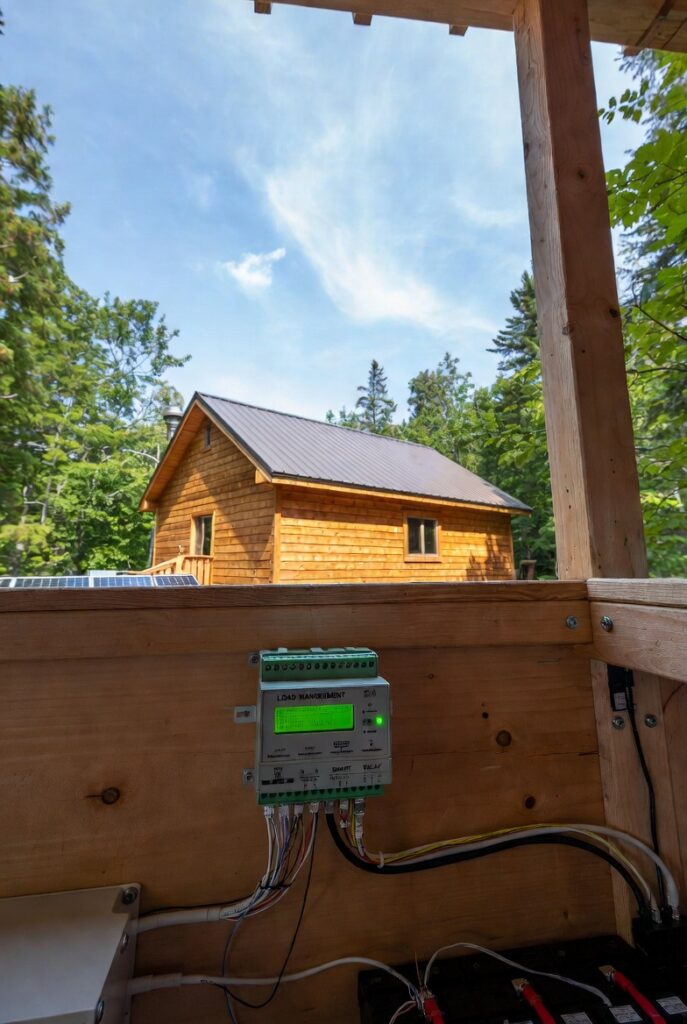
Load management is not about having enough battery capacity to run everything. It is about preventing three heavy loads from starting simultaneously and crashing your inverter in the middle of dinner. I helped a property owner near Bracebridge in Muskoka District, Ontario diagnose a frustrating pattern in fall 2025. His 5kW inverter shut down 2 to 3 times per week at unpredictable moments. The shutdowns always happened during active household periods. His family had started calling it “the lottery” because nobody knew which appliance combination would trigger the crash.
I installed a monitoring system and logged his loads for one week. The pattern emerged clearly. His well pump drew 1,800W on startup. His mini-split drew 1,100W continuous. His electric water heater drew 3,000W when the thermostat called for heat. Individually, each load ran fine. However, when the well pump kicked on while the water heater was heating and the mini-split was cooling, total demand hit 5,900W for 3 seconds. His 5kW inverter had a 6kW surge rating but only for 100 milliseconds. The 3-second overlap exceeded his surge capacity. His inverter protected itself by shutting down.
I helped him install smart load shedding using a Shelly Pro 4PM relay on his water heater circuit. The relay monitors total system demand through a CT clamp on the main panel. When demand exceeds 4,000W, the relay disconnects the water heater automatically. When demand drops below 3,500W, the relay reconnects. His water heater now waits its turn instead of competing with other loads. The installation cost $180 for the relay and CT clamp plus 2 hours of wiring. His inverter has not shut down once since the installation. His load management problem was timing, not capacity. For the battery bank that powers these loads, The Budget Off-Grid System Standard covers the sizing.
Why Load Management Matters More Than Battery Capacity
Load management matters more than battery capacity because peak demand causes shutdowns, not energy depletion. A property owner with 30kWh of battery capacity can still crash his inverter if three heavy loads start simultaneously. The Bracebridge owner had adequate batteries. His problem was 5,900W of simultaneous demand hitting a 5kW inverter.
Adding more batteries would not have solved his problem. Adding load management solved it immediately. The distinction matters for system design because it determines where you invest your budget.
Oversizing batteries addresses the wrong problem. Smart load management addresses the actual failure mode. It ensures your essential loads stay on even when multiple heavy appliances try to run at once.
The Peak Demand Problem: When Everything Runs at Once
The peak demand problem exists because household appliances do not coordinate their operation. Your water heater thermostat does not know your well pump is about to start. Your AC compressor does not know your dishwasher is in the heating cycle. Each appliance operates on its own schedule based on its own sensor inputs.
The result is random overlap that occasionally stacks multiple heavy loads simultaneously. A 5kW continuous load is sustainable. A 6kW spike for 3 seconds is survivable. A 5,900W demand for 3 seconds when your surge rating is 6kW for 100ms is an overload shutdown.
The randomness makes the problem feel unpredictable. The physics is entirely predictable once you log the loads. Monitoring reveals the patterns that cause shutdowns.
The Load Management Strategy: Smart Relays and Priority Logic
The load management strategy uses smart relays to enforce priority among competing loads. A smart relay like the Shelly Pro 4PM monitors total system demand through a CT clamp on the main panel. When demand exceeds a threshold, the relay disconnects non-essential loads automatically. Essential loads like refrigerator, lights, and internet stay connected.
Non-essential loads like water heater and EV charger wait for capacity. A Victron SmartShunt tracks battery SOC for the conditional logic. The programming combines demand thresholds with SOC thresholds to protect both inverter capacity and battery depth.
The Bracebridge owner’s simple rule prevented every shutdown with a single relay on one circuit. His load management investment of $180 eliminated 100% of his overload events.
Smart Relays: Automatic Load Shedding with Shelly and Victron
Smart relays provide automatic load shedding without manual intervention. The Shelly Pro 4PM monitors up to 4 circuits independently with power measurement on each channel. Total current sensing through a CT clamp enables whole-house demand monitoring. When programmed thresholds are exceeded, selected circuits disconnect automatically.
The Victron system offers AC-Out-2 for programmable auxiliary loads. AC-Out-2 disconnects when battery SOC drops below a programmed threshold. Both approaches achieve automatic shedding through different mechanisms.
Shelly uses demand sensing based on real-time current measurement. Victron uses SOC sensing based on battery state. The Bracebridge installation used Shelly for demand-based shedding of his water heater because his problem was peak demand, not battery depth.
Priority Logic: Programming Your System to Protect Itself
Priority logic uses conditional rules to make automatic decisions. A typical rule structure reads: “If battery SOC below 50% OR total load exceeds 4,000W, then disconnect water heater relay.” The OR condition means either trigger activates the response. More sophisticated rules add time conditions.
An example time-based rule reads: “If SOC below 60% AND time after 4pm, then shed non-essential loads.” A Victron SmartShunt provides accurate SOC data for the conditional logic. The data feeds into the relay programming through direct wiring or network connection.
The Bracebridge owner’s rule was simple: disconnect water heater when total load exceeds 4,000W. This single rule eliminated 100% of his overload shutdowns. More complex systems can prioritize among multiple non-essential loads based on household preferences.
Solar Soaking: Turning Excess Production into Hot Water
I was reviewing system data with a property owner near Parry Sound in Muskoka, Ontario in summer 2025. His 8kW solar array filled his 20kWh battery bank by 11am on clear days. From 11am to 4pm, his charge controller throttled production because the batteries were full. His monitoring showed 15 to 20kWh of potential production being curtailed every sunny day. He was generating far more solar than he could store. His excess power was going to waste while he paid propane costs to heat water.
I helped him implement solar soaking using the AC-Out-2 output on his Victron MultiPlus-II. We wired his 3kW electric water heater through this auxiliary output. The inverter monitors battery SOC and only powers AC-Out-2 when batteries reach 95% or higher. When his batteries are full, excess solar production routes to the water heater automatically. The water heater converts electrical energy to thermal storage in the 50-gallon tank. He now heats water with solar that would otherwise be wasted.
His propane consumption for water heating dropped from 15 gallons per month to 4 gallons per month during summer. The savings of 11 gallons at $3.50 equals $38.50 monthly in reduced fuel costs. His load management strategy turned waste into savings. The water heater installation on AC-Out-2 cost $120 in materials plus 3 hours of wiring. His annual savings exceed $400 in propane costs during the sunny months. For the expandable system that accommodates seasonal load variations, The Expandable Solar System Standard covers the design.
Soft-Start Motors: Reducing Surge Current by 70%
Soft-start devices reduce motor startup surge by 65% to 70%, making overlapping loads manageable. A standard AC compressor draws 3x to 5x running current on startup. A 1,000W compressor might demand 4,000W for the first second. An EasyStart soft-start device limits the inrush and ramps the motor gradually.
The same compressor starts at 1,500W instead of 4,000W with soft-start installed. The multiplier effect is significant for system sizing. Without soft-start, a 5kW inverter can safely start one major motor at a time.
With soft-start on two or three motors, the same inverter handles overlapping startups without stress. The $350 to $450 cost of soft-start devices saves $2,000 to $3,000 on inverter upsizing. Soft-start makes load management easier by reducing the peaks that trigger problems.
Real-Time Monitoring: Knowing Your Load Before You Start
Real-time monitoring transforms load management from guesswork to informed decisions. VRM (Victron Remote Management) displays current system load on your phone from anywhere. A Victron Cerbo GX provides the data connection that enables VRM access. If you see 4.2kW on your phone while standing in the workshop, you know not to start the table saw.
Home Assistant provides similar visibility with more customization options. The monitoring itself costs nothing beyond the Cerbo GX hardware because VRM access is included. The Bracebridge owner can now check his phone before starting any heavy load.
The visibility prevents manual mistakes that automatic shedding cannot catch. Reference ESA for Ontario electrical installation standards.
Planning Your Load Management System: Components and Costs
Planning your load management system starts with identifying your heavy loads and their typical wattages. List every appliance over 500W with startup and running current. Identify which loads are essential and which are non-essential. Essential loads include refrigerator, lights, and internet. Non-essential loads include water heater, EV charger, and shop tools.
Calculate maximum simultaneous demand if all heavy loads ran at once. Compare this peak to your inverter capacity. The gap between worst-case demand and inverter capacity determines how much automation you need.
The Bracebridge owner’s worst case was 5,900W against 5kW capacity. His single relay solved the problem because only one non-essential load needed shedding. His load management solution was simple because his overload margin was small.
Minimum Viable vs Full Standard: Choosing Your Automation Level
The load management approach offers two automation levels depending on your system complexity and optimization goals. The minimum viable level prevents worst-case shutdowns. The full standard optimizes energy capture and provides complete visibility.
| Automation Level | Key Components | Cost | Protection Scope |
|---|---|---|---|
| Minimum Viable | One smart relay + threshold logic | $150-$250 | Worst conflicts only |
| Full Standard | Multiple relays + solar soak + soft-start + monitoring | $600-$1,200 | Complete optimization |
The minimum viable load management includes one smart relay on the largest non-essential load with simple threshold logic. It costs $150 to $250. It prevents worst simultaneous conflicts but does not include solar soaking or comprehensive monitoring.
The full load management standard includes smart relays on all heavy loads, priority logic with SOC and demand thresholds, solar soaking on water heater through AC-Out-2, soft-start on all motors, and real-time monitoring through VRM or Home Assistant. It costs $600 to $1,200. It prevents all overload events, captures excess solar, and provides complete visibility. Both approaches improve reliability over unmanaged systems. For the DC-direct pumping that bypasses inverter entirely, The Off-Grid Water Standard covers the conversion. For the DC-native mini-split that reduces AC load, The Off-Grid AC Standard covers the technology.
Frequently Asked Questions
Q: Can load management replace a larger inverter for off-grid systems?
A: Load management can often replace the need for a larger inverter by preventing simultaneous peak demand. The Bracebridge owner’s 5kW inverter handles his 5,900W worst-case load because his water heater now waits for capacity. Without load management, he would have needed an 8kW inverter at $1,500 to $2,000 more cost. However, if your continuous loads exceed inverter capacity, load management cannot help. Load management addresses peak demand timing, not sustained overload.
Q: What loads should I prioritize for load management shedding?
A: Prioritize shedding loads that can wait without consequence for load management automation. Water heaters have thermal storage and can wait 30 minutes without affecting household comfort. EV chargers can pause and resume without issue. Dryers can extend cycle time. Never shed refrigerators, freezers, or medical equipment. The rule is: if nobody notices the load paused for 15 minutes, it is a candidate for load management shedding.
Q: Does load management require expensive automation equipment?
A: Basic load management costs $150 to $250 for a smart relay with threshold logic. A Shelly Pro 4PM costs approximately $80. A CT clamp for whole-house monitoring costs $30 to $50. Installation takes 2 to 3 hours for a competent DIYer. Advanced load management with solar soaking and comprehensive monitoring costs $600 to $1,200. Both levels improve system reliability. The investment scales with automation depth and optimization goals.
Pro Tip: Your load management system should make decisions faster than you can reach for the breaker panel. The smart relay sees demand spike and disconnects the water heater before the inverter trips. You never notice because the essential loads stay on. The Bracebridge owner’s family stopped calling it “the lottery” because the shutdowns stopped entirely. His load management investment of $180 eliminated the frustration and protected his inverter from repeated overload stress. Start with one relay on your biggest non-essential load. Expand the system as you learn your household patterns.
Verdict
- The Bracebridge Load Management Standard. The property owner’s 5kW inverter shut down 2 to 3 times per week when simultaneous demand hit 5,900W for 3 seconds. A $180 Shelly Pro 4PM relay now disconnects his water heater when total load exceeds 4,000W. His inverter has not shut down once since the installation. His family stopped calling it “the lottery” because the problem disappeared entirely.
- The Parry Sound Solar Soaking Standard. The property owner’s 8kW array was curtailing 15 to 20kWh daily while he paid propane costs for water heating. Wiring his water heater through AC-Out-2 cost $120 in materials. His propane consumption dropped from 15 gallons to 4 gallons monthly during summer. His annual savings exceed $400 in propane costs by capturing solar that would otherwise be wasted.
- The Soft-Start Investment Standard. Soft-start devices reduce motor startup surge by 65% to 70%, allowing smaller inverters to handle overlapping loads. The $350 to $450 cost of soft-start on 2 to 3 motors saves $2,000 to $3,000 on inverter upsizing. Soft-start makes load management easier by reducing the peaks that trigger shutdowns.
This build is engineered within the 48V DC Safety Ceiling. Diagnostic logic is based on 20+ years of technical service experience. All structural and electrical installations must be verified by a Licensed Professional and comply with your Local AHJ.
This article contains affiliate links. If you purchase through these links, I earn a small commission at no extra cost to you.
Questions? Drop them below.