
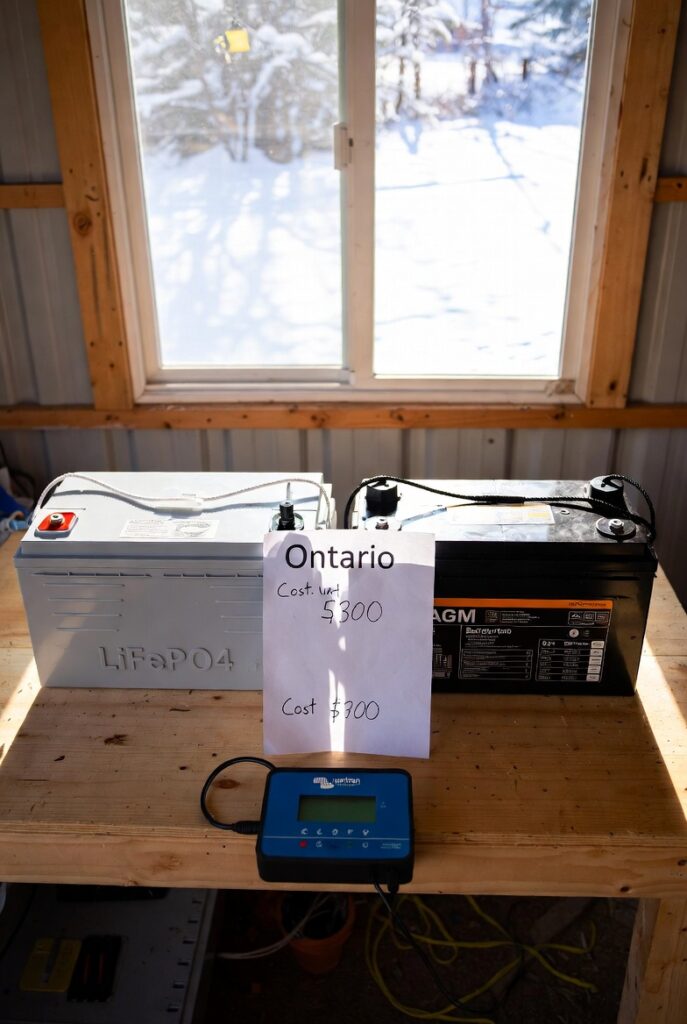
The lifepo4 vs agm decision comes down to one number: cost per cycle. In April 2025 a retired electrician on Kortright Road West in Guelph, Wellington County switched from his third set of AGM batteries to a single Battle Born 100Ah LiFePO4. He had built a 400W workshop solar array in 2019 with two 100Ah Group 31 AGM deep cycle batteries at $220 each. He replaced them in 2021 after one developed a dead cell and both had dropped to approximately 60% of original capacity. He replaced them again in 2023. By 2025 he had spent $880 on AGM batteries over six years and still had no working battery in the shed.
He had also lost approximately 12 weekends to battery-related issues: flat batteries on Friday evenings, failed charges, and two instances where his inverter shut down at midnight due to voltage sag. The Battle Born 100Ah LFP cost $469 CAD. At the moment he installed it, he had already spent $880 on AGM replacements. The math was not close.
I helped him calculate the total cost of ownership after the installation. His AGM batteries delivered approximately 400 cycles each at 50% depth of discharge before falling below 80% capacity. He paid $220 per battery for 400 cycles of 50Ah usable capacity. That works out to $1.10 per 100Ah-equivalent cycle. The Battle Born delivers 3,500 cycles at the midpoint of its 3,000 to 5,000 cycle rating, with 100Ah usable capacity per cycle at $469.
That is $0.13 per 100Ah cycle. The AGM cost 8.5 times more per unit of delivered energy over its service life. He said he wished someone had shown him that math before he bought his first AGM in 2019. See our solar sizing guide to confirm how much battery capacity you actually need before choosing chemistry.
What the lifepo4 vs agm cost comparison actually looks like over 10 years
The math is straightforward once you apply it correctly. A standard 100Ah Group 31 AGM battery costs approximately $200 CAD and delivers approximately 400 cycles at 50% depth of discharge before falling below 80% usable capacity. Usable capacity per cycle is 50Ah. Cost per 50Ah cycle is $0.50. To compare fairly with LFP, which delivers 100Ah per cycle, the AGM cost per 100Ah-equivalent cycle is $1.00.
A Battle Born 100Ah LFP costs approximately $469 CAD and delivers 3,500 cycles at the 3,000 to 5,000 cycle midpoint with 100Ah usable capacity per cycle. Cost per 100Ah cycle is $0.13. Over 3,500 cycles, the AGM replacement cost is $1,750 in batteries. The LFP cost is $469. Savings: $1,281 over the battery service life.
| Specification | Battle Born 100Ah LFP | Typical 100Ah Group 31 AGM |
|---|---|---|
| Rated capacity | 100Ah | 100Ah |
| Usable capacity (safe DoD) | 100Ah (100% DoD safe) | 50Ah (50% DoD max) |
| Cycle life | 3,000 to 5,000 cycles @ 80% DoD | 300 to 500 cycles @ 50% DoD |
| Weight | 31 lbs (14.1 kg) | 60 to 68 lbs (27 to 31 kg) |
| Charge efficiency | ~99% | 80 to 85% |
| Cold weather charging | BMS cuts off below 0C (heater version available) | Capacity drops 20% at 0C, 50% at -27C |
| Cost per 100Ah cycle | $0.13 | $1.00 |
| Price (Amazon.ca approx.) | $469 to $500 CAD | $150 to $250 CAD |
| Warranty | 10 years | 1 to 2 years (deep cycle) |
The double penalty compounds the cost difference. Not only does AGM cost more per cycle, it also delivers only half the usable capacity. Buyers comparing a $200 AGM to a $469 LFP are comparing a $200/50Ah battery to a $469/100Ah battery. To get 100Ah of usable AGM capacity you need to buy 200Ah of rated AGM capacity at $400 or more, and that still only lasts 400 cycles. The lifepo4 vs agm comparison is not battery-to-battery but energy-delivered-to-energy-delivered. On that basis the LFP is cheaper from the first cycle.
The 50% rule: why a 100Ah AGM is actually a 50Ah battery
AGM plates sulfate when discharged below 50% state of charge. At rest, 12.1V indicates 50% charge on a 12V AGM. Below that threshold, sulfation begins immediately and accumulates with every partial discharge cycle. Most inverters and loads continue drawing current until 11.5V, which means an unprotected AGM regularly goes below safe depth of discharge without the owner realising it. Each over-discharge shortens cycle life.
An AGM cycled regularly to 70% DoD instead of 50% may deliver only 200 to 250 cycles instead of 400, which doubles the cost per cycle to $0.80 to $1.00 before the comparison with LFP is even made.
The Ontario winter penalty exacerbates the 50% rule significantly. At 0C, AGM capacity is approximately 80% of rated. At -10C, capacity drops to approximately 70%. At -27C, which is possible in a January Guelph cold snap, capacity drops to approximately 50% of rated. A 100Ah AGM in an unheated Ontario shed at -27C delivers approximately 35Ah at the 50% DoD safety limit before the BMS or inverter trips.
A Battle Born LFP at -10C delivers the full 100Ah discharge. It will not accept a recharge below 0C, but it will discharge its full capacity through the night. The lifepo4 vs agm cold weather gap in Ontario is not a minor seasonal inconvenience. It is the difference between 35Ah and 100Ah on the coldest morning of the year.
Voltage sag: why AGM batteries trip inverters at the worst possible moment
Lead acid chemistry produces a variable voltage curve across the discharge cycle. A fully charged AGM reads 12.7V at open circuit. At 50% state of charge, the open circuit voltage drops to approximately 12.0V. Under a 300W load drawing approximately 25A, the terminal voltage drops further to 11.6 to 11.8V. Most standard inverters have a low-voltage disconnect set between 11.0 and 11.5V. In practice, an AGM-powered inverter under a moderate load in an Ontario January unheated shed trips at 60 to 70% state of charge, before the battery even reaches its nominal safe discharge limit. The owner wakes up to a tripped inverter with 30 to 40% of the AGM’s already-limited capacity still unused.
LFP maintains approximately 13.2 to 13.3V at 90% state of charge and holds above 12.8V all the way to approximately 10% state of charge. An inverter on LFP runs at full rated power from 100% to approximately 5% state of charge without any voltage-related tripping. The Kortright Road West workshop inverter had been tripping at midnight with AGM batteries. After the Battle Born installation it ran until 4 AM before the battery reached 10% state of charge, on the identical solar harvest and identical load profile. The difference was not the inverter or the solar array. It was the voltage curve.
Charge efficiency: how AGM wastes 15 to 20 percent of your solar harvest
AGM batteries waste 15 to 20% of incoming solar energy as heat during the absorption charging phase. For a 200W solar array delivering 800Wh on a clear Ontario July day, that is 120 to 160Wh simply not stored. Over a 150-day Ontario camping season from May through September, that is 18,000 to 24,000Wh of solar energy lost to heat, equivalent to approximately 45 to 60 full production days from the 200W array.
LFP charge efficiency is approximately 99%. Because less energy is wasted as heat, the effective cost per stored watt-hour is 15 to 20% lower with LFP than with AGM from the identical panel array. For a 400W array with a fixed budget, AGM forces you to either add panels to compensate or accept reduced stored energy.
Charge speed is the second efficiency difference. AGM must slow to a C/10 trickle rate during the final 20% of charging, called the absorption stage. A 100Ah AGM being charged from 80% to 100% state of charge by a 10A solar charge controller takes approximately 2 hours at reduced rate. LFP accepts charge at full rate all the way to 99% state of charge. For an Ontario cottage owner who arrives Friday evening with a partially depleted battery and needs to top up before Sunday morning, the LFP finishes charging while the AGM is still in absorption. See our full battery chemistry comparison for how LFP compares to other lithium chemistries.
The lifepo4 vs agm cold weather reality for Ontario off-grid systems
In October 2024 a seasonal cottage owner on 15th Sideroad in Puslinch Township, Wellington County reported that her battery was “never getting above 11.8V” even after three consecutive clear days. I inspected: the AGM at 8C ambient temperature in the unheated mechanical room was delivering approximately 75% of rated capacity. The battery was sitting at 50% state of charge before she arrived each Friday evening. The 200W array at a 37-degree October sun angle was adding only approximately 250Wh per day, not enough to reach full charge before the weekend ended.
The battery was also beginning to sulfate from repeated partial-state-of-charge storage through the previous winters. She had been running the system for two and a half years and was on her second AGM battery.
I replaced the AGM with a Battle Born 100Ah Heated LFP. The following February she reported the battery reaching 98% state of charge by 2 PM on clear days despite the cottage being at -8C. The heated LFP’s internal heater activates automatically below 0C, warms the cells to a safe charging temperature, and then accepts the full charge current from the solar panels. The AGM in the same location would have delivered approximately 35Ah at that temperature due to cold weather capacity reduction and the 50% DoD limit.
The heated LFP delivered the full 100Ah. For any Ontario system installed in an unheated space that you want to charge from solar between October and April, the heated Battle Born is the correct choice. The $50 to $80 CAD premium over the standard version is the lowest-cost insurance available for Ontario winter solar charging.
A standard non-heated LFP installed in an unheated Ontario shed will NOT accept solar charge below 0C. The built-in BMS disconnects the charge circuit to protect the cells. The solar panels continue producing power and that power has nowhere to go, it is wasted. The battery is not damaged, but the system is effectively offline from November to March in an unheated space. This is a common and expensive mistake in Ontario.
Buyers purchase a quality LFP battery, install it in an unheated trailer or shed, and then wonder why their battery stops charging in November. The lifepo4 vs agm cold weather comparison only favours LFP if the correct LFP version is installed for the environment. See our RV solar panels guide for battery placement and winter protection strategies.
NEC and CEC: code compliance for battery installations in Ontario
NEC 690 governs solar PV system design and installation. Battery energy storage installations are additionally governed by NEC 706. NEC 706.10 requires that energy storage system installations meet minimum clearance and separation requirements from living spaces and ignition sources. NEC 706.20 requires appropriate ventilation for battery chemistry. LFP batteries do not produce hydrogen gas during normal charging and are therefore suitable for enclosed spaces without forced ventilation, unlike flooded lead acid. However, NEC 706 still requires that all energy storage system installations be performed by or under the supervision of a qualified electrical person. Contact the NFPA at nfpa.org for current NEC 706 requirements applicable to residential battery storage installations.
In Ontario, energy storage systems are governed by CEC Section 64. An ESA permit is required for any permanent battery bank installation connected to a solar array in an Ontario property. This applies to residential homes, cottages, and outbuildings including sheds and detached garages. CEC Section 50 governs the PV array. CEC Section 64 governs the battery bank, inverter, and associated wiring. Both sections require compliance for any Ontario solar-plus-storage installation. Battle Born LFP batteries carry UL-62133-2 certification with CAN/CSA-C22.2 No. 62133-2, confirming they meet Canadian electrical safety standards. Contact the Electrical Safety Authority Ontario at esasafe.com for current permit requirements before installing any battery storage system in Ontario.
Pro Tip: Install a Victron SmartShunt when you switch from AGM to LFP. AGM voltage is a reasonable state-of-charge proxy, 12.7V is full, 12.0V is 50%. LFP voltage is flat across 90% of the discharge curve, sitting at 13.2V at 90% SOC and 13.0V at 20% SOC. A voltmeter tells you almost nothing about your LFP state of charge until the battery is nearly empty. The SmartShunt uses coulomb counting to track actual amp-hours in and out, giving you a precise percentage readout via Bluetooth on your phone. The Kortright Road West electrician’s biggest complaint in the first two weeks after the Battle Born installation was not knowing how much charge he had left. After adding the SmartShunt he had a precise readout and stopped checking the battery entirely. The SmartShunt costs approximately $85 CAD and eliminates battery anxiety permanently.
The lifepo4 vs agm verdict: three Ontario buyer profiles
- Ontario shed, workshop, or outbuilding owner cycling the battery daily year-round: Battle Born 100Ah LFP B06XX197GJ. The Kortright Road West TCO calculation settled the lifepo4 vs agm debate for daily cycling use permanently. AGM at $1.00 per 100Ah cycle versus LFP at $0.13 per 100Ah cycle is an 8.5x cost disadvantage for AGM. Over 3,500 cycles the AGM user spends $1,750 in replacement batteries while the LFP user spends $469 once. For any system that cycles daily, a workshop with a DC fridge, a security camera installation, a shed with tools and lighting, the Battle Born standard version is the correct choice. The shed should be insulated or the battery should be above 0C during winter for the charging circuit to remain active. If the shed drops below 0C between November and March, see the heated version below.
- Ontario cottage, seasonal trailer, or unheated outbuilding where the battery sits below 0C in winter: Battle Born 100Ah Heated LFP B092RKVC1D. The Puslinch Township cottage result confirmed the case. A heated LFP reaching 98% state of charge by 2 PM on a clear February day at -8C versus an AGM delivering 35Ah in the same conditions is not a marginal improvement. It is a system that works versus a system that does not work. The $50 to $80 CAD premium for the heated version is the single best-value upgrade available for any Ontario off-grid seasonal installation. It eliminates the winter charging dead zone, prevents the sulfation from partial-state-of-charge storage that kills AGM batteries, and delivers full capacity on every February weekend regardless of outside temperature.
- Budget-first beginner who is building a first learning system and expects to upgrade within 12 to 18 months: standard AGM is acceptable temporarily. The lifepo4 vs agm TCO case for LFP requires enough cycles to justify the upfront premium. For a beginner who is not certain about their load profile, system size, or whether they will continue with the installation, spending $200 on an AGM to learn the system before committing to a $469 LFP is a legitimate approach. Use AGM for the first season, measure your actual daily consumption, confirm your solar array size is correct, and then switch to LFP when you upgrade. The learning season on AGM is far less wasteful than buying a $469 LFP for a system you might redesign entirely after your first winter.
Frequently Asked Questions
Q: In the lifepo4 vs agm comparison, which battery is better for a 12V Ontario off-grid solar system?
A: For any system cycling more than a few times per month, LFP wins on cost per cycle, winter performance, and service life. The lifepo4 vs agm cost per 100Ah cycle is $0.13 for Battle Born LFP versus $1.00 for standard AGM. The LFP also delivers the full 100Ah of rated capacity per cycle versus 50Ah for AGM at safe depth of discharge. The only situation where AGM remains appropriate is a short-term or low-cycling installation where the upfront cost premium for LFP cannot be recovered before the system is changed or removed. For any permanent Ontario off-grid installation, LFP is the correct long-term choice.
See our best 100W solar panel guide to size the panel array that pairs with your battery bank.
Q: Can I use a standard AGM charge controller profile with a LiFePO4 battery?
A: No. Standard PWM charge controllers set to AGM or sealed lead acid profiles charge to approximately 14.4V absorption and 13.6V float. LFP requires a different profile: typically 14.6V bulk/absorption with no float stage, or a reduced float of 13.5V or lower depending on the battery manufacturer. Charging an LFP on an AGM profile consistently undercharges the battery and reduces capacity over time. Most modern MPPT charge controllers including Victron SmartSolar have a dedicated LiFePO4 profile. Set the controller to the LFP setting before connecting the battery. An incorrectly configured charge controller is the most common reason LFP batteries underperform after installation.
Q: How does the lifepo4 vs agm comparison change in Ontario winter conditions below -10C?
A: Below -10C the standard LFP advantage in discharge capacity holds: the Battle Born LFP delivers the full 100Ah discharge at -10C while an AGM delivers approximately 35Ah at the 50% DoD safe limit. However, the standard LFP cannot accept solar charge below 0C. Its BMS disconnects the charge circuit to protect cells from damage.
For Ontario systems in unheated spaces where the battery temperature drops below 0C between November and April, the heated Battle Born B092RKVC1D is the correct version. The internal heater activates automatically below 0C, warms the cells to a safe charge temperature, and then accepts the full charge current from the solar panels. The Puslinch Township cottage result confirmed 98% state of charge by 2 PM on a clear February day at -8C ambient temperature.
This build is engineered within the 48V DC Safety Ceiling. Diagnostic logic is based on 20+ years of technical service experience. All structural and electrical installations must be verified by a Licensed Professional and comply with your Local AHJ.
This article contains affiliate links. If you purchase through these links, I earn a small commission at no extra cost to you.
Pingback: How Much Solar Power Do I Need? The Ontario Sizing Guide