
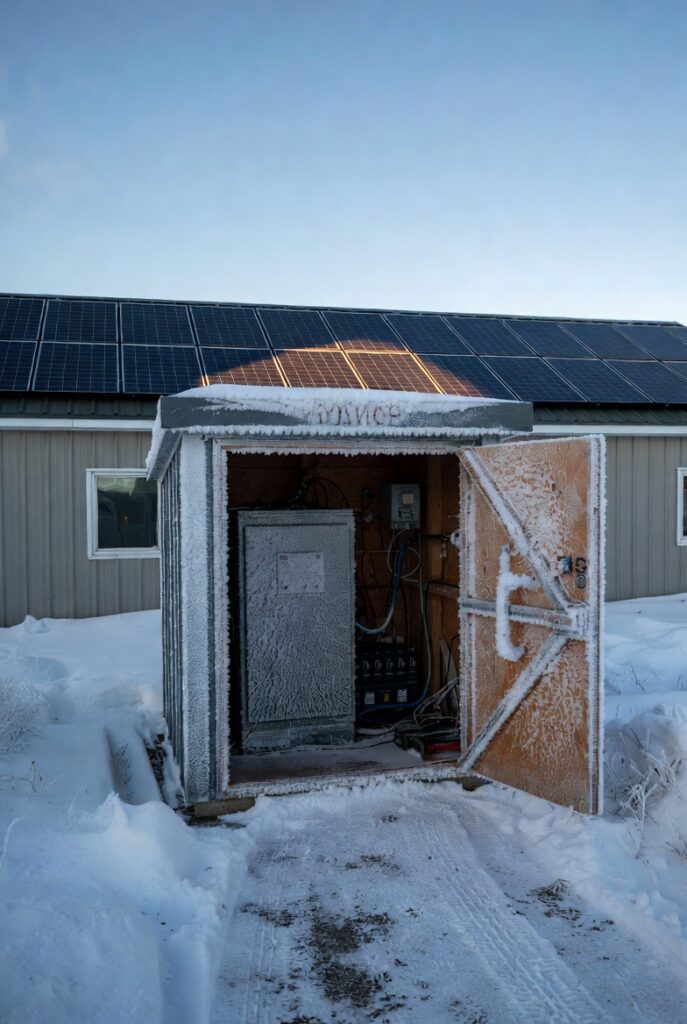
LFP winter charging failures are not solar failures. They are battery management failures that happen on clear sunny January mornings when the panels are producing 280W and the batteries are refusing every watt, and the owner is standing in the utility shed wondering why the MPPT dashboard shows full production and zero charging simultaneously. I was called to review a winter solar failure at a rural property on the 5th Line of Innisfil Township in Simcoe County, Ontario where the owner had installed a 400W solar array, a 200Ah 24V LFP battery bank in an unheated detached utility shed, and a Victron MPPT 100/30 charge controller. The system had produced normally through October. By December the owner was watching the MPPT dashboard show 280W of panel production and zero battery charging simultaneously on clear sunny days. The owner assumed the panels were degrading.
The actual problem was that the battery cells were at minus 14°C at 9 AM while the MPPT enclosure was reading 4°C from solar gain, and the MPPT was attempting to deliver 280W of charging current to cells that could safely accept only 22W at minus 14°C, which is 8% of the rated 280W, before lithium plating began depositing metallic dendrites on the graphite anode surface. The BMS charge inhibit was opening correctly at 0°C cell temperature. However, on days when the MPPT enclosure warmed above 0°C before the battery cells had risen from the overnight minimum, the controller was delivering partial charging current to cells still at minus 7°C for 40 to 80-minute windows every clear morning. Over 11 weeks of this partial below-zero charging the bank had accumulated lithium dendrite deposits on 3 of the 8 cells in the 24V series string, measurable as an internal resistance increase from 8 milliohms per cell to 19 milliohms per cell on the affected cells. The capacity loss was 14% from the dendrite deposits alone. The owner had not noticed because the Cerbo GX SoC display showed normal percentages. The terminal voltage based SoC estimation cannot detect per-cell internal resistance increases until they reach 35 to 40% capacity loss.
I installed a Victron Bat Sense on the battery terminal, reconfigured the MPPT to use Bat Sense cell temperature for charge inhibit rather than controller enclosure temperature, and installed a 60W silicone heater pad on the battery case bottom wired through a BatteryProtect to activate when the Bat Sense reading dropped below 2°C. The heater pad warms the cells from minus 14°C to 5°C in approximately 22 minutes at minus 14°C ambient, consuming 22Wh of stored battery energy before the first solar production window opens. After the Bat Sense installation the MPPT has not delivered a single ampere of charging current to cells below 0°C. In the subsequent winter the 14% capacity loss stabilised, the existing dendrite deposits did not grow and no new deposits formed. The Bat Sense and heater pad installation cost $280. The 14% capacity loss it stopped costing on the $1,400 battery bank represented $196 in permanent battery damage that had been accumulating silently every clear winter morning. For the full system sizing hub that covers the load calculation foundation, the hub covers the numbers.
Why LFP Winter Charging Fails at the Cell Level
When a LFP cell is charged below 0°C the solid-state diffusion coefficient of lithium in graphite drops from 10 to the minus 10 cm² per second at 25°C to 10 to the minus 13 cm² per second at minus 10°C. That is a 1,000-fold reduction in the rate at which lithium ions can migrate from the electrolyte surface into the graphite crystal structure. When charging current arrives faster than lithium can insert into the graphite, excess lithium ions deposit as metallic lithium on the anode surface rather than intercalating into the lattice, forming dendritic crystal structures that grow with each charge cycle. At minus 10°C the safe LFP winter charging current is 8% of the room temperature rated value, meaning a cell rated for 50A at 25°C can safely accept only 4A at minus 10°C before dendrite deposition begins.
Lithium dendrites grow preferentially toward the cathode because the electric field gradient between anode and cathode provides a directional growth vector for the metallic lithium crystal. The polyethylene or polypropylene separator between the anode and cathode is 20 to 25 micrometres thick, approximately one-quarter the diameter of a human hair. A dendrite growing at 0.1 micrometres per charge cycle reaches the separator in 200 to 250 charge cycles at minus 10°C without thermal protection, producing a hard internal short circuit that permanently destroys the cell. The LFP chemistry is more thermally stable than NMC or NCA lithium chemistries. The separator piercing event in an LFP cell typically produces a capacity collapse rather than a fire, but the cell is permanently destroyed and must be replaced.
The ghost charging problem is what the owner in the utility shed actually sees. On a clear January morning in Barrie a 400W solar array produces 280W of real power. The MPPT controller cannot store this power in a battery below 0°C and cannot divert it to a load or back to the grid. The 280W dissipates as heat in the MPPT controller’s internal shunt circuit and the panel string resistance, converting free solar energy to waste heat at the rate of 280W for the 40 to 80 minutes per morning that the battery cells remain below 0°C while the panels produce full output. Over a 90-day Ontario winter with 45 clear mornings this represents 45 × 70 minutes × 280W = 882,000 Wh of wasted solar production. That is 882kWh of free energy that never reached the battery because the cells were 8°C too cold. For the cold weather solar charging Bat Sense installation and heater pad retrofit standard that covers the complete thermal protection hardware installation, Article 244 covers the full specification.
| Temperature | Safe Charging Current | Annual Production Loss |
|---|---|---|
| 25°C – room temperature | 100% of rated value | Zero loss – full harvest |
| 0°C – freezing threshold | BMS charge inhibit opens | 882kWh lost per 90-day winter on 400W array |
| Minus 10°C – deep winter | 8% of rated value – 4A maximum on 50A cell | Dendrite deposition begins on every charge cycle |
The Frozen Engine Analogy and What It Actually Costs
A LFP cell at minus 14°C is not a dead battery. It is a battery whose internal chemistry is running at 0.1% of its normal ion transport rate. Forcing full LFP winter charging current into a cell at minus 14°C is not like trying to start a frozen engine. It is like trying to start a frozen engine while also pouring engine oil into the combustion chamber. The lithium does not just fail to insert. It deposits where it should not be and stays there permanently.
An unheated shed battery bank in Barrie loses approximately 24.5% of available winter solar production to the cold charging problem alone. A 400W array on a 90-day Ontario winter produces approximately 3,600kWh of potential energy. The BMS charge inhibit window of 40 to 80 minutes per clear morning represents 882kWh of that production going to waste heat in the MPPT shunt circuit rather than stored energy in the battery. Add the partial below-zero charging damage accumulating at 1 to 2% capacity loss per week of unprotected winter operation and the total cost of an unheated battery shed over a 5-year system life is 15 to 25% permanent capacity loss plus 882kWh of annual wasted production. For the solar system monitoring VRM winter production deficit tracking standard that covers the same daily production versus consumption tracking through grey-sky winter periods, Article 249 covers the full specification.
The Active vs Passive Heating Decision and the Gazebo Effect
The most energy-efficient LFP winter charging protection is keeping the battery bank in a conditioned space where the ambient temperature never drops below 10°C. My own installation in Rockwood uses an enclosed insulated gazebo with a 200W panel-powered ceramic heater maintaining 12°C overnight. The gazebo maintains the battery cells above 5°C through every Ontario winter including the February 2024 cold snap that dropped the Rockwood overnight ambient to minus 23°C for 11 consecutive nights. At 12°C cell temperature the LFP winter charging acceptance rate is 95% of the room temperature rated value, meaning the MPPT delivers full panel production from the first watt of every morning without any charge inhibit window. The heater consumes approximately 1.2kWh per day in January, totalling 108kWh over a 90-day winter, which is 12.2% of the 882kWh of winter solar production that the heated gazebo recovers by eliminating the cold charging problem entirely. The conditioned space solution costs zero in heater pad hardware and zero in BatteryProtect wiring. It costs 108kWh of heating energy per winter to recover 882kWh of solar production, a 8.2-to-1 energy return on the heating investment that also extends cell cycle life by 40 to 60% compared to a bank cycled at minus 5°C.
For existing installations where moving the battery bank is not practical, a 60W silicone heater pad bonded to the battery case bottom and wired through a BatteryProtect activating at 2°C Bat Sense reading warms a 200Ah 24V LFP bank from minus 14°C to 5°C in 22 minutes, consuming 22Wh of stored energy per morning heating event. At minus 14°C this represents 22Wh consumed to recover 19.6kWh of morning production per event, a 891-to-1 energy return on the heating investment per clear morning. The Battle Born heated LFP factory internal heating element provides the same thermal protection from inside the cell case without any external wiring, warming from minus 40°C to 5°C before the BMS opens the charge gate. For the BMS battery protection shutdown logic and charge inhibit standard that covers the same BMS temperature protection function at the cell level, Article 254 covers the full specification.
The Low-Current Pre-Warm Protocol
Some high-end MPPT controllers including the Victron MPPT series support a temperature-compensated pre-warm charging mode that delivers a low trickle current of 0.5 to 1A to the battery cells before the main charging stage begins, using the resistive heating of the cell’s own internal resistance to warm the cells from the overnight minimum toward the 0°C LFP winter charging threshold. At 1A charging current through a cell with 8 milliohm internal resistance the resistive heating is I²R = 1² × 0.008 = 0.008W per cell, which is insufficient to meaningfully warm a large battery bank in a reasonable time but sufficient to prevent the cell temperature from dropping further during the pre-dawn period. The Victron SmartShunt logging the pre-warm current confirms the protocol is functioning before the main solar production window opens.
The correct LFP winter charging pre-warm architecture combines the Bat Sense cell temperature reading with the heater pad activation circuit and the MPPT temperature-compensated charging mode. The Bat Sense tells the MPPT the actual cell temperature. The MPPT activates the heater pad through the BatteryProtect relay when cell temperature drops below 2°C. The heater pad warms the cells to 5°C, and the MPPT then delivers full solar charging current only after the Bat Sense confirms the cells are above the safe charging threshold. For the solar parasitic load standby current and winter battery draw standard that covers the same winter battery energy management and heater pad consumption tracking principle, Article 252 covers the full specification.
The LFP Winter Charging System: Minimum Viable vs Full Winter Standard
The LFP winter charging decision follows whether the battery bank is in a conditioned space, an unheated shed, or an outdoor enclosure, and whether the installation already has a Bat Sense or is relying on controller enclosure temperature for charge inhibit.
The minimum viable LFP winter charging protection for an existing unheated shed installation includes a Victron Bat Sense bonded to the battery terminal replacing the controller enclosure temperature source for charge inhibit, ensuring the MPPT enforces 0°C inhibit at actual cell temperature rather than enclosure temperature. Capital cost $140. It eliminates the partial below-zero charging window that was accumulating 1 to 2% per week capacity loss from dendrite deposition on every clear winter morning without any other hardware change.
The full LFP winter charging standard for a new build or system with identified cold charging damage includes a Victron Bat Sense bonded to the battery terminal, a 60W silicone heater pad on the battery case bottom wired through a BatteryProtect activating at 2°C, the MPPT configured for temperature-compensated charging using the Bat Sense reading, and a Victron SmartShunt logging the heater activation events and pre-warm current draw for VRM monitoring. Capital cost $280 to $420. It eliminates the 882kWh annual winter production loss, stops dendrite accumulation at its current level, and provides complete temperature-compensated charging protection through any Ontario winter regardless of overnight ambient temperature.
NEC and CEC: What the Codes Say About LFP Winter Charging
NEC 706 governs energy storage systems including temperature management requirements for LFP battery installations. NEC 706.15 requires listed BMS with temperature protection functions including charge inhibit below the minimum safe charging temperature specified by the cell manufacturer. The cell manufacturer’s minimum safe LFP winter charging temperature is 0°C and this limit is a required BMS protective function under NEC 706.15 that cannot be bypassed or overridden to capture additional solar production. The heater pad circuit is a DC load circuit subject to NEC 690 branch circuit requirements for conductor sizing and overcurrent protection. Contact the NFPA for current NEC 706 and NEC 690 requirements applicable to LFP winter charging installations at Ontario residential and rural properties.
In Ontario the LFP winter charging installation is subject to CEC Section 26 for storage battery systems including temperature management requirements for battery installations in unheated enclosures. CEC Section 26 requires that battery installations in locations subject to freezing temperatures include temperature monitoring and charge inhibit capability to prevent charging below the manufacturer’s minimum temperature specification. The heater pad circuit is subject to CEC Section 14 for overcurrent protection and conductor sizing. Contact the Electrical Safety Authority Ontario for the current permit requirements applicable to LFP winter charging and battery temperature management installations at Ontario residential and rural properties before modifying any existing solar battery installation.
Pro Tip: If your battery bank is in an unheated shed and your MPPT shows panel production with zero battery charging on clear winter mornings, check the Bat Sense cell temperature reading before assuming the panels are degrading. I have reviewed installations where the owner had already ordered replacement panels after watching 280W of production and zero charging for three consecutive clear December mornings, and the Bat Sense showed battery cells at minus 11°C while the MPPT enclosure was reading 3°C. The panels were producing correctly. The cells were refusing the charge correctly. The Bat Sense was the missing piece that costs $140 and reveals the 18°C temperature differential between the controller enclosure and the battery cells on every cold clear morning. The replacement panels were cancelled. The Bat Sense was installed. The 882kWh winter harvest was recovered.
The Verdict
A LFP winter charging system built to the winter standard means the Innisfil Township Simcoe County owner never watches 280W of clear January solar production dissipate as heat in the MPPT shunt circuit while the battery cells at minus 14°C refuse every watt, accumulating 14% capacity loss over 11 weeks from dendrite deposits that the Cerbo GX terminal voltage display cannot see until they reach 35% damage, and the Rockwood gazebo installation never loses a single watt of winter solar production because the 12°C conditioned space recovers 882kWh of annual winter harvest at a cost of 108kWh of heating energy.
- Install a Victron Bat Sense on the battery terminal before the first winter of any LFP installation in an unheated Ontario enclosure. The Innisfil Township MPPT was reading 4°C and delivering partial charging current to cells at minus 7°C for 40 to 80 minutes every clear morning. The Bat Sense revealed the 18°C differential. The $140 sensor stopped the 1 to 2% per week capacity loss that had accumulated to 14% permanent damage over 11 weeks. The terminal voltage display cannot see the difference between a healthy cell and a cell with 14% dendrite damage. The Bat Sense can.
- Move the battery bank to a conditioned space before spending money on heater pads if the installation design allows it. The Rockwood gazebo at 12°C recovers 882kWh of winter production at zero heater pad cost and extends cell cycle life by 40 to 60% compared to a bank cycled at minus 5°C. The 108kWh of annual heating energy is 12.2% of the production it recovers. A 60W heater pad is the correct solution when moving the bank is not practical. The conditioned space is always the better solution when it is.
- Never interpret zero battery charging alongside full panel production as a panel failure before checking cell temperature. The Innisfil Township owner had watched 280W of production and zero charging for weeks and concluded the panels were degrading. The panels were functioning correctly. The cells were at minus 14°C and the BMS was protecting them correctly. The diagnosis took 3 minutes with a Bat Sense reading. The panel replacement that was almost ordered would have cost $800 and produced identical results because the cells would still have been at minus 14°C.
In the shop, we do not replace parts when the warning light is on without reading the fault code first. At the off-grid property, we do not replace panels when winter production is low without reading the cell temperature first.
Frequently Asked Questions
Q: Why are my solar panels producing power in winter but my batteries are not charging? A: Your battery cells are most likely below 0°C and the BMS charge inhibit has opened to prevent lithium plating. The MPPT controller may be reading its own enclosure temperature above 0°C from solar gain while the battery cells are still at minus 7°C to minus 14°C from the overnight minimum. Install a Victron Bat Sense bonded to the battery terminal to give the MPPT the actual cell temperature. The 40 to 80-minute morning window where panels produce and batteries refuse is eliminated when the MPPT enforces the charge inhibit at actual cell temperature rather than enclosure temperature.
Q: What is lithium plating and why is it permanent damage? A: Lithium plating occurs when charging current is applied to LFP cells below 0°C faster than the solid-state diffusion coefficient allows lithium ions to insert into the graphite anode lattice. The excess lithium deposits as metallic dendrites on the anode surface rather than intercalating into the lattice. These dendrites grow toward the cathode at 0.1 micrometres per charge cycle and reach the 20 to 25 micrometre separator in 200 to 250 cycles at minus 10°C, producing a permanent internal short circuit. The damage is irreversible because the metallic lithium deposits do not re-insert into the lattice on the next discharge cycle.
Q: Is a self-heating battery worth the extra cost over a standard LFP with a heater pad? A: For new builds in locations where the battery bank cannot be placed in a conditioned space, a self-heating LFP like the Battle Born heated module eliminates all external wiring and BatteryProtect hardware, warming from minus 40°C to 5°C before the BMS opens the charge gate. For existing installations the Victron Bat Sense plus 60W silicone heater pad achieves equivalent results at $280 total hardware cost versus the premium for a self-heating battery module. The conditioned space solution remains the most energy-efficient approach at any system voltage when the installation design allows it.
Questions? Drop them below.
Master Tech Advisory: This build is engineered within the 48V DC Safety Ceiling. Diagnostic logic is based on 20+ years of technical service experience. All structural and electrical installations must be verified by a Licensed Professional and comply with your Local Authority Having Jurisdiction (AHJ).
This post contains affiliate links. If you purchase through our links, we may earn a small commission at no extra cost to you.