
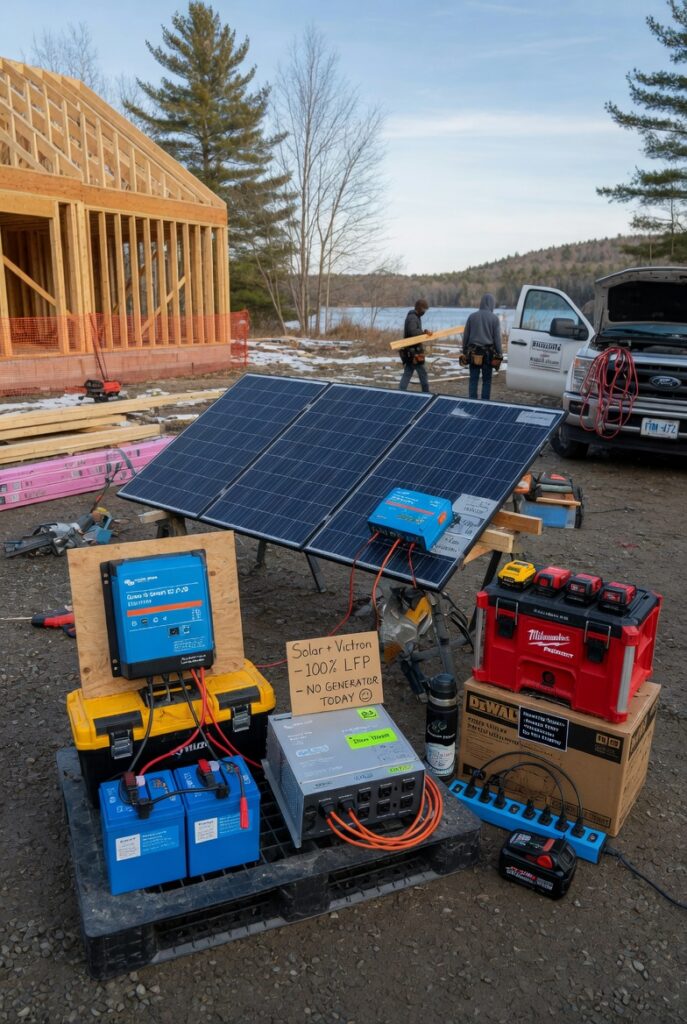
Jobsite solar power failures on a remote Muskoka framing site are not technical failures. They are a $3,000-a-day crew standing around a pile of premium lumber at 7:45 AM because a big-box generator will not start and every tool battery in the charging rack is flashing red. I was asked to review the jobsite power setup for a custom home framing crew working on a 4,800-square-foot timber frame build on a lakefront lot on Peninsula Lake Road near Huntsville in Muskoka District Municipality, Ontario. The site had no temporary power pole. The crew was relying on a 6,500W contractor-grade gasoline generator to run a 6-bay tool battery charging rack, a table saw, and site lighting. The generator had been adequate through the summer.
On a November morning when the overnight temperature had dropped to minus 8°C the generator’s carburetor had ice in the float bowl from condensation during the previous night’s temperature swing. The crew lead spent 47 minutes attempting to start the generator before calling the rental company. The replacement generator arrived at 10:52 AM. By then the 5-person framing crew had been standing on site for 3 hours and 5 minutes producing zero billable work. At $95 per hour per tradesperson the idle labour cost was $1,473. The rental exchange fee was $280. The one-day schedule impact pushed the drywall subcontractor’s start date by one day at a rescheduling cost of $640. Total cost of the frozen carburetor was $2,393 for a single November morning.
I designed a mobile jobsite power system for the Huntsville framing crew built around a 200Ah 12V metal-case LFP battery in a 6mm steel toolbox in the truck bed, a Victron Orion-Tr Smart 12/12 30A isolated DC-DC charger recharging the LFP bank during the 34-kilometre drive from the crew lead’s Huntsville shop to the Peninsula Lake site, and a 1,200W pure sine wave inverter powering the 6-bay charging rack from the LFP bank on site without any generator running. The LFP bank arrives at the site every morning at 94 to 98% SoC from the drive recharge. In 2 subsequent November through March seasons including a morning at minus 17°C the crew has not had a single generator-related work stoppage. The system build cost $1,840. The $2,393 single-event work stoppage cost it eliminates paid for the system on the first prevented event. For the construction site solar fixed generator and site power standard that covers the same jobsite power reliability principle for permanent crane and compactor installations, Article 221 covers the full specification. For the full system sizing hub that covers the load calculation foundation, the hub covers the numbers.
Why Jobsite Solar Power Beats a Generator Before 8 AM
A gasoline generator at minus 8°C fails for the same reason a customer’s car fails to start on a January morning: carburetor icing, battery discharge, or fuel gelling in the float bowl. None of these failures are dramatic. They are all silent and complete and they happen at 7:45 AM when the crew has already driven 34 kilometres to the site. A mobile LFP battery bank charged during the drive arrives at the site at full capacity regardless of ambient temperature and starts delivering tool charging power within 30 seconds of parking.
The Blue Sea 600A disconnect on the LFP battery positive terminal provides a single-switch site-ready isolation that the crew lead opens at the end of the day and closes the next morning before connecting the charging rack, preventing any parasitic drain from the inverter quiescent current overnight. For the construction site solar fixed generator and VFD motor power standard that covers the same jobsite power reliability principle for permanent site installations, Article 221 covers the full specification.
| Power Source | Cold-Start Reliability at Minus 8°C | Crew Ready Time |
|---|---|---|
| Contractor-grade gasoline generator | Carburetor ice, battery discharge, fuel gelling – silent and complete failure | 47 minutes to diagnose + 3 hours for replacement delivery |
| Mobile LFP battery bank | No cold-start failure mode – charged during the drive | 30 seconds from parking to first tool charging bay live |
The Orion-Tr Smart DC-DC Charger and Alternator Protection
Jobsite solar power alternator failures from direct-connected lithium battery charging are the most expensive single-event failure in a mobile tool power system. I reviewed an alternator failure on a 2022 RAM 1500 Tradesman owned by a Parry Sound-based roofing contractor who had installed a 150Ah 12V LFP battery connected to the vehicle charging system through a 120A solenoid isolator. The RAM 1500’s factory Remy 180A alternator had performed normally through the summer. The LFP battery had been running the roofing crew’s tool chargers on site all day and had been drawn down to 11% SoC by 4:30 PM.
When the contractor started the RAM for the drive back to Parry Sound the solenoid closed and the depleted 150Ah LFP battery presented as a near-dead-short load to the alternator at the LFP’s very low internal resistance of 0.003 to 0.006 ohms. The Remy 180A alternator immediately went to full output and ran at thermal limit for 31 continuous minutes on the highway between the jobsite and Parry Sound. The voltage regulator failed from sustained thermal overload 2 days later at a Parry Sound parking lot. The alternator tow and replacement at a RAM dealer cost $2,180 in parts and labour. The roofing crew lost a half-day on site while the contractor waited for the tow truck at $85 per person per hour for a 4-person crew, adding $680 in idle labour. Total alternator failure cost was $2,860.
I replaced the solenoid isolator with a Victron Orion-Tr Smart 12/12 30A isolated DC-DC charger. The Orion-Tr Smart limits its output to 30A regardless of battery state of charge, presenting a maximum 360W demand to the alternator regardless of how deeply the LFP bank has been depleted during the site day. In 18 months since the installation including full framing and roofing seasons with daily full LFP discharge and drive recharge cycles the RAM alternator has remained at normal operating temperature throughout every drive home. The Orion-Tr Smart cost $340. The $2,860 alternator and labour cost it prevents paid for it more than 8 times over on the first prevented event. The isolated DC-DC architecture also prevents the LFP cell balancing current from circulating through the truck chassis ground on salted Muskoka winter roads, eliminating the galvanic corrosion mechanism at frame penetrations and suspension brackets through the full 6-month winter salting season. For the overland solar power Orion-Tr Smart isolated DC-DC and chassis corrosion prevention standard that covers the same galvanic isolation principle for winter road vehicles, Article 233 covers the full specification.
The Pure Sine Wave Inverter and Tool Charger Circuit Board Protection
A modern 18V, 20V, or 40V tool battery charger manufactured after 2018 uses an active power factor correction circuit on its input stage that is designed for a pure sine wave supply. A modified sine wave inverter produces 18 to 25% THD that creates harmonic losses in the PFC switching transistors at 15 to 35% above rated current draw, heating the transistors and reducing the charger board life from a rated 5,000 charge cycles to 800 to 1,200 cycles before failure. As a result a $220 Milwaukee charger on a modified sine wave inverter fails after 1,200 cycles at a cost of $0.18 per cycle versus $0.044 per cycle on a pure sine wave supply, a 4x operating cost difference from a single inverter selection decision.
A 1,200W pure sine wave inverter powering a 6-bay tool charging rack produces less than 2% THD at full rack load, keeping every charger’s PFC board within its thermal design specification through a full 5,000-cycle service life. For the home medical solar pure sine wave inverter and harmonic heating standard that covers the same modified sine wave PCB destruction mechanism for sensitive electronics, Article 236 covers the full specification.
The Per-Circuit Fuse Block and SmartShunt SoC Monitoring
A dedicated per-circuit fuse block with one fuse per tool charger bay limits the fault current from a defective battery pack to the fused capacity of that single circuit. As a result when one battery pack develops an internal short the remaining 5 bays continue charging normally and the blown fuse identifies the faulty pack within 30 seconds without testing every pack on the rack individually. A shared circuit without individual bay fuses would trip the inverter’s overcurrent protection and shut down every charger simultaneously, forcing the crew lead to diagnose the faulty pack by reinserting one bay at a time into a live circuit.
The Victron SmartShunt monitors the LFP bank SoC and transmits real-time data to the crew lead’s phone via Bluetooth without cellular service, showing exactly how many amp-hours remain and calculating the estimated tool cycle count before the bank needs recharging from the drive home. As a result the crew lead can tell at 2 PM whether the bank has enough capacity for the final afternoon charge cycle or whether it is worth running the truck for 20 minutes to add 10Ah from the alternator before the last push. For the remote telecom solar SmartShunt Bluetooth SoC monitoring standard that covers the same real-time battery monitoring principle for unmanned critical power systems, Article 232 covers the full specification.
The Jobsite Solar Power System: Minimum Viable vs Full Tradesman Standard
The decision follows whether the crew is 2 to 3 people with a small charging rack or 4 to 6 people with a full charging rack plus table saw and site lighting.
The minimum viable jobsite solar power system for a 2 to 3-person crew with a single 4-bay tool charging rack includes a Victron Orion-Tr Smart 12/12 30A isolated DC-DC charger, a 100Ah 12V metal-case LFP battery, a 600W pure sine wave inverter, and a 4-circuit fuse block. Capital cost runs $1,200 to $1,800. It provides 4 to 6 hours of simultaneous tool charging on site with full LFP recharge during the drive from shop to site and no generator required.
The full tradesman standard for a 4 to 6-person framing or roofing crew with a 6-bay charging rack, table saw, and site lighting includes a Victron Orion-Tr Smart 12/12 30A isolated DC-DC charger, a 200Ah 12V metal-case LFP bank, a 1,200W pure sine wave inverter, a 6-circuit fuse block, and a Victron SmartShunt with Bluetooth SoC monitoring. Capital cost runs $1,840 to $2,600. It provides a full 8-hour tool charging day on site, silent operation in the enclosed site trailer, and SoC visibility so the crew lead knows the remaining tool cycle count before the afternoon drive back to shop.
NEC and CEC: What the Codes Say About Jobsite Solar Power
NEC 590 governs temporary wiring installations on construction sites including mobile power systems used as the primary electrical supply before permanent service is installed. A jobsite solar power system providing AC power to tool chargers, lighting, and small power tools on a construction site is subject to NEC 590 requirements for overcurrent protection, GFCI protection on all 120V single-phase 15 and 20A circuits, and grounding of the inverter output neutral. The pure sine wave inverter neutral-to-ground bond must comply with NEC 590.6 for personnel protection at construction sites. Contact the NFPA for current NEC 590 requirements applicable to mobile power systems used as temporary construction power in Ontario and across North America.
In Ontario, a mobile jobsite power system used on a construction site is subject to the Occupational Health and Safety Act and Ontario Regulation 213/91 Construction Projects for electrical safety requirements including GFCI protection on all portable electrical equipment. The vehicle-mounted DC power system is additionally subject to CEC Section 10 for grounding and bonding of the vehicle chassis and inverter output neutral. Contact the Electrical Safety Authority Ontario for the current requirements applicable to mobile inverter-based power systems used as temporary construction power at Ontario building sites before commissioning any jobsite solar power system at a worksite subject to Ministry of Labour inspection.
Pro Tip: Before driving to any remote Muskoka or Parry Sound jobsite in November, check the LFP bank SoC on the SmartShunt app before you leave the yard. I have arrived at a Peninsula Lake site at 7:30 AM to find the LFP bank at 34% SoC because the previous crew lead had left the inverter switched on in the site trailer overnight drawing 18W of quiescent current through a 14-hour Muskoka night. At 18W overnight the 200Ah bank loses 252Wh, about 12.6% of capacity, before the morning drive recharge adds it back. One switch flip before leaving the site saves the next morning’s first two hours of charging capacity. Check the app at the yard gate, not at the site. If the SoC is below 60%, run the truck for 20 minutes before you leave.
The Verdict
A jobsite solar power system built to the tradesman standard means the Huntsville Peninsula Lake framing crew never stands around a pile of premium lumber for 3 hours and 5 minutes at minus 8°C because a frozen carburetor cost $2,393 in idle labour and a pushed drywall schedule, and the Parry Sound RAM 1500 never gets towed from a parking lot because a depleted 150Ah LFP bank through a solenoid isolator ran a Remy alternator at thermal limit for 31 minutes on the highway home.
- Replace every contractor-grade generator at every remote Muskoka and Parry Sound jobsite with a mobile LFP battery bank before November. The Huntsville carburetor failure cost $2,393 in idle labour and subcontractor rescheduling for a problem that costs nothing to prevent. The LFP bank charges during the drive, starts in 30 seconds, and produces zero exhaust in the site trailer. The generator that will not start at minus 8°C costs more in one morning than the system build cost.
- Replace every solenoid isolator connecting a lithium battery to a truck alternator with a Victron Orion-Tr Smart isolated DC-DC charger before the first full-depletion site day. The Parry Sound RAM ran at thermal limit for 31 minutes from a 11% SoC LFP bank through a 120A solenoid and failed 2 days later at a cost of $2,860. The Orion-Tr Smart limits alternator demand to 30A regardless of depletion state. It cost $340. The alternator it protects cost $2,180 to replace.
- Specify a pure sine wave inverter for every tool charging rack before commissioning any mobile jobsite power system. A modified sine wave inverter reduces a $220 Milwaukee charger from 5,000 cycles to 1,200 cycles at a 4x cost premium per charge cycle. The inverter upgrade costs less than one replacement charger board. Specify pure sine wave at the build. Not after the first charger fails.
In the shop, we do not let a crew stand around while a piece of equipment is diagnosed on the clock. At the jobsite, we do not let a frozen carburetor decide whether $1,473 of labour is productive before 10 AM.
Frequently Asked Questions
Q: Why does a generator fail on a cold Muskoka November morning when it ran fine all summer? A: Gasoline generators are vulnerable to carburetor icing, battery self-discharge, and fuel gelling at temperatures below minus 5°C. The carburetor float bowl accumulates condensation during overnight temperature swings and ice can form in the fuel passages before the engine warms up. A mobile LFP battery bank charged during the drive to site has no cold-start failure mode and delivers full power within 30 seconds of arrival regardless of overnight temperature.
Q: Why does a solenoid isolator destroy a truck alternator when the LFP battery is depleted? A: A depleted LFP battery has very low internal resistance of 0.003 to 0.006 ohms. When a solenoid connects a depleted LFP directly to the alternator the battery presents a near-dead-short demand that forces the alternator to full output immediately. The alternator enters thermal overload within minutes and the voltage regulator fails from sustained heat. A Victron Orion-Tr Smart DC-DC charger limits charging current to 30A regardless of battery state, protecting the alternator from inrush at any depletion level.
Q: Why does a pure sine wave inverter protect tool charger circuit boards that a modified sine wave inverter destroys? A: Modern tool chargers use active power factor correction circuits designed for pure sine wave input. A modified sine wave inverter produces 18 to 25% THD that creates harmonic losses in the PFC switching transistors at 15 to 35% above rated current, heating the transistors and reducing charger life from 5,000 cycles to 800 to 1,200 cycles before failure. A pure sine wave inverter produces less than 2% THD and keeps the PFC board within its thermal specification through a full 5,000-cycle service life.
Questions? Drop them below.
Master Tech Advisory: This build is engineered within the 48V DC Safety Ceiling. Diagnostic logic is based on 20+ years of technical service experience. All structural and electrical installations must be verified by a Licensed Professional and comply with your Local Authority Having Jurisdiction (AHJ).
This post contains affiliate links. If you purchase through our links, we may earn a small commission at no extra cost to you.