
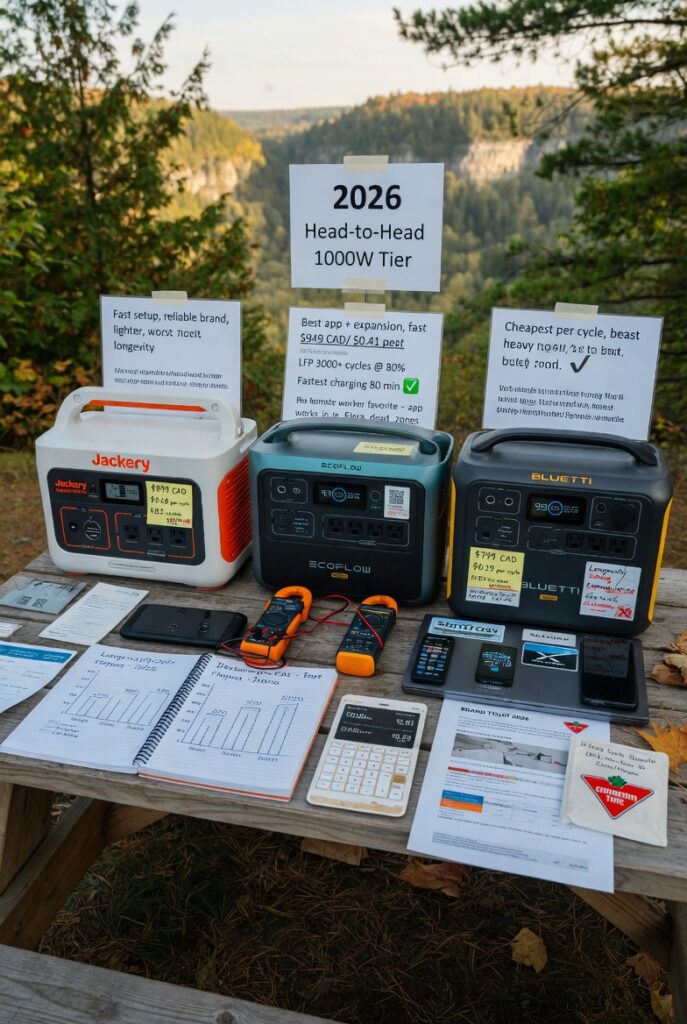
A jackery vs ecoflow buyer in 2026 walks into the conversation already half decided. He has a brother-in-law with a Jackery that has worked flawlessly for 4 years, a coworker who swears by his EcoFlow DELTA 2, and a Reddit thread that told him Bluetti is the value pick. He is asking one honest question: Is brand reputation alone worth paying more per cycle than the math says I should?
I was asked to evaluate the 1000W tier head-to-head for a homeowner in Fergus, Ontario who had a $500 Canadian budget and a brother-in-law who had owned the same Jackery Explorer 1000 NMC original since 2022 with zero failures. I drove out to his property on a Saturday morning with my laptop and my Kill A Watt meter, and we sat at his kitchen table to walk through the actual numbers.
His critical load was modest: a fridge for outage backup, a Starlink Standard kit, two phone chargers, and a CPAP for his wife. Total daily watt-hour need came to approximately 600Wh, which any of the 3 units in this tier could handle on a single charge for a full 24 hours. The capacity question was effectively neutral. The real question was which brand delivered the lowest cost of ownership over the next 10 years if he cycled the unit every weekend for camping plus 6 to 10 outage events per year.
The math made the decision uncomfortable for him. The Jackery Explorer 1000 v2 at $359 on sale with 4000 cycles to 80% delivered a cost per cycle of $0.090. The Bluetti AC180 at $399 on sale with 3500 cycles to 80% delivered $0.114 per cycle. The EcoFlow DELTA 2 at $599 on sale with 3000 cycles to 80% delivered $0.200 per cycle, more than double the Jackery. His brother-in-law’s brand trust matched what the math said was the right pick. The Jackery won on both initial price and long-term cycle economics.
He ordered the Jackery Explorer 1000 v2 at $359 plus tax from his kitchen table while I was still standing in his driveway. For the broader buyer math on this entire product class, see the 1000w solar generator standard comparison.
Why the 2026 Jackery vs EcoFlow Decision Comes Down to Cycle Count
The 2026 jackery vs ecoflow decision at the 1000W tier is not really about capacity or surge ceiling. All 3 units in this comparison deliver 1024Wh to 1152Wh of LFP capacity, 1500W to 1800W continuous AC output, and 2700W to 3000W surge. The capacity differences are within 12 percent across the tier.
The real differentiator is cycle count.
As a result, the jackery vs ecoflow buyer who runs the numbers honestly discovers that the unit they buy at $359 versus $599 is the same unit on every spec except total usable cycles before degradation. For a deeper look at the underlying battery science, the LiFePO4 vs lithium ion vs AGM breakdown covers the chemistry context. For the 4-unit comparison at this same tier with Anker added, see the 1000w solar generator standard.
The Cycle Count Reality Most Reviews Skip
The cycle count specification difference between the 3 brands is the single most important number for long-term cost of ownership, and almost no review site walks the math openly. Jackery publishes 4000 cycles to 80 percent on the Explorer 1000 v2.
Bluetti publishes 3500 cycles to 80 percent on the AC180. The EcoFlow DELTA 2 publishes 3000 cycles to 80 percent. The 1000 cycle difference between Jackery and EcoFlow is approximately 33 percent more usable life on the same unit.
For a high cycle count user, that translates to 3 to 4 additional years of service before noticeable degradation. For a comparison of cycle count behavior across different chemistries, see the battery chemistry guide.
The Elora High-Cycle Use Case
A jackery vs ecoflow comparison gets more interesting when the buyer cycles the unit hard rather than occasionally. I was asked to evaluate the same 3 units for a remote worker east of Elora, Ontario who ran his Starlink, his laptop, and his dual monitor setup off a portable power station 4 to 5 days per week during shoulder season power outages and weekend cottage trips. His annual cycle count was approximately 250 to 300 cycles per year, which is 2 to 3 times the typical recreational user.
His original Jackery Explorer 240 had served him faithfully for 6 years and had cycled approximately 1800 times before the battery showed noticeable capacity degradation. I worked through the 10-year cost of ownership math with him on a Sunday afternoon at his property. At 275 cycles per year, the 4000 cycle Jackery Explorer 1000 v2 would deliver approximately 14.5 years of usable life before hitting 80% capacity.
The 3500 cycle Bluetti AC180 would deliver approximately 12.7 years. The 3000 cycle EcoFlow DELTA 2 would deliver approximately 10.9 years. For his use case, the Jackery again came out ahead on absolute longevity, but the Bluetti AC180 had a meaningful advantage on charging speed at 45 minutes to 80 percent versus 60 minutes for the Jackery.
The fix for him was the Bluetti AC180 at $399 because the 45-minute fast charge mattered more for his daily workflow than the slightly longer cycle life of the Jackery. He needed the unit recharged and ready for the next outage cycle as fast as possible during morning solar windows. His cost per cycle worked out to $0.114 over the 10-year horizon, only $0.024 higher per cycle than the Jackery, which translated to approximately $66 more in cycle cost over the full 10 years.
That $66 was worth the 15-minute charging time savings on every cycle. He bought the Bluetti AC180 at $399 plus tax. For the inverter idle draw principle that compounds at high cycle count, see the inverter idle draw guide.
The Jackery vs EcoFlow Cost Per Cycle Diagnostic
The 2026 jackery vs ecoflow cost per cycle breakdown across the 3 units in this 1000W tier looks like this:
| Unit | Sale Price | Capacity | Cycle Life | Cost per Cycle |
|---|---|---|---|---|
| Jackery Explorer 1000 v2 | $359 | 1070Wh | 4000 cycles | $0.090 |
| Bluetti AC180 | $399 | 1152Wh | 3500 cycles | $0.114 |
| EcoFlow DELTA 2 | $599 | 1024Wh | 3000 cycles | $0.200 |
The Jackery Explorer 1000 v2 at $359 on sale delivers the lowest cost per cycle in the tier at $0.090, which is less than half the EcoFlow DELTA 2 at $0.200. The Bluetti AC180 at $399 sits in the middle at $0.114, only $0.024 higher per cycle than the Jackery.
The EcoFlow DELTA 2 at $599 is the most expensive unit in the tier on every economic metric: highest sale price, lowest cycle count, and highest cost per cycle. As a result, the Jackery and Bluetti are the value picks at this price point, and the EcoFlow carries a brand premium of approximately 67 percent on initial price and 122 percent on cost per cycle compared to the Jackery.
The X-Stream Charging Speed vs Fast Charge Standard
The X-Stream charging speed advantage on the EcoFlow DELTA 2 is real but is offset by the Bluetti AC180’s 45-minute fast charge spec. Both units beat the Jackery Explorer 1000 v2 at 60 minutes.
The X-Stream tech delivers 80 percent in 50 minutes on the DELTA 2. The Bluetti AC180 delivers 80 percent in 45 minutes. The Jackery Explorer 1000 v2 delivers 100 percent in 60 minutes.
For most buyers, all 3 are fast enough that the difference does not matter. For the high cycle count remote worker who needs the unit ready for the next morning, the 15-minute difference between the Bluetti and the Jackery is the deciding factor that justifies the higher cost per cycle.
The Expansion Battery Architecture That Determines Future Cost
The expansion battery architecture on the 3 units in this tier is genuinely different and matters for buyers who anticipate growing their setup later. The Jackery Explorer 1000 v2 does not currently support expansion batteries.
The EcoFlow DELTA 2 expands to 3072Wh with 1 DELTA Max Smart Extra Battery or 2 DELTA 2 Smart Extra Batteries. The Bluetti AC180 does not support expansion batteries either.
As a result, the EcoFlow is the only one of the 3 brands at this tier that lets a buyer start small and add capacity later without buying a second power station. For buyers who are uncertain about future capacity needs, that flexibility is worth real money even at the higher cost per cycle.
Brand Reliability and Canadian Customer Support
All 3 units in this tier carry 5-year warranties after registration. Jackery, EcoFlow, and Bluetti all include 5 years standard on the LFP cells and the protection circuitry. In practice, the Jackery Canadian customer support reputation is the strongest in the category, with warranty claims processed reliably and replacement units shipped without argument.
EcoFlow ranks second in Canadian support reputation with strong direct-to-consumer service through their Canadian fulfillment channels. Bluetti relies more heavily on Amazon return policies for defective unit handling rather than direct manufacturer support, which is the weakest customer service position of the 3 brands. For a first-time buyer who values warranty service over raw cost per cycle, the Jackery is also the safe choice on the customer support axis, which makes the brand trust narrative match the math.
Choosing Your Jackery vs EcoFlow Winner by Use Case Profile
The jackery vs ecoflow decision follows whether the use case is occasional outage backup with weekend camping, high cycle count daily use, or future expansion plans.
For occasional outage backup totaling under 100 cycles per year, the Jackery Explorer 1000 v2 at $359 on sale delivers the lowest initial price and the lowest cost per cycle in the tier. The Fergus homeowner bought this exact configuration after his brother-in-law’s brand trust matched the math.
For high cycle count daily use of 250 to 300 cycles per year, the Bluetti AC180 at $399 on sale delivers the fastest 80 percent recharge in the tier at 45 minutes. The Elora remote worker bought this configuration because the 15-minute charging time savings on every cycle was worth the $66 higher cycle cost over 10 years.
For buyers who anticipate adding expansion battery capacity later, the EcoFlow DELTA 2 at $599 on sale is the only unit in the tier that supports modular expansion to 3072Wh. The expansion flexibility is worth the higher initial cost and higher cost per cycle if the buyer is uncertain about their future capacity needs.
Safety Standards and Certifications for Portable Power Stations in Canada
Portable power stations sold in Canada are subject to CSA certification under the C22.2 No. 107.1 standard for general use power supplies and the C22.2 No. 107.3 standard for inverter products. All 3 units in this tier carry CSA marking on the bottom plate confirming compliance with the relevant Canadian electrical safety standards.
The internal battery management systems on all 3 units protect against overcurrent, overvoltage, undervoltage, overtemperature, and short circuit conditions per the UL 2743 standard for portable power packs. For the current Canadian electrical safety requirements applicable to portable power stations, the Electrical Safety Authority of Ontario maintains the authoritative reference.
Pro Tip: Before buying any unit in the jackery vs ecoflow comparison, walk your annual cycle count math honestly. Most buyers underestimate how often they will actually cycle the unit and over-prioritize the surge ceiling or the capacity number. The Fergus homeowner cycles his unit approximately 60 to 80 times per year, and the Jackery wins on both initial price and cost per cycle. The Elora remote worker cycles his unit 250 to 300 times per year, and the Bluetti AC180 wins because the 45-minute fast charge matters more than the slightly longer Jackery cycle life. Match the unit to your real cycle profile, not the spec sheet number that looks biggest. Most jackery vs ecoflow comparison articles skip this math entirely, which is why most buyers end up paying more per cycle than they should.
The Verdict
- The Jackery vs EcoFlow Verdict for Occasional Outage Backup. The Fergus homeowner bought the Jackery Explorer 1000 v2 at $359 on sale because the cost per cycle math at $0.090 was less than half the EcoFlow DELTA 2 at $0.200, and the brother-in-law’s brand trust matched what the numbers said was the right pick. He ordered the Jackery from his kitchen table while I was still standing in his driveway. For a buyer cycling under 100 times per year with a $500 budget and a fridge plus Starlink critical load, the Jackery is the right answer on both axes.
- The High Cycle Count Use Case Demands the Fast Charge Spec. The Elora remote worker bought the Bluetti AC180 at $399 because his 250 to 300 cycle per year workflow needed the unit recharged and ready for the next morning faster than the 60-minute Jackery could deliver. The 45-minute Bluetti fast charge saved him 15 minutes per cycle, which mattered more than the $66 higher cycle cost over the full 10-year horizon. For high cycle count users, the charging speed differential is the deciding spec.
- Match the Unit to Your Real Cycle Profile, Not the Brand Reputation. Every buyer at this price point should walk their annual cycle count math before opening any product page. The Fergus homeowner cycles 60 to 80 times per year, and the Jackery wins. The Elora remote worker cycles 250 to 300 times per year, and the Bluetti wins. Both bought different units for different reasons, and both bought the right unit for their actual use profile. Brand reputation is real, but it should match the math, not override it.
Frequently Asked Questions
Q: In the jackery vs ecoflow comparison at the 1000W tier, which unit actually delivers the lowest cost per cycle over a 10-year ownership horizon?
A: The Jackery Explorer 1000 v2 at $359 on sale delivers the lowest cost per cycle at $0.090, which is less than half the EcoFlow DELTA 2 at $0.200. This is driven by both the lower initial price ($359 vs $599) and the higher cycle count (4000 cycles vs 3000 cycles to 80 percent capacity). Over a 10-year horizon at 100 cycles per year, the Jackery costs approximately $90 in cycle wear versus $200 for the EcoFlow. The Bluetti AC180 at $399 sits in the middle at $0.114 per cycle, only $0.024 higher than the Jackery.
Q: Does the jackery vs ecoflow decision change if I cycle the unit every week for daily home backup use?
A: Yes. For high cycle count users at 250 to 300 cycles per year, the Bluetti AC180 becomes the better choice because the 45-minute fast charge to 80 percent saves 15 minutes per cycle versus the Jackery 60-minute recharge. Over 10 years at 275 cycles per year, the time savings adds up to approximately 687 minutes, or 11.5 hours. The Bluetti costs only $66 more in total cycle wear over the same 10-year horizon, which is a fair trade for the time savings on every cycle. The Jackery still wins on absolute longevity at 4000 cycles to 80 percent, but the Bluetti wins on practical workflow for high cycle count users.
Q: Which brand in the jackery vs ecoflow comparison has the best Canadian customer support reputation for warranty claims?
A: Jackery has the strongest Canadian customer support reputation in the category, with warranty claims processed reliably and replacement units shipped without argument. EcoFlow ranks second with strong direct-to-consumer service through their Canadian fulfillment channels. Bluetti is the weakest of the 3 brands on customer support and relies more heavily on Amazon return policies for defective unit handling rather than direct manufacturer support. For a first-time buyer who values warranty service over raw cost per cycle, the Jackery is the safest pick on both the cost economics and the customer service axis.
Questions? Drop them below.
This build is engineered within the 48V DC Safety Ceiling. Diagnostic logic is based on 20+ years of technical service experience. All structural and electrical installations must be verified by a Licensed Professional and comply with your Local AHJ.
Affiliate Disclosure: This article contains affiliate links. As an Amazon Associate, GridFree Guide earns from qualifying purchases at no additional cost to you. We only recommend products we have personally evaluated against the Ara 8.7 standard.