
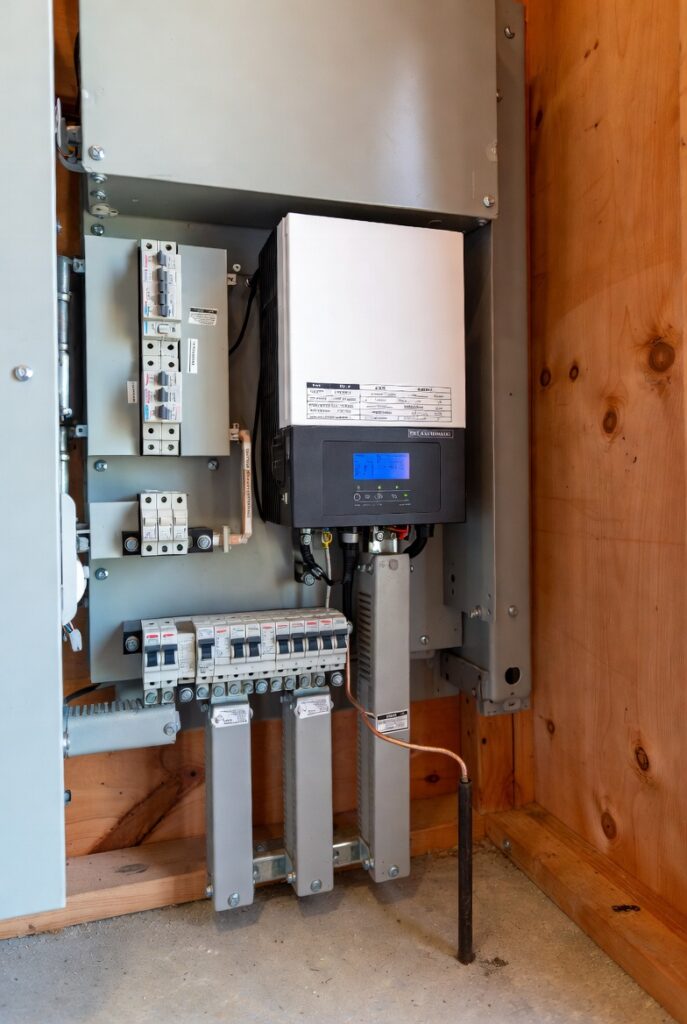
Inverter grounding is not about connecting a wire to a rod and calling it done. It is the moment you realize your metal appliances can become energized at 60V because your inverter never established a neutral-to-ground bond. I helped a property owner near Bancroft in Hastings County, Ontario diagnose a shocking problem in summer 2025. He reported a tingle every time he touched his stainless steel sink while standing barefoot on the cabin floor. His wife felt the same tingle on the metal handle of their chest freezer. They assumed it was static electricity from the dry cabin air.
I measured voltage between the sink and the floor with a multimeter. The reading was 63V AC. His chest freezer handle measured 58V to ground. His inverter was producing clean 120V AC power, but the neutral conductor was floating with no reference to ground. In a grid-connected home, the utility transformer bonds neutral to ground at the service entrance. His off-grid inverter was supposed to create that bond internally. The ground relay setting was disabled by default. His system had operated for 14 months with a floating neutral. Every metal appliance chassis carried half the line voltage to ground. His family had been receiving 60V shocks that felt like static but were actually fault current.
I enabled the internal ground relay in his Victron MultiPlus-II through the configuration software. The inverter now creates a neutral-to-ground bond automatically when inverting. The sink voltage dropped from 63V to 0.2V. The freezer handle dropped from 58V to 0.1V. The tingle disappeared completely. The fix took 10 minutes and cost nothing except the knowledge that the setting existed. His inverter grounding had been misconfigured since installation day. For 14 months, his breakers would not have tripped on a ground fault because there was no complete fault path. The shock hazard was real. The fire hazard was worse. For the equipment bonding that completes the safety circuit, The Off-Grid Grounding Standard covers the full specification.
Why Inverter Grounding Creates Your Service Entrance Bond
Inverter grounding establishes the safety reference that makes fault protection work. In a grid-connected home, the utility transformer bonds neutral to ground at the service entrance. This bond creates the return path for fault current that trips breakers. When your off-grid inverter becomes the power source, it must create that same bond.
Without it, fault current has no return path. Breakers cannot detect the fault. The fault continues until something burns or someone gets hurt. The Bancroft owner’s family lived with this hazard for 14 months without knowing it existed.
The inverter grounding bond is not optional. It is the foundation of electrical safety for every AC circuit your inverter powers. Every outlet, every light, every appliance depends on this bond to ensure breakers trip when faults occur.
The Floating Neutral Problem: When Metal Becomes Energized
A floating neutral means the neutral conductor has no reference to ground potential. In a 120V system, the hot conductor sits at 120V above ground. The neutral conductor should sit at 0V relative to ground. Without a ground bond, the neutral floats to whatever potential balances the connected loads.
With unbalanced loads, the neutral can float to 60V or higher above ground. Every metal appliance chassis connected to neutral through its internal filter capacitors becomes energized at this floating potential. The voltage is real. The shock hazard is immediate.
The Bancroft owner’s 63V sink was the result of this floating neutral. His appliances were working correctly. His inverter grounding was not. The appliances did exactly what they were designed to do. The missing N-G bond made them dangerous.
The Inverter Grounding Configuration: Enabling the Ground Relay
The inverter grounding configuration centers on the internal ground relay. A Victron MultiPlus-II includes this relay as standard equipment. The relay is a physical switch that connects neutral to ground inside the inverter chassis. When enabled, the relay closes whenever the inverter is producing power from batteries. The N-G bond exists.
When external AC is detected from generator or shore power, the relay opens automatically. The internal bond breaks. The external source’s bond takes over as the single reference point. This automatic switching maintains exactly one N-G bond regardless of which power source is active.
The relay setting must be enabled in the configuration software. Many inverters ship with this setting disabled by default. The Bancroft owner’s inverter had the relay disabled from the factory. His installer never changed it. The 10-minute configuration fix eliminated 14 months of accumulated shock hazard.
The Switched Neutral Protocol: Automatic Bond Management
The switched neutral protocol solves the multi-source problem automatically. When inverting from batteries, the inverter relay closes and creates the N-G bond. When external AC appears from generator or shore power, the inverter relay opens before switching to passthrough mode. The external source’s bond becomes the active reference.
When external AC disappears, the inverter relay closes before switching back to inverting. The bond transfers cleanly between sources. No double-bond moment exists during the transition. No floating neutral moment exists either. The protection is continuous.
The Victron MultiPlus-II handles this sequence in milliseconds. The transition is seamless to connected loads. A Victron Cerbo GX confirms ground relay status and logs switching events for verification. The logged data proves the system is maintaining proper inverter grounding through every power source transition.
Generator Connection: Preventing the Double Bond
I was troubleshooting a GFCI trip problem at a cabin near Haliburton in the Kawartha Highlands, Ontario in fall 2025. The owner had a properly configured inverter grounding setup that worked perfectly on solar power. However, every time he started his backup generator and the inverter switched to passthrough mode, every GFCI outlet in the cabin tripped instantly. He could reset them only after disconnecting the generator. He assumed the generator was faulty and had it tested twice. The generator passed all tests.
I traced the problem to a double neutral-ground bond. His inverter created an N-G bond when inverting. His generator also created an N-G bond at its output panel. When the inverter switched to passthrough, both bonds were active simultaneously. Current flowed through both the neutral conductor and the ground conductor. The GFCI outlets detected the current imbalance and tripped immediately. The protection was working correctly. The inverter grounding configuration was wrong for generator backup operation.
I reconfigured his inverter to disable the internal ground relay when external AC was detected. The inverter now senses generator input and opens its ground relay, allowing the generator’s bond to be the single point of reference. The GFCI trips stopped immediately. The generator bond becomes active. The inverter bond deactivates. Only one N-G bond exists at any time. The reconfiguration took 15 minutes through the Victron software. His inverter grounding now handles the automatic switchover correctly. ESA Bulletin 64-8-2 requires exactly one N-G bond in a system. Two bonds create the current path that trips GFCIs and confuses fault protection. For Ontario electrical standards, reference ESA.
Equipment Bonding: Every Metal Chassis on the Same Path
Every metal component in your system must bond to the grounding electrode through a continuous conductor. The inverter chassis, battery enclosure, charge controller housing, panel mounting rails, combiner box, and distribution panel all require bonding. The bonding conductor is typically #6 AWG bare or green-insulated copper.
All bonding conductors connect to a common busbar or terminal that connects to the grounding electrode. A Blue Sea fuse block provides a central bonding point when configured for equipment grounding. The continuous bond ensures all metal components sit at the same electrical potential.
No voltage difference between components means no shock hazard when touching two metal parts simultaneously. Equipment bonding completes the circuit that inverter grounding starts. The N-G bond at the inverter and the equipment bonding throughout the system work together to create the complete safety path.
Inverter Grounding Verification: The Click Test and Multimeter Check
The inverter grounding verification takes 60 seconds with two simple tests. First, the click test: with the inverter in passthrough mode on generator or shore power, disconnect the external AC and listen for the relay click as the inverter takes over. The click confirms the ground relay is engaging. No click means the relay is disabled or has failed.
Second, the multimeter test: measure voltage between the neutral slot and ground slot at any outlet. The reading should be 0V to 0.5V. A reading above 2V indicates a connection problem. A reading of 60V or higher indicates a floating neutral with no N-G bond. The Bancroft owner’s 63V reading immediately identified the floating neutral problem.
These tests confirm your inverter grounding is protecting your family. Run them after any configuration change. Run them annually as part of system maintenance. The 60 seconds of testing can identify hazards before they cause harm.
Minimum Viable vs Full Standard: Choosing Your Configuration Level
The inverter grounding approach offers two configuration levels depending on your power sources and backup plans. The minimum viable level covers solar and battery operation only. The full standard handles all sources including generator backup.
| Configuration Level | Components | Cost | Protection Scope |
|---|---|---|---|
| Minimum Viable | Ground relay enabled + chassis bond | $0-$50 | Solar/battery only |
| Full Standard | Auto switchover + full equipment bonding + verification | $100-$200 | All sources including generator |
The minimum viable inverter grounding includes enabling the internal ground relay and connecting the inverter chassis to the grounding electrode. Cost runs $0 to $50 if grounding wire is needed. It establishes the N-G bond required for breaker protection on faults. It does not include automatic switchover for generator or shore power connection.
The full inverter grounding standard includes properly configured ground relay with automatic switchover, equipment bonding of all metal components with #6 AWG, dedicated grounding electrode, and verified single-bond operation in all modes. Cost runs $100 to $200. It maintains exactly one N-G bond regardless of power source. Both approaches provide basic fault protection. The difference is whether the system handles multiple power sources correctly. For the expandable system that may add generator backup later, The Expandable Solar System Standard covers future-proofing. For the battery room layout that affects equipment bonding distances, The Battery Room Ventilation Standard covers enclosure design.
Frequently Asked Questions
Q: Why does my inverter grounding matter if I have a grounding rod?
A: The grounding rod provides a path to earth for lightning and static discharge. Inverter grounding creates the neutral-to-ground bond that allows breakers to trip on faults. Without the N-G bond, your breakers cannot detect ground faults because there is no return path for fault current. The grounding rod and the N-G bond work together. Neither replaces the other. Both are required for complete protection.
Q: How do I know if my inverter grounding is configured correctly?
A: Two quick tests verify inverter grounding configuration. First, listen for the relay click when the inverter switches from passthrough to inverting mode. The click confirms the ground relay is engaging. Second, measure voltage between neutral and ground at any outlet. The reading should be 0V to 0.5V. A reading of 60V or higher indicates a floating neutral with no N-G bond. Both tests take less than 60 seconds.
Q: Will incorrect inverter grounding trip my GFCI outlets?
A: Both floating neutral and double bonding can affect GFCI operation. A floating neutral may cause random trips or prevent trips entirely depending on load conditions. A double bond causes immediate trips when both bonds are active because current flows through both neutral and ground conductors. The GFCI detects the imbalance and trips. Correct inverter grounding with a single N-G bond eliminates both problems.
Pro Tip: Before you connect a generator to your off-grid system, verify your inverter grounding handles the switchover correctly. Start the generator with the inverter in passthrough mode. If your GFCIs trip instantly, you have a double bond problem. Your inverter grounding relay should open when external AC is detected. Check the configuration software to ensure automatic switchover is enabled. The Haliburton owner spent months troubleshooting a “bad generator” when his inverter grounding configuration was the actual problem. The 15-minute software fix saved him from buying a replacement generator he did not need.
Verdict
- The Bancroft Inverter Grounding Standard. The cabin owner’s sink measured 63V to ground because his inverter ground relay was disabled by default. His family received 60V shocks for 14 months that felt like static but were actually fault current. Enabling the ground relay through the configuration software took 10 minutes. The sink voltage dropped to 0.2V. The tingle disappeared. The breakers can now trip on ground faults as designed.
- The Haliburton Double Bond Standard. Every GFCI outlet tripped instantly when the generator started because both the inverter and generator created N-G bonds simultaneously. The owner had the generator tested twice before calling for help. Reconfiguring the inverter to open its ground relay when external AC is detected took 15 minutes. The GFCI trips stopped immediately. The generator was never faulty.
- The Single Bond Verification Standard. ESA Bulletin 64-8-2 requires exactly one N-G bond in any electrical system. The click test confirms your ground relay engages when inverting. The multimeter test confirms 0V between neutral and ground at any outlet. Both tests take 60 seconds combined. Run them after any configuration change and annually as maintenance.
This build is engineered within the 48V DC Safety Ceiling. Diagnostic logic is based on 20+ years of technical service experience. All structural and electrical installations must be verified by a Licensed Professional and comply with your Local AHJ.
This article contains affiliate links. If you purchase through these links, I earn a small commission at no extra cost to you.
Questions? Drop them below.