
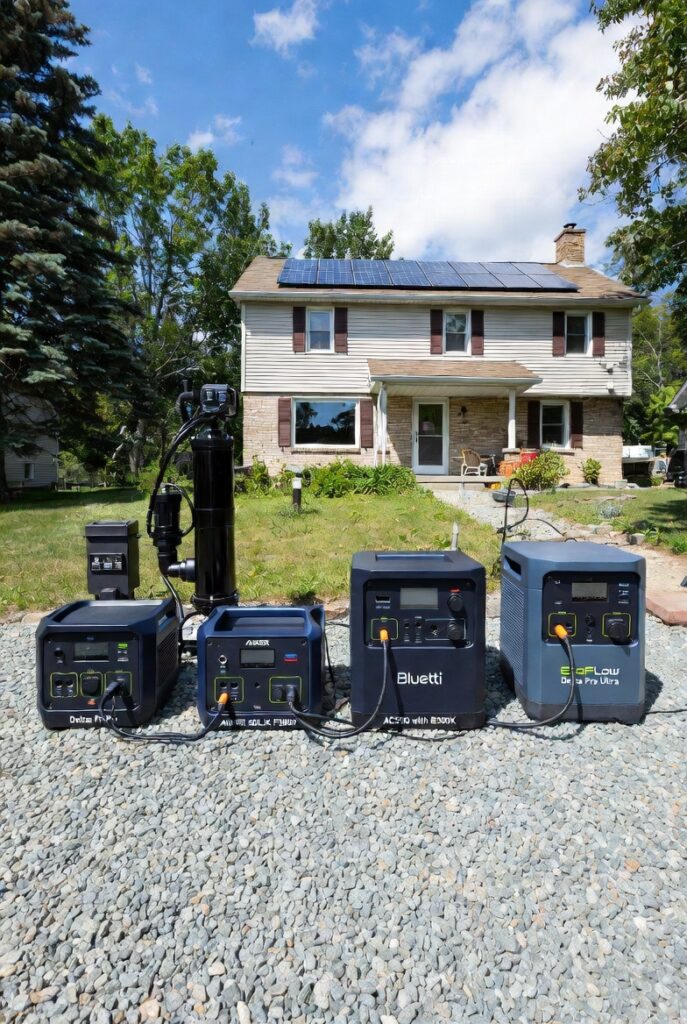
A home solar backup buyer in 2026 who lives in rural Ontario is not asking which unit has the prettiest app or the most outlets. He is asking one question. Will this $4,500 box actually start my 240V submersible well pump, run my fridge, and keep my furnace board powered for 72 hours when the next ice storm takes the line down and my cattle have no water? I was asked to evaluate the true 240V installed home backup tier for a property owner near Eramosa Township east of Guelph, Ontario.
He had a 1.5 horsepower submersible well pump rated at 1200W running with a 4000W startup surge, 240V split-phase only. During the February 14 ice storm, his power was out for 41 hours and his cattle had no automatic waterer. He hauled water from his neighbour’s gas-powered backup setup in 5 gallon pails for 36 of those 41 hours. I drove out to his property on the second Saturday after the storm to look at his actual critical load list and his electrical panel.
The list was different from the suburban portable tier load lists I had been working through the week before. A Franklin Electric 1.5 HP submersible well pump at 240V, 1200W running, 4000W startup surge, cycling 8 to 12 times per day during normal use and up to 30 times per day during cattle peak demand. A Whirlpool 25 cubic foot fridge at 110W average, 360W compressor surge. A second Whirlpool chest freezer for meat storage at 95W average, 320W surge. A Lennox high-efficiency furnace control board and ECM blower at 110W combined. A Starlink Standard kit at 65W average. The well pump alone made every portable power station in the 1000W to 2400W tier irrelevant. This was true 240V split-phase territory.
The fix was the Anker SOLIX F3800 at $3,999 on sale, delivering 3840Wh of LFP capacity, 6000W continuous AC output, native 120V/240V dual voltage, and a NEMA L14-30 split-phase outlet that wired directly into a manual transfer switch on his existing electrical panel. The big news for him was the Ontario Home Renovation Savings Program rebate. At $300 per kWh of battery storage, 3.84 kWh of capacity qualified for $1,152 back from HRSP. Net installed cost dropped to $2,847 plus the cost of an HRSP-approved installer for the transfer switch. He pre-applied for HRSP rebate approval before placing the order, which is the critical step most buyers miss. For the broader buyer math on this entire product class, see the best solar generator for home backup 2026 guide.
Why the 2026 Home Solar Backup Tier Demands True 240V Split Phase
The 2026 home solar backup tier under $8,000 sits at the capacity sweet spot for rural Ontario homeowners with 240V loads that no portable power station can handle. The 3000Wh to 6000Wh capacity range covers a typical rural critical load list of 240V submersible well pump cycling plus fridge plus freezer plus furnace control board plus Starlink for 24 to 36 hours on a single charge.
That same capacity supports native 120V/240V split-phase output without transformers or adapters.
As a result, the home solar backup tier is the right answer for any Ontario property owner with a 240V well pump, central air conditioner, electric dryer, or other 240V critical load that determines whether the property remains habitable during a multi day outage. For a deeper look at the underlying battery science, the LiFePO4 vs lithium ion vs AGM breakdown covers the chemistry context. For the under $2,500 portable tier, see the home backup solar standard.
The 1.5 HP Well Pump Surge Math Most Reviews Ignore
The 4000W startup surge of a 1.5 horsepower submersible well pump is the load that determines which units qualify for rural Ontario home backup. A typical Franklin Electric or Goulds 1.5 HP submersible draws 1200W running but spikes to 3500W to 4000W for the first 1 to 2 seconds of each startup cycle.
The Anker SOLIX F3800 at 6000W continuous absorbs this surge cleanly. The EcoFlow DELTA Pro 3 at 4000W rated and 6000W X-Boost handles it.
The Bluetti AC500 at 5000W continuous and 10000W peak absorbs it. The EcoFlow DELTA Pro Ultra at 7200W continuous handles it without breaking a sweat. Every portable unit in the 1000W to 2400W tier from the previous Buyers Guide articles fails this test.
The Ontario HRSP Rebate Stack Math That Makes the Project Pencil Out
A home solar backup investment earns its full economic return when the buyer stacks the maximum HRSP rebate by pairing battery storage with new solar panels in the same project. I was asked to evaluate the flagship tier for a homeowner near Eden Mills west of Acton, Ontario who had a 240V submersible well pump, a wife on a 350W home oxygen concentrator, a Liberty 257 sump pump in a finished basement, and a $15,000 budget for a permanent installed home backup solution. His goal was 5 to 7 days of off-grid autonomy with full 240V whole-home capability and the maximum possible HRSP rebate stacking before the November 2026 program expiration.
I worked through the load math with him on a Saturday morning at his kitchen table with his electrical panel diagrams spread out. His total daily critical load came to approximately 14,500Wh including the well pump cycling 12 times per day, the oxygen concentrator running continuously at 350W, the sump pump cycling 4 to 6 times per hour during spring melt, the fridge and freezer, and standard household lighting and electronics. The right unit for that load profile was the EcoFlow DELTA Pro Ultra at $6,999 on sale, delivering 6144Wh of LFP capacity, 7200W continuous AC output with native 120V/240V split-phase, and the ability to expand to 90kWh with additional batteries and inverter stacks. With one base unit of 6144Wh, he had approximately 10 hours of his daily load. To reach the 5 to 7 day autonomy goal, he needed solar recharge.
The HRSP rebate math made the project pencil out. The DELTA Pro Ultra at 6.144 kWh qualified for $300 per kWh, which came to $1,843 back from HRSP for the battery alone. He paired the install with a 5 kW rooftop solar panel array at $1,000 per kW under the same HRSP program, which added another $5,000 to the rebate stack. Combined HRSP rebate hit $6,843, which is just under the $10,000 program maximum because the battery rebate is capped at $5,000 individually. Total system cost came to $14,800 installed for the DELTA Pro Ultra plus solar panels plus electrician labor for the transfer switch and panel work. Net cost after the HRSP rebate dropped to $7,957. For comparison, a comparable Tesla Powerwall 3 install through an HRSP-approved contractor would have cost approximately $18,000 to $20,000 minus the $4,050 HRSP rebate, for a net of $13,950 to $15,950. The DELTA Pro Ultra route was approximately $6,000 cheaper net while delivering comparable functionality. He pre-applied for HRSP approval, signed with an HRSP-approved installer, and had the system commissioned 6 weeks later. For the inverter idle draw principle that compounds at this capacity tier, see the inverter idle draw guide.
Pre-Approval Is Non-Negotiable: How HRSP Rebates Get Killed
The Ontario HRSP rebate pre-approval requirement is the rule that kills more rebates than any other technicality. The HRSP requires written pre-approval from both the program administrators and your local distribution company before any equipment is purchased or installed.
If a homeowner buys the unit on Amazon, installs it, and then applies for HRSP, the rebate is denied with no exceptions.
The correct order is contact an HRSP-approved installer first, get written pre-approval, then purchase and install. Solar X is one of the larger HRSP-approved installers in Ontario but most regional electricians can register with the program if they are not already. For the authoritative HRSP program details and approved contractor list, see homerenovationsavings.ca.
The November 2026 Program Expiration Risk
The current HRSP program is confirmed through November 2026 but has been extended once already and could close at any time if annual funding is exhausted. Previous Ontario rebate programs like the GreenON Rebate Program and the federal Canada Greener Homes Grant were both ended without extended notice when funding ran out.
For an Ontario homeowner considering a true 240V installed home backup system in 2026, the $5,000 to $10,000 HRSP rebate is real money that may not be available in 2027.
The honest framing is that this is a finite rebate window with hard procedural requirements. As a result, the buyers who execute pre-approval correctly in the next 6 to 8 months are the ones who capture the full economic benefit.
The Home Solar Backup Cost Per Watt Hour Diagnostic
The 2026 home solar backup cost per watt hour breakdown across the 4 units in this true 240V installed tier looks like this. Every home solar backup buyer at this price point should walk this math before choosing a unit.
| Unit | Sale Price | Capacity | Cost per Wh | Continuous |
|---|---|---|---|---|
| Bluetti AC500 + B300K | $3,799 | 2764.8Wh | $1.37 | 5000W |
| Anker SOLIX F3800 | $3,999 | 3840Wh | $1.04 | 6000W |
| EcoFlow DELTA Pro 3 | $3,499 | 4096Wh | $0.85 | 4000W |
| EcoFlow DELTA Pro Ultra | $6,999 | 6144Wh | $1.14 | 7200W |
The EcoFlow DELTA Pro 3 at $3,499 on sale delivers the lowest dollar per watt hour at $0.85 in the true 240V installed tier. The Anker SOLIX F3800 at $3,999 on sale delivers the second lowest at $1.04 with the highest continuous output at 6000W.
The Bluetti AC500 + B300K bundle is the most expensive per watt hour at $1.37 but offers the deepest modular expansion runway through additional B300K batteries. The EcoFlow DELTA Pro Ultra at $6,999 sits at the flagship end of the tier with the highest standalone capacity and the highest continuous output. As a result, the DELTA Pro 3 wins on value per watt hour, the F3800 wins on output ceiling per dollar, and the DELTA Pro Ultra wins for buyers who need 5 to 7 day autonomy without compromise.
Choosing Your Home Solar Backup Unit by HRSP Rebate Stack
The home solar backup decision follows whether the use case is rural property with a 240V well pump and standard household loads, multi day autonomy with continuous medical equipment, or maximum HRSP rebate stacking with paired solar panels.
For rural property with a 240V well pump and standard critical loads totaling under 8000Wh per day, the Anker SOLIX F3800 at $3,999 on sale plus an HRSP-approved installer for the transfer switch delivers the highest output ceiling for the well pump surge and a $1,152 HRSP rebate that drops the net cost to $2,847 plus labor. The Eramosa Township property bought this exact configuration.
For multi day autonomy with continuous medical equipment plus a 240V well pump, the EcoFlow DELTA Pro Ultra at $6,999 plus a 5 kW solar panel array runs $14,800 installed and delivers a combined HRSP rebate of $6,843 for a net cost of $7,957. The Eden Mills property used this configuration.
For maximum modular expansion runway with the lowest entry cost into true 240V capability, the Bluetti AC500 + B300K bundle at $3,799 offers the deepest scalability via additional B300K batteries up to 16,589Wh total capacity. For buyers who prefer the lowest dollar per watt hour and the strongest battery economics, the EcoFlow DELTA Pro 3 at $3,499 on sale is the value pick of the tier.
How the 4 Units Compare to Tesla Powerwall 3 and Enphase IQ
For Ontario buyers shopping the true permanent installed market, two products dominate the HRSP-approved installer recommendations. The Tesla Powerwall 3 at 13.5 kWh runs approximately $16,500 to $20,700 fully installed in 2026.
The Enphase IQ Battery 5P runs $8,500 to $11,200 per 5 kWh module and is the modular alternative for buyers who want to start small and add modules over time.
Both products require a Tesla Certified Installer or an Enphase Certified Installer respectively, both qualify for HRSP rebates at $300 per kWh up to $5,000, and both are sold exclusively through approved installer channels rather than Amazon. For a buyer who wants the maximum installed capacity per project at the highest tier and is willing to pay the labor premium for a fully integrated whole-home solution, the Powerwall and Enphase route is worth comparing against the 4 portable-but-installable units in this article.
Safety Standards and Certifications for Installed Home Battery Systems in Canada
True 240V installed home backup systems in Canada are subject to CSA certification under the C22.2 No. 107.1 standard for general use power supplies, the C22.2 No. 107.3 standard for inverter products, and the UL 9540 standard for energy storage systems. All 4 units in this tier carry CSA marking confirming compliance with the relevant Canadian electrical safety standards. The transfer switch and electrical panel work required for true 240V split-phase home backup must be performed by a licensed electrician and inspected by the Electrical Safety Authority of Ontario before energization.
Pro Tip: Before buying any home solar backup system in the true 240V tier, contact an HRSP-approved installer in your region and apply for written pre-approval before purchasing the unit. The HRSP rebate of $5,000 to $10,000 is real money that requires correct procedural sequencing to capture. Most home solar backup buyers shop on Amazon first, install the unit, and then discover they cannot claim the rebate because pre-approval is mandatory before any work begins. The Eramosa Township homeowner pre-applied and captured $1,152 back. The Eden Mills property captured $6,843 back by stacking battery and solar in the same project. Match the unit to your load profile, but match the timing to the rebate procedural rules.
The Verdict
- The Home Solar Backup Verdict for Rural 240V Well Pump Coverage. The Eramosa Township homeowner bought the Anker SOLIX F3800 at $3,999 on sale because the 6000W continuous AC output absorbed his 4000W well pump startup surge alongside the fridge, freezer, and furnace, and the native 120V/240V dual voltage wired directly into his existing electrical panel via a manual transfer switch. He pre-applied for the HRSP rebate before placing the order and captured $1,152 back, dropping his net cost to $2,847 plus electrician labor. For a rural Ontario property with a 240V submersible well pump and a $5,000 budget, the F3800 is the right answer.
- The Multi Day Autonomy Use Case Demands the Flagship Tier Plus Solar Stack. The Eden Mills property could not be served by any sub-$5,000 unit because the wife’s oxygen concentrator at 350W continuous, the well pump cycling, the sump pump in the finished basement, and the 5 to 7 day autonomy goal demanded both a 7200W continuous inverter and a daytime solar recharge stack. The fix was the EcoFlow DELTA Pro Ultra at $6,999 plus a 5 kW rooftop solar array, total $14,800 installed, with a combined HRSP rebate of $6,843 for a net cost of $7,957. For continuous medical loads plus 240V critical equipment plus multi day autonomy, plan on the flagship tier and stack the rebates.
- The HRSP Pre-Approval Sequence Is the Single Most Important Step. Every buyer in this tier needs to contact an HRSP-approved installer before purchasing any unit. The rebate requires written pre-approval from program administrators and the local distribution company before any equipment is bought or installed. Buying first and applying later results in a denied rebate with no exceptions. The Eramosa Township and Eden Mills owners both pre-applied correctly and captured the full economic benefit. The November 2026 program expiration is a real deadline. Match the unit to the surge profile and the use case, and match the timing to the rebate procedural rules.
Frequently Asked Questions
Q: Is a home solar backup system in the true 240V installed tier actually able to start a 1.5 horsepower submersible well pump in rural Ontario?
A: Yes. All 4 units in this tier deliver native 120V/240V split-phase output and have continuous AC ratings of 4000W to 7200W, which comfortably absorb the 3500W to 4000W startup surge of a typical 1.5 HP Franklin Electric or Goulds submersible well pump. The Anker SOLIX F3800 at 6000W continuous and the EcoFlow DELTA Pro Ultra at 7200W continuous have the most surge headroom. The EcoFlow DELTA Pro 3 at 4000W rated handles the surge via X-Boost up to 6000W. The Bluetti AC500 at 5000W continuous and 10000W peak absorbs it cleanly. Every portable unit below this tier (1000W to 2400W) fails the well pump surge test.
Q: How much can I really save with the Ontario HRSP rebate when I buy a home solar backup system in 2026?
A: The Ontario Home Renovation Savings Program pays $300 per kWh of battery storage up to a maximum of $5,000, and $1,000 per kW of solar panel capacity up to a maximum of $5,000, for a combined maximum of $10,000 when battery and solar are paired in the same project. A 4 kWh battery alone qualifies for $1,200 back. A 6 kWh battery paired with a 5 kW solar array qualifies for $1,800 plus $5,000 = $6,800 combined. The program requires written pre-approval before any equipment is purchased or installed, requires installation by an HRSP-approved contractor, and is currently confirmed through November 2026. Pre-approval is non-negotiable. Buying first and applying later results in a denied rebate.
Q: Which home solar backup unit has the best dollar per watt hour value in the true 240V installed tier?
A: The EcoFlow DELTA Pro 3 at $3,499 on sale delivers the lowest dollar per watt hour at $0.85 in the true 240V installed tier with 4096Wh of LFP capacity, 4000W rated continuous output, 6000W X-Boost surge handling, and native 120V/240V split-phase support. The Anker SOLIX F3800 at $3,999 delivers the second-lowest cost per watt hour at $1.04 but with the highest standalone continuous output at 6000W. The EcoFlow DELTA Pro Ultra at $6,999 sits at the flagship end of the tier and is the right answer for buyers who need 5 to 7 day autonomy with multi day medical loads. The Bluetti AC500 + B300K bundle at $3,799 is the most modular and offers the deepest expansion runway via additional B300K batteries.
Questions? Drop them below.
This build is engineered within the 48V DC Safety Ceiling. Diagnostic logic is based on 20+ years of technical service experience. All structural and electrical installations must be verified by a Licensed Professional and comply with your Local AHJ.
Disclosure: This article contains affiliate links to Amazon, including the Anker SOLIX F3800, EcoFlow DELTA Pro 3, Bluetti AC500 + B300K, and EcoFlow DELTA Pro Ultra. We may earn a commission on qualifying purchases at no additional cost to you. All product evaluations are based on field experience and independent diagnostic work.