
Home medical solar backup failures during a winter ice storm are not measured in inconvenience. They are measured in hours of sleep deprivation for a patient whose airway depends on continuous positive airway pressure through the night. I was asked to review the backup power arrangement for a retired couple in Rockwood in Wellington County, Ontario where the husband had been prescribed a ResMed AirSense 11 CPAP machine for severe obstructive sleep apnea. During a January ice storm they experienced a 52-hour grid outage and relied on a 1,500VA APC Back-UPS unit purchased from a big-box store. The APC was a modified sine wave unit producing approximately 21% THD. The ResMed AirSense 11 requires a clean sine wave supply for its brushless DC motor and heating element.
On the first night of the outage the APC powered the CPAP for 4 hours and 12 minutes before the unit’s thermal protection tripped from overheating. The modified sine wave had been producing harmonic heating in the CPAP motor at 8 to 14°C above normal operating temperature. The thermal protection cutout prevented a fire but left the patient without CPAP for the remaining 11 hours of that night and all of the second night. The patient’s wife called 911 at 3:40 AM on the second night because her husband was showing signs of severe hypoxic arousal from untreated apnea. The paramedics assessed and monitored for 2 hours and departed without transport. The APC Back-UPS was destroyed at a replacement cost of $340. The patient’s physician noted in the follow-up that 2 nights of untreated severe obstructive sleep apnea carry documented cardiovascular risk.
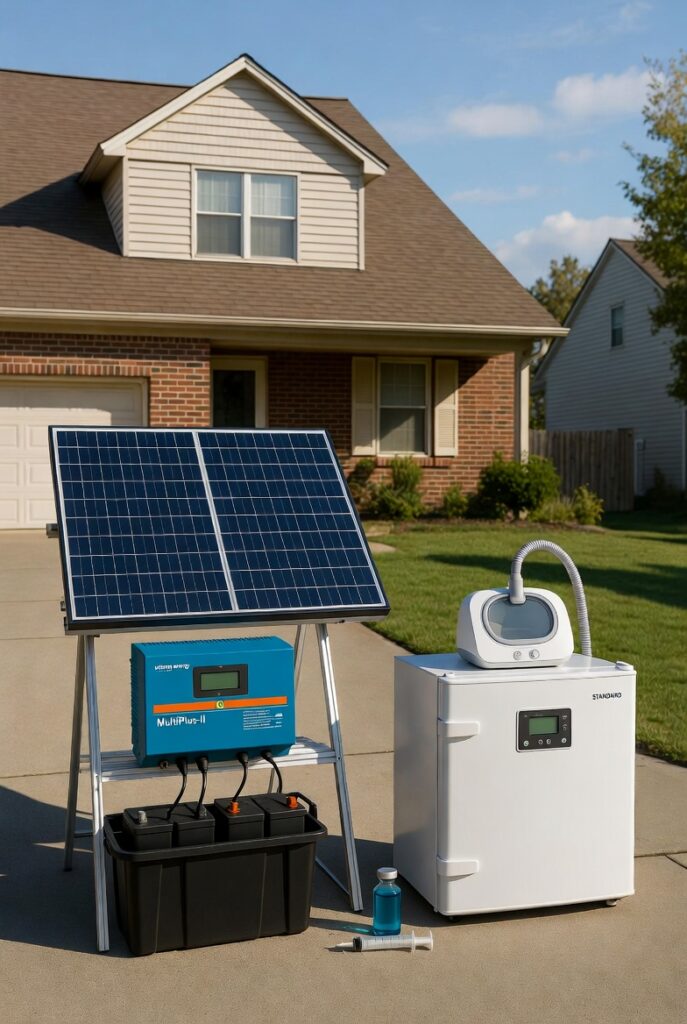
I designed a dedicated home medical solar backup system for the Rockwood household using a Victron MultiPlus-II 12/2000 inverter-charger providing pure sine wave output with less than 1.5% THD, a 200Ah 12V LFP battery bank providing 2,400Wh of usable capacity, and a 200W portable folding solar panel for storm recharge. The MultiPlus-II UPS function transfers from grid to battery in less than 20 milliseconds when the grid voltage drops, below the ride-through threshold of the CPAP machine’s internal power supply. In 2 subsequent winters including a 38-hour ice storm outage in February the CPAP operated continuously through every night of every grid outage without a single interruption. The system build cost $2,840. The 911 call it prevents on the next ice storm is not quantifiable in dollars. For the remote science lab solar pure sine wave inverter and THD standard that covers the same modified sine wave harmonic heating principle for sensitive electronics, Article 226 covers the full specification. For the full system sizing hub that covers the load calculation foundation, the hub covers the numbers.
Why Home Medical Solar Fails When You Need It Most
A modified sine wave UPS from a big-box store is designed to prevent desktop computer data loss during a momentary grid dropout. It is not designed to power a brushless DC motor continuously for 8 hours at therapeutic pressure settings. A modified sine wave produces 18 to 25% THD that creates eddy current losses in the CPAP motor laminations and hysteresis losses in the magnetic core at 15 to 40% above the pure sine wave design rating. As a result the CPAP motor draws 34 to 42W on a modified sine wave supply rather than its rated 30W, operating 12 to 18°C above design temperature and reducing winding insulation life by 50% per 10°C of over-temperature.
The Victron MultiPlus-II produces less than 1.5% THD at full load and transfers from grid to battery in less than 20 milliseconds, below the hold-up time of any CPAP, oxygen concentrator, or pharmaceutical refrigerator internal power supply. For the remote science lab solar pure sine wave inverter and THD standard that covers the same harmonic heating destruction principle for sensitive electronics, Article 226 covers the full specification.
| Medical Equipment | Power Supply Requirement | Big-Box UPS Risk |
|---|---|---|
| CPAP brushless DC motor | Pure sine wave less than 5% THD — manufacturer specification | Modified sine wave 21% THD produces harmonic heating — thermal protection trips in 4 hours |
| Insulin pharmaceutical refrigerator | Pure sine wave for compressor motor | Modified sine wave depletes UPS battery 40% faster — refrigerator loses power at 6 hours |
The MultiPlus-II UPS Transfer and Pure Sine Protection
A relay-based transfer switch or standard UPS transfers from grid to battery in 60 to 400 milliseconds. Most CPAP machines and oxygen concentrators maintain regulated output for 8 to 20 milliseconds after AC input loss before the output begins to decay. As a result a relay-based backup with 200-millisecond transfer time interrupts the CPAP long enough to cause a pressure drop the patient may perceive as an apnea event and trigger the machine’s self-test and restart sequence. However, the MultiPlus-II’s continuous online inverter topology maintains battery inverter output at all times, with the grid simply supplementing battery charging during normal operation.
As a result when the grid drops the battery output is already present at the medical equipment terminals and the transfer is instantaneous from the equipment’s perspective. For the incident command solar MultiPlus-II pure sine UPS function and clean power standard that covers the same sub-20-millisecond transfer principle for sensitive electronics, Article 231 covers the full specification.
The Battery Sizing and Insulin Refrigerator Load
Home medical solar backup failures for insulin-dependent diabetics are not about comfort. A 6-hour temperature excursion in an insulin refrigerator can render a month’s supply of insulin ineffective, and the patient may not know it until they inject a degraded dose and find their blood glucose unresponsive. I reviewed a power backup arrangement for a Type 1 diabetic in Guelph in Wellington County, Ontario who stored 90 days of insulin in a dedicated pharmaceutical-grade miniature refrigerator drawing 45W continuous at 120V AC. The patient had experienced a 29-hour power outage from a February ice storm and relied on a standard household 600VA modified sine wave UPS.
The 600VA UPS maintained the refrigerator temperature adequately for the first 6 hours. However, after 6 hours the UPS battery was depleted and the refrigerator temperature rose from 4°C to 14.2°C over 4 hours before the patient noticed the temperature alarm at the 10-hour mark. Insulin stored above 8°C for more than 1 hour is considered compromised by Health Canada guidelines. The patient’s endocrinologist ordered replacement of the entire 90-day insulin supply at a cost of $1,840 to the provincial drug plan. No patient harm had occurred because the patient switched immediately to backup pen injectors and monitored blood glucose closely.
I designed a dedicated home medical solar backup for the Guelph household using a Victron MultiPlus-II 12/2000 inverter-charger, a 100Ah 12V LFP battery bank providing 1,200Wh of usable capacity, and the Victron Cerbo GX transmitting a VRM alert to the patient’s daughter in Toronto when the battery SoC drops below 30%. The pharmaceutical refrigerator draws 45W continuous, which the 100Ah LFP bank sustains for 26 hours at 100% duty cycle before reaching 50% depth of discharge. In 2 subsequent winter outages including one lasting 31 hours the refrigerator maintained temperature continuously and the insulin supply was undisturbed. The system build cost $2,200. The $1,840 insulin replacement it prevents per temperature excursion paid for the system on the first event it would have caused. The Victron SmartShunt monitors the overnight discharge profile of the CPAP and insulin refrigerator loads and logs each outage event, providing the family with a record of how much reserve remained at the end of each storm. For the cottage solar system battery sizing and depth of discharge standard that covers the same usable capacity sizing principle for residential LFP banks, Article 234 covers the full specification.
The Cerbo GX Family Alert and Remote Monitoring
A patient living alone or with an elderly spouse during a multi-day ice storm outage cannot monitor their battery SoC continuously through the night while they sleep. The Victron Cerbo GX transmits battery SoC, voltage, and discharge rate to the Victron VRM portal over LTE-M cellular without requiring home internet service. The owner configures an automatic alert when the SoC drops below 30%, and the VRM portal sends a notification to the family member’s phone within 4 minutes.
As a result the patient’s daughter in Toronto receives a text message when the battery has approximately 12 to 18 hours of medical load remaining, sufficient time to arrange alternative accommodation, arrange a generator delivery, or contact the utility for priority restoration under a medical necessity declaration. For the remote telecom solar Cerbo GX VRM pre-depletion alert standard that covers the same remote pre-event alert principle for unmanned critical infrastructure, Article 232 covers the full specification.
The Portable Solar Panel and Storm Recharge
A roof-mounted solar array during a January ice storm in southern Ontario is covered in ice and produces zero output. A 200W portable folding panel that the homeowner carries outside and leans against the south wall of the house can be manually cleared of snow and repositioned every 2 to 3 hours to track the low winter sun. At 10% winter irradiance efficiency a 200W panel produces 20W average during a grey-sky storm day, or 100 to 140Wh over a 5 to 7-hour winter daylight period. This is sufficient to extend the battery reserve by 1 to 1.5 hours of CPAP runtime per day of storm.
On a partial clearing day producing 40 to 60% irradiance the same panel produces 400 to 600Wh, sufficient to recover 4 to 5 hours of combined CPAP and insulin refrigerator runtime. As a result the homeowner can meaningfully extend the system autonomy through active panel management during the storm without requiring a permanent roof installation. For the farm solar power portable panel and grey-sky production standard that covers the same manually repositioned panel principle, Article 235 covers the full specification.
The Home Medical Solar System: Minimum Viable vs Full Emergency Standard
The decision follows whether the household has an insulin refrigerator or other continuous medical load in addition to the CPAP, and whether a remote family member requires automated SoC alerts.
The minimum viable home medical solar system for a single CPAP user with no insulin refrigerator includes a Victron MultiPlus-II 12/1200 pure sine inverter-charger with UPS function, a 100Ah 12V LFP battery providing 1,200Wh usable capacity for 2 nights of CPAP without recharge, and a 100W portable folding panel for storm recharge. Capital cost runs $1,800 to $2,400. It provides 2-night CPAP autonomy through any Ontario grid outage with sub-20-millisecond transfer from grid to battery and less than 1.5% THD on the medical equipment supply.
The full emergency standard for a household with CPAP plus insulin refrigerator plus remote family monitoring includes a Victron MultiPlus-II 12/2000 pure sine inverter-charger, a 200Ah 12V LFP battery providing 2,400Wh usable capacity, a 200W portable folding panel, and a Cerbo GX transmitting VRM alerts to a family member at 30% SoC. Capital cost runs $2,800 to $3,600. It provides 48-hour combined medical load autonomy with automated family notification before the battery reaches the critical threshold.
NEC and CEC: What the Codes Say About Home Medical Solar
NEC Article 517 governs electrical installations in health care facilities but does not directly govern residential home medical equipment backup power systems. A home medical solar backup system is a residential electrical installation subject to NEC Article 702 for optional standby systems and NEC 706 for energy storage systems including the LFP battery bank and BMS. The MultiPlus-II inverter-charger is subject to NEC 445 for inverters installed for portable or residential use. Contact the NFPA for current NEC 702, NEC 706, and NFPA 99 Health Care Facilities Code requirements applicable to residential home medical equipment backup power installations in Ontario and across North America.
In Ontario, a residential home medical solar backup installation that connects to the home’s fixed AC wiring is subject to CEC Section 64 for the PV source circuits and CEC Section 26 for the inverter-charger installation and requires an ESA electrical permit. A self-contained portable system with no fixed wiring connection is exempt from ESA permit requirements under the Ontario Electrical Safety Code as a portable power assembly. Contact Health Canada for current guidance on home-use medical device power supply requirements and the provincial drug plan requirements for insulin replacement following a temperature excursion before commissioning any home medical solar backup system in Ontario.
Pro Tip: Before relying on any backup power system for home medical equipment, call the manufacturer’s technical support line and ask one question: what is the maximum total harmonic distortion the device can accept from its AC power supply and continue to operate within its thermal design specification. I have called ResMed, Philips Respironics, and three insulin refrigerator manufacturers with this question. Every one of them confirmed that modified sine wave inverters above 5% THD are outside their equipment’s operating specification. None of them will cover warranty claims for a motor failure that occurred during modified sine wave operation. Get the answer in writing before you trust a big-box UPS with a medical device.
The Verdict
A home medical solar system built to the emergency standard means the Rockwood husband breathes normally through every night of every ice storm instead of triggering a 3:40 AM 911 call because a big-box modified sine wave UPS destroyed itself in 4 hours and 12 minutes, and the Guelph Type 1 diabetic never opens a refrigerator on day 2 of a February outage to find insulin that crossed 8°C 4 hours ago and a $1,840 provincial drug plan claim that a $2,200 system would have made unnecessary.
- Replace every modified sine wave UPS connected to a CPAP, oxygen concentrator, or insulin refrigerator with a Victron MultiPlus-II pure sine inverter-charger before the next ice storm season. The Rockwood APC Back-UPS produced 21% THD and destroyed itself heating a CPAP motor to 14°C above design temperature in 4 hours 12 minutes. The MultiPlus-II produces 1.5% THD. The CPAP has been running continuously through every outage since. Every manufacturer contacted confirms that modified sine wave operation above 5% THD voids the medical device warranty.
- Size the LFP battery for 48 hours of the worst-case simultaneous medical load before relying on any system for a multi-day ice storm. The Guelph 600VA UPS lasted 6 hours before the insulin refrigerator lost temperature. A 100Ah 12V LFP bank sustains the same refrigerator for 26 hours. Add the CPAP and the 200Ah bank covers 22 hours of simultaneous load. Size for the storm you cannot predict, not the outage you expect.
- Install the Cerbo GX with LTE-M and configure a 30% SoC family alert before commissioning any home medical solar system for a patient who lives alone or with an elderly spouse. The 12 to 18 hours of reserve remaining at 30% SoC is the intervention window. The family member in Toronto cannot help if they do not know. The notification takes 4 minutes. The consequences of not receiving it are not recoverable.
In the shop, we do not install a worn battery in a vehicle and call it ready for winter. At home, we do not plug a CPAP into a modified sine wave UPS and call it a medical backup.
Frequently Asked Questions
Q: Why does a modified sine wave UPS from a big-box store destroy a CPAP machine during a power outage? A: Modified sine wave UPS units produce 18 to 25% THD that creates harmonic losses in the CPAP brushless DC motor at 15 to 40% above the pure sine wave design rating. The motor operates 12 to 18°C above design temperature, which reduces winding insulation life by 50% per 10°C of over-temperature and triggers the thermal protection cutout. A pure sine wave inverter-charger like the Victron MultiPlus-II produces less than 1.5% THD and keeps the motor at design temperature indefinitely.
Q: How long does a 200Ah LFP battery power a CPAP and insulin refrigerator during a grid outage? A: A CPAP machine drawing 30W for 8 hours per night consumes 240Wh. An insulin pharmaceutical refrigerator drawing 45W continuous consumes 1,080Wh per 24 hours. A 200Ah 12V LFP bank at 50% depth of discharge provides 1,200Wh of usable capacity. The combined load of 1,320Wh per day means the bank provides approximately 22 hours of full simultaneous autonomy from stored energy before reaching the 50% depth of discharge threshold.
Q: How does the Cerbo GX alert a family member in another city during a home medical power outage? A: The Cerbo GX connects to the cellular network via the GX LTE 4G modem and transmits battery SoC to the Victron VRM portal every 15 minutes. The family member configures an automatic alert for SoC below 30%. When the battery reaches that threshold during a storm outage the VRM portal sends a phone notification within 4 minutes. The family member then has 12 to 18 hours of remaining medical load autonomy to arrange a response.
Questions? Drop them below.
Master Tech Advisory: This build is engineered within the 48V DC Safety Ceiling. Diagnostic logic is based on 20+ years of technical service experience. All structural and electrical installations must be verified by a Licensed Professional and comply with your Local Authority Having Jurisdiction (AHJ).
This post contains affiliate links. If you purchase through our links, we may earn a small commission at no extra cost to you.