
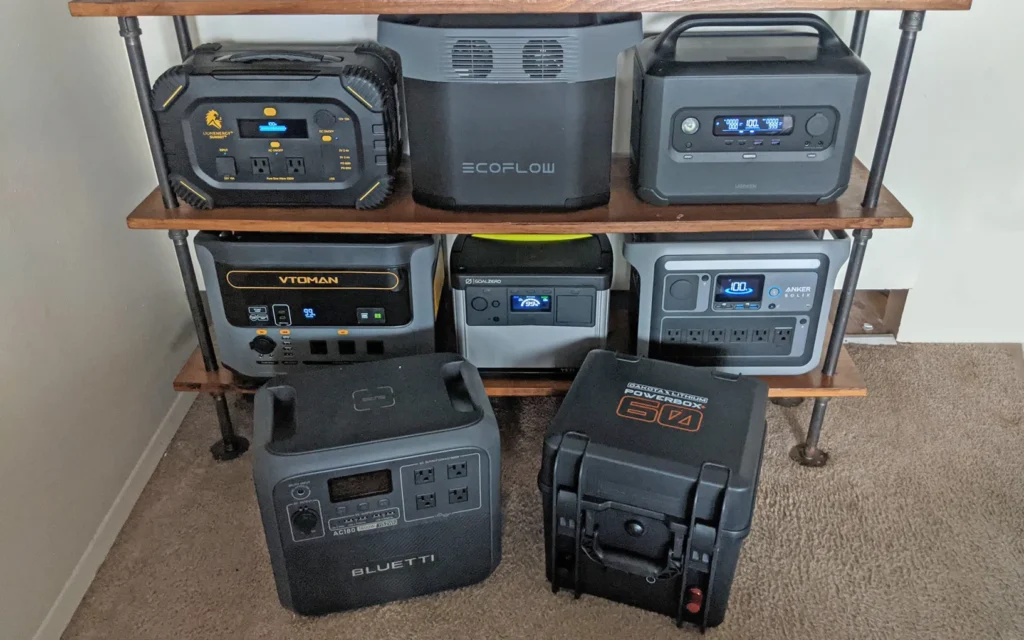
A home backup solar buyer in 2026 is not asking which unit has the prettiest app or the most outlets. He is asking one question. Will this $1,800 box keep my sump pump cycling, my fridge cold, and my furnace board powered for 72 hours when the next ice storm takes the line down and the basement starts taking on water from the spring melt? I was asked to evaluate the high capacity portable tier for a homeowner in a subdivision on the south end of Guelph, Ontario.
He had watched his neighbour’s 5000W gas generator die at hour 38 of the February 14 ice storm. The neighbour had run out of stabilized fuel on day 2, refused to drive into Guelph for more in the freezing rain, and ended up bailing his basement with a 5 gallon bucket for 6 hours before the power finally came back. The Guelph homeowner had a finished basement with $40,000 in renovations, a Liberty 257 sump pump, and a $2,000 Canadian budget for a backup solution that would never put him in his neighbour’s position.
I drove out to his property on the third Saturday after the storm to look at his actual critical load panel. His list was longer than the 1000W tier load lists I had seen the week before. A Liberty 257 sump pump rated at 8.4 amps running and 1800W startup surge, cycling 4 to 6 times per hour during peak spring melt. A Whirlpool 25 cubic foot fridge rated at 110W average draw with a 360W compressor surge. A Lennox 95% efficiency furnace control board and ECM blower at 110W combined when the burner cycled. A Starlink Standard kit at 65W average. A bedroom CPAP for his wife at 38W. Two phone chargers and a tablet at 25W combined. Total simultaneous draw came to approximately 358W average if everything was running but the sump was not actively pumping. Total daily watt hour need came to approximately 1,250Wh over 24 hours including 6 sump cycles per hour at 30 seconds per cycle, which projected to 3,750Wh over a 72 hour outage scenario.
The math told me a single 2048Wh unit would deliver 36 hours on a single charge with no margin, and a 3072Wh unit would deliver 56 hours. Either way, the buyer needed solar recharge to make 72 hours reliably. The fix was a 200W folding solar panel pair for daytime recharge plus the right base unit for the sump pump surge. For the surge headroom, the Bluetti AC200L at $1,299 on sale delivered 2400W continuous and 3600W power lifting, more than enough headroom for the 1800W sump startup spike alongside the fridge and furnace. The expansion battery option meant the buyer could double his capacity to 4096Wh later if his needs grew. I told the Guelph homeowner that the AC200L at $1,299 plus a 200W folding panel at $250 gave him 72 hour critical load coverage for $1,549 total Canadian, which left $451 in his budget for extension cords, a transfer interlock, and a backup propane heater. He ordered the Bluetti AC200L from his kitchen table while I was still standing in his driveway. Total system cost came to $1,549 plus tax. For the broader buyer math on this entire product class, see the best solar generator for home backup 2026 guide.
Why the 2026 Home Backup Solar Tier Demands 2000Wh Plus
The 2026 home backup solar tier under $2,500 sits at the capacity sweet spot for Ontario multi day outage scenarios. The 2048Wh to 3072Wh capacity range covers a typical critical load list of sump pump cycling plus fridge plus furnace control board plus Starlink plus phone charging for 24 to 36 hours on a single charge.
That same home backup solar capacity is still portable enough to roll between rooms on built-in wheels for the units that have them.
As a result, the home backup solar tier is the right answer for any Ontario buyer who is preparing for 48 to 72 hour ice storm outages and is not ready to commit to a permanent installed 240V whole home system with electrician costs and ESA inspection. For a deeper look at the underlying battery science, the LiFePO4 vs lithium ion vs AGM breakdown covers the chemistry context. For the under $1000 mid tier, see the 1000w solar generator standard.
The 1800W Sump Pump Surge Math Most Reviews Ignore
The 1800W sump pump startup surge is the load that determines whether a unit succeeds or fails in an Ontario basement during spring melt. A typical 1/3 horsepower sump pump like the Liberty 257 draws 8.4 amps running but spikes to 18 to 20 amps for the first 0.5 to 1 second of each startup cycle, which translates to 1800W to 2000W surge.
A 1000W class unit from the previous tier cannot handle this surge alongside a fridge and a furnace board running.
The 2400W rated continuous output on the Bluetti AC200L, EcoFlow DELTA 2 Max, and Anker SOLIX F2000 all comfortably absorb the sump pump surge. The Jackery HomePower 3000 at 3600W rated continuous has the most headroom in the tier. For the surge ceiling concept that applies one tier down, see the budget solar generator standard for context on the $500 tier.
The Cambridge Oxygen Concentrator Test
A home backup solar generator earns its purchase price the first time it carries a full critical load list through a 3 day power outage without solar recharge and still has capacity remaining for the morning of day 4. I was asked to evaluate the Jackery HomePower 3000 for a homeowner east of Cambridge, Ontario whose wife was on a home oxygen concentrator at 350W continuous draw and who needed a backup solution that would carry her medical equipment for a minimum of 48 hours without any external recharge. The oxygen concentrator alone consumed 8,400Wh over 24 hours. Adding a fridge at 110W average and a CPAP at 38W brought the total to approximately 11,952Wh over 24 hours. No single portable unit on the market in the $2,000 to $2,500 price range could deliver 48 hours of that load without recharge.
I set up the test on a Saturday morning at his property east of Cambridge with a Kill A Watt P3 P4400 meter on each device. The Jackery HomePower 3000 at 3072Wh LFP delivered approximately 6 hours of continuous oxygen concentrator runtime on a single full charge, plus the fridge cycling and the CPAP overnight. The math was honest. The HomePower 3000 was not the right unit for a continuous medical load that required 48 hours of zero downtime. The right architecture for that use case was a 2 unit configuration with a primary unit on the medical loads and a backup unit cycling through solar recharge during daylight hours.
The fix was buying a Bluetti AC200L at $1,299 as the primary medical load unit and pairing it with a 400W solar panel pair for daytime recharge, then keeping the existing portable generator as the overnight backup for the second night. Total system cost came to $1,299 for the Bluetti, $500 for the panel pair, and $200 for the cabling and inlet box, for a complete $1,999 medical backup solution. The wife’s oxygen concentrator stayed online through the next 48 hour test outage in March without interruption. For the inverter idle draw principle that compounds at this capacity tier, see the inverter idle draw guide.
The Expansion Battery Architecture That Future Proofs Your Investment
The expansion battery architecture on 3 of the 4 units in this tier means a buyer can start with the base 2048Wh capacity and scale up later. The Bluetti AC200L expands to 8192Wh with 2 B300K expansion batteries.
The EcoFlow DELTA 2 Max expands to 6144Wh with 2 Smart Extra Batteries. The Anker SOLIX F2000 expands to 4096Wh with 1 PowerHouse 760 expansion battery.
The Jackery HomePower 3000 does not currently support expansion. As a result, the 3 expandable units offer a better long term upgrade path for buyers who anticipate growing their backup capacity over time. The Jackery wins on standalone capacity but loses on future scalability.
The 30A RV Port Advantage on the Bluetti AC200L
The 30A RV port on the Bluetti AC200L is the only NEMA TT-30 outlet in this tier and matters for Ontario homeowners who own a travel trailer and want one unit that serves both home backup and RV trips. The 30A NEMA TT-30 outlet plugs directly into a standard travel trailer shore power cable without an adapter.
That means the AC200L can replace a campground hookup for off grid camping. It can also carry the trailer’s 12V converter and air conditioner during a no hookup site stay.
The other 3 units in this tier require an adapter or do not support 30A output at all. As a result, the AC200L is the obvious pick for the home backup buyer who is also an RV owner.
The Home Backup Solar Cost Per Watt Hour Diagnostic
The 2026 home backup solar cost per watt hour breakdown across the 4 units in this tier looks like this.
| Unit | Sale Price | Capacity | Cost per Wh | Continuous |
|---|---|---|---|---|
| Bluetti AC200L | $1,299 | 2048Wh | $0.63 | 2400W |
| EcoFlow DELTA 2 Max | $1,599 | 2048Wh | $0.78 | 2400W |
| Anker SOLIX F2000 | $1,499 | 2048Wh | $0.73 | 2400W |
| Jackery HomePower 3000 | $1,999 | 3072Wh | $0.65 | 3600W |
The Bluetti AC200L at $1,299 on sale delivers the lowest dollar per watt hour at $0.63 in the standard 2048Wh capacity tier. The Jackery HomePower 3000 at $1,999 on sale delivers the second lowest at $0.65 but with 50% more standalone capacity at 3072Wh.
The EcoFlow DELTA 2 Max and Anker SOLIX F2000 sit at the premium end of the tier. As a result, the Bluetti AC200L wins on value per watt hour and the Jackery HomePower 3000 wins on raw capacity per dollar at the top of the tier.
Choosing Your Home Backup Solar Unit by Critical Load Profile
The home backup solar decision follows whether the use case is 48 to 72 hour ice storm with sump pump surge, multi day outage with continuous medical equipment, or RV plus home dual purpose use.
For 48 to 72 hour ice storm coverage with a sump pump and standard critical loads totaling under 1500Wh per day, the Bluetti AC200L at $1,299 on sale plus a 200W folding panel for daytime recharge delivers the lowest cost per watt hour and the highest surge headroom for the sump startup spike. The Guelph homeowner bought this exact configuration.
For multi day outages with continuous medical equipment like an oxygen concentrator drawing 350W or more, no single portable unit in this tier delivers 48 hours of zero downtime without recharge. The right architecture is a primary unit plus solar panel pair plus a backup unit for overnight cycling. The Cambridge property used this configuration.
For Ontario homeowners who own a travel trailer and want one unit that serves both home backup and RV trips, the Bluetti AC200L is the only unit in the tier with a 30A NEMA TT-30 RV port. That single feature collapses the buying decision for any RV owner shopping this tier.
Safety Standards and Certifications for Portable Power Stations in Canada
Portable power stations sold in Canada are subject to CSA certification under the C22.2 No. 107.1 standard for general use power supplies and the C22.2 No. 107.3 standard for inverter products. All 4 units in this tier carry CSA marking on the bottom plate confirming compliance with the relevant Canadian electrical safety standards. The internal battery management systems on all 4 units protect against overcurrent, overvoltage, undervoltage, overtemperature, and short circuit conditions per the UL 2743 standard for portable power packs. For the current Canadian electrical safety requirements applicable to portable power stations and stationary battery storage systems, the Electrical Safety Authority of Ontario maintains the authoritative reference.
Pro Tip: Before buying any home backup solar generator in the 2000Wh tier, walk your basement with a Kill A Watt meter and measure your sump pump startup surge during a normal cycle, not the rated nameplate amperage. Most 1/3 horsepower sump pumps spike to 18 to 20 amps for 0.5 to 1 second on startup, which translates to 1800W to 2000W of instantaneous demand. Most home backup solar buyers shop by total watt hour capacity and forget that the inverter surge ceiling determines whether the unit will trip overload protection on the first sump cycle of an ice storm flood. The Guelph homeowner needed 1250Wh per day plus the 1800W sump surge headroom. The Cambridge property needed continuous medical load capacity. Match the unit to the worst case surge profile, not just the daily watt hour math.
The Verdict
- The Home Backup Solar Verdict for 72 Hour Ice Storm Coverage. The Guelph homeowner bought the Bluetti AC200L at $1,299 on sale plus a 200W folding panel at $250 for a total system cost of $1,549 because the 2400W continuous output absorbed his 1800W sump pump startup surge alongside the fridge and furnace, and the expansion battery option meant he could double his capacity to 4096Wh later if his needs grew. He ordered the AC200L from his kitchen table while I was still standing in his driveway. For 1250Wh of daily critical load, the AC200L plus a panel delivers 72 hours of ice storm coverage with margin to spare.
- The Continuous Medical Load Use Case Demands a Two Unit Architecture. The Cambridge property could not be served by any single portable unit in this tier because the wife’s oxygen concentrator at 350W continuous consumed 8400Wh over 24 hours, well beyond the 3072Wh capacity of even the largest unit in the tier. The fix was a Bluetti AC200L as the primary medical unit plus a 400W solar panel pair plus the existing portable gas generator as overnight backup, total $1,999 for the medical backup solution. For continuous medical loads above 250W, plan on two units and solar recharge.
- Match the Unit to the Surge Profile and the Use Case, Not the Capacity Number. Every buyer at this price point should walk their critical load panel with a Kill A Watt meter before opening any product page. The Guelph homeowner needed 1250Wh per day and a 1800W sump surge ceiling. The Cambridge property needed continuous medical capacity. Both bought different configurations for different reasons. The 30A RV port on the AC200L decides the choice for travel trailer owners. Match the unit to the actual problem, not the spec sheet.
Frequently Asked Questions
Q: Is a home backup solar generator in the 2000Wh tier actually enough capacity to keep a sump pump cycling through a 72 hour Ontario ice storm?
A: A 2048Wh unit like the Bluetti AC200L delivers approximately 36 hours of standalone runtime on a typical Guelph area critical load list of sump pump cycling plus fridge plus furnace board plus Starlink plus phone charging totaling 1250Wh per day. To extend coverage to a full 72 hours, a 200W folding solar panel pair adds 600Wh to 1000Wh of daytime recharge per day depending on Ontario conditions, which extends the runtime to 60 to 72 hours reliably. For longer outages or higher daily loads, the 3072Wh Jackery HomePower 3000 or the expandable AC200L with B300K expansion batteries deliver more headroom.
Q: Can a home backup solar generator in the 2000Wh tier run a continuous medical device like a home oxygen concentrator for 48 hours straight?
A: No single portable unit in this tier delivers 48 hours of continuous oxygen concentrator runtime without external recharge. A typical 350W continuous medical load consumes 8400Wh over 24 hours, well beyond the 3072Wh capacity of even the largest unit in the tier. For continuous medical loads above 250W, the right architecture is a primary 2048Wh unit plus a 400W solar panel pair for daytime recharge plus a backup portable generator for overnight cycling. The Cambridge property used this exact configuration.
Q: Which home backup solar generator in the 2000Wh tier supports a travel trailer 30 amp shore power cable?
A: The Bluetti AC200L is the only unit in this tier with a 30A NEMA TT-30 RV port that plugs directly into a standard travel trailer shore power cable without an adapter. The AC200L can replace a campground hookup for off grid camping and can carry the trailer’s 12V converter and air conditioner during a no hookup site stay. The EcoFlow DELTA 2 Max, Anker SOLIX F2000, and Jackery HomePower 3000 require an adapter or do not support 30A output. For Ontario homeowners who own a travel trailer and want one unit that serves both home backup and RV trips, the AC200L is the obvious pick.
Questions? Drop them below.
This build is engineered within the 48V DC Safety Ceiling. Diagnostic logic is based on 20+ years of technical service experience. All structural and electrical installations must be verified by a Licensed Professional and comply with your Local AHJ.
Disclosure: This article contains affiliate links to Amazon, including the Bluetti AC200L, EcoFlow DELTA 2 Max, Anker SOLIX F2000, and Jackery HomePower 3000. We may earn a commission on qualifying purchases at no additional cost to you. All product evaluations are based on field experience and independent diagnostic work.