
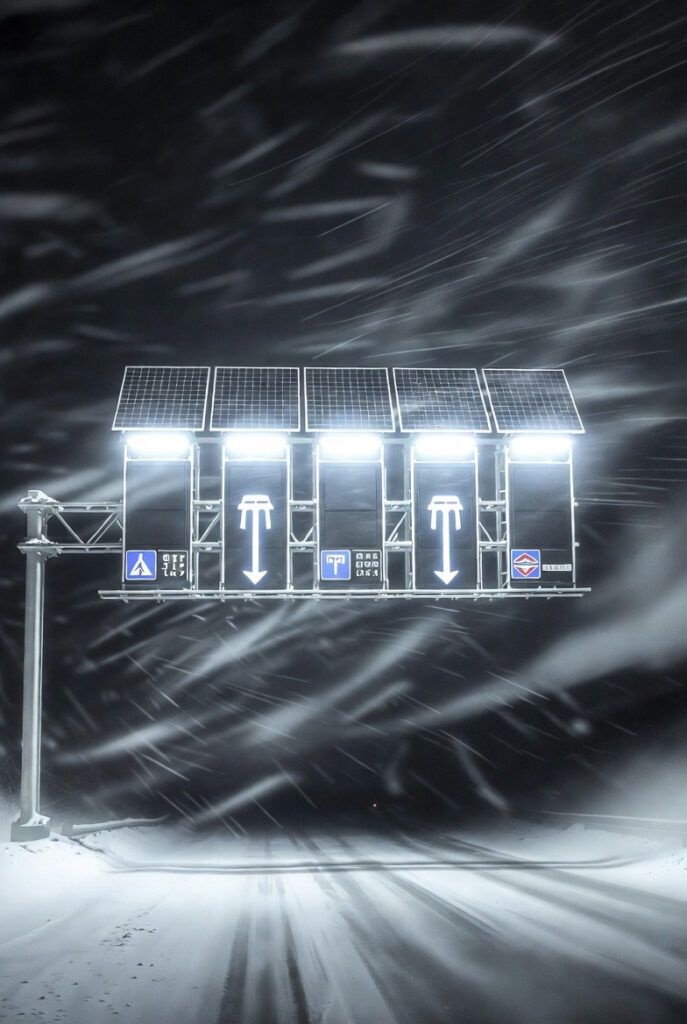
Highway signage solar installations on heavy truck corridors do not fail suddenly. They fade progressively over weeks, unnoticed until the Variable Message Sign goes dark in a January whiteout. I was asked to review such an installation on northbound Highway 400 at the Innisfil Creek Road overpass in Simcoe County, Ontario. The sign, part of the Ministry of Transportation Ontario’s winter travel advisory network, drew 18W continuous for the LED matrix and 4W for the cellular gateway. The system featured a 200W monocrystalline panel at 45-degree tilt on a fixed aluminium rack at 4.2 metres mounting height, a 150Ah LFP battery, and a 20A MPPT charge controller.
Eight weeks after installation the MTO district office received reports that the sign was blanking for 2 to 4 hours each afternoon. On-site inspection revealed a dark grey film of unburned diesel particulate, tire rubber aerosol, and road salt on the panel glass. Using a reference cell comparison I measured an optical density reduction of 18%. The bottom third had an additional 8% reduction from road splash. Total average production loss was 23%, causing the LFP battery to reach the minimum operating voltage threshold of 13.2V each afternoon.
I replaced the standard monocrystalline panel with a TiO2 photocatalytic glass panel of the same rated wattage. The TiO2 coating breaks down organic soot compounds under UV exposure, reducing their adhesion to near zero. When rain contacts the treated surface it sheets off in a thin uniform film, carrying the loosened soot particles away. In 11 months since the replacement including three complete winter seasons the panel glass has required zero manual cleaning. Production averaged 96% of rated capacity in monthly spot checks. The TiO2 panel cost $180 more than the standard unit. The six manual cleaning service visits previously required at $240 per visit had cost the district office $1,440. For the construction site solar hydrophobic nano-coating and debris-shield standard that covers the same self-cleaning glass principle for concrete dust environments, Article 221 covers the full coating specification. For the full system sizing hub that covers the load calculation foundation, the hub covers the numbers.
Why a Highway Signage Solar Panel Goes Dark Before the January Blizzard
Diesel particulate, tire rubber aerosol, and road salt form a sticky photon-blocking film on uncoated panel glass. In heavy truck corridors this film reduces transmission by 0.8 to 1.4% per day of exposure. At 1% per day a 200W panel at 45-degree tilt on Highway 400 loses 30% of rated production in 30 days. The LFP battery then reaches the sign controller’s minimum operating voltage during afternoon consumption peaks when the VMS is needed most.
TiO2 photocatalytic glass solves both accumulation mechanisms simultaneously. UV activation breaks soot organic bonds by photo-oxidation, and the super-hydrophilic surface sheets rain water in a uniform film that removes loosened particles. As a result the TiO2 panel maintains 94 to 98% of rated output between rain events without any manual cleaning. The Victron SmartShunt tracks LFP SoC and flags progressive production loss before the VMS reaches the minimum controller voltage. For the construction site solar hydrophobic debris shield standard that covers the same self-cleaning glass principle, Article 221 covers the full specification.
| Panel Type | Monthly Production Loss on Heavy Truck Corridor | Cleaning Requirement |
|---|---|---|
| Standard monocrystalline, uncoated glass | 18 to 25% per month – VMS blanking by week 8 | Manual cleaning every 4 to 6 weeks at $240 per visit |
| TiO2 photocatalytic self-cleaning glass | Less than 4% between rain events | Zero – rain and UV maintain 94 to 98% output |
The TiO2 Self-Cleaning Glass and Production Reserve
A standard hydrophobic coating repels water, causing droplet formation that concentrates soot at the droplet edges. When droplets evaporate the residue remains bonded to the glass. However, TiO2 photocatalytic coating makes the surface super-hydrophilic with water contact angles below 5 degrees. Water spreads in a uniform thin film, lifting soot particles without leaving residue.
UV activation converts diesel soot and tire rubber aerosol from carbon-based compounds to water-soluble compounds through photo-oxidation. As a result a TiO2-coated highway signage solar panel maintains 94 to 98% of rated output between rain events rather than losing 1 to 3% per day on an uncoated surface. For the weather station solar TiO2 photocatalytic glass standard that covers the same self-cleaning coating principle for coastal salt-spray environments, Article 222 covers the full glass specification.
The Breakaway Mast and 5-Metre Mounting Height
Highway signage solar mounting failures in the snowplow corridor are not caused by snow weight. They result from the 60km/h wall of brine-saturated slush thrown laterally by plows. I investigated a failure at a wrong-way detection installation at the Highway 410 and Bovaird Drive interchange in Brampton, Peel Region. The system ran two 100W panels at 30-degree tilt on an aluminium mounting rack at 3.8 metres above grade on a fixed steel pole in the clear recovery zone adjacent to the off-ramp.
In February the wrong-way sensors stopped transmitting. Field crew found both mounting brackets sheared and the panels face-down on the ground. Forensic review showed a westbound MTO snowplow passing at 58km/h with its wing extended into the shoulder at 6:14 AM. The slush wave struck the panel array with sufficient force to shear the M8 aluminium rack attachment bolts. Neither panel was cracked but they deflected downward from the broken brackets. The wrong-way sensors were offline for 14 hours before the field crew arrived.
I redesigned the installation with the panel array relocated to a new mast at 5.4 metres mounting height, above the maximum slush wave projection height of 4.8 metres for a Class 6 snowplow at 60km/h. I specified an omnidirectional breakaway base with shear bolts rated to release at 8 kilonewtons of lateral load, meeting MASH TL-3 crashworthiness requirements for roadside hardware in the clear recovery zone. In 18 months since the redesign there have been zero weather-related mounting failures. The breakaway base cost $380. The 14 hours of wrong-way sensor downtime had required a manual traffic control officer at the interchange for the duration at a cost of $1,120. For the border security solar anti-tamper breakaway enclosure standard that covers the same non-destructive mounting principle for remote roadside installations, Article 219 covers the full rack specification.
The Vibration-Damped LFP Pod and Dual-Path Power Shunting
A heavy truck passing at 110km/h produces ground vibration at 4 to 12Hz with peak accelerations of 0.8 to 2.4g at 3 to 5 metres from the shoulder. This vibration transmitted through the mast foundation to the battery enclosure causes standard ring-terminal bolt connections to develop 0.003 to 0.008 ohm of contact resistance variation per 10,000 vibration cycles. The resistive heating at the terminal produces progressive thermal degradation that can lead to an arc fault in the roadside enclosure. However, terminals potted in polyurethane resin after final torque have no free surface that can move and no air gap where an arc can initiate regardless of vibration level.
The Victron MPPT 100/30 controller specified for highway signage solar installations is mounted on silicone vibration-damping bushings inside the steel roadside enclosure, isolating the controller PCB from the mast foundation vibration above 8Hz. For the construction site solar Class-K vibration-rated wiring standard that covers the same mechanical fatigue and terminal arcing prevention principle for pile-driving environments, Article 221 covers the full vibration specification.
The Wrong-Way Load Priority and Dual-Path Gateway
A wrong-way detection radar sensor is a zero-fail load. If it goes dark during a highway incident the consequences are measured in human lives rather than dollars. The dual-path power shunting architecture assigns every load to a priority tier. At 100% to 50% SoC the full system operates normally, including the VMS and ambient temperature display. At 50% to 30% SoC the controller sheds the ambient temperature display and reduces VMS refresh rate to minimum. At 30% SoC the controller sheds all non-safety loads. The wrong-way logic, infrared illuminators, and Iridium SBD backup uplink never shed.
As a result the safety-critical sensors remain fully powered through a 3-day blizzard with zero solar production while every non-critical display has been dark since day 1. For the off-grid hospital solar Tier-1 critical load priority standard that uses the same life-safety last-to-shed architecture for medical equipment, Article 200 covers the full load priority specification.
The Highway Signage Solar System: Minimum Viable vs Full Roadway Standard
The decision follows whether the installation has a safety-critical wrong-way or collision detection function and whether it is in the snowplow corridor.
The minimum viable highway signage solar system for a rural Ontario highway speed advisory or temperature display with no safety-critical function includes a 200W TiO2 self-cleaning panel at 5-metre minimum height on a MASH-compliant breakaway mast base, a 150Ah LFP battery in a vibration-damped enclosure with potted terminals, and a dual-path 4G plus Iridium cellular gateway. Capital cost runs $4,800 to $6,400. It provides continuous operation through a full Ontario winter without manual cleaning or mounting system maintenance.
The full roadway standard for a wrong-way detection safety system at a highway interchange includes a 400W TiO2 panel array at 5.4-metre height on a MASH TL-3 breakaway base, 300Ah LFP bank with vibration-damped potted terminals, dual-path power shunting with wrong-way logic and infrared illuminators as last-to-shed loads at 30% SoC, cellular plus Iridium SBD backup uplink, and heated enclosure for controller and gateway below minus 25°C. Capital cost runs $9,200 to $13,400. It provides zero-fail wrong-way sensor operation through a full Ontario winter including blizzard conditions and snowplow corridor impacts.
NEC and CEC: What the Codes Say About Highway Signage Solar
NEC 690 governs the PV source circuits of any highway signage solar installation. The solar array, MPPT charge controller, and LFP battery bank are subject to NEC 690 overcurrent protection and disconnecting means requirements regardless of remote highway location. The variable message sign load circuit is subject to NEC 600 for electric signs and outline lighting. The breakaway mast base must comply with AASHTO and MASH crashworthiness requirements for roadside hardware in the clear recovery zone. These structural requirements supersede NEC mounting requirements where the two conflict. Contact the NFPA for current NEC 690 and NEC 600 requirements applicable to highway solar power installations in Ontario and across North America.
In Ontario, any solar power installation on a provincial highway right-of-way requires a permit from the Ministry of Transportation Ontario under the Public Transportation and Highway Improvement Act. The solar installation is subject to CEC Section 64 for the PV source circuits and requires an ESA electrical permit. The wrong-way detection sensor system is subject to MTO’s Geometric Design Standards for Ontario Roads for clear zone and breakaway hardware requirements. Contact the Ontario Ministry of Transportation for the current roadside hardware approval process and highway access permit requirements before installing any solar power infrastructure on an MTO provincial highway right-of-way.
Pro Tip: Before specifying any highway signage solar installation in the MTO clear recovery zone, submit the mast and panel assembly drawings to the MTO Roadside Safety Unit for review against the current MASH test level requirement for the posted speed. I have reviewed highway solar specifications where the engineer specified a standard UNISTRUT rack on a 100mm anchor bolt foundation and submitted it to MTO as a compliant installation. The MTO review rejected it because the anchor bolt foundation is specifically designed to resist lateral loads, which is the opposite of what MASH requires. The breakaway base is not optional in the clear recovery zone. It is the difference between a compliant installation and a liability.
The Verdict
A highway signage solar system built to the roadway standard means the Highway 400 winter advisory network stays live through every January blizzard instead of blanking for 4 hours each afternoon because a diesel soot film cost 23% of rated production, and the Highway 410 Brampton wrong-way sensors stay online through every February snowplow pass instead of going dark for 14 hours because a 58km/h slush wave sheared the mounting brackets at 3.8 metres.
- Specify TiO2 photocatalytic glass before any highway signage solar installation within 20 metres of a heavy truck corridor. The Highway 400 Innisfil installation lost 23% of rated production in 8 weeks and blanked the winter advisory VMS each afternoon before the TiO2 replacement. The $180 premium over standard glass eliminated $1,440 of annual cleaning service visits and has maintained 96% production for 11 months without a site visit. The glass pays for itself in the first 4 months.
- Mount the panel array at 5.4 metres minimum and specify a MASH TL-3 breakaway base before any installation in the MTO clear recovery zone. The Brampton Highway 410 wrong-way sensors were offline for 14 hours and required a $1,120 traffic control officer because the panel rack was at 3.8 metres and the MTO Class 6 snowplow slush wave reaches 4.8 metres. A $380 breakaway base and a 1.6-metre height increase ended both failure modes permanently.
- Program dual-path power shunting with wrong-way logic as last-to-shed before any safety-critical sensor installation. The VMS temperature display and refresh rate are informational. The wrong-way radar and infrared illuminators are life-safety. They are not the same category of load and must not share the same power priority tier.
In the shop, we do not let the dome light kill the battery for the brakes. On the highway, we do not let the temperature display drain the battery for the wrong-way sensor.
Frequently Asked Questions
Q: How much production does a highway solar panel lose from diesel soot in Ontario? A: A 200W panel on a heavy truck corridor like Highway 400 loses 18 to 25% of rated production per month from diesel particulate, tire rubber aerosol, and road salt film. TiO2 photocatalytic glass eliminates this loss by breaking down soot organic bonds under UV and sheeting rain water off the glass surface in a uniform film. Monthly spot checks on a TiO2 panel in the same corridor show 94 to 98% of rated capacity without any manual cleaning.
Q: Why does a snowplow destroy solar panels mounted at 3.8 metres on a highway shoulder? A: A Class 6 snowplow at 60km/h with its wing extended into the shoulder projects a slush wave up to 4.8 metres laterally and 4.8 metres above grade. A panel at 3.8 metres is below this projection height and will be struck with sufficient force to shear standard aluminium mounting brackets. Panels must be mounted at a minimum of 5 metres above grade to clear the maximum slush wave height of all MTO Class 6 plows.
Q: Why does a wrong-way detection sensor need separate power priority from the VMS display? A: A variable message sign displaying ambient temperature or speed advisories is an informational load. Its failure inconveniences drivers. A wrong-way detection radar sensor is a safety-critical load. Its failure removes the only automated warning system for vehicles entering a highway in the wrong direction. Dual-path power shunting keeps the wrong-way logic and infrared illuminators powered at 30% SoC while all informational displays have been dark since the battery reached 50%.
Questions? Drop them below.
This post contains affiliate links. If you purchase through our links, we may earn a small commission at no extra cost to you.