
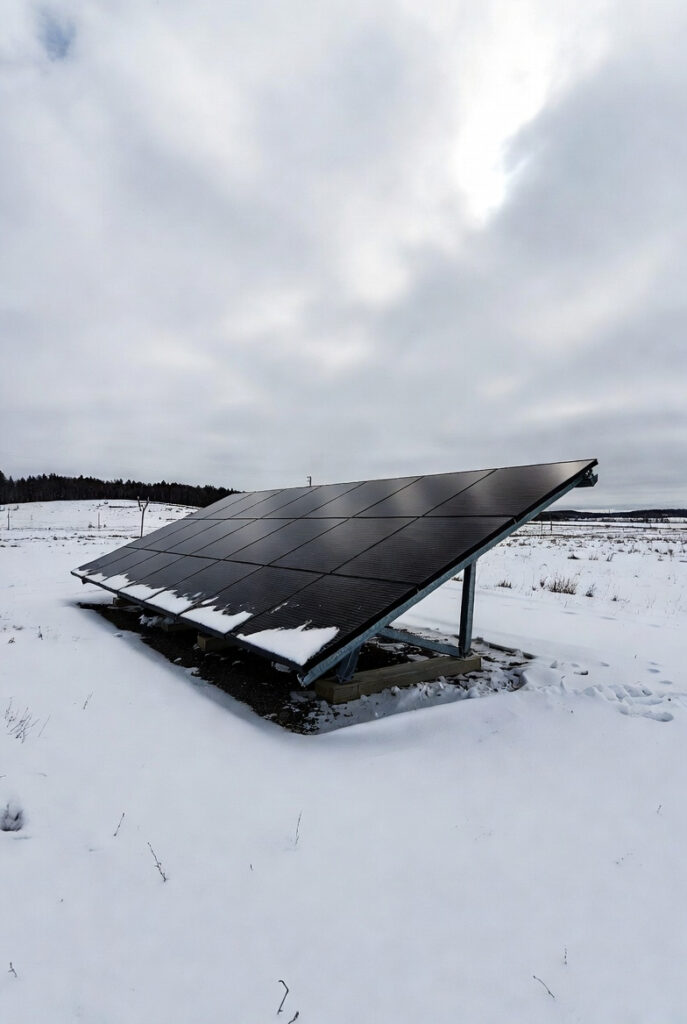
It is 7:00 AM in Rockwood Ontario and -18°C with a fresh layer of wet snow on your roof-mounted solar panels. Do you want to be on that icy 30° pitch with a foam rake and a safety harness or do you want to be standing in your driveway in boots clearing ground-mounted panels with a squeegee in under 5 minutes? That question is the entire ground mount vs roof mount solar debate for anyone living north of 43°N latitude.
Amanda asked me last February why I was spending 45 minutes on the roof with a foam rake when I could have cleared a ground-mounted array from the driveway in 5 minutes. She was right. That conversation convinced me that adjustable ground mounts are the long-term answer for anyone serious about off-grid power in Ontario.
Ground Mount vs Roof Mount Solar: The Core Trade-Off
The simple version: Roof mount uses your existing structure as the foundation lower upfront cost, no land required, invisible from the street. Ground mount requires its own foundation higher upfront cost, requires land, fully accessible from the ground year-round.
Why the trade-off matters more in cold climates: In California the ground mount vs roof mount solar decision is mostly about cost and aesthetics. In Ontario, Minnesota, and Montana it is about survival. Snow clearing. Tilt adjustment. Ice dam prevention. Frost heave. Roof leak risk. Every cold climate factor favors ground mounting for off-grid primary residences.
The Roof Mount Reality – What the Brochure Does Not Tell You
The genuine pros:
- Uses existing roof structure – no separate foundation cost
- Lower hardware cost – roof rails are simpler than ground racking
- No land footprint required – important for small properties
- Aesthetically integrated – panels less visible from the street
Snow clearing requires roof access: Every snow clearing event is a safety risk. A 30° roof pitch covered in wet snow at -18°C is a genuine fall hazard. Most homeowners either do not clear their panels accepting production loss or take dangerous risks doing so. Ground mount eliminates this entirely. Safe feet on the ground is a survival priority.
Fixed tilt is nearly permanent: Adjusting roof-mounted panels to the optimal winter angle of latitude + 15° requires removing and remounting every panel. It is effectively impossible for most homeowners. The panels stay at the installation angle usually a compromise that underperforms in winter. Our Solar Panel Tilt Angles for Ontario Winters guide covers exactly what you are losing.
Ice dams – the hidden cost: Roof-mounted panels with insufficient air gap create perfect conditions for ice dam formation. Ice dams force meltwater under shingles causing interior water damage. The panels did not cause the leak but they made it far more likely. Our Solar Panel Snow Load guide covers the 100mm air gap requirement in detail.
The roof leak engine pull: This is the detail nobody puts in roof mount brochures. If your roof develops a leak under the solar array from a failed penetration, a cracked shingle, or an ice dam finding it requires removing every panel above the affected area. That is a full day of labor at electrician and roofer rates. A roof leak under a solar array is a $3,000-5,000 diagnostic job before a single shingle is replaced. On a ground mount there is no roof to leak.
The Ground Mount Advantage What Actually Matters in the North
Snow clearing in seconds: Stand on the ground. Use a squeegee or foam roof rake. Done in under 5 minutes for a typical residential array. No ladder. No harness. No ice risk. Amanda can clear the panels. The kids can clear the panels. Safe feet on the ground is not a convenience it is a survival priority when the temperature is -25°C and you need those panels producing.
Optimal winter tilt actually achievable: A ground-mounted adjustable rack can be set to 60-65° for winter and 30-35° for summer in under an hour. Twice per year adjustment recovers 15-25% more annual production compared to a fixed roof mount angle. The ground mount owner is capturing the winter sun the roof mount owner is missing entirely.
Better cooling in summer: Panels lose approximately 0.4% efficiency per degree above 25°C. Ground-mounted panels have airflow on both front and back surfaces. Roof-mounted panels trap heat between the panel and the roof. In Ontario summers ground-mounted panels run 10–15°C cooler than roof-mounted equivalents producing measurably more power during the hottest months.
The albedo bonus is stronger on the ground: Ground-mounted panels at 60° winter tilt sit closer to the snow-covered ground. The reflected light from fresh snow albedo 0.8-0.9 enters the panel from below at a more favorable angle than on roof-mounted systems. Ground mount owners in Ontario and Minnesota see 10-15% additional production from snow albedo that roof-mounted panels miss entirely.
Expandability without roof risk: Adding panels to a ground mount means extending the rack. Adding panels to a roof mount means finding roof space, running new wiring, and creating new penetration points every one a potential leak. Every expansion of a roof mount is a new risk.
The Ground Mount Cons – The Real Ones
Cost: A ground-mounted system costs 10-25% more than a roof-mounted equivalent due to the separate racking structure and concrete footings. For a 4kW system in Ontario the additional cost is typically $1,500-3,000 CAD. Over a 25-year system life this premium is recovered through better winter production and eliminated maintenance costs.
Land requirement: A 4kW array requires approximately 25-30 square meters of ground space plus clearance for snow shedding and maintenance access. Rural Ontario and Minnesota properties typically have this space. Urban and suburban properties may not.
Trenching for underground wiring: DC wiring from a ground mount to the house must run underground minimum 450mm depth in Ontario for direct burial cable or 300mm in conduit. Use 10AWG solar extension cable rated for direct burial applications. A typical 15-30 meter trench run adds $500-1,500 to installation cost depending on ground conditions.
Permitting complexity: Ground mounts are classified as new construction in most Ontario municipalities. Expect a building permit, setback requirements from property lines, and potentially an engineering drawing for the footing design. Budget $500-1,500 for permitting and engineering documentation.
Frost Heave – The Ground Mount Killer Nobody Mentions
This is the cold climate detail completely absent from every ground mount vs roof mount solar comparison guide.
What frost heave is: When soil freezes it expands. When it thaws it contracts. This freeze-thaw cycle exerts enormous upward force on anything embedded in the soil above the frost line. A ground mount footing that does not extend below the frost line will move shifting upward in spring and settling unevenly in fall. Over 2-3 seasons the racking frame twists, panel alignment is lost, and rail connections develop stress fractures.
Ontario frost line depths:
- Southern Ontario (Guelph, Rockwood, Toronto): 1.2-1.5 metres
- Central Ontario: 1.5-1.8 meters
- Northern Ontario, Minnesota, Montana: 1.8-2.1 metres
The minimum footing standard: Ground mount footings in Ontario must extend a minimum of 1.5 metres below grade. Helical pier installations reaching 1.8-2.1 metres are preferred for permanent off-grid systems. Concrete tube footings (Sonotubes) poured to 1.5 metres are acceptable for most southern Ontario installations.
The amateur mistake: Driven stakes or footings poured only 600-900mm deep look solid at installation. By year 2 they have heaved 50-100mm unevenly twisting the entire racking frame. The panels still work but the frame is permanently stressed and wiring connections have been pulled. This is a complete reinstallation far more expensive than doing it right the first time.
The Decision Matrix
| Your Situation | Recommendation |
|---|---|
| Rural property, space available, primary residence | Ground mount – no exceptions |
| Ontario winter, off-grid survival priority | Ground mount – safety and production |
| Urban/suburban, limited yard space | Roof mount – no alternative |
| Seasonal cottage, grid-tied backup | Roof mount – adequate for use case |
| Existing roof mount, considering switch | Add ground mount for critical circuits |
| New build, designing system from scratch | Ground mount – design it in from day one |
Pro Tip: If you are designing a new off-grid system in Ontario, Minnesota, or Montana and have any available ground space design the ground mount first and treat roof mount as the fallback. The wiring trench is your largest incremental cost. If you trench for 4 panels design the trench to accommodate 8. Future expansion costs only additional panels and racking the trench and footing work is already done. This single planning decision saves $2,000-3,000 on future expansion.
The Verdict
The ground mount vs roof mount solar debate in the North is not really a debate. It is a question of whether you want a system optimized for summer production and minimum installation cost or a system optimized for year-round survival, safe maintenance, and maximum winter output.
Roof mount: lower cost, less space, permanent compromise on winter performance and maintenance access.
Ground mount: higher cost, requires land, adjustable tilt, safe snow clearing, no roof penetration risk, better cooling, stronger albedo boost.
In Ontario, Minnesota, and Montana for a primary residence ground mount wins. If you have the space build it right the first time.
Disclosure: This article contains affiliate links. If you buy through them, GridFree Guide earns a small commission at no extra cost to you.