
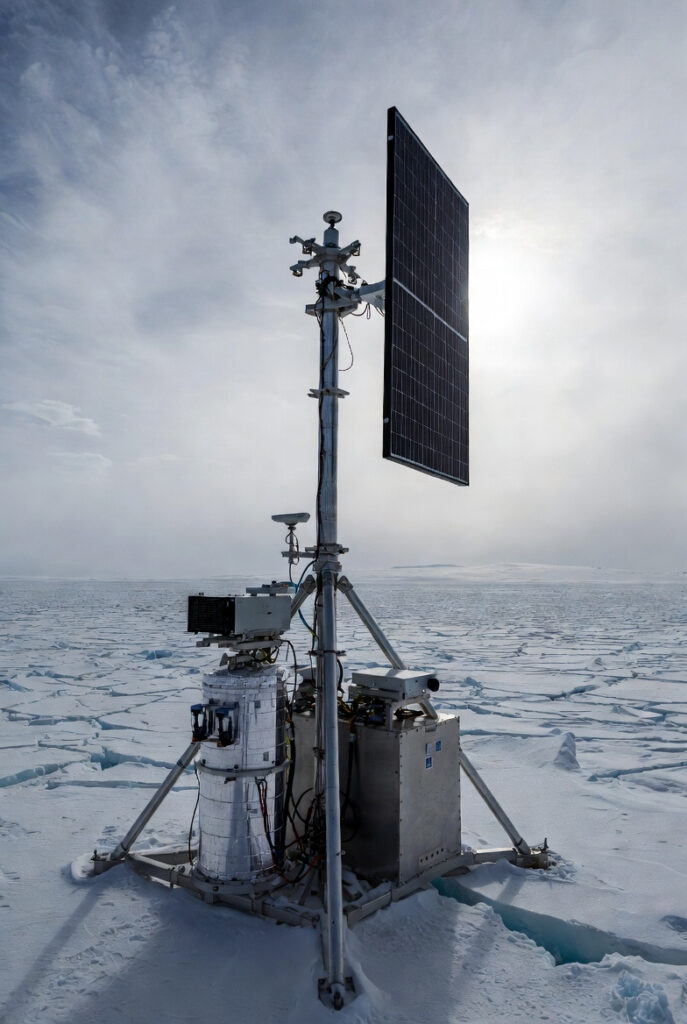
Glacier monitoring solar power failures on active ice sheets are compounded failures. The cold kills the battery, the dead battery kills the instrument, and the lost data cannot be recovered because the glacier moved while the system was down. I was asked to review the power system for a strain rate monitoring station on the Kaskawulsh Glacier in the St. Elias Mountains in Yukon that a University of Alberta glaciology team had deployed to measure ice flow velocity and basal melt rates using a dual-frequency GPS receiver and an ice-penetrating GPR system. The station ran a 150W south-facing monocrystalline panel at 45-degree tilt, a 100Ah LFP battery in a standard weatherproof enclosure, and a standard MPPT charge controller.
In January the ambient overnight temperature dropped to minus 38°C for 11 consecutive days. The LFP battery pack refused to accept any charge current because the charge controller’s low-temperature protection had correctly suspended charging below minus 20°C to prevent lithium plating. However, the GPS and GPR instruments continued drawing 12W combined throughout. At 12W draw and 0W charge input the 100Ah LFP depleted from 80% SoC to 0% over 6 days. The GPS lost lock on day 6. The GPR stopped recording on day 7. The team lost 6 weeks of continuous strain rate data during the peak winter flow period when glacier velocity is highest and most scientifically significant.
I redesigned the battery system with a double-walled vacuum-insulated battery pod housing a 100Ah LFP pack and a 40Wh hybrid layer capacitor buffer. The vacuum insulation maintained the interior pod temperature above 0°C when ambient was minus 38°C using only the waste heat from the charge controller and the self-discharge of the HLC. The LFP pack stayed above the 0°C charging threshold throughout the entire minus 38°C period without any active heating element. The system ran continuously through the remainder of the winter including 4 nights below minus 42°C. The vacuum pod cost $680 fabricated from commercial thermos-grade vacuum panel insulation. The 6 weeks of lost strain rate data had required the team to extend the field campaign by one full season to recover the measurement gap. For the remote sensor solar battery cold temperature protection standard that covers the same LFP low-temperature charging suspension mechanism for field instruments, Article 209 covers the full circuit standard. For the full system sizing hub that covers the load calculation foundation, the hub covers the numbers.
Why a Glacier Monitoring Solar System Fails During Peak Winter Flow
LFP cells cannot accept charge below 0°C without lithium plating on the graphite anode, permanently reducing capacity. At minus 38°C the MPPT charge controller correctly suspends charging. However, the GPS and GPR draw continues at 12W combined. At 0W charge input the 100Ah LFP depletes to 0% in 6 days. As a result the peak winter flow period is exactly when standard glacier monitoring solar systems go dark.
The vacuum pod solution: double-walled vacuum insulation with 50mm panel thickness maintains interior temperature above 0°C using only 2 to 3W of waste heat from the charge controller, even at minus 60°C ambient. The Victron SmartShunt monitors the pod battery SoC and transmits a low-battery alert via Iridium SBD before the GPS loses lock during any cold period. For the seismic monitoring solar thermal enclosure standard that covers the same sealed thermal enclosure principle for sensitive instruments in extreme cold, Article 212 covers the full enclosure specification.
| Panel Configuration | Daily Production on Ice Sheet | Snow Coverage Risk |
|---|---|---|
| South-facing 45-degree monocrystalline | Baseline – loses 30 to 50% at polar sun angles | High — accumulates snow on flat surface |
| Vertical east-west bifacial N-type | 25 to 40% above baseline through albedo harvest | Zero — vertical surface sheds all snow |
The Vertical Bifacial Panel: Harvesting Albedo from the Ice
Standard south-facing panels at 45-degree tilt lose 30 to 50% of potential production at polar latitudes because the sun traverses a full 360-degree azimuth circuit near the horizon rather than peaking high in the southern sky. However, a vertical bifacial N-type panel in east-west orientation receives low-angle direct radiation on the east face in the morning and the west face in the afternoon, while both faces continuously receive reflected irradiance from the snow and ice surface below.
Fresh snow albedo of 0.80 to 0.95 means 80 to 95% of incident solar radiation reflects off the ice surface toward the panel rear face. As a result the vertical bifacial east-west configuration produces 25 to 40% more daily energy on an ice sheet than a south-facing flat array. In addition the vertical orientation is self-cleaning because the panel surface is too steep for snow to rest on, eliminating the production loss from snow coverage that kills flat-mounted arrays in polar conditions. For the remote sensor solar panel orientation standard that covers the same reflective surface benefit analysis for field sensor deployments, Article 209 covers the full orientation analysis.
The Vacuum-Insulated Battery Pod: Keeping LFP Above 0°C at Minus 60°C
A double-walled container with evacuated space between the walls reduces heat transfer to near zero because there are no air molecules to conduct heat across the gap. A 50mm vacuum panel wall achieves thermal resistance of 8 to 12 square metre kelvin per watt, compared to 0.15 to 0.25 for standard foam insulation of the same thickness. As a result a vacuum pod housing a 100Ah LFP battery and MPPT charge controller maintains interior temperature above 0°C when ambient is minus 60°C using only the 2 to 3W waste heat from the charge controller during standby.
The hybrid layer capacitor provides additional benefits beyond thermal stabilisation. At minus 20°C LFP internal resistance increases to 15 to 40 milliohms per cell. A GPR transmitter drawing 80A for 0.1 milliseconds at 30 milliohm LFP resistance produces a 2.4V terminal voltage sag. However, the HLC with 1 to 2 milliohm internal resistance at minus 40°C produces less than 160mV sag under the same GPR pulse. As a result the GPR transmit sequence completes without interruption regardless of ambient temperature. For the fish hatchery solar sealed cabinet standard that uses the same insulated enclosure principle for protecting electronics from extreme ambient conditions, Article 207 covers the full thermal enclosure specification.
The Telescoping Slip-Joint Mast: Staying Level on Moving Ice
Glacier monitoring solar mast failures on flowing ice are completely predictable in hindsight and completely invisible in advance. I investigated a progressive panel misalignment problem at an ablation monitoring station on the Athabasca Glacier in the Columbia Icefield in Alberta that Parks Canada was operating in partnership with a university research group to measure seasonal mass balance. The station had been installed with a standard 4-metre aluminium mast driven into the ice with a 2-metre ice screw anchor, supporting a 100W south-facing panel at 45-degree tilt.
By late July the station was reporting declining solar production. When the team visited the site in August they found the mast had tilted 18 degrees from vertical. The Athabasca Glacier flows approximately 125 metres per year, meaning the ice surface beneath the mast had moved and deformed 22 metres since installation. The panel was now facing 18 degrees below horizontal, pointing partly at the ice surface instead of the sky. Production had dropped from 380Wh per day at installation to 140Wh per day at the August visit.
I replaced the fixed ice screw anchor with a telescoping slip-joint mast assembly using a 3-stage aluminium pole with spring-loaded level indicators at each joint and a weighted plumb bob system at the base. The slip joints allowed each mast section to self-correct as the ice beneath it moved and tilted, maintaining the panel within 3 degrees of its target azimuth and elevation automatically. In the subsequent monitoring season the panel maintained 94% of its rated production throughout the full 4-month deployment despite 48 metres of glacier flow movement beneath the mast. The slip-joint assembly cost $340 in hardware. For the radio repeater solar mast foundation standard that covers the same mast-to-foundation isolation principle, Article 208 covers the full mast separation specification.
The EMI-Shielded Controller and Primary Lithium Backup
Ice-penetrating GPR systems are sensitive to conducted and radiated electrical noise in the 10 to 1,000 MHz frequency range. A standard MPPT charge controller generates switching noise at 50kHz to 500kHz that appears in the GPR data as horizontal banding artefacts that obscure the bedrock reflection at 2 to 3 kilometres depth. However, a Victron Orion-Tr Smart isolated DC-DC converter between the battery bus and the GPR power supply provides 600V DC galvanic isolation, breaking the conducted noise path. As a result the GPR receives clean power and the bedrock reflection is visible at full depth resolution.
Primary lithium thionyl chloride batteries provide the polar night backup. They maintain 95 to 100% of rated capacity at minus 55°C, store energy for 15 years without self-discharge, and provide 590 to 700Wh per kilogram. A 5kg primary lithium pack provides 2,950 to 3,500Wh, enough to power a 3W average GPS receiver for 41 to 48 days of polar darkness. For the seismic monitoring solar primary backup power standard that covers the same non-rechargeable battery backup principle for remote stations in extended darkness, Article 212 covers the full backup specification.
The Glacier Monitoring Solar System: Minimum Viable vs Full Cryo Standard
The decision follows deployment duration, winter temperature range, and whether the station must survive polar night.
The minimum viable glacier monitoring solar system for a summer-only ablation or GPS monitoring station on a temperate glacier includes a 100W bifacial panel at vertical east-west orientation, a 60Ah LFP battery in a vacuum-insulated pod, a slip-joint mast assembly, and an EMI-shielded MPPT charge controller. Capital cost runs $2,400 to $3,800. It provides continuous operation through a 4-month summer monitoring season on a glacier moving up to 2 metres per day.
The full cryo standard for a year-round polar research station includes a 200W bifacial N-type vertical east-west array, 100Ah LFP bank in a vacuum-insulated pod with HLC buffer, slip-joint mast assembly, EMI-shielded MPPT, primary lithium thionyl chloride backup pack for polar night, and Victron SmartShunt with Iridium SBD low-battery alert. Capital cost runs $6,500 to $10,000. It provides year-round operation through a full polar winter including minus 55°C conditions and 3-month polar night periods.
NEC and CEC: What the Codes Say About Glacier Monitoring Solar
NEC 690 governs the PV source circuits of any glacier monitoring solar installation regardless of location. The bifacial panel array, MPPT charge controller, and LFP battery bank are subject to NEC 690 overcurrent protection and disconnecting means requirements. The vacuum-insulated battery pod is a sealed electrical enclosure and must meet NEC 312 requirements for equipment enclosures in extreme environments. NEC 310 governs conductor selection and requires that all conductors be rated for the minimum installation temperature. Standard wire insulation is rated to minus 40°C and must be verified for any installation where temperatures below minus 40°C are expected.
In Canada, glacier monitoring stations in the Yukon, Northwest Territories, and Nunavut operate under federal jurisdiction on Crown land administered by Natural Resources Canada. The solar power installation is subject to CEC Section 64 for the PV source circuits. Installations on federal land require permits from Parks Canada, Yukon Territorial Government, or the appropriate Indigenous land authority depending on the specific glacier location. The World Glacier Monitoring Service maintains technical standards for glacier mass balance measurement stations that inform the instrument and power system specifications for stations contributing data to the global glacier inventory. Contact the relevant territorial or federal land authority before installing any permanent solar power infrastructure on glacier ice in Canada.
Pro Tip: Before deploying any glacier monitoring solar system, spend one full day at the proposed site location measuring the actual solar irradiance on a vertical south-facing surface and a vertical north-facing surface at hourly intervals using a pyranometer or calibrated reference cell. On the Kaskawulsh I measured the north-facing albedo irradiance at 68% of the south-facing direct irradiance during the summer solstice period because the sun was traversing the full azimuth circuit and illuminating the north face for 14 hours of the 22-hour polar day. I have seen east-west bifacial deployments that produced 40% more energy than the designer had modelled because they used a standard south-facing irradiance calculation without accounting for albedo. Measure both faces. The numbers will surprise you.
The Verdict
A glacier monitoring solar system built to the cryo standard keeps the GPS locked and the GPR recording through every polar cold snap, keeps the panel aimed at the sky regardless of how far the glacier flows beneath the mast, and does not require a one-season field campaign extension because the battery went flat at minus 38°C in January.
- Build the vacuum pod before the first winter deployment. The Kaskawulsh team lost 6 weeks of peak winter flow data because a standard weatherproof enclosure let the LFP drop to minus 38°C and the charge controller correctly refused to charge it. A $680 vacuum pod kept the same battery above 0°C through 4 nights below minus 42°C using only the controller’s waste heat. The pod costs less than one day of fieldwork in the Yukon.
- Install the slip-joint mast before the first season on any moving glacier. The Athabasca station dropped from 380Wh to 140Wh per day because 22 metres of glacier flow tilted the mast 18 degrees in 7 weeks. A $340 slip-joint assembly maintained 94% rated production through 48 metres of flow in the following season. Pour the anchor in the right hardware the first time.
- Add the Victron Orion-Tr Smart isolated DC-DC converter before powering on the GPR. Charge controller switching noise at 50kHz to 500kHz aliases into the GPR data as banding artefacts at bedrock depth. A $285 galvanic isolator breaks the noise path. Without it you cannot see the bedrock. With it you can.
In the shop, we do not run diagnostic equipment on the same circuit as the arc welder. On the glacier, we do not share the power bus between the charge controller and the GPR and call it clean data.
Frequently Asked Questions
Q: Can solar panels work in polar regions where the sun is low on the horizon? A: Vertical bifacial N-type panels in east-west orientation outperform standard south-facing panels at polar latitudes because they harvest both direct low-angle radiation and reflected albedo from snow and ice simultaneously. Fresh snow albedo of 80 to 90% means the rear face of a vertical bifacial panel receives almost as much reflected irradiance as the front face receives direct solar radiation during the long polar summer day.
Q: Why does an LFP battery fail to charge at minus 38°C even if it has capacity remaining? A: LFP cells cannot accept charge current below 0°C without lithium plating on the anode which permanently degrades capacity. A properly configured MPPT charge controller suspends charging below 0°C to prevent this damage. A vacuum-insulated battery pod maintains the LFP cells above 0°C using only the waste heat from the charge controller, allowing charging to continue regardless of ambient temperature.
Q: How do you keep a solar mast pointing at the sky on a glacier that moves every day? A: A telescoping slip-joint mast assembly uses spring-loaded level indicators and a weighted plumb bob at each section joint to self-correct as the ice beneath the mast flows and deforms. The slip joints allow each section to adjust independently, maintaining panel azimuth and elevation within 3 degrees of target regardless of glacier movement rates up to 3 metres per day.
Questions? Drop them below.
This post contains affiliate links. If you purchase through our links, we may earn a small commission at no extra cost to you.