
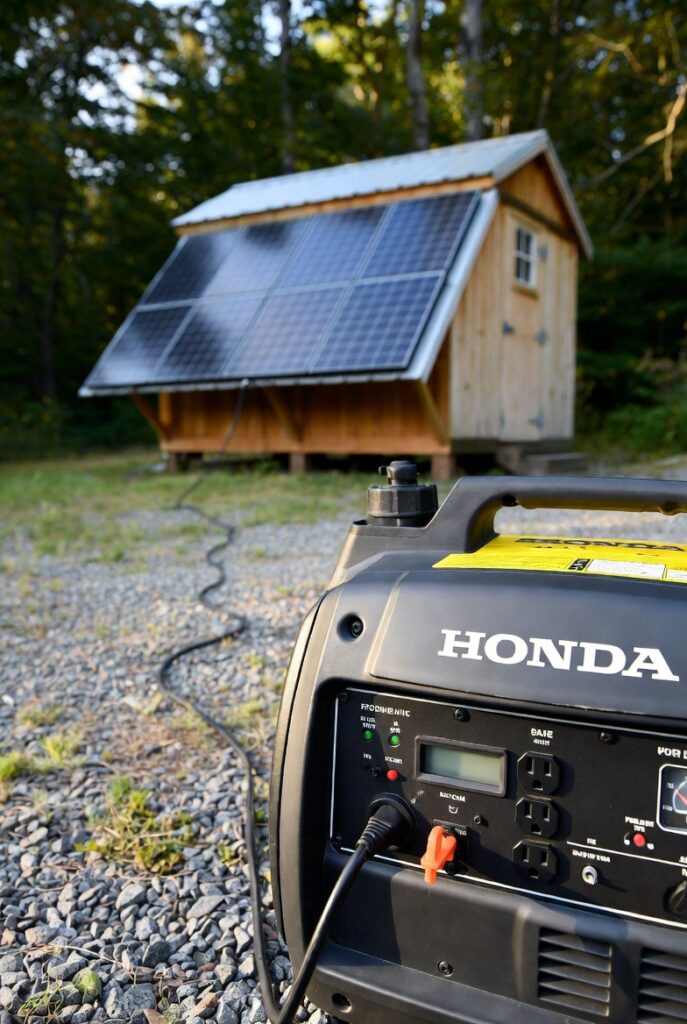
Generator ground bond failures between a Honda EU2200i and a Victron MultiPlus-II are not compatibility problems. They are a $15 bonding plug solution disguised as a $5,000 equipment conflict. I was called to diagnose a generator charging fault at a rural acreage property on the 9th Line of Centre Wellington Township in Wellington County, Ontario where the owner had installed a Victron MultiPlus-II 12/3000 as the primary inverter-charger for an off-grid solar system and had purchased a Honda EU2200i portable inverter generator as the backup charging source for extended cloudy periods. The owner had connected the Honda to the MultiPlus AC input through a properly rated 30-metre extension cord and switched the generator on. The MultiPlus immediately displayed a ground relay fault on the Cerbo GX screen and refused to accept AC input.
The owner had attempted to charge using the generator 14 times over 3 days, each time receiving the same fault. He had called the Victron dealer who suggested the Honda might be incompatible with the MultiPlus. He had then called Honda support who said the generator was functioning normally. After 3 days of unsuccessful charging attempts the battery bank had dropped from 82% SoC to 31% SoC from continuous off-grid load draw. The owner was preparing to drive 140 kilometres to Kitchener to purchase a different generator at a cost of $1,400 when his neighbour suggested calling a technician first. I arrived, connected a standard 3-lamp outlet tester to the Honda EU2200i receptacle, and confirmed the generator had a floating neutral. The ground lamp was unlit, confirming zero voltage between neutral and ground at the generator output. The MultiPlus internal ground relay was correctly refusing AC input because it detected an unbonded neutral on the incoming AC source. I installed a neutral-ground bonding plug in the second receptacle of the Honda EU2200i, reconnected the extension cord, and switched the generator on. The MultiPlus produced a single audible click as the internal ground relay closed and the AC input LED illuminated green. The system began charging the battery bank at 70A within 4 seconds of the click. The bonding plug cost $14.80. The battery bank recovered from 31% to 84% SoC in 3 hours and 20 minutes.
The floating neutral is not a Honda design flaw. It is the correct electrical architecture for a portable generator that might be connected to a building panel that already has a neutral-to-ground bond at the service entrance. NEC 250 and CEC Section 10 require the neutral-to-ground bond to occur at only one point in any AC system, and a second bond would create a parallel ground path. The Victron MultiPlus manages the bond correctly when it knows the source it closes its own internal relay in inverter mode and defers to the source in pass-through mode. The only information missing is the confirmation that the source has a bond. The bonding plug provides that confirmation in a single $14.80 component. For the workshop solar power MultiPlus-II LF transformer and PowerAssist mode standard that covers the same MultiPlus internal relay architecture, Article 243 covers the full specification. For the full system sizing hub that covers the load calculation foundation, the hub covers the numbers.
Why the Generator Ground Bond Fails the Victron MultiPlus Test
The Victron MultiPlus-II internal ground relay is a physical relay that connects the AC output neutral to the system ground in inverter mode, creating the neutral-to-ground bond required for safe AC output. When an external AC source is connected to the MultiPlus AC input the MultiPlus opens this relay and expects the external source to provide the bond instead, because two simultaneous bonds on the same AC system create a ground loop that can cause nuisance GFCI trips. If the external source has a floating neutral with no bond the MultiPlus detects the absence and generates a ground relay fault rather than accepting an unverified source. The audible click when the MultiPlus transitions from inverter mode to AC pass-through is the physical sound of the internal relay opening, and the click back is the relay closing.
A neutral-ground bonding plug inserted into the generator’s output receptacle creates the bond at the source. The MultiPlus sensing circuit detects it, the relay opens, the click occurs, and charging begins. For the workshop solar power MultiPlus-II PowerAssist and internal relay topology standard that covers the same internal relay function in generator assist mode, Article 243 covers the full specification.
| Generator Type | Neutral Status | MultiPlus Response |
|---|---|---|
| Portable inverter generator – Honda EU2200i, Predator 3500 | Floating neutral – no neutral-to-ground bond at output | Ground relay fault – MultiPlus refuses AC input |
| Generator with neutral-ground bonding plug installed | Bonded neutral – confirmed neutral-to-ground bond at output | Single audible click – MultiPlus accepts AC input and begins charging |
The Floating Neutral Explained and the Bonding Plug Fix
A portable generator’s output receptacle leaves the neutral conductor unbonded from the generator chassis and equipment ground because NEC 250.20 requires the neutral-to-ground bond to occur at only one point in any AC system. A generator connected to a building panel that already has a bond at the service entrance would create two bonds if the generator also provided a bond, forming a parallel ground path that allows fault current to return through the equipment grounding conductor rather than exclusively through the neutral. However, when the generator is the only AC source in the system and there is no building panel bond in the circuit the generator’s floating neutral produces an unverifiable ground reference that the MultiPlus cannot safely accept.
The fix is a neutral-ground bonding plug in the generator’s second output receptacle, a standard NEMA 5-15 plug with a single internal wire from the neutral blade to the ground pin, that creates the bond at the generator output without modifying the generator’s internal wiring. An outlet tester inserted in the active receptacle before connecting the extension cord confirms the bond: all three indicator lamps should be illuminated including the ground lamp that was dark on the floating neutral generator. For the cottage winterization solar MultiPlus-II AC source verification standard that covers the same MultiPlus AC input acceptance and ground reference verification principle, Article 240 covers the full specification.
The Generator Sizing and AC Input Current Limit
Generator ground bond problems are the first fault. Generator undersizing problems are the second fault and they happen to owners who fix the bonding issue, celebrate when the MultiPlus starts charging, and then run the generator for 6 hours before it shuts down on thermal overload and the MultiPlus logs an AC input overload event. I reviewed a generator integration failure at an off-grid property on Mono Road near Orangeville in Dufferin County, Ontario where the owner had installed a Victron MultiPlus-II 24/3000 as the primary inverter-charger and was using a Predator 3500W inverter generator as the backup charging source. The owner had correctly installed the neutral-ground bonding plug after experiencing the initial ground relay fault. The MultiPlus was accepting AC input without fault.
However, after 2 to 3 hours of generator charging the generator would shut down on overload, the MultiPlus would log an AC overload event, and the battery bank would stop charging. The Predator 3500W is rated at 3,500W running output and 4,000W peak. The default MultiPlus AC input current limit was set to 30A, limiting the generator contribution to 3,600W. The combined generator charging load of 3,600W plus the continuous AC property load of 1,200W drew 4,800W total from the 3,500W generator, overloading it at 137% of rated output.
I reconfigured the MultiPlus AC input current limit from 30A to 20A, reducing the generator charging contribution to 2,400W. As a result the total generator load dropped to 2,400W charging plus 1,200W property AC load, equal to 3,600W, within the Predator’s 3,500W continuous rating at 103% with adequate thermal headroom for a 6-hour charging session. In 4 subsequent generator charging sessions each lasting 4 to 6 hours the generator has not shut down on overload and the MultiPlus has not logged an AC overload event. The reconfiguration cost nothing. The Victron SmartShunt confirms the MultiPlus is drawing the correct charging current during a generator session, showing the actual DC charging amps to the battery bank in real time and confirming the AC input current limit is working as configured. For the incident command solar MultiPlus-II PowerAssist and AC input current limit standard that covers the same simultaneous load management principle for mobile generator charging deployments, Article 231 covers the full specification.
The Generator Ground Bond System: Minimum Viable vs Full Integration Standard
The decision follows whether the system requires only fault resolution or whether it also requires correct generator sizing and DC bus isolation for safe session management.
The minimum viable generator ground bond solution for a portable inverter generator connected to a Victron MultiPlus includes a neutral-ground bonding plug in the generator output receptacle and an outlet tester to verify the bond before connecting. Capital cost runs $20 to $30. It resolves the ground relay fault permanently on any floating neutral portable generator including Honda EU2200i, Yamaha EF2200iS, and Predator 3500 series and confirms the bond condition before each generator charging session.
The full generator integration standard for a properly sized, correctly configured generator charging session includes a bonding plug in the generator receptacle, a Victron SmartShunt logging the charging current to confirm the MultiPlus is accepting AC input at the configured current limit, a Blue Sea 600A disconnect on the DC bus for safe generator charging session management, and the MultiPlus AC input current limit correctly set to the generator continuous rating minus simultaneous AC load. Capital cost runs $200 to $400 in hardware and configuration time. It provides fault-free generator charging through any extended cloudy period without thermal overload shutdown.
NEC and CEC: What the Codes Say About Generator Ground Bond
NEC 250.20 governs the neutral-to-ground bonding requirements for AC power systems and requires the neutral conductor to be bonded to the equipment grounding conductor at only one point in any separately derived system. A portable generator used as a standalone power source isolated from the building wiring is a separately derived system and the neutral-to-ground bond may occur at the generator when it is the sole source. NEC 250.35 specifically addresses portable generators and permits the neutral-to-ground bond to be omitted at the generator when a system bonding jumper is provided by the connected equipment, which is exactly the function the MultiPlus internal ground relay performs in inverter mode. Contact the NFPA for current NEC 250.20 and NEC 250.35 requirements applicable to portable generator integration with inverter-charger systems in Ontario and across North America.
In Ontario, the generator ground bond requirements for a portable generator connected to a MultiPlus inverter-charger in a standalone off-grid solar system are governed by CEC Section 10 for grounding and bonding. A standalone off-grid system with no connection to the utility grid is a separately derived system and the neutral-to-ground bond occurs at the MultiPlus in inverter mode. Contact the Electrical Safety Authority Ontario for the current requirements applicable to portable generator integration with off-grid solar inverter-charger systems at Ontario residential and rural properties before connecting any generator to a fixed solar battery system.
Pro Tip: Before connecting any generator to a Victron MultiPlus for the first time, buy a 3-lamp outlet tester and plug it into the generator receptacle before you connect the extension cord. I have arrived at off-grid properties where the owner has already purchased a second generator, a new extension cord, and a replacement MultiPlus input fuse trying to solve what a $12 outlet tester would have identified in 4 seconds. The three lamps should all be lit. If the ground lamp is dark the neutral is floating and you need the bonding plug before the MultiPlus will accept the generator. Test first. One lamp dark is a $14.80 problem. Three days of troubleshooting and a 140-kilometre drive to Kitchener to buy a second generator is the alternative.
The Verdict
A generator ground bond system built to the integration standard means the Centre Wellington Township owner never drives 140 kilometres to Kitchener to spend $1,400 on a replacement generator for a Honda EU2200i that was functioning perfectly, and the Orangeville Mono Road property owner never watches a correctly bonded Predator 3500 shut down on thermal overload every 2 to 3 hours because the AC input current limit was set to 30A without subtracting the 1,200W simultaneous property load that pushed the generator to 137% of rated output.
- Buy a 3-lamp outlet tester and confirm all three lamps are lit before connecting any portable generator to a Victron MultiPlus for the first time. The Centre Wellington Township owner spent 3 days and nearly $1,400 on a problem that a $12 tester identifies in 4 seconds. One dark lamp means a floating neutral. A floating neutral means the bonding plug. The bonding plug costs $14.80. The alternative is documented above.
- Install the neutral-ground bonding plug in the generator’s second receptacle and leave it there permanently for every generator charging session. The bonding plug does not affect generator output, frequency, or current capacity. It does not create any safety risk when the generator is the sole AC source and there is no building panel bond in the circuit. It costs $14.80 and it ends the ground relay fault on every floating neutral generator.
- Set the MultiPlus AC input current limit to the generator’s continuous watt rating minus the simultaneous property AC load, divided by 120V, before the first generator charging session. The Orangeville Predator 3500 was running at 137% of rated output because a 1,200W property load was not subtracted from the 3,500W generator rating before setting the 30A current limit. Reconfiguring to 20A dropped the generator to 103% with thermal headroom. The reconfiguration costs nothing except knowing the formula.
In the shop, we do not diagnose a no-start condition by ordering a new engine. We test the battery first. At the off-grid property, we do not diagnose a generator charging fault by ordering a new generator. We test the neutral-to-ground bond first.
Frequently Asked Questions
Q: Why does a Honda EU2200i produce a ground relay fault on a Victron MultiPlus when it works fine on everything else? A: Portable generators including the Honda EU2200i use a floating neutral output for safety compliance — the neutral conductor is not bonded to the equipment ground at the generator output. This is correct for generators that might be connected to a building panel that already has a neutral-to-ground bond. However, the Victron MultiPlus internal ground relay requires a confirmed neutral-to-ground bond on any external AC source before accepting it as a charging input. A neutral-ground bonding plug in the generator’s second receptacle creates this bond and resolves the fault.
Q: Is it safe to use a neutral-ground bonding plug with a portable generator? A: Yes, when the generator is connected to a standalone off-grid inverter-charger system with no connection to a building utility panel. The bonding plug is correct because the generator is the sole AC source and the bond must occur somewhere in the system. It is not correct to install a bonding plug when the generator is connected to a building panel that already has a neutral-to-ground bond at the service entrance, because two bonds would create a parallel ground path and a NEC 250 violation.
Q: Why does the Victron MultiPlus shut down the generator after 2 hours even though the bonding plug fixed the initial fault? A: The generator shutdown after 2 hours is a generator thermal overload caused by the MultiPlus AC input current limit being set too high. The MultiPlus draws charging current up to the configured AC input limit from the generator, and if the simultaneous property AC load plus the charging current exceeds the generator’s continuous rated output the generator overloads and shuts down. The fix is to set the MultiPlus AC input current limit to the generator’s continuous watt rating minus the simultaneous property AC load in watts, divided by 120V.
Questions? Drop them below.
Master Tech Advisory: This build is engineered within the 48V DC Safety Ceiling. Diagnostic logic is based on 20+ years of technical service experience. All structural and electrical installations must be verified by a Licensed Professional and comply with your Local Authority Having Jurisdiction (AHJ).
This post contains affiliate links. If you purchase through our links, we may earn a small commission at no extra cost to you.