
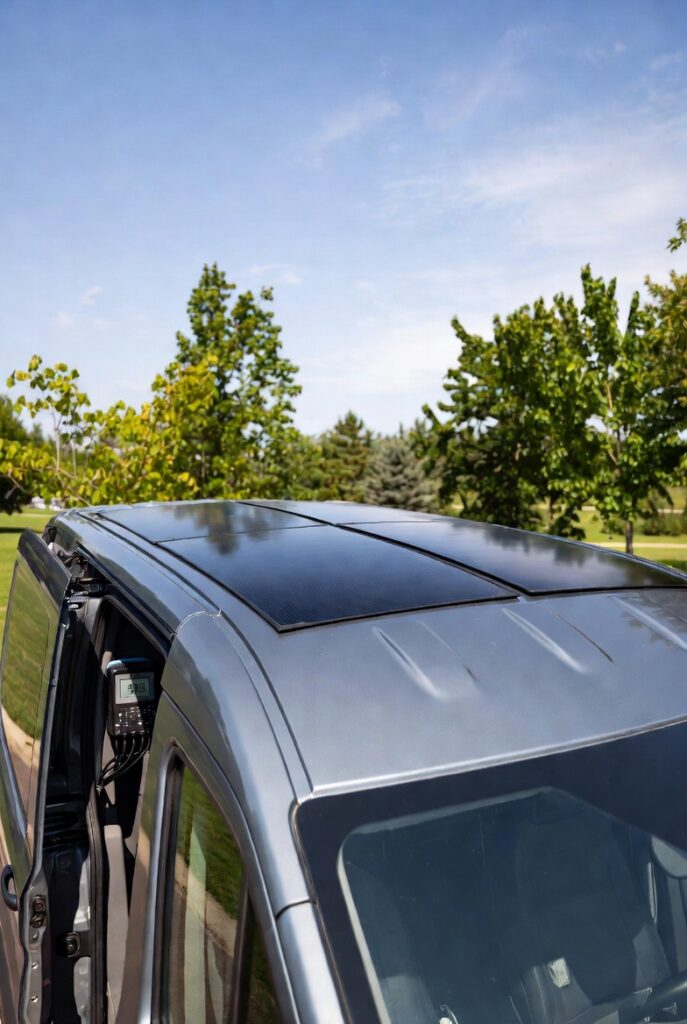
Flexible solar panels are not cheap rigid panels, they are a different product for a different job. In Rockwood, Wellington County a van-lifer converted her high-roof Transit in the spring of 2024. She installed two Renogy 100W ETFE flexible panels on the curved fibreglass roof cap using silicone adhesive and nothing else, flat against the roof with no gap between the panel back and the roof surface. In July 2025 at Riverside Park in Guelph during a 31-degree afternoon, she noticed her charge controller was reporting only 84W combined from both panels. She checked the cell temperature by touch and both panels were too hot to hold for more than two seconds.
She pulled up her data and compared July output to May output. The May average was 106W at similar sun angles. The July average was 83W, approximately 22% below the May baseline. The roof surface under the panels was reaching approximately 68 degrees Celsius and the panel cells were running at approximately 75 to 80C, which is 50 to 55 degrees above the 25C STC reference temperature. At that cell temperature, the half-cut PERC temperature coefficient of -0.35% per degree means actual output drops to approximately 82.5W per panel instead of the rated 100W.
The fix was inexpensive and took one Saturday. She lifted the panels, cut twin-wall corrugated polycarbonate (coroplast) to the same dimensions as each panel, and bonded the coroplast to the roof with VHB 4950 tape. The 5mm corrugated channels created a natural airflow gap between the roof and the panel backs. She re-attached the panels on top of the coroplast. The following Saturday at Riverside Park in similar conditions, the charge controller reported 98W combined, an increase of approximately 17% over the thermal-trapped installation.
Her total materials cost was approximately $28. Over a 150-day Ontario season at 4.5 PSH, that 15Wh-per-hour improvement adds up to approximately 10 kWh of recovered production from a single afternoon of work. See our Ontario solar sizing guide before specifying how many flexible panels your system needs
What flexible solar panels actually are: performance tire, not cheap rigid
Flexible solar panels exist because rigid glass panels cannot conform to curved surfaces. A high-roof Sprinter cap has a compound curve that no rigid panel can follow. A teardrop trailer’s aluminium skin curves fore-to-aft and side-to-side simultaneously. A sailboat’s coach roof curves in three planes at once. In all of these applications, a rigid panel requires elevated mounting brackets that add height, weight, and wind drag. A flexible panel bonds directly to the surface, adds approximately 2.5mm of profile, and weighs approximately 4.2 lbs instead of 16 to 18 lbs for a rigid equivalent. That difference matters on a vehicle where roof load affects handling and parking clearance.
| Factor | Flexible Panel (ETFE) | Rigid Panel |
|---|---|---|
| Weight (100W) | 4.2 lbs (1.9 kg) | 16 to 18 lbs (7 to 8 kg) |
| Profile height | 2.5 mm (0.1 inches) | 35 mm + mount height |
| Curved surface fit | Yes, up to 240 degrees | No |
| Power warranty | 5 years | 25 years |
| Efficiency (typical) | 22% | 23 to 25% |
| Snow load | 5,400 Pa ✓ | 5,400 Pa ✓ |
| Service life (Ontario) | 7 to 10 years (ETFE) | 25+ years |
| Thermal performance flat-mounted | Poor without air gap | Good with 25mm standoff |
| Correct application | Curved, weight-critical, mobile | Flat roof, ground mount, permanent |
For a flat Ontario garage roof or ground mount, rigid panels are correct. Flexible solar panels are not a cost-saving alternative in those applications, they cost approximately the same per watt, carry a shorter warranty, and perform worse thermally when flat-mounted without careful air gap management. However, for the four legitimate Ontario mobile use cases, Sprinter and Transit curved roof caps, boat decks, teardrop trailer skins, and weight-critical camper shells, flexible panels are the correct tool. See our Ontario RV solar guide for full system sizing across all of these applications.
ETFE vs PET: why the lamination material determines your Ontario service life
ETFE, or Ethylene Tetrafluoroethylene, is a fluoropolymer with exceptional chemical stability. Its UV transmittance is approximately 95%, meaning it passes more sunlight to the cells than the 80% transmittance of standard PET lamination. More importantly for Ontario, ETFE does not yellow under UV exposure and does not crack or delaminate under freeze-thaw cycling. An ETFE-laminated flexible panel installed correctly in Ontario will typically deliver 7 to 10 years of reliable service. The Renogy 100W ETFE panel carries a 5-year product and power warranty, which is shorter than rigid panels but reflects the honest service life difference between flexible and rigid construction.
PET, or Polyethylene Terephthalate, is a standard plastic that begins yellowing under Ontario UV levels within 18 to 24 months. By year three, a PET panel’s surface transmittance has dropped enough to meaningfully reduce output. By year four, delamination from freeze-thaw cycling typically begins at the edges. The $40 premium for an ETFE panel over a PET equivalent buys approximately 5 to 8 additional years of Ontario service life.
A weekend camper on Bronte Road in Milton, Halton County learned this in October 2025. He had previously used a PET flexible panel with no bypass diodes on his teardrop trailer. During a camping trip to Elora Gorge Conservation Area, a large oak branch shaded approximately one-third of his panel from 10 AM to noon and killed all charging for two hours, no bypass diodes meant the shaded string dragged the entire panel to near-zero output.
He replaced it with the Renogy 100W ETFE flexible panel with integrated bypass diodes. The following October at the same site, the same oak branch created the same partial shade event. The bypass diodes isolated the shaded cell string and allowed the remaining two strings to continue producing approximately 62 to 65W. Over the two-hour shade event he captured approximately 126Wh instead of zero. He described the ETFE upgrade and bypass diode protection as the best $40 he spent on the trailer, referring to the price difference between the PET panel he had replaced and the Renogy ETFE.
For Ontario van-lifers, both ETFE lamination and integrated bypass diodes are non-negotiable specifications. See our best 100W rigid panel guide to compare the rigid alternative for the same budget.
The flexible solar panels thermal trap: why flat-glue kills Ontario output
The thermal trap problem is the most common and most preventable failure mode for flexible solar panels in Ontario. A metal van roof in direct Ontario July sun reaches approximately 65 to 70C on the surface. When a flexible panel is bonded flat against that surface with no air gap, the panel back conducts heat directly from the roof. Cell temperatures reach approximately 75 to 80C, 50 to 55 degrees above the 25C STC reference.
The temperature coefficient for half-cut PERC cells is approximately -0.35% per degree Celsius above STC. At 75C the output is 100W × (1 – 0.35% × 50) = 82.5W. At 80C the output drops to 100W × (1 – 0.35% × 55) = 80.75W. A 200W rated two-panel installation produces approximately 163W on a peak summer afternoon instead of the 200W rated output.
The coroplast air gap fix is the correct solution and it costs approximately $28 in materials. Twin-wall corrugated polycarbonate sheet, sold as coroplast at most Ontario hardware stores, is cut to panel dimensions and bonded to the roof with VHB 4950 tape before the panel is mounted. The 5mm corrugated channels run horizontally, allowing natural convective airflow from the panel’s leading edge through to the trailing edge as warm air rises.
With the air gap in place, cell temperatures drop from approximately 75 to 80C to approximately 55 to 60C. Output recovers from 82.5W to approximately 89.5W per panel at the improved cell temperature of 55C. The Rockwood van-lifer’s two-panel result, 98W combined versus 83W before the fix, falls within this calculated range. An alternative to coroplast is 5mm adhesive foam spacers bonded every 150mm along the panel back, which achieves the same airflow effect with a cleaner visual profile but slightly less airflow volume than the corrugated channels.
Micro-cracking: why silicon cells and repeated flexing do not mix
Silicon solar cells are approximately 180 to 200 microns thick, which is comparable in brittleness to an eggshell. Flexible panels are designed to be installed once on a curved surface at a fixed angle, not to flex dynamically in service. The 240-degree flex rating on the Renogy 100W ETFE panel means it can be conformed to a curved surface during installation, it does not mean the panel can flex 240 degrees repeatedly.
Each flex cycle beyond the installed curve creates shear stress in the cell matrix. That stress propagates micro-cracks through the silicon. A micro-crack typically isolates one bypass diode zone, which covers approximately one-third of the panel’s cells, reducing output by 25 to 33W permanently. The damage is invisible from the outside and does not show on a basic multimeter test until the cell temperature is high enough to make the crack conductive.
Walking on a flexible panel causes micro-cracking regardless of how tough the ETFE lamination feels from outside. The lamination protects the cells from moisture, UV, and abrasion, it does not protect them from compressive load. A single footstep concentrates approximately 60 to 80 kg of force onto approximately 200 square centimetres, creating more than enough pressure to fracture the 180-micron cell connections beneath the flexible substrate.
High-speed wind flutter is the second micro-cracking cause. Any flexible panel installed with adhesive at the edges only will flutter at highway speed, creating thousands of small flex cycles per hour of driving. Therefore, full-surface bonding with silicone adhesive or VHB tape across the entire panel back is not optional for any vehicle-mounted installation. Partial edge bonding is a guarantee of progressive micro-cracking that will be indistinguishable from normal aging until output has already dropped 15 to 20%.
NEC and CEC: code compliance for flexible panel installations in Ontario
NEC 690 governs solar PV installations regardless of panel type. Flexible panels installed with permanent wiring on a vehicle, fixed conduit, junction boxes, and a charge controller connected to a battery bank, connect identically to rigid panels under NEC 690. The same overcurrent protection, disconnect, and conductor sizing requirements apply. NEC 690.7 cold-temperature voltage calculation applies to flexible panels the same as rigid: at Ontario -18C, a 100W ETFE panel’s VOC rises from approximately 22.3V at STC to approximately 25.2V. Two panels in series at -18C reach approximately 50.4V, safely within standard MPPT controller limits for any 12V or 24V system. Contact the NFPA at nfpa.org for current NEC 690 requirements for vehicle and marine PV installations.
CEC Section 50 governs solar PV installations in Ontario. Flexible panels installed as part of a permanent off-grid system, with fixed wiring, a charge controller, and a battery bank in a van, trailer, or shed, require an ESA permit before the system is energised, identical to any rigid panel installation. Portable flexible panel setups with no fixed wiring, connected directly to a portable power station via MC4 plugs and no permanent conduit, do not require a permit under the portable exemption.
The critical distinction is whether the wiring is permanently fixed to the vehicle or structure. A van conversion with conduit, a shore power inlet, and a built-in battery system is a permanent installation requiring a permit. A flexible panel draped over the roof and plugged into a Jackery or EcoFlow via MC4 cables is portable and exempt. Contact the Electrical Safety Authority Ontario at esasafe.com for permit requirements specific to your installation type before energising any permanent flexible panel system.
Pro Tip: The fastest way to determine whether your flexible solar panels installation needs a permit is to ask one question: can the panels and wiring be removed in under 10 minutes with no tools? If yes, it is portable and exempt. If no, it is permanent and requires an ESA permit. The Rockwood van-lifer’s installation, with a fixed charge controller, battery bank, and conduit through the roof cap, was a permanent installation requiring a permit. The coroplast air gap fix she made later did not change the permit status. Her original permit covered the full system. New Ontario van builders should budget for the permit process from the start, not as an afterthought. The permit protects the vehicle insurance coverage in the event of a fire. An unpermitted electrical system in a vehicle is grounds for an insurance claim denial.
The flexible solar panels verdict: three Ontario use cases
- Ontario van-lifer with a curved high-roof Sprinter or Transit: Renogy 100W ETFE flexible panel , mounted on coroplast spacers with full-surface VHB adhesion. The Rockwood van result confirms the spec: two panels on coroplast produce 98W in conditions that produced 83W with flat-glue installation. The ETFE lamination handles Ontario UV and freeze-thaw over a 7 to 10 year service life. The integrated bypass diodes protect production under partial tree or structure shade, which is the default condition at any campsite. Use a proper cable gland at the roof penetration point, silicone-sealed grommets degrade in Ontario freeze-thaw within two to three years. Specify a Victron SmartSolar MPPT 75/15 for two panels in series at 24V. At -18C Ontario minimum the two-panel string reaches approximately 50.4V, well within the 75V controller limit. See our 400W rigid panel guide if you are building a permanent home system rather than a mobile conversion.
- Ontario teardrop trailer owner or weekend boater where weight is the primary constraint: ETFE flexible panel with bypass diodes, full-surface bonded to the curved roof skin. The Milton Bronte Road teardrop result confirms the bypass diode case: 126Wh captured during a two-hour partial shade event versus zero from a PET panel with no bypass diodes. The weight difference between flexible and rigid, 4.2 lbs versus 16 to 18 lbs for a 100W panel, matters on a teardrop trailer where total trailer weight directly affects tow vehicle fuel consumption and handling. The ETFE lamination survives Ontario winters without the cracking and delamination that ends a PET panel’s useful life in year three or four. The 5-year warranty is shorter than rigid, but for a seasonal trailer used approximately 40 to 60 days per year, 5 years of warranty covers approximately 250 days of actual use, reasonable value for the weight and profile advantages.
- Ontario homeowner with a flat garage or shed roof considering flexible panels to avoid drilling: use rigid panels with proper mounting hardware. The 25-year rigid panel warranty versus the 5-year flexible warranty is the defining comparison for any permanent installation. A flat surface has no curved-roof requirement that would justify the flex trade-off. A rigid 100W panel with a standard Z-bracket mount requires four anchor points in the roofing surface. The installation is reversible, the panel is replaceable, and the 25-year warranty provides real long-term value. A flexible panel bonded to a flat roof surface with silicone adhesive is difficult or impossible to remove without damaging the roofing membrane. For flat-roof applications, flexible solar panels are the wrong choice. See our solar sizing guide for the full load calculation before specifying any array.
Frequently Asked Questions
Q: Are flexible solar panels worth it for an Ontario van or RV conversion?
A: For a curved high-roof Transit or Sprinter cap, yes, with two conditions. First, specify ETFE lamination, not PET. PET delaminates under Ontario UV and freeze-thaw within 2 to 4 years. Second, mount on a 5mm coroplast air gap, not flat-glued to the roof. Flat-gluing on a metal Ontario van roof costs approximately 15 to 22% of rated output on July afternoons. The Rockwood van-lifer recovered 17% output simply by cutting coroplast spacers for $28. With those two conditions met, ETFE flexible solar panels on a curved van roof are the correct tool for the job. For a flat shed roof or ground mount, use rigid panels with a 25-year warranty instead.
Q: What is the difference between ETFE and PET flexible solar panels for Ontario use?
A: ETFE is a fluoropolymer that resists Ontario UV and freeze-thaw cycling for 7 to 10 years without yellowing or delamination. PET is a standard plastic that begins yellowing under Ontario UV within 18 to 24 months and delaminates at adhesive edges within 3 to 4 years. The practical result is that a PET flexible panel in Ontario is a 3 to 4 year product while an ETFE panel is a 7 to 10 year product. The price difference is typically $30 to $50 per 100W panel. For any Ontario outdoor installation, that premium buys approximately 5 additional years of useful service life. ETFE is non-negotiable for Ontario van, boat, or trailer installations exposed to full outdoor conditions year-round.
Q: How do I fix the thermal trap problem with flexible solar panels on a van roof?
A: Cut 5mm twin-wall corrugated polycarbonate (coroplast) to the panel dimensions and bond it to the roof with VHB 4950 tape before mounting the panel on top. The corrugated channels run horizontally, creating convective airflow from the leading edge to the trailing edge as warm air rises. This drops cell temperature from approximately 75 to 80C to approximately 55 to 60C, recovering 7 to 9W per panel of thermally-lost output. The Rockwood van result was 98W combined from two 100W panels versus 83W before the fix, at a total materials cost of $28. An alternative is 5mm adhesive foam spacers bonded every 150mm along the panel back, which achieves similar airflow with a slightly cleaner installation profile.
This build is engineered within the 48V DC Safety Ceiling. Diagnostic logic is based on 20+ years of technical service experience. All structural and electrical installations must be verified by a Licensed Professional and comply with your Local AHJ.
This article contains affiliate links. If you purchase through these links, I earn a small commission at no extra cost to you.