
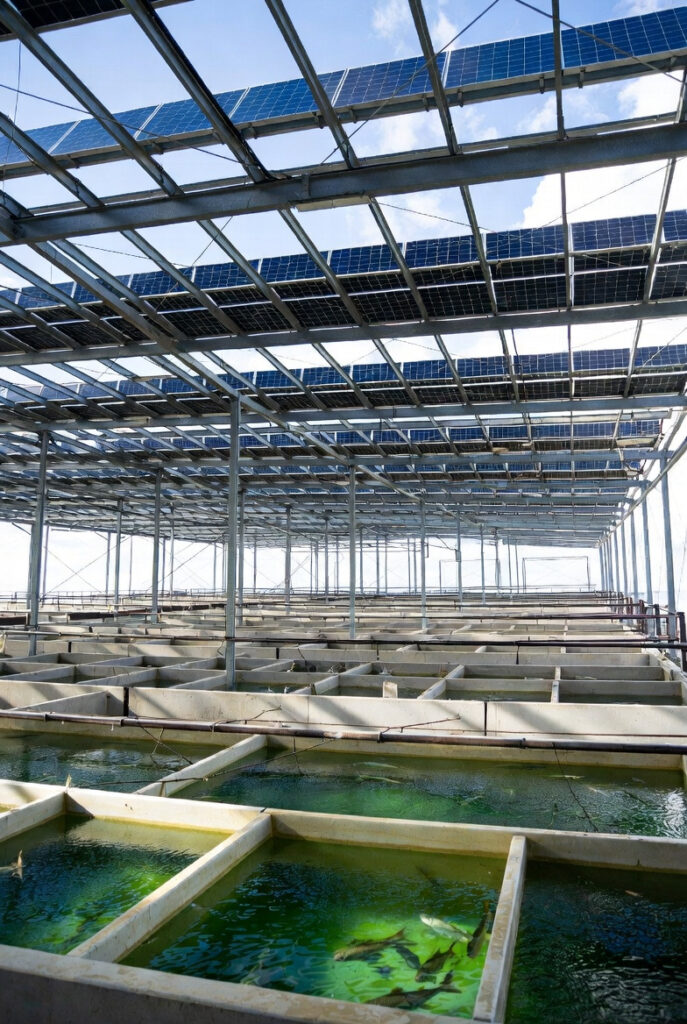
Fish hatchery solar failures do not announce themselves before the stock dies. I was called to review the power system at a brook trout nursery near Thessalon in the Algoma District operated by a conservation authority that had experienced a catastrophic stock loss the previous August. The facility ran 12 fibreglass rearing tanks with a combined volume of 180,000 litres, holding approximately 85,000 juvenile brook trout averaging 8 grams each. The aeration system was a single 1,500W AC paddle wheel aerator connected to a 3,000W pure sine wave inverter backed by a 200Ah LFP battery bank and a 400W solar array. The monitoring system was a single dissolved oxygen probe on the largest tank with a local alarm buzzer mounted inside the equipment shed.
In August the inverter developed an internal fault at 11:30 PM on a Saturday and shut down on thermal protection. The aerator stopped. The DO alarm activated inside the equipment shed. However, the nearest staff member was at a residence 1.8 kilometres away and the alarm was inaudible from that distance. By the time the fault was discovered at 5:45 AM Sunday the dissolved oxygen in all 12 tanks had dropped below 1.2mg/L. At 1.2mg/L brook trout enter irreversible hypoxic stress. The mortality event was 100%. All 85,000 fish were dead. The replacement value of the stock was approximately $47,000. The conservation authority had three years of brood line genetics in that cohort. A single inverter thermal fault at 11:30 PM on a Saturday set the facility back four years.
I redesigned the aeration system with two 800W brushless DC aerators running directly from the 48V battery bank through individual 60A fused circuits, completely independent of the inverter. The inverter remained in the system to power lighting, water pumps, and monitoring equipment. However, the aerators no longer passed through it. I also added a Starlink Mini alert trigger that sent a text message to three staff phones when the DO in any tank dropped below 5mg/L. The system has been running for 22 months without an aeration failure. The cohort currently in those tanks is on schedule for release. For the solar remote monitoring standard that covers the VRM alert integration used for the DO threshold notification, Article 187 covers the full monitoring architecture. For the full system sizing hub that covers the load calculation foundation, the hub covers the numbers.
Why a Fish Hatchery Solar System Must Bypass the Inverter for Aeration
An AC aerator requires a functioning inverter to convert 48V DC to 120V AC. If the inverter faults the aerator stops regardless of battery charge level. However, a BLDC aerator on the 48V DC bus runs until the bank drops to 42V low-voltage cutoff with no inverter involved. The DO depletion timeline at commercial density makes this distinction critical.
At 40 to 60kg per cubic metre rearing density a high-density brook trout tank drops from safe 8mg/L to lethal 1mg/L in 35 to 50 minutes without aeration. 35 minutes is not enough time to drive from town. It is barely enough time to get dressed and find the keys. The Victron SmartShunt on the 48V bank tracks real-time SoC and confirms the aerators have sufficient reserve before the last staff member leaves the facility each evening. For the solar security gate DC bypass standard that uses the same direct DC circuit principle to eliminate the inverter from the most critical load, Article 204 covers the full bypass architecture.
| Aeration Configuration | Time to Lethal DO | Inverter Failure Risk |
|---|---|---|
| AC aerator on inverter | 35 to 50 minutes | 100% — aerator stops with inverter |
| BLDC aerator on 48V DC bus | 35 to 50 minutes | Zero — aerator bypasses inverter entirely |
The Solar-Thermal Pre-Heat Collector: Eliminating Cold Shock at Water Change
Fish hatchery solar cold shock failures are slower and quieter than anoxic events but just as expensive. I consulted on a whitefish rearing facility near Wiarton on the Bruce Peninsula that was experiencing chronic growth suppression and elevated fin rot incidence every February and March. The facility drew intake water from a well at a consistent 8°C year-round. However, in winter the rearing tanks gradually equilibrated to 4°C to 5°C in the unheated hatchery building. When the operators performed the mandatory twice-weekly partial water changes the sudden 3°C to 4°C temperature differential caused thermal stress in the fry.
Thermally stressed whitefish suppress their immune response for 18 to 72 hours after each cold-shock event. The twice-weekly water change schedule meant the fish were in an immunosuppressed state 3 to 4 days out of every 7. Fin rot and bacterial gill disease are opportunistic infections that colonise immunosuppressed fish. The facility was treating for bacterial disease twice per winter season at a combined cost of $3,200 in antibiotics and lost growth from treatment-induced appetite suppression.
I installed a flat-plate solar-thermal collector feeding a 200-litre pre-heat tank between the wellhead and the rearing building. The solar-thermal loop raised the intake water temperature from 8°C to 11°C to 12°C on clear winter days. As a result the temperature differential at water change dropped from 4°C to less than 1°C. The thermal stress response was eliminated from the water change protocol. The facility has not treated for bacterial fin disease in two winter seasons since. The collector cost $1,800 installed. The antibiotic treatment it replaced cost $3,200 per year. For the solar weather station multi-parameter sensor standard that covers the same DO, pH, and temperature monitoring hub used in the Bio-Link telemetry configuration, Article 199 covers the full sensor architecture.
The Vibration-Free Electronics Cabinet: Protecting Fish from Power Hum
Fish detect vibration through the lateral line, a sensory organ that runs the length of the body and responds to pressure waves in the water. Chronic low-frequency vibration at 50 to 120Hz, the frequency range of inverters and charge controllers, causes chronic stress in hatchery fish. However, mounting the entire electronics cabinet on rubber isolation mounts breaks the vibration transmission path between the electronics and the tank structure.
The isolation mount specification: 40 to 60 Shore A hardness rubber at the cabinet base and wall brackets, minimum 4 mount points, each sized for the cabinet weight. At 50Hz excitation 50 Shore A rubber mounts provide approximately 15 to 20dB of vibration attenuation. As a result the tank water experiences only ambient thermal and flow disturbances, not electronic switching noise. In addition the rubber isolation mounts protect the electronics from tank pump vibration that can loosen terminal connections over time. For the mobile solar trailer vibration-proof WAGO connector standard that addresses vibration-induced terminal loosening in high-vibration environments, Article 203 covers the full wiring specification.
The Debris Guard and Panel Maintenance Protocol
A remote hatchery under cedar or maple canopy loses 30 to 40% of October panel production to leaf accumulation without a debris guard. A single leaf covering 10% of one panel reduces that panel’s output by 30 to 40% due to the bypass diode string architecture. In a 400W array during peak October spawning preparation total output drops from 400W to approximately 250W. However, a fine mesh guard mounted 150mm above the panel surface catches leaves and needles before they contact the panel.
The mesh opening size: 12 to 15mm, small enough to catch leaves but large enough to allow rain cleaning and cooling airflow. The mesh frame material must be 316 stainless steel or HDPE. Aluminium mesh corrodes within two seasons in the organic acid environment of a forest hatchery site. The Victron Smart Battery Sense wireless temperature sensor confirms panel operating temperature stays within safe range even with the mesh guard reducing airflow by approximately 15%.
The Bio-Link Monitoring: DO Alarm and Starlink Alert
The 5mg/L DO threshold is the standard early warning level for salmonid rearing facilities. Brook trout begin showing stress behaviours at 5 to 6mg/L. However, at 3mg/L stress becomes severe and at 1 to 2mg/L mortality begins within 20 to 30 minutes. A threshold alert at 5mg/L gives staff 35 to 50 minutes to respond before the situation becomes irreversible.
The Starlink Mini alert system: a multi-parameter sensor hub monitoring DO, pH, and temperature sends a threshold trigger to the Starlink router when DO drops below 5mg/L. The Starlink transmits an SMS alert to three designated staff phones within 30 seconds of the threshold event. The same alert fires if pH drops below 6.5 or above 8.5, if water temperature exceeds 18°C, or if battery SoC drops below 25%. For the DC-native Starlink setup that reduces Starlink standby draw from 75W to 30W in the hatchery power budget, Article 175 covers the POE bypass standard. For the off-grid hospital load shedding standard that uses the same 4-tier priority with critical loads protected above all others, Article 200 covers the full hierarchy.
The Fish Hatchery Solar System: Minimum Viable vs Full Spawn Standard
The decision follows rearing density, stock value, and distance from staff accommodation.
The minimum viable fish hatchery solar system for a small conservation nursery with 4 to 6 rearing tanks includes a 400W panel array, a 200Ah 48V LFP battery bank, two BLDC aerators on direct DC circuits with individual 60A fusing, a single multi-parameter DO and temperature sensor with Starlink alert at 5mg/L threshold, and a fine mesh debris guard. Capital cost runs $4,500 to $7,000. It eliminates the inverter as a single point of failure in the aeration system.
The full spawn standard for a commercial hatchery operating year-round in the Algoma District or Bruce Peninsula includes an 800W panel array with solar-thermal pre-heat collector, 400Ah 48V LFP bank with N+1 BLDC aerator redundancy, multi-parameter DO, pH, and temperature monitoring with Starlink real-time alert, rubber-isolated vibration-free electronics cabinet, fine mesh debris guard, and 4-tier load shedding protecting aerators as Tier 1 load above all other facility power. Capital cost runs $12,000 to $18,000. It provides Tier-1 biological resilience for a commercial hatchery with stock valued above $50,000.
NEC and CEC: What the Codes Say About Fish Hatchery Solar
NEC 690 governs the PV source circuits of any fish hatchery solar installation. The 48V battery bank, charge controller, and BLDC aerator DC circuits are subject to NEC 690 overcurrent protection and disconnecting means requirements. NEC 547 covers agricultural buildings and applies to fish hatchery installations, requiring all electrical equipment in wet or damp locations to comply with NEC 547.5 splash-proof and dust-proof enclosure requirements. The rubber-isolated electronics cabinet must comply with NEC 547.5 for equipment in areas subject to water spray from tank management operations. NEC 310 governs conductor selection and requires wet-location rated conductors for all wiring in the hatchery tank area where condensation and water spray are present.
In Ontario, a commercial fish hatchery solar installation is subject to CEC Section 64 for the PV source circuits and requires an ESA electrical permit. The hatchery facility itself requires an aquaculture licence from the Ontario Ministry of Natural Resources and Forestry under the Fish and Wildlife Conservation Act. The solar installation permit application to the ESA should reference the MNRF aquaculture licence number to confirm the installation is part of a licensed agricultural operation. Hatcheries operated by conservation authorities under the Ontario Conservation Authorities Act may qualify for simplified permitting as non-commercial conservation facilities. Contact Fisheries and Oceans Canada for federal aquaculture permit requirements that apply if the hatchery releases fish into navigable Canadian waters.
Pro Tip: Before specifying the aerator circuit for a hatchery solar system, calculate the DO depletion time for the highest-density tank at the peak rearing density you plan to operate. I have reviewed hatchery power specifications where the designer sized the battery for 24 hours of aerator runtime at average tank density. However, the peak density in August during final grow-out was 3 times the average density. The DO depletion time at peak density was 35 minutes. A 24-hour battery reserve with a 35-minute mortality window is not a safety margin. It is a false sense of security. Calculate for peak density, not average density.
The Verdict
A fish hatchery solar system built to the spawn standard keeps the aerators running regardless of what the inverter does, eliminates the cold shock that was suppressing the whitefish immune system twice a week, and puts a text message on three phones within 30 seconds of any DO threshold event.
- Bypass the inverter for the aerators before anything else. The Thessalon nursery lost 85,000 brook trout and four years of brood line genetics because a single inverter thermal fault stopped the aerator at 11:30 PM on a Saturday. Two BLDC aerators on direct 48V DC circuits cost $1,400. The stock they protect is worth $47,000. Wire the aerators to the bank, not the inverter.
- Install the solar-thermal pre-heat collector before the first winter water change. The Wiarton whitefish facility was spending $3,200 per year treating bacterial disease caused by cold shock at water change. An $1,800 solar-thermal collector raised the intake water temperature by 3°C to 4°C and eliminated the thermal stress response entirely. The collector paid for itself in under 7 months.
- Mount the electronics cabinet on rubber isolation mounts before the first tank cycle. The lateral line detects 50Hz inverter switching through the tank walls. Stressed fish eat less, grow slower, and get sick more often. The rubber mounts cost $80. The growth suppression they prevent is worth more than every other upgrade on this list combined.
In the shop, we do not run a single-point failure system on a critical engine. In the hatchery, we do not run a single aerator circuit through a single inverter when 85,000 fish are depending on it.
Frequently Asked Questions
Q: How quickly can dissolved oxygen drop to lethal levels in a hatchery tank? A: At commercial rearing density of 40 to 60kg per cubic metre, a high-density brook trout tank can drop from a safe 8mg/L to a lethal 1mg/L in 35 to 50 minutes without aeration. This is why the aerator circuit must bypass the inverter entirely and run directly from the battery bank.
Q: What is the advantage of a BLDC aerator over a standard AC aerator in a solar hatchery? A: A brushless DC aerator connects directly to the 48V battery bank with no inverter in the power path. If the inverter fails for any reason the BLDC aerator continues running from the battery bank. A standard AC aerator stops immediately when the inverter faults, regardless of battery bank charge level.
Q: Can solar power handle the full energy load of a remote fish hatchery in Ontario winter? A: A well-designed fish hatchery solar system with a solar-thermal pre-heat collector, DC-direct aeration, and event-triggered monitoring can operate autonomously through a normal Ontario winter. The solar-thermal collector reduces the electrical heating load, DC aeration eliminates the inverter efficiency loss, and proper battery sizing provides 48 to 72 hours of autonomous operation during overcast periods.
Questions? Drop them below.
This post contains affiliate links. If you purchase through our links, we may earn a small commission at no extra cost to you.
Pingback: Remote Sensor Solar: Lab-Grade Power for Field Data Loggers