
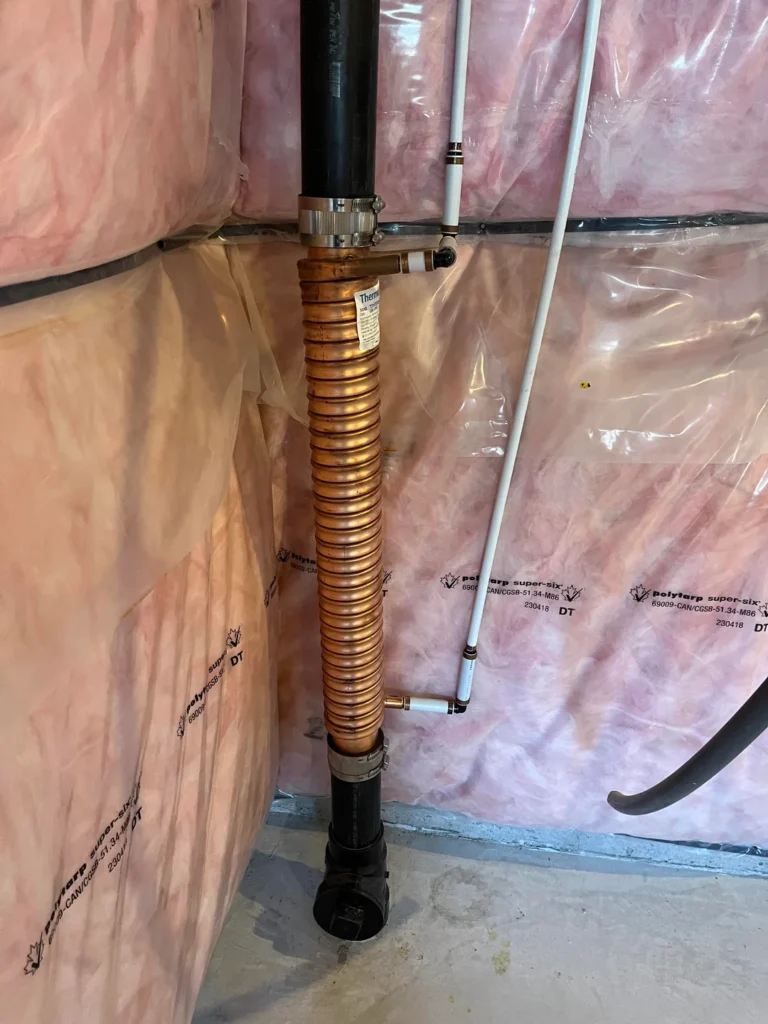
DWHR captures waste heat that most property owners watch disappear down the drain every shower. I helped a property owner near Minden in Haliburton County, Ontario pass a final inspection on his new two-story off-grid build in fall 2025. His inspector flagged the missing DWHR unit as a code violation under OBC 2024/2026. His plumber had never installed one and did not know it was now mandatory. His DWHR requirement existed because his two-story design provided sufficient vertical fall for the heat exchanger.
I examined his drain stack and identified the installation location. His 3-inch vertical drain from the second-floor bathroom provided 8 feet of straight fall. His cold water supply ran within 6 feet of the stack. His installation required cutting into the existing drain and splicing in a 4-foot DWHR unit. His pre-heated water would feed both the water heater cold inlet and the shower mixing valve. His DWHR would recover heat in real-time during every shower without storage or electricity.
I helped him source and install a vertical DWHR unit rated at 58% heat recovery. We replaced 4 feet of his drain stack with the copper heat exchanger. We plumbed the pre-heated output to both destinations. His total cost was $1,100 for the unit plus $600 for installation. His DWHR now recovers 58% of shower heat energy with no moving parts. His inspection passed three days later with the certificate issued. For the heating system that benefits from this reduced load, The Off-Grid Heating Standard covers the approach.
Why DWHR Recovers 40-60% of Shower Heat Energy
DWHR recovers 40-60% of shower heat through falling film physics in vertical copper pipe. The Minden owner’s unit captures 58% of heat energy during every shower. His DWHR transfers heat from drain water to incoming cold water through the copper wall.
His water heater works 58% less hard for every shower taken. The heat recovery happens passively with no electricity and no moving parts.
Mechanical simplicity means 30-year lifespan with zero maintenance requirements. The technology is proven and requires no ongoing attention.
The Thermal Leak Problem: 38°C Down the Drain While 4°C Enters
The thermal leak problem exists because shower water leaves at 38°C while replacement water enters at 4°C. The temperature difference represents pure energy waste. The Bobcaygeon owner’s 60-liter showers each required 2.5 kWh of heat energy.
His two daily showers consumed 5 kWh of propane energy per day. His 150 kWh monthly for showers alone drove his $180 propane bill.
Most property owners never calculate this loss because the water simply disappears down the drain. The waste is invisible but constant.
OBC 2024/2026 Mandate: Required for Two-Story and Basement Builds
OBC 2024/2026 now mandates drain water heat recovery for all new residential construction with sufficient vertical fall. Two-story homes and homes with basements must install DWHR units. The Minden owner’s inspection failure confirmed this requirement is actively enforced.
Reference Ontario’s Building Code for current requirements. Certificate of occupancy cannot be issued without compliant installation.
Existing homes are not required to retrofit but benefit equally from the technology. The code applies only to new construction and major renovations.
Falling Film Physics: Why Vertical Beats Horizontal by 3x
Falling film physics explains why vertical units achieve 55-60% efficiency while horizontal units achieve only 15-25%. Warm water falling through a vertical pipe clings to the inner copper wall as a thin film. The thin film maximizes surface contact for heat transfer.
In horizontal units, water pools at the bottom of the pipe reducing contact area. The Minden owner’s 8-foot vertical fall provides optimal falling film conditions.
Slab-on-grade builds without vertical fall must accept significantly lower recovery rates. The physics cannot be overcome with horizontal orientation.
Simultaneous Flow: Real-Time Recycling Not Storage
I was troubleshooting high propane consumption with a property owner near Bobcaygeon in Kawartha Lakes, Ontario in winter 2025. His propane water heater ran constantly despite serving only a 2-person household. His propane bill for water heating alone exceeded $180 monthly in winter. His incoming cold water temperature measured 4°C at the tap. His DWHR opportunity was invisible because he did not know the technology existed. His warm shower water was leaving at 38°C while ice-cold water entered to replace it.
I examined his water heating cycle and calculated the thermal loss. His average shower used 60 liters of water heated from 4°C to 40°C. Each shower required approximately 2.5 kWh of heat energy. His two daily showers consumed 5 kWh of propane energy per day. His 150 kWh monthly for showers alone explained his high propane consumption. His DWHR would pre-heat incoming water from 4°C to approximately 24°C. His water heater would then heat from 24°C to 40°C instead of from 4°C.
I helped him install a vertical DWHR in his basement below the main bathroom. His 10-foot vertical drop provided ideal conditions for falling film heat transfer. His unit recovers 55% of the heat energy from every shower. His water heater now heats from 24°C instead of 4°C reducing energy consumption by approximately 55%. His monthly propane cost for water heating dropped from $180 to $85. His total cost was $1,400 for unit and installation. His DWHR paid for itself in 15 months through propane savings alone. For the ventilation that works alongside this efficiency upgrade, The Off-Grid Ventilation Standard covers the approach.
Delta-T Optimization: Dual-Feed Plumbing for Maximum Recovery
Delta-T optimization requires feeding pre-heated water to both water heater inlet AND shower mixing valve. Feeding only the water heater wastes potential recovery. The mixing valve still blends with cold water reducing overall benefit.
Dual-feed plumbing maximizes the temperature difference benefit at both destinations. The Minden owner’s dual-feed installation provides maximum efficiency.
Single-feed installations recover approximately 35% less total energy than dual-feed configurations. The extra plumbing is worth the investment.
Horizontal Limitations: When Slab-on-Grade Forces Compromise
Horizontal installations become necessary when slab-on-grade construction eliminates vertical fall opportunity. Horizontal units achieve only 15-25% heat recovery compared to 55-60% for vertical. Water pools at the bottom instead of clinging to walls as falling film.
The reduced efficiency may not justify the installation cost in some applications. Slab-on-grade property owners should calculate payback carefully before proceeding.
Horizontal units still provide benefit but require longer payback periods. The decision depends on your hot water usage and fuel costs.
Maintenance-Free Operation: 30 Years with No Moving Parts
Maintenance-free operation comes from pure mechanical simplicity. Vertical copper pipe has no pumps, no valves, no sensors, and no electricity requirement. The Minden owner’s unit will operate for 30 years without service calls.
Copper resists corrosion from both drain water and supply water. No filters require replacement. No moving parts require lubrication.
The only maintenance is occasional visual inspection of plumbing connections. This technology requires attention at installation, then nothing.
The DWHR Strategy: Vertical Installation and Plumbing Configuration
The DWHR strategy combines vertical installation with dual-feed plumbing for maximum efficiency. Vertical units with 6+ feet of fall achieve 55-60% heat recovery. Dual-feed plumbing maximizes Delta-T benefit at both water heater and mixing valve. A Victron SmartShunt tracks reduced water heater consumption and confirms savings.
The Minden owner’s complete DWHR strategy provides code compliance plus significant energy reduction. His system operates passively while reducing water heater workload by more than half.
The combination of vertical installation and dual-feed plumbing extracts maximum value from every shower.
Planning Your DWHR System: Components and Costs
Planning your DWHR system starts with measuring available vertical fall from shower drain to basement or crawlspace. Six feet minimum provides adequate falling film conditions. Eight to ten feet provides optimal recovery.
A Victron Cerbo GX tracks overall system efficiency gains from reduced heating load. The Bobcaygeon owner’s 10-foot fall provided ideal conditions.
Your DWHR investment pays back through reduced propane or electricity consumption within 12-18 months.
Minimum Viable vs Full Standard: Choosing Your Recovery Level
The DWHR approach offers two recovery levels depending on your plumbing configuration and vertical fall distance. The minimum viable level provides code compliance with good recovery. The full standard provides maximum efficiency with optimized Delta-T.
| Recovery Level | Key Components | Cost | Heat Recovery |
|---|---|---|---|
| Minimum Viable | Vertical unit + single-feed + 6ft fall | $800-$1,200 | 40-50% |
| Full Standard | Vertical unit + dual-feed + 8ft+ fall | $1,400-$2,000 | 55-60% |
Both DWHR approaches meet OBC requirements for new construction. The difference is plumbing configuration and recovery optimization. Properties with 8+ feet of vertical fall should invest in the full standard.
Frequently Asked Questions
Q: What heat recovery percentage does a vertical DWHR unit achieve?
A: A vertical DWHR unit achieves 55-60% heat recovery through falling film physics. The Minden owner’s unit captures 58% of shower heat energy during every simultaneous flow event. Vertical installation is critical because horizontal units achieve only 15-25% recovery. DWHR effectiveness depends on vertical fall distance and dual-feed plumbing configuration.
Q: Is DWHR installation mandatory under Ontario Building Code?
A: DWHR installation is mandatory under OBC 2024/2026 for all new residential construction with sufficient vertical fall. Two-story homes and homes with basements must include compliant units. The Minden owner’s certificate of occupancy was held until his DWHR was installed. Existing homes are not required to retrofit but benefit equally from the technology.
Q: How quickly does a DWHR system pay for itself?
A: A DWHR system typically pays for itself in 12-18 months through reduced water heating costs. The Bobcaygeon owner’s $1,400 installation reduced his monthly propane from $180 to $85 providing 15-month payback. DWHR payback depends on hot water usage, fuel costs, and recovery percentage. Higher usage households see faster payback periods.
Pro Tip: Your DWHR unit should feed both the water heater cold inlet AND the shower mixing valve cold side for maximum Delta-T benefit. The Minden owner’s dual-feed plumbing extracts 35% more value from his DWHR investment than single-feed would provide. Single-feed installations leave energy on the table at every shower. Run the extra plumbing during installation. The cost difference is minimal and the efficiency gain is permanent.
Verdict
- The OBC Compliant DWHR Standard. The Minden owner’s two-story build failed final inspection because his plumber did not know DWHR was now mandatory under OBC 2024/2026. His $1,700 installation with 58% recovery unit and dual-feed plumbing passed inspection three days later. His DWHR now captures 58% of shower heat energy with no moving parts, no electricity, and a 30-year lifespan.
- The Propane Reduction Standard. The Bobcaygeon owner’s $180 monthly propane bill for water heating dropped to $85 after installing a vertical DWHR in his basement. His 10-foot vertical fall provided ideal falling film conditions for 55% heat recovery. His $1,400 investment paid for itself in 15 months through propane savings alone.
- The Dual-Feed Optimization Standard. Single-feed installations recover approximately 35% less total energy than dual-feed configurations. The Minden owner’s dual-feed plumbing to both water heater inlet and mixing valve extracts maximum value from every shower. The extra plumbing cost during installation provides permanent efficiency gains.
This build is engineered within the 48V DC Safety Ceiling. Diagnostic logic is based on 20+ years of technical service experience. All structural and electrical installations must be verified by a Licensed Professional and comply with your Local AHJ.
This article contains affiliate links. If you purchase through these links, I earn a small commission at no extra cost to you.
Questions? Drop them below.