
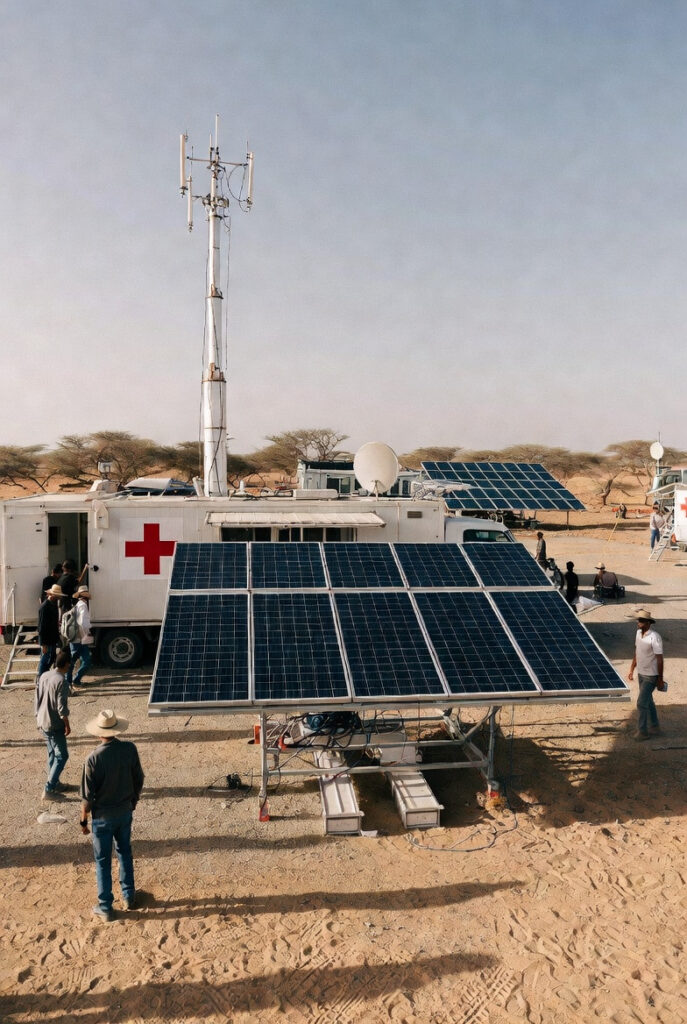
Disaster relief solar power failures cost lives in the first 90 minutes and the cause is always the same inverter that nobody tested before it went into the shipping container. I was asked to review the power system for a mobile clinic deployment by a Canadian NGO operating near Port-au-Prince, Haiti following a 7.2 magnitude earthquake in the Nippes department. The clinic held 847 doses of tetanus toxoid and antibiotics in two medical refrigerators running from a 2,000W modified sine wave inverter connected to a 400Ah LFP battery bank and a 600W solar array.
On day 7 the inverter failed at 2:47 AM due to a MOSFET driver board failure under sustained high-temperature operation. The failure had not been evident during the pre-deployment bench test because the board failed under continuous load at field temperatures, not at startup. By 6:15 AM the refrigerators had risen to 18°C, irreversibly denaturing all 847 doses of tetanus toxoid. The replacement doses had to be flown from Santo Domingo at a cost of $18,400 including emergency air freight.
I redesigned the cold chain power system using DC-direct medical refrigerators connected directly to the 24V LFP battery bank through individual 30A fused circuits, bypassing the inverter entirely. Each refrigerator contained a 2kg phase change material insert rated to maintain 2°C to 8°C for 72 hours without power at 35°C ambient. In four subsequent deployments the cold chain maintained continuous integrity through two additional inverter faults and one 36-hour battery depletion event. The DC-direct conversion cost $1,200 in refrigerators and wiring. The 847 destroyed doses at $18,400 replacement cost paid for the redesign 15 times over. For the off-grid hospital solar DC-direct critical load bypass standard that covers the same inverter-bypass principle for permanent medical facility installations, Article 200 covers the full architecture. For the full system sizing hub that covers the load calculation foundation, the hub covers the numbers.
Why a Disaster Relief Solar System Loses the Cold Chain at 2:47 AM
A modified sine wave inverter running at 80% of rated capacity in 35°C ambient reaches internal junction temperatures of 70 to 85°C. At those temperatures MOSFET driver boards have a mean time between failures of 3,000 to 8,000 hours, or 125 to 333 days. A 30-day disaster relief deployment falls within this failure window. As a result the inverter is statistically likely to fail during a standard tropical deployment.
However, a DC-direct circuit has no active conversion device between the battery and the refrigerator. There are no semiconductors, no switching devices, and no heat-generating conversion stages in the cold chain circuit. As a result the DC-direct cold chain circuit has no component that can fail under sustained high-temperature operation. The Victron SmartShunt monitors the 24V LFP bank SoC and provides the medical team with real-time cold chain power reserve before any depletion risk. For the off-grid hospital solar DC-direct critical load bypass standard that covers the same inverter-bypass principle for permanent medical facilities, Article 200 covers the full architecture.
| Power Configuration | Time to Cold Chain Failure at 35°C | Backup Protection |
|---|---|---|
| Modified sine wave inverter, standard refrigerator | 3 to 4 hours after inverter failure | None — all 847 doses lost at 18°C |
| DC-direct circuit, standard refrigerator | No inverter in cold chain circuit | None needed — no inverter to fail |
| DC-direct circuit, PCM refrigerator | No inverter in cold chain circuit | 5.5 to 9.3 hours per 2kg PCM insert |
The Pre-Wired Solar Trailer: Crate to Kilowatts in 30 Minutes
A field hospital built from individual components on-site requires 4 to 8 hours of wiring, mounting, and commissioning time. A pre-wired trailer with fold-out bifacial arrays, integrated LFP bank, distribution board, and military 50A twist-lock connectors requires zero on-site wiring. The team parks, unfolds the array wings, runs the twist-lock cables to the clinic tents, and has power in under 30 minutes.
For a single-tent minimum viable deployment the EcoFlow DELTA Pro 3 provides an integrated 3,600Wh LFP bank with 3,600W AC output and 1,600W solar input in a single carry case, deployable in under 5 minutes without any tools. However, for a multi-tent field hospital the custom pre-wired trailer provides the 600Ah LFP capacity and 1,200W bifacial array that a single carry case cannot match. For the mobile solar trailer construction site fast-deploy standard that covers the same pre-wired rapid deployment architecture for field operations, Article 203 covers the full trailer specification.
The DC-Direct Cold Chain and PCM Buffer
A 2kg phase change material insert at a melting point of 4°C absorbs 400,000 to 668,000 joules of heat before the refrigerator interior temperature rises above 4°C. In a well-insulated medical refrigerator in 35°C ambient the heat gain rate without compressor operation is approximately 15 to 25 watts. As a result the 2kg PCM insert provides 5.5 to 9.3 hours of thermal protection before the interior exceeds the PCM melting point.
Multiple PCM inserts extend this proportionally to 72 hours in a fully loaded refrigerator. However, the PCM buffer is the backup. The DC-direct circuit is the primary. Together they provide two independent layers of cold chain protection. As a result the medical team can survive two simultaneous failures, a depleted battery and a failed compressor, and still maintain cold chain integrity for 72 hours. For the solar security gate DC-direct bypass standard that covers the same inverter-removal principle for critical loads, Article 204 covers the full bypass architecture.
The Solar RO Water Skid and Gravity Distribution
A 1,200W bifacial array at midday surplus in a tropical deployment produces 800 to 1,000W above the clinic baseline load. This 800 to 1,000W surplus drives a 500 litre per hour reverse osmosis pump for 5 to 6 hours per day, producing 2,500 to 3,000 litres of treated water per clear day. Elevated bladder tanks at 3 metres above the distribution point provide 0.3 bar of gravity pressure through the distribution lines without any pump operation after sunset.
As a result the clinic has pressurised clean water around the clock using the battery bank only for medical equipment and communications, not for water pressure. For the fish hatchery solar gravity-fed water standard that covers the same solar-surplus-to-stored-energy principle for biological water systems, Article 207 covers the full thermal and gravity architecture.
The Air-Blast Panel Cleaning Protocol: Protecting 8,000 Litres Per Day
Disaster relief solar dust load failures are invisible on the monitoring dashboard because the production drop is gradual. I reviewed a power shortfall problem at a solar-powered water purification station deployed by a disaster response team in northern Syria near Aleppo that was providing clean water to a displacement camp of approximately 12,000 people. The station ran a 1,200W bifacial array driving a 500 litre per hour reverse osmosis pump. On day 14 the RO pump began cycling on and off every 4 to 6 hours instead of running continuously through the midday peak.
When I reviewed the production logs the array was producing 680W at solar noon on a clear day in what should have been an 1,100W production window. I inspected the panels and found a 2 to 3mm layer of fine concrete and gypsum dust from ongoing building demolition 400 metres upwind. The deposit had accumulated over 14 days of continuous demolition operations. The dust was not visually obvious from the ground but covered approximately 60% of each panel surface.
I implemented a twice-daily dry air blast protocol using a 12V rechargeable air compressor drawing 8A for 4 minutes per panel. The first cleaning cycle restored production from 680W to 1,040W within 8 minutes. The 14 days of reduced production had supplied approximately 4,200 litres per day instead of the 8,000 litres the camp required. The 56,000 litre deficit over 14 days required 4 emergency water tanker deliveries at $480 each. The air compressor cost $95. For the trail camera solar dry-brush panel cleaning protocol that covers the same no-liquid cleaning principle for remote installations near demolition activity, Article 205 covers the full surface cleaning specification.
The Disaster Relief Solar System: Minimum Viable vs Full Resilience Standard
The decision follows clinic size, deployment duration, and whether the mission requires water production and telemedicine.
The minimum viable disaster relief solar system for a single-tent field clinic with 2 medical refrigerators and basic lighting includes a pre-wired 400W trailer with fold-out bifacial panels, a 200Ah LFP battery, DC-direct refrigerator circuits with PCM inserts, a 2,000W pure sine inverter for general loads, military 50A twist-lock connectors, and an air compressor for panel cleaning. Capital cost runs $8,400 to $12,000. It provides cold chain integrity and basic field clinic power for a 30-day deployment in any tropical disaster zone.
The full resilience standard for a multi-tent field hospital with RO water production and telemedicine includes a pre-wired 1,200W trailer with fold-out bifacial arrays, a 600Ah LFP bank, DC-direct cold chain circuits with PCM inserts, 500 litre per hour RO skid, elevated water bladder system, Starlink Flat High Performance on trailer roof, military connectors throughout, and air compressor panel cleaning protocol. Capital cost runs $28,000 to $42,000. It provides complete life-support infrastructure for a 50-bed field hospital operating for 90 days in any disaster zone globally.
NEC and CEC: What the Codes Say About Disaster Relief Solar
NEC 690 governs the PV source circuits of any disaster relief solar installation. A pre-wired solar trailer is a portable power assembly and must comply with NEC 590 for temporary wiring installations, including GFCI protection for all receptacle circuits and overcurrent protection at the source. The DC-direct medical refrigerator circuits are Class 2 circuits under NEC 725 due to their 24V voltage level and are exempt from many standard raceway requirements. The military 50A twist-lock distribution connectors must be listed for the current and voltage ratings of the distribution circuits. The NFPA publishes NEC 590 requirements for temporary power assemblies applicable to disaster relief deployments globally.
In Canada, a disaster relief solar trailer deployed for emergency response operations is a temporary portable power installation and does not require an ESA electrical permit under the Ontario Electrical Safety Code temporary installation exemptions, provided the system is disconnected from the grid and does not connect to any permanently installed building wiring. For international deployments, the applicable electrical code is the national code of the host country or the IEC standards under the relevant UN humanitarian logistics framework. Contact Sphere Standards for the minimum power and water standards that govern solar power specifications in humanitarian response deployments. Contact the World Health Organization for cold chain management standards applicable to vaccine storage in field hospital solar installations.
Pro Tip: Before a disaster relief solar deployment, run a 48-hour full-load bench test of the complete pre-wired trailer at 40°C ambient using a heat gun or an enclosed test space before the trailer leaves the warehouse. I have reviewed field hospital solar systems that passed individual component tests but failed at the system level because the combined heat output of the inverter, charge controller, and battery management system in a sealed trailer enclosure exceeded the thermal rating of the MOSFET driver boards at sustained load. The component test is not the system test. Test the full trailer at full load at the worst ambient temperature the deployment zone will see. Test it on the warehouse floor. Not in the middle of Port-au-Prince.
The Verdict
A disaster relief solar system built to the resilience standard means the Port-au-Prince field clinic keeps 847 doses of tetanus toxoid viable through every overnight inverter fault, and the Aleppo displacement camp receives 8,000 litres of clean water per day instead of 4,200 because nobody noticed the panels were 60% covered in gypsum dust.
- Install DC-direct cold chain circuits with PCM inserts before any tropical deployment. The Port-au-Prince clinic lost 847 doses of tetanus toxoid and paid $18,400 for emergency replacement because a modified sine wave inverter at 80% load in 35°C ambient failed its MOSFET driver board on night 7. A $1,200 DC-direct conversion eliminated the inverter from the cold chain circuit entirely. In four subsequent deployments it survived two more inverter faults without losing a single dose.
- Pack the $95 air compressor before the trailer leaves the warehouse. The Aleppo water station dropped from 1,100W to 680W production in 14 days because nobody could see the 2 to 3mm concrete dust layer from the ground. The 56,000 litre deficit cost $1,920 in emergency water tanker deliveries. The first 8-minute air blast restored 360W of production. The compressor costs less than one tanker delivery.
- Specify the full resilience standard for any deployment expected to exceed 30 days or 50 patients. The minimum viable system handles a single-tent clinic through a normal deployment. The full standard handles a 50-bed hospital for 90 days with RO water, telemedicine, and cold chain redundancy. The difference between the two is the difference between a field clinic and a field hospital.
In the shop, we do not send a car out with a known fault because the customer is in a hurry. In the field, we do not send a trailer to Port-au-Prince with an untested inverter because the deployment is urgent.
Frequently Asked Questions
Q: Why do vaccines get destroyed when a field hospital generator or inverter fails overnight? A: Medical refrigerators lose their internal temperature within 90 minutes to 4 hours of power loss depending on ambient temperature and insulation quality. At 35°C ambient an unpowered standard medical refrigerator reaches 18°C within 3 hours, irreversibly denaturing tetanus toxoid and other temperature-sensitive vaccines. A DC-direct connection to the battery bank with a PCM insert provides 5.5 to 9.3 hours of thermal protection per 2kg insert even when the battery is completely depleted.
Q: How does a solar-powered field hospital produce clean water without running the pump overnight? A: The solar array’s midday surplus above clinic baseline load drives a 500 litre per hour reverse osmosis pump for 5 to 6 hours per day, filling elevated bladder tanks at 3 metres height. The 0.3 bar of gravity pressure from the elevated tanks provides continuous pressurised water supply to the clinic through the night without any battery draw. The battery bank is reserved entirely for medical equipment and communications after sunset.
Q: Why can you not wash solar panels with water in a disaster zone? A: Clean water is a critical medical resource in a disaster zone. Using it to wash solar panels diverts it from drinking water, IV fluid preparation, and wound irrigation. A 12V rechargeable air compressor using 8A for 4 minutes per panel removes 85 to 92% of dust loading without any water. A complete 4-panel array cleaning takes under 20 minutes and restores full production immediately.
Questions? Drop them below.
This post contains affiliate links. If you purchase through our links, we may earn a small commission at no extra cost to you.